To counteract a dangerous increase in brain pressure in time, it must be monitored precisely. For this, Kitea Health has developed a system consisting of a brain pressure sensor and a mobile reading device. However, verifying the safety-critical firmware is associated with complex challenges.
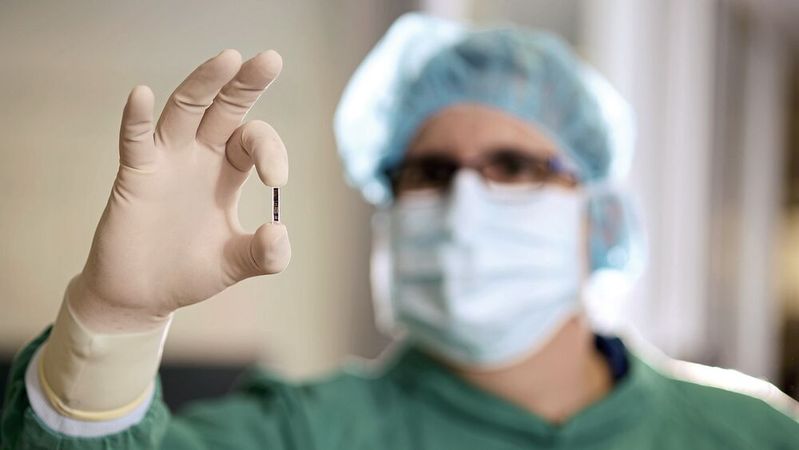
Miniaturization: The implantable brain pressure sensor (Kitea sensor) weighs only about 0.3 grams (approx. 0.01 ounces). The safety-critical electronics are hermetically sealed in a biocompatible glass casing.
(Image: Parasoft)
Until now, doctors have been unable to objectively measure intracranial pressure outside of a clinic and often had to make therapy decisions based solely on symptoms. The medical technology company Kitea Health has therefore developed a new system: it consists of an implantable intracranial pressure sensor (Kitea Sensor) and a mobile reader device (Kitea Wand). This provides the treating physician with real-time data directly from the patient's brain. Since the system directly influences therapy decisions, it must be inherently safe. This posed enormous challenges, particularly in firmware development.
Hurdles in Firmware Development
When programming the software for the implantable sensor and the mobile handheld device, three key challenges were central:
Systematic risk control: Strict compliance with the IEC 62304 standard (software safety class B) was mandatory to demonstrate reliability and eliminate any patient risks caused by software errors.
High manual testing effort: The manual creation, management, and execution of over 1,000 unit test cases for more than 35,000 lines of C code proved to be error-prone and hardly scalable.
Limits of open-source tools: Free testing tools failed to handle the hardware-related system calls and library dependencies of the firmware. This repeatedly led to configuration errors and delays during the project.
High Demands on the Tools
A robust, automated testing solution was therefore needed, one that could seamlessly integrate into the company's development environment. The requirement was for a unified tool for comprehensive unit testing and static code analysis that supports programming standards for medical devices and achieves the high code coverage metrics essential for regulatory submissions. Additionally, professional support for quickly overcoming technical challenges had to be ensured.
The Kitea system at a glance
The implant (Kitea sensor): A wireless, battery-less micro-implant (weight approx. 0.3 g). Electronics and pressure sensors are hermetically sealed and adhesive-free in a biocompatible glass casing (Schott Proteon).
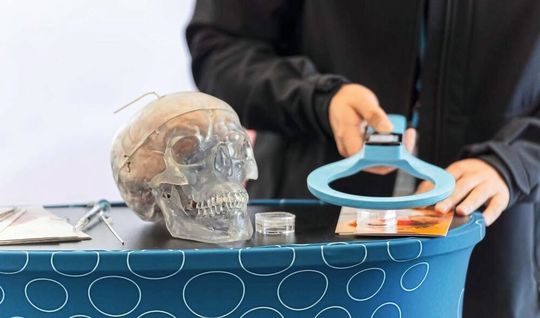
Communication and energy: Since the implant does not have a traditional battery, power supply and data exchange are conducted wirelessly through the skull using an external reading device (Kitea stick).
Firmware scope: More than 35,000 lines of C code for the sensor node and handheld device.
Regulations and standards: Development according to IEC 62304 (software safety class B) as well as compliance with programming guidelines such as MISRA C, CERT, and CWE for the planned FDA approval.
Testing metrics: Fully automated test suite with over 1,000 unit tests (runtime: < 30 minutes). Achieved code coverage: 99 to 100 percent statement coverage, > 90 percent branch coverage, and 80 to 90 percent MC/DC.
Image 1: The mobile handheld device (Kitea stick) wirelessly reads the real-time data from the sensor node through the skull.
(Image: Parasoft)
After a thorough evaluation, Kitea Health chose the tool C/C++test from Parasoft. The deciding factors were not only the range of features and the price-performance ratio but also its suitability for the medical technology sector. For the development of safety-critical real-time embedded applications, the software aids in compliance with programming guidelines such as MISRA, CERT, and CWE.
Additionally, the test solution is certified by TÜV SÜD for functional safety according to the standards IEC 61508, IEC 62304, ISO 26262, and EN 50128/EN 50716. This helps development teams achieve the desired safety integrity level (SIL/ASIL).
Stubs and Metrics in One Environment
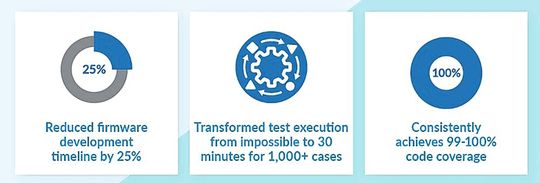
Image 2: By using the automated testing environment, Kitea Health was able to maximize code coverage, execute 1,000 test cases in under 30 minutes, and reduce firmware development time by 25 percent.
(Image: Parasoft)
Since unit tests and static code analyses are performed within the same environment, proving industry-specific standards has become significantly easier for developers at Kitea. Efficiency improvements have also been achieved: the test case editor allows for simple configuration of hardware stubs and parameterization of values, significantly accelerating the creation and maintenance of tests. The integration of the automated testing solution has fundamentally transformed Kitea Health's firmware development process and delivered measurable results for the project:
Accelerated development: The market launch could be brought forward by more than a month. The shortened development cycle ensured that the project remained on schedule for clinical trials and the future submission to the FDA.
High test speed: The entire suite with over 1,000 test cases now runs in just 30 minutes. This enables continuous test-driven development in practice.
Verifiable code coverage: The team consistently validates its firmware for high coverage and delivers the metrics required for regulatory audits: 99 to 100 percent statement coverage, more than 90 percent branch coverage, and 80 to 90 percent MC/DC (Modified Condition/Decision Coverage).
Automated proofs: The system automatically generates the required pass/fail reports as well as traceability evidence, providing convincing arguments for the FDA and other regulatory authorities.
High reliability: This thorough approach has led to no firmware-related errors being found in the field so far.
This is also confirmed by Masahiro Kondo, lead engineer for embedded systems at Kitea Health: "Managing test suites and running tests at the rigorous level required for medical devices was simply not feasible with free unit testing tools. Running our entire suite with over 1,000 test cases in just 30 minutes makes the use of C/C++test invaluable for us."
The article is based on a case study by Parasoft.
Date: 08.12.2025
Naturally, we always handle your personal data responsibly. Any personal data we receive from you is processed in accordance with applicable data protection legislation. For detailed information please see our privacy policy.
Consent to the use of data for promotional purposes
I hereby consent to Vogel Communications Group GmbH & Co. KG, Max-Planck-Str. 7-9, 97082 Würzburg including any affiliated companies according to §§ 15 et seq. AktG (hereafter: Vogel Communications Group) using my e-mail address to send editorial newsletters. A list of all affiliated companies can be found here
Newsletter content may include all products and services of any companies mentioned above, including for example specialist journals and books, events and fairs as well as event-related products and services, print and digital media offers and services such as additional (editorial) newsletters, raffles, lead campaigns, market research both online and offline, specialist webportals and e-learning offers. In case my personal telephone number has also been collected, it may be used for offers of aforementioned products, for services of the companies mentioned above, and market research purposes.
Additionally, my consent also includes the processing of my email address and telephone number for data matching for marketing purposes with select advertising partners such as LinkedIn, Google, and Meta. For this, Vogel Communications Group may transmit said data in hashed form to the advertising partners who then use said data to determine whether I am also a member of the mentioned advertising partner portals. Vogel Communications Group uses this feature for the purposes of re-targeting (up-selling, cross-selling, and customer loyalty), generating so-called look-alike audiences for acquisition of new customers, and as basis for exclusion for on-going advertising campaigns. Further information can be found in section “data matching for marketing purposes”.
In case I access protected data on Internet portals of Vogel Communications Group including any affiliated companies according to §§ 15 et seq. AktG, I need to provide further data in order to register for the access to such content. In return for this free access to editorial content, my data may be used in accordance with this consent for the purposes stated here. This does not apply to data matching for marketing purposes.
Right of revocation
I understand that I can revoke my consent at will. My revocation does not change the lawfulness of data processing that was conducted based on my consent leading up to my revocation. One option to declare my revocation is to use the contact form found at https://contact.vogel.de. In case I no longer wish to receive certain newsletters, I have subscribed to, I can also click on the unsubscribe link included at the end of a newsletter. Further information regarding my right of revocation and the implementation of it as well as the consequences of my revocation can be found in the data protection declaration, section editorial newsletter.



:quality(80)/p7i.vogel.de/wcms/d1/ef/d1ef6b6f7d4543f7999980bacccaf22b/0133499261v1.jpeg "As the growing imbalance in trade relations with China continues to widen, the EU Chamber of Commerce foresees a day when trade with China will have to be seriously reevaluated ... (Image: AI-generated)")
:quality(80)/p7i.vogel.de/wcms/fe/1f/fe1fa5ee713f94deaba963dc24c3abc5/0133299273v1.jpeg "The Flexistar enables highly flexible production of laser-welded tubes thanks to its tool-free clamping system. (Image:Because Technology, LLC)")
:quality(80)/p7i.vogel.de/wcms/1b/5a/1b5ac72f83db4dbee3ff91e51bc398f4/0133496095v1.jpeg "BASF announces that it will take the next step toward producing the polyurethane precursor MDI in India ... (Image:BASF)")
:quality(80)/p7i.vogel.de/wcms/3f/cf/3fcfa390902944ffcf24e7fe973cc3ee/0133486258v1.jpeg "Do you need to create secure connections on structures using blind rivets, but space is tight? Then you should take a closer look at the Universalgrip from Gesipa ... (Image: Gesipa)")
:quality(80)/p7i.vogel.de/wcms/60/ef/60ef4f07e4829b2c2929befc0f353c58/0133511729v1.jpeg "Humanoid robots can match human performance in certain tasks. (Image:Gemini / AI-generated)")
:quality(80)/p7i.vogel.de/wcms/2e/99/2e99726b522e4b35b690e25eb6a42643/0133463991v1.jpeg "Robotics: In AMR applications, connection technology must reliably transmit power, signals, and data despite vibration and shock loads—in very confined spaces and in a way that allows for regular maintenance. (Image:Hyperever)")
:quality(80)/p7i.vogel.de/wcms/d0/18/d01801e3d5dbd7bc9d0b4f60408b630c/0133468429v1.jpeg "Quality requirements for film packaging are on the rise. At the same time, many companies are turning to recyclable film materials, which, however, have their own challenges. Fraunhofer researchers have therefore developed a fast system that detects problems in real time. (Image:Fraunhofer IKTS)")
:quality(80)/p7i.vogel.de/wcms/b1/06/b106cf44923ce39565c3264982fd20eb/0133414574v1.jpeg "Robots Build Robots: At the new Ubtech factory, automated systems even handle parts of the material supply and logistics for the production of humanoid robots. (Image:Ubtech)")
:quality(80)/p7i.vogel.de/wcms/c0/52/c052f405eb55fc3d08c4837e77206fc0/adobestock-2021845957--aucartstudio-stock-adobe-com-ki-generiertv1.jpeg "An innovation from China to combat extreme summer heat: A novel coating lowers temperatures. (Source: © AucArtStudio – stock.adobe.com_AI-generated)")
:quality(80)/p7i.vogel.de/wcms/66/a7/66a7b78159caeacce57136529688799f/0133503398v1.jpeg "Sunlight Makes Stone! These stone blocks weren't made the traditional way. Instead, they were additively manufactured from sand using a laser. In the future, however, the laser is set to be replaced by concentrated sunlight—if the startup Addisol is successful... (Image:Addisol / F. Fiedler)")
:quality(80)/p7i.vogel.de/wcms/72/b9/72b995c2c8d812c5e2115cbef31e035a/0133462727v1.jpeg "Eggl manufactures center hoods that are precisely tailored to each cooking island—whether standard size or custom shape. They are made entirely of stainless steel and are individually customized in terms of size and filter arrangement. (Image:SPI)")
:quality(80)/p7i.vogel.de/wcms/13/5d/135dfae6229ceaf5c55467a43e8f7257/adobestock-1879961393--ardi-stock-adobe-com-ki-generiertv1.jpeg "Annoying chatterboxes or awkward silences in response to questions—a moderator should specifically prepare for difficult situations in order to navigate them effectively. (Image:ardi - stock.adobe.com_AI-generated)")
:quality(80)/p7i.vogel.de/wcms/aa/a2/aaa2c6dd2daa24b485cddbf9297590c0/0133467318v1.jpeg "Battery Monitoring: Battery monitoring using electrochemical impedance spectroscopy offers several advantages. (Image:TI)")
:quality(80)/p7i.vogel.de/wcms/39/b2/39b21bf03be1683831862239a369987c/0133469638v1.jpeg "Data from autonomous vehicles and robots operating autonomously is in high demand, and Ruqi wants to capitalize on this. (Image:Ruqi Mobility)")
:quality(80)/p7i.vogel.de/wcms/8a/bb/8abbb6217220595edc1549ac9b84f307/0133429906v1.jpeg "The IAA in Hanover showcased the ambitions of Chinese commercial vehicle manufacturers in Europe. (Image:Wehner - VCG)")
:quality(80)/p7i.vogel.de/wcms/0c/53/0c5313ef91c14b6df0d0996efc33c8ad/jpg03568-bearbeitetv1.jpeg "The category winners of the 2027 German Car of the Year award. (Source: GCOTY)")
:quality(80)/p7i.vogel.de/wcms/ca/b4/cab46fd26d19d6a2febca032048200b6/0133471827v1.jpeg "Photonics SDK for C and Python: Computational operations are now abstracted as standard mathematical functions. (Image:Q.ANT)")
:quality(80)/p7i.vogel.de/wcms/92/b2/92b2ed5299cde450c0764f4f64468395/0133505895v1.jpeg "The \"Iris 100\" test system for high-precision volume production of microLEDs uses a spectrometer and a high-resolution camera. (Image:Teradyne)")
:quality(80)/p7i.vogel.de/wcms/f3/d8/f3d870d8f31a5a5110449c929ea3e641/0133470449v1.jpeg "The new Nexora sensor family from Teledyne e2v: These CMOS image sensors combine BSI technology with a global shutter and are available in 12- and 16-megapixel versions. (Image:Teledyne)")
:quality(80)/p7i.vogel.de/wcms/11/2e/112eabc5fb41e1a401f0e93e9326ef51/0133489329v1.jpeg "A sandbox limits the actions an AI agent can take, but it is not an impenetrable barrier. Only multiple independent layers of protection prevent an escape from immediately granting access to production systems. (Image:freely licensed)")
:fill(fff,0)/images.vogel.de/vogelonline/companyimg/76800/76895/65.jpg "FAULHABER_120mm.jpg ()")
:fill(fff,0)/p7i.vogel.de/companies/68/a4/68a47beec75ce/logo-cmyk-de.jpeg "logo-cmyk-de (https://www.datatec.eu/)")
:fill(fff,0)/p7i.vogel.de/companies/69/de/69de1b7403b0d/simtos-logo.jpeg "simtos-logo (SIMTOS)")
:quality(80)/p7i.vogel.de/wcms/61/f8/61f892896038f0fc6e5bad556ba36adc/brain-850x478v1v1.jpeg "Researchers at the University of Missouri have developed new methods to better simulate the complex nature of human brain tissue. (Image:University of Missouri)")
:quality(80)/p7i.vogel.de/wcms/80/5c/805c31ab52ed4e39222b5bf82b135e03/0131052307v1.jpeg "The brain remains untouched: The electrode mat (Laplace electrode) placed under the skin stimulates the cortex with electrical pulses through the skull. (Image:Precisis)")
:quality(80)/p7i.vogel.de/wcms/e3/88/e388cad0626d1f2445a4dbfda5de3042/0132330257v1.jpeg "No hands, no distractions, just AI. But is it safe? (Image: ©Kittinan - stock.adobe.com | generated with AI)")