







AI Surface Finish

The Robot Is Now Putting the Finishing Touches on the Press Die

< previous

Page: 3/3

Related Vendor

A Camera Takes a Close Look at the Whole Picture

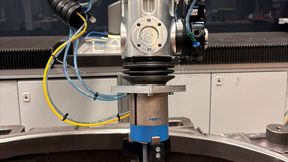
Experienced toolmakers assess the progress of machining primarily based on the appearance of the surface. Reflections, visible milling marks, grinding marks, and the uniformity of the surface indicate to them whether a further machining step is necessary. To automate this visual inspection, a custom camera system was developed as part of the project. The so-called “Vision Head” combines a monochrome industrial camera with controlled lighting for this purpose. A protective glass cover and an integrated compressed-air system keep the camera and the workpiece surface as free as possible from grinding dust. To train the computer vision model, approximately 10,000 images of different surface conditions were captured at BMW Toolmaking. Together with BMW specialists, these were then categorized into four typical processing stages: From the milled initial state through two intermediate stages to the fully machined surface. An initial classification model was able to distinguish between the four states on two independent test datasets with an accuracy of around 95 percent. In the future, this evaluation will be integrated directly into the automated process. If the system detects any visible machining marks, the corresponding area can then be re-polished. Once the desired condition is achieved, the machining is terminated or the next process step is initiated.

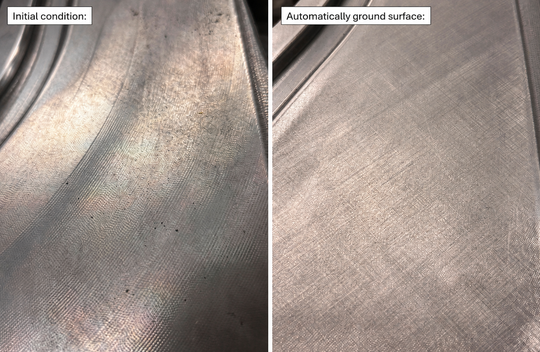
The computer vision system evaluates the grinding progress based on characteristic surface features. Here, you can see a surface area on the left before and on the right after a single pass with a robot-guided grinding wheel. Milling grooves and deeper milled edges can thus be removed efficiently and automatically.(Image: Munich University of Applied Sciences)
The computer vision system evaluates the grinding progress based on characteristic surface features. Here, you can see a surface area on the left before and on the right after a single pass with a robot-guided grinding wheel. Milling grooves and deeper milled edges can thus be removed efficiently and automatically.
(Image: Munich University of Applied Sciences)

Together, from the Lab to Actual Toolmaking

The partners bring different areas of expertise to the project. BMW provides process knowledge from toolmaking, actual components, and industrial reference surfaces. Munich University of Applied Sciences is responsible for scientific coordination and is developing the test bench, the end effectors, the path planning, and the computer vision system. MRK Systeme provides support, particularly in the areas of mechatronic integration, system control, and the safety concept. Tebis supports the work with expertise in surface digitization, CAD/CAM process chains, and automated programming. The key components have now been prototyped: The laboratory test bench is operational, the end-effectors have been successfully tested, robot paths can be generated automatically, and the computer vision model recognizes different grinding conditions.

Here's How to Proceed with the Automatic Surface Finish

The results to date already demonstrate the potential of the automation solution that has been developed: In current tests on the laboratory test bench, approximately 80% of the component surfaces can already be sanded automatically. These include, in particular, planar, convex, and slightly concave surface areas. As a result, a significant portion of the grinding work that was previously performed manually has already been successfully transferred to the robot. The next steps will involve further optimizing the machining strategies, refining the end-effectors for industrial use, and validating the grinding results under production-like conditions using a pilot system at BMW’s toolmaking facility. The long-term goal is a reliable, automated process that also enables largely unmanned operation over extended periods. The robot is not intended to completely replace skilled workers, but rather to take over repetitive and physically demanding tasks in particular. Complex radii, edges, and special cases will initially remain the responsibility of experienced toolmakers, who will thus be able to focus more on more demanding tasks and process optimization.

It's Not Just the Automotive Tooling Industry that Benefits from this

The technology’s potential extends beyond automotive toolmaking. This is because comparable challenges in manual surface finishing also exist in the field of tool and mold making for plastic injection molding, as well as in the production of molds for fiber-reinforced plastic parts made of CFRP and GFRP. The technologies developed in the project could therefore also be applied in these industrial sectors in the future. Munich University of Applied Sciences is open to further research collaborations and exchanges with interested industry partners to tap into additional fields of application and jointly advance the technology. “AutoFIN” is already demonstrating how a manufacturing step that has been largely manual until now can be successfully automated through the interplay of robotics, intelligent software, and adaptive tooling technology.

Anyone interested in learning more about this topic or who would like to become a partner is welcome to contact the author and research assistant at Munich University of Applied Sciences, Mr. M. Eng. Joshua Jegg: joshua.jegg@hm.edu ...(Image: Munich University of Applied Sciences)
Anyone interested in learning more about this topic or who would like to become a partner is welcome to contact the author and research assistant at Munich University of Applied Sciences, Mr. M. Eng. Joshua Jegg: joshua.jegg@hm.edu ...
(Image: Munich University of Applied Sciences)

Subscribe to the newsletter now

Don't Miss out on Our Best Content

By clicking on „Subscribe to Newsletter“ I agree to the processing and use of my data according to the consent form (please expand for details) and accept the Terms of Use. For more information, please see our Privacy Policy. The consent declaration relates, among other things, to the sending of editorial newsletters by email and to data matching for marketing purposes with selected advertising partners (e.g., LinkedIn, Google, Meta).

Unfold for details of your consent