The automotive industry is poised for profound changes in the next five years, driven by key megatrends such as electrification, autonomous driving, connectivity, sustainability, and mobility-as-a-service (MaaS). This article delves into these trends, examining their implications for established automotive giants, innovative suppliers, and emerging players, including Chinese manufacturers. By exploring cutting-edge technologies, key global players, and real-world examples, this piece provides a roadmap for understanding how the automotive sector will evolve and adapt in the coming years.
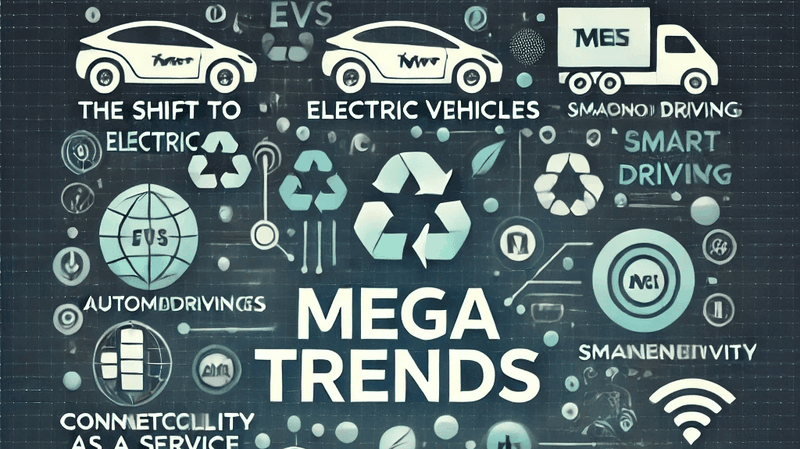
6 Megatrends in Automotive Industry: As manufacturers and suppliers embrace these trends and adapt to the changing market dynamics, they will play a crucial role in shaping the future of transportation.
(Bild: AI-based)
The automotive industry is undergoing a monumental shift as new technologies, regulatory pressures, and evolving consumer preferences drive transformation. With electrification, automation, and connectivity at the forefront of this revolution, the next five years will be crucial in defining the future of mobility. Key players across the globe—both established manufacturers and emerging challengers—are racing to lead this transition.In this article, we will explore the major megatrends impacting the automotive sector, with a particular focus on electric and autonomous vehicles, digital transformation, and sustainability. Additionally, we will highlight influential manufacturers and suppliers, including those from China, which is emerging as a key global player in automotive innovation
1. Electrification: The Rise of Electric Vehicles (EVs)
Electrification is one of the most transformative forces in the automotive sector, driven by both environmental regulations and consumer demand for sustainable mobility. The shift toward electric vehicles (EVs) is accelerating, fueled by advancements in battery technology, government incentives, and an evolving charging infrastructure. The global push for carbon neutrality, especially in regions like Europe and China, is further driving the transition to electric mobility. Examples: Tesla: Tesla continues to dominate the EV market, pushing the boundaries of battery technology, vehicle range, and autonomous features. With the launch of its new Cybertruck and expansion of its battery production at Gigafactories, Tesla remains a key player in driving the future of electric vehicles. Source: Tesla BYD (China): As one of the largest EV manufacturers globally, BYD has rapidly expanded its electric vehicle offerings. The Chinese automaker has become a leader in both electric passenger cars and buses, capitalizing on government incentives and a robust domestic market. The company's EV sales have surged, positioning BYD as a global leader in electrification. Source: BYD
2. Autonomous Driving: From Assisted to Fully Autonomous Vehicles
Autonomous driving technology has made significant strides over the past few years. The race to develop fully self-driving cars (Level 5 autonomy) is driven by advancements in artificial intelligence (AI), machine learning, and sensor technologies. The automotive industry is now shifting from semi-autonomous systems, such as lane-keeping and adaptive cruise control, to fully autonomous vehicles, with implications for safety, efficiency, and the future of car ownership. Examples: Waymo (Alphabet Inc.): Waymo, the autonomous driving arm of Google’s parent company Alphabet, is leading the development of Level 4 and Level 5 autonomous vehicles. The company’s fully autonomous ride-hailing service, currently operating in select areas, is one of the first commercial applications of self-driving technology. Source: Waymo Geely (China): Geely, one of China’s largest automakers, is heavily investing in autonomous driving technologies. Through its subsidiary, Volvo Cars, and partnerships with tech companies, Geely is advancing its self-driving vehicle capabilities, with plans to launch fully autonomous vehicles in the near future. Source: Geely
3. Connectivity and Digital Transformation: Smart and Connected Vehicles
The integration of connectivity into vehicles is revolutionizing the driving experience, turning cars into mobile hubs of information and entertainment. Connectivity also plays a key role in safety and vehicle diagnostics. Over-the-air (OTA) software updates, vehicle-to-everything (V2X) communication, and advanced telematics are enhancing real-time interaction with infrastructure and other vehicles, paving the way for smarter cities and mobility ecosystems. Examples: BMW iDrive 8: BMW’s iDrive 8 system is a cutting-edge digital platform that provides real-time navigation, voice assistance, and vehicle control features. The system integrates seamlessly with mobile apps and supports over-the-air software updates, making it a prime example of the industry’s push towards smart connectivity. Source: BMW Group NIO (China): NIO, an innovative Chinese electric vehicle manufacturer, integrates advanced connectivity features into its vehicles, such as its NIO Pilot autonomous driving system and NIO House—smart spaces where users can interact with their cars and the NIO community. Source: NIO
4. Sustainability and Green Manufacturing: Eco-friendly Practices and Circular Economy
Sustainability is increasingly important in the automotive industry, from the materials used in manufacturing to how vehicles are powered. Automakers are prioritizing carbon-neutral production processes, renewable energy adoption, and recycling efforts to reduce waste. Additionally, many companies are embracing circular economy principles to extend product lifecycles and reduce the environmental impact of vehicles. Examples: Volvo’s Circular Economy: Volvo Cars has committed to achieving climate neutrality by 2040. The company is focusing on making cars from renewable and recycled materials and reducing emissions from manufacturing. Volvo’s "Circular Business" model aims to recycle parts from older vehicles and reuse materials in new models. Source: Volvo Cars BYD’s Green Manufacturing: BYD is not only a leader in electric vehicle production but also a key player in green manufacturing. The company uses sustainable materials and energy-efficient production processes in its EV plants, contributing to its carbon-neutral production goals. Source: BYD
Date: 08.12.2025
Naturally, we always handle your personal data responsibly. Any personal data we receive from you is processed in accordance with applicable data protection legislation. For detailed information please see our privacy policy.
Consent to the use of data for promotional purposes
I hereby consent to Vogel Communications Group GmbH & Co. KG, Max-Planck-Str. 7-9, 97082 Würzburg including any affiliated companies according to §§ 15 et seq. AktG (hereafter: Vogel Communications Group) using my e-mail address to send editorial newsletters. A list of all affiliated companies can be found here
Newsletter content may include all products and services of any companies mentioned above, including for example specialist journals and books, events and fairs as well as event-related products and services, print and digital media offers and services such as additional (editorial) newsletters, raffles, lead campaigns, market research both online and offline, specialist webportals and e-learning offers. In case my personal telephone number has also been collected, it may be used for offers of aforementioned products, for services of the companies mentioned above, and market research purposes.
Additionally, my consent also includes the processing of my email address and telephone number for data matching for marketing purposes with select advertising partners such as LinkedIn, Google, and Meta. For this, Vogel Communications Group may transmit said data in hashed form to the advertising partners who then use said data to determine whether I am also a member of the mentioned advertising partner portals. Vogel Communications Group uses this feature for the purposes of re-targeting (up-selling, cross-selling, and customer loyalty), generating so-called look-alike audiences for acquisition of new customers, and as basis for exclusion for on-going advertising campaigns. Further information can be found in section “data matching for marketing purposes”.
In case I access protected data on Internet portals of Vogel Communications Group including any affiliated companies according to §§ 15 et seq. AktG, I need to provide further data in order to register for the access to such content. In return for this free access to editorial content, my data may be used in accordance with this consent for the purposes stated here. This does not apply to data matching for marketing purposes.
Right of revocation
I understand that I can revoke my consent at will. My revocation does not change the lawfulness of data processing that was conducted based on my consent leading up to my revocation. One option to declare my revocation is to use the contact form found at https://contact.vogel.de. In case I no longer wish to receive certain newsletters, I have subscribed to, I can also click on the unsubscribe link included at the end of a newsletter. Further information regarding my right of revocation and the implementation of it as well as the consequences of my revocation can be found in the data protection declaration, section editorial newsletter.
5. Mobility-as-a-Service (MaaS): The Future of Shared and On-Demand Mobility
Mobility-as-a-Service (MaaS) is reshaping how people interact with transportation, shifting from ownership to access-based models. Ride-hailing, car-sharing, bike-sharing, and on-demand services are increasingly integrated into everyday life. MaaS has the potential to reduce car ownership, especially in urban areas, while enhancing convenience and reducing environmental impact. Examples: Uber and Lyft: As the global leaders in ride-hailing, Uber and Lyft have significantly influenced how people access transportation. The companies continue to expand their services, including electric and autonomous vehicle fleets, to meet the growing demand for shared, on-demand mobility. Source: Uber Source: Lyft Didi Chuxing (China): Didi Chuxing, China’s largest ride-hailing service, has integrated electric and autonomous vehicles into its fleet. The company is leading the MaaS revolution in China and expanding internationally, offering everything from taxi services to long-distance ride-sharing. Source: Didi Chuxing
6. Advanced Materials and Lightweighting: Performance and Sustainability
The demand for lighter, more durable, and more energy-efficient vehicles is driving the use of advanced materials such as carbon fiber, aluminum alloys, and composite materials. Lightweighting reduces fuel consumption, improves performance, and enhances safety. These innovations are particularly crucial for electric vehicles, where efficiency is key to maximizing battery range. Examples: Tesla's Use of Aluminum and Composites: Tesla continues to push the envelope with lightweight materials, using aluminum and advanced composites to build vehicles that are both energy-efficient and high-performing. The Model S and Model 3 both benefit from lightweight materials to improve battery efficiency and driving range. Source: Tesla Xpeng Motors (China): Xpeng Motors, a leading Chinese electric vehicle startup, uses high-strength steel and lightweight composites in its vehicles to improve both safety and efficiency. Xpeng’s P7 sedan is a prime example of the integration of lightweight materials to boost EV range. Source: Xpeng Motors
Conclusion
The automotive sector is entering a transformative era driven by electrification, autonomy, connectivity, and sustainability. The megatrends outlined here will shape the next five years, bringing about a paradigm shift in how vehicles are designed, manufactured, and used. With global players such as Tesla, BMW, and BYD, alongside Chinese innovators like NIO, Geely, and Xpeng, the race to lead the future of mobility is intensifying.
As manufacturers and suppliers embrace these trends and adapt to the changing market dynamics, they will play a crucial role in shaping the future of transportation. The integration of cutting-edge technologies, the push for sustainability, and the rise of new business models promise a new era of smarter, greener, and more accessible mobility.



:quality(80)/p7i.vogel.de/wcms/eb/2b/eb2bd1b8487afe577b37363cd02f16ff/0113143253v1.jpeg "In our China Market Insider, we regularly provide you with relevant information straight from China. (Image:© Eisenhans - stock.adobe.com)")
:quality(80)/p7i.vogel.de/wcms/dd/b8/ddb8edc98c49b384734ab2432b297eb5/adobestock-1913662309--irene-stock-adobe-com-ki-generiertv1.jpeg "Rotary joints are used in grippers and swivel mechanisms to allow assemblies to rotate or swivel smoothly relative to one another, even under very high loads (illustrative image). (Source: Irene - stock.adobe.com / KI-generiert)")
:quality(80)/p7i.vogel.de/wcms/d1/ef/d1ef6b6f7d4543f7999980bacccaf22b/0133499261v1.jpeg "As the growing imbalance in trade relations with China continues to widen, the EU Chamber of Commerce foresees a day when trade with China will have to be seriously reevaluated ... (Image: AI-generated)")
:quality(80)/p7i.vogel.de/wcms/fe/1f/fe1fa5ee713f94deaba963dc24c3abc5/0133299273v1.jpeg "The Flexistar enables highly flexible production of laser-welded tubes thanks to its tool-free clamping system. (Image:Because Technology, LLC)")
:quality(80)/p7i.vogel.de/wcms/60/ef/60ef4f07e4829b2c2929befc0f353c58/0133511729v1.jpeg "Humanoid robots can match human performance in certain tasks. (Image:Gemini / AI-generated)")
:quality(80)/p7i.vogel.de/wcms/2e/99/2e99726b522e4b35b690e25eb6a42643/0133463991v1.jpeg "Robotics: In AMR applications, connection technology must reliably transmit power, signals, and data despite vibration and shock loads—in very confined spaces and in a way that allows for regular maintenance. (Image:Hyperever)")
:quality(80)/p7i.vogel.de/wcms/d0/18/d01801e3d5dbd7bc9d0b4f60408b630c/0133468429v1.jpeg "Quality requirements for film packaging are on the rise. At the same time, many companies are turning to recyclable film materials, which, however, have their own challenges. Fraunhofer researchers have therefore developed a fast system that detects problems in real time. (Image:Fraunhofer IKTS)")
:quality(80)/p7i.vogel.de/wcms/b1/06/b106cf44923ce39565c3264982fd20eb/0133414574v1.jpeg "Robots Build Robots: At the new Ubtech factory, automated systems even handle parts of the material supply and logistics for the production of humanoid robots. (Image:Ubtech)")
:quality(80)/p7i.vogel.de/wcms/c0/52/c052f405eb55fc3d08c4837e77206fc0/adobestock-2021845957--aucartstudio-stock-adobe-com-ki-generiertv1.jpeg "An innovation from China to combat extreme summer heat: A novel coating lowers temperatures. (Source: © AucArtStudio – stock.adobe.com_AI-generated)")
:quality(80)/p7i.vogel.de/wcms/66/a7/66a7b78159caeacce57136529688799f/0133503398v1.jpeg "Sunlight Makes Stone! These stone blocks weren't made the traditional way. Instead, they were additively manufactured from sand using a laser. In the future, however, the laser is set to be replaced by concentrated sunlight—if the startup Addisol is successful... (Image:Addisol / F. Fiedler)")
:quality(80)/p7i.vogel.de/wcms/72/b9/72b995c2c8d812c5e2115cbef31e035a/0133462727v1.jpeg "Eggl manufactures center hoods that are precisely tailored to each cooking island—whether standard size or custom shape. They are made entirely of stainless steel and are individually customized in terms of size and filter arrangement. (Image:SPI)")
:quality(80)/p7i.vogel.de/wcms/13/5d/135dfae6229ceaf5c55467a43e8f7257/adobestock-1879961393--ardi-stock-adobe-com-ki-generiertv1.jpeg "Annoying chatterboxes or awkward silences in response to questions—a moderator should specifically prepare for difficult situations in order to navigate them effectively. (Image:ardi - stock.adobe.com_AI-generated)")
:quality(80)/p7i.vogel.de/wcms/3e/2f/3e2f1ec6c4e1a24eac32957acebd0901/0133601693v1.jpeg "From the boule (bottom) to the wafer to the chip (on top of the boule). Transistors are used as switches in power electronics. (Image:Bosch)")
:quality(80)/p7i.vogel.de/wcms/8f/99/8f9956e7dce99d1b28c27fb1c30ea236/04-dsc-2230v1.jpeg "Bosch is cutting jobs in Nuremberg. (Source: Bosch)")
:quality(80)/p7i.vogel.de/wcms/aa/a2/aaa2c6dd2daa24b485cddbf9297590c0/0133467318v1.jpeg "Battery Monitoring: Battery monitoring using electrochemical impedance spectroscopy offers several advantages. (Image:TI)")
:quality(80)/p7i.vogel.de/wcms/39/b2/39b21bf03be1683831862239a369987c/0133469638v1.jpeg "Data from autonomous vehicles and robots operating autonomously is in high demand, and Ruqi wants to capitalize on this. (Image:Ruqi Mobility)")
:quality(80)/p7i.vogel.de/wcms/28/28/2828c5261714321afb0bab67bf771823/0133353387v1.jpeg "The 130-meter-long China Zorrilla draws its power from a battery system with a capacity of more than 40 MWh. Eight electric motors drive an equal number of water jets. (Image:Incat Australia Pty Ltd)")
:quality(80)/p7i.vogel.de/wcms/48/15/4815da27c45973ca629a99b375ac3aef/0133509585v1.jpeg "Ventuno Q RoadTest: Designed to help the Element14 community gain practical insights from real-world tests using the Ventuno Q. (Image:Farnell/Element14)")
:quality(80)/p7i.vogel.de/wcms/17/2b/172bd132f9febdfcbcedba292ad0504d/aufmacherv1.jpeg "Micro-Epsilon offers a wide range of IO-Link-compatible sensors. (Source: Micro-Epsilon Messtechnik GmbH & Co. KG)")
:quality(80)/p7i.vogel.de/wcms/ca/b4/cab46fd26d19d6a2febca032048200b6/0133471827v1.jpeg "Photonics SDK for C and Python: Computational operations are now abstracted as standard mathematical functions. (Image:Q.ANT)")
:fill(fff,0)/images.vogel.de/vogelonline/companyimg/76800/76895/65.jpg "FAULHABER_120mm.jpg ()")
:quality(80)/p7i.vogel.de/wcms/33/be/33be0659e7949b9459d12230d26bbc14/byd-haendlertagung-de-5-20-281-29-3240x1822v1v1.jpeg "The photo was taken at the BYD dealer conference in Germany. Globally, the manufacturer has significantly expanded its sales network and thereby been able to substantially increase its sales. (Image:BYD)")
:quality(80)/p7i.vogel.de/wcms/61/eb/61eb2c9fe2ec3295593bd63ebc610f59/0130504331v1.jpeg "Headquarters of the Chinese truck start-up Zeron. (Image:Jiangsu 01 Automobile Technology/Screen shot)")