Software-Defined VehiclesWhy Electronics Architecture Is the New Battleground
By
Michele Del Mondo* | Translated by AI
5 min Reading Time
The software-defined vehicle is turning traditional vehicle development on its head: No longer are individual control units the foundation for new features and continuous software updates—instead, it is networked, centralized electronic architectures. This is increasing the pressure on development processes, data management, and variant management.
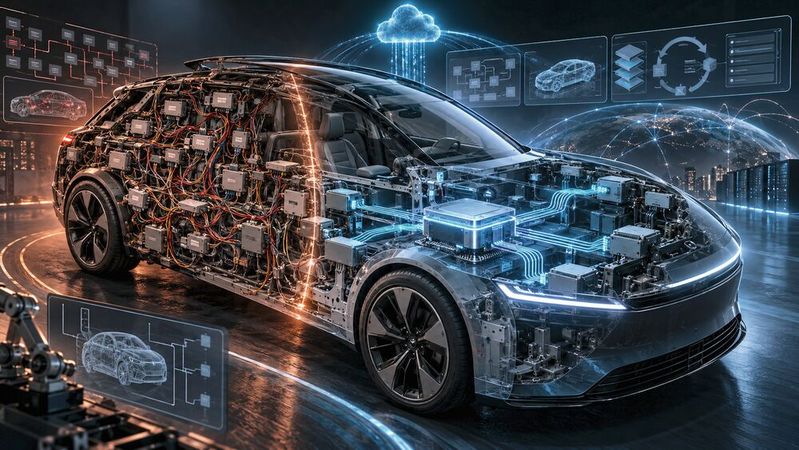
The path to the software-defined vehicle leads from control modules and wiring harnesses to a centralized, networked E/E architecture.
(Image: Dall-E / AI-generated)
The car is becoming a moving computer. This statement has become so commonplace that it obscures rather than explains the complexity behind it. And that is precisely the problem: While the industry talks about Software-Defined Vehicles (SDV), development teams struggle daily with a reality that still lags far behind this vision. Control units don’t communicate with each other, requirements are managed in Excel spreadsheets, and software versions are no longer fully traceable by anyone.
The real bottleneck is the E/E architecture on which the software runs, and the way it is developed. It determines whether functions exist side by side in a distributed manner or can work together as a networked, updatable system.
From Distributed Hardware to Centralized Platforms
For decades, vehicle development followed a tried-and-true pattern. Every function was assigned its own electronic control unit (ECU), whether it was a window regulator or a powertrain control system. Everything was separate, and everything was hardwired. As a result, modern vehicles today contain up to 150 ECUs, which are connected to one another by kilometers of wiring harnesses. However, this model can no longer accommodate the growing complexity. New vehicle functions can no longer be easily implemented by simply adding another control unit, while at the same time the requirements for
Over-the-Air Updates and Functional Safety are on the Rise
The industry’s response to these growing demands is centralization: high-performance computing platforms are taking on tasks that were previously distributed across dozens of ECUs, zone architectures are replacing functional domains, and software is being decoupled from hardware as much as possible. In practice, however, this transformation represents a profound shift in existing development processes. Without a consistent data foundation, it is easy to lose track of the big picture before the vehicle even hits the road.
The Real Problem: Fragmented Development Landscapes
Established OEMs and Tier 1 suppliers work with complex tool landscapes that have evolved over many years, in which requirements, system architecture, and software development exist in separate systems. Manual handoffs and interface documents arise between these worlds, which, in the worst case, can lead to inconsistencies that only become apparent during vehicle testing.
At its core, this is an architectural problem. As long as Application Lifecycle Management (ALM) and Product Lifecycle Management (PLM) are not seamlessly integrated, gaps will inevitably arise. If a requirement changes, the affected system components often go undetected, and updated software versions lose their traceability back to the original requirement. For safety-critical systems, this is no small matter. ISO 26262 and ASPICE require seamless traceability, and anyone who tries to ensure this with manual processes pays a high price in terms of time and error risk.
End-to-End Engineering as the Foundation
To overcome this fragmentation, OEMs and Tier 1 suppliers need an end-to-end digital database that serves as a single source of truth and links requirements, system architecture, and validation evidence. This is the only way to avoid data discontinuities between ALM and PLM and reduce manual handoffs between disciplines.
Model-Based Systems Engineering (MBSE) is the tool that enables development teams to describe system behavior, visualize dependencies, and assess the impact of changes early on. Anyone who maintains a system model that is synchronized with requirements and the current software version can answer a question that often remains unresolved in traditional processes: namely, what happens when a requirement changes.
This is particularly relevant in the context of the software-defined vehicle, because over-the-air updates mean that software continues to be developed after the vehicle goes into production. Without end-to-end traceability, it is impossible to reliably assess whether an update affects a system’s functional safety.
Date: 08.12.2025
Naturally, we always handle your personal data responsibly. Any personal data we receive from you is processed in accordance with applicable data protection legislation. For detailed information please see our privacy policy.
Consent to the use of data for promotional purposes
I hereby consent to Vogel Communications Group GmbH & Co. KG, Max-Planck-Str. 7-9, 97082 Würzburg including any affiliated companies according to §§ 15 et seq. AktG (hereafter: Vogel Communications Group) using my e-mail address to send editorial newsletters. A list of all affiliated companies can be found here
Newsletter content may include all products and services of any companies mentioned above, including for example specialist journals and books, events and fairs as well as event-related products and services, print and digital media offers and services such as additional (editorial) newsletters, raffles, lead campaigns, market research both online and offline, specialist webportals and e-learning offers. In case my personal telephone number has also been collected, it may be used for offers of aforementioned products, for services of the companies mentioned above, and market research purposes.
Additionally, my consent also includes the processing of my email address and telephone number for data matching for marketing purposes with select advertising partners such as LinkedIn, Google, and Meta. For this, Vogel Communications Group may transmit said data in hashed form to the advertising partners who then use said data to determine whether I am also a member of the mentioned advertising partner portals. Vogel Communications Group uses this feature for the purposes of re-targeting (up-selling, cross-selling, and customer loyalty), generating so-called look-alike audiences for acquisition of new customers, and as basis for exclusion for on-going advertising campaigns. Further information can be found in section “data matching for marketing purposes”.
In case I access protected data on Internet portals of Vogel Communications Group including any affiliated companies according to §§ 15 et seq. AktG, I need to provide further data in order to register for the access to such content. In return for this free access to editorial content, my data may be used in accordance with this consent for the purposes stated here. This does not apply to data matching for marketing purposes.
Right of revocation
I understand that I can revoke my consent at will. My revocation does not change the lawfulness of data processing that was conducted based on my consent leading up to my revocation. One option to declare my revocation is to use the contact form found at https://contact.vogel.de. In case I no longer wish to receive certain newsletters, I have subscribed to, I can also click on the unsubscribe link included at the end of a newsletter. Further information regarding my right of revocation and the implementation of it as well as the consequences of my revocation can be found in the data protection declaration, section editorial newsletter.
Variant Management: The Underestimated Challenge
Variant management often takes a back seat in SDV discussions, yet it is one of the most complex challenges in vehicle development. A modern vehicle program encompasses hundreds of variants across different markets, trim levels, and powertrain concepts, and each variant has its own combination of hardware and software. In fragmented development environments, this means that requirements, architectures, and software versions must be maintained separately for each variant. The effort scales linearly with the number of variants—and so do errors.
End-to-end engineering solves this problem through configuration management at the model level. Variants are treated as configurations of a common system model, so that changes are made once and then propagated in a controlled manner to all affected variants.
What This Means for Development Teams
The transition to a centralized E/E architecture is not a one-time project. It is an ongoing process that actively changes the way teams work and make decisions. Anyone who still manages requirements manually today and makes architectural decisions without comprehensive documentation will no longer be able to understand tomorrow why decisions were made in favor of certain systems. Automated change management is therefore evolving from a mere convenience feature to a necessity, because given the complexity of modern vehicle programs, manual impact analyses are simply no longer scalable. This also applies to the integration of ALM and PLM: Those who continue to operate these two worlds separately create silos that will sooner or later become a problem in the context of the SDV.
What the SDV Really Needs
The software-defined vehicle is, above all, a matter of development infrastructure. Anyone who transforms the E/E architecture without simultaneously modernizing development processes and the data infrastructure creates new complexity instead of resolving old issues. MBSE, integrated ALM and PLM, and variant management are proven approaches that are already delivering results in practice: They provide transparency regarding requirements, architectures, and software versions, reduce manual handoffs, and make variants manageable. The challenge lies in their consistent implementation across disciplines and organizational boundaries. Those who succeed will have a robust foundation for the software-defined vehicle. Those who do not will find that the next generation of software is built on the same problems as the last.
*Michele Del Mondo is Global Advisor Automotive at PTC



:quality(80)/p7i.vogel.de/wcms/88/91/88915656ec26bd5f6e79ce0e523dd33b/0131576263v1.jpeg "Dr. Volker Nilles is CEO of Arburg GmbH + Co KG. In this role, he leads the six-member executive team and, since the beginning of the year, has been responsible for steering the course of the manufacturer of injection molding machines and digital systems for plastics processing. The family-owned company, based in Loßburg, employs approximately 3,400 people worldwide and has a history spanning more than 100 years. (Image: Arburg GmbH + Co. KG)")
:quality(80)/p7i.vogel.de/wcms/81/d4/81d47ab5407c961b55233009313ac9d2/0133075510v1.jpeg "Small, but designed for demanding applications: KSK demonstrates that the diameter of ball screws says nothing about their load-carrying capacity. (Image:Arkero)")
:quality(80)/p7i.vogel.de/wcms/6b/80/6b80bac3b1b33a0e3bc17849bef4ba59/0133171618v1.jpeg "With its portal solution for the MAK 4 Evolution UD swivel-bending machine, Schröder enables the fully automated production of sheet-metal enclosures. (Image:Schröder Group)")
:quality(80)/p7i.vogel.de/wcms/a0/1d/a01ddede6a787a4844122c2f42cfbce9/0133067101v1.jpeg "In solar module manufacturing, lasers are used for tasks such as patterning, drilling, and cutting delicate layers. Precise energy delivery is crucial to avoid damaging adjacent areas. (Image:Dall-E / AI-generated)")
:quality(80)/p7i.vogel.de/wcms/13/2d/132df0ce425eb46f046ffe1065912b19/699704-he-xiaopeng-und-iron-36d230-original-1788864307v1.png "He Xiaopeng hangs an employee ID badge around the neck of the humanoid \"IRON,\" as part of the team. (Source: Xpeng)")
:quality(80)/p7i.vogel.de/wcms/cc/80/cc8031ca517f9ff98cec245efa899b25/0133211591v1.jpeg "The two CEOs of the companies: Max Mauri of Seco and David Reger of Neura. (Image:Neura Robotics)")
:quality(80)/p7i.vogel.de/wcms/ae/eb/aeeb20bb1bf0e6226c35d50b11551a89/0133237319v1.jpeg "At ArcelorMittal Bremen, steel coils are cut to size using blades, a process that takes place at high speed. This makes it difficult to ensure the quality of both the product and the blades. However, TS Sensors and Selmatec have now developed a real-time system ... (Image:AT Sensors)")
:quality(80)/p7i.vogel.de/wcms/ee/de/eedeb235bb6ee164059ea34e6bea795f/0132989868v1.jpeg "From a small Irish bakery to a major manufacturer with expansion plans: Processes can only be scaled through real-time data transparency. (Image:West-Bake)")
:quality(80)/p7i.vogel.de/wcms/6e/1a/6e1ac5a0f1f7b4e9d0b42d34ab3fc47b/geda-sh250w-1v1.jpeg "According to the manufacturer, the battery-powered lift for wind turbines sets new standards in safety, availability, and efficiency. (Source: Geda GmbH)")
:quality(80)/p7i.vogel.de/wcms/45/20/45208dbb0868aa49d32ded081173ebdb/siemens-sarla-aviation-01v1.jpeg "To ensure that data does not remain isolated in individual departments or systems, three companies are leveraging the Digital Thread with Siemens solutions. (Source: Sarla Aviation)")
:quality(80)/p7i.vogel.de/wcms/92/e9/92e9f029ef416e02b6f0b772b39c30df/limbitless-stratasys-zacharyv1.jpeg "The renewed focus of the expanded partnership between Stratasys and Limbitless is on sustainability, education, and improved access to 3D-printed prosthetics. (Source: Stratasys)")
:quality(80)/p7i.vogel.de/wcms/01/f1/01f16ebdc19b9cbde5bc1a7f421f9174/csm-a264340-web-1440-d0360d8de9v1.webp "At the 2026 Dutch Grand Prix in late August, two filtration systems developed by TU Berlin were used in top-level motorsports for the first time. (Source: Audi Revolut F1 Team)")
:quality(80)/p7i.vogel.de/wcms/99/9f/999f4972c3c4cbb69c30830e80dedd4e/dacia-spring-exterioradriencortesi-001v1.jpeg "Dacia has developed a successor to the Spring electric compact car. (Source: Dacia)")
:quality(80)/p7i.vogel.de/wcms/a4/b6/a4b6fc6ca18008acda9ff06c711555e9/a264385-largev1.jpeg "The A2 E-Tron is in a completely different league than the car that gave it its name, which was introduced nearly 30 years ago. (Source: Audi)")
:quality(80)/p7i.vogel.de/wcms/12/33/1233e00dd83a287e5225169847b22799/0133224119v1.jpeg "The path to the software-defined vehicle leads from control modules and wiring harnesses to a centralized, networked E/E architecture. (Image:Dall-E / AI-generated)")
:quality(80)/p7i.vogel.de/wcms/00/ad/00adb77750d3b28827e3739e6812f803/manuel-mengelkoch-director-sales-operations-volvo-trucks-2v1.jpeg "Manuel Mengelkoch is Director of Sales Operations at Volvo Trucks Germany. (Source: Volvo Trucks)")
:quality(80)/p7i.vogel.de/wcms/c4/b5/c4b5badd67b0037f23c1d69806a13d16/0133216860v1.jpeg "Fascinating Technology: ASML's NXE3800E EUV machine. (Image:ASML)")
:quality(80)/p7i.vogel.de/wcms/7c/57/7c5719c462b2973564651ca5e472bb58/0133230109v1.jpeg "Prototype of the Diamond Spin Quantum Computer: Users can operate it using the Fujitsu Hybrid Quantum Computing Platform, even without any additional specialized knowledge. (Image:Fujitsu)")
:quality(80)/p7i.vogel.de/wcms/87/96/879685114467b0fe5a43f25923787762/set-explosion-2000pxv1.jpeg "Not explosive, but safe: The new KDS-Rail Fire Safety Kit. (Source: Conta-Clip)")
:quality(80)/p7i.vogel.de/wcms/a4/4e/a44e89f5d47d037ca5d0c870b8dabc65/0133203720v1.jpeg "Transparent DC charging connector from Lapp featuring the vSECC.InPlug communication controller board from Vector (Image:Vector Informatics)")
:quality(80)/p7i.vogel.de/wcms/74/30/7430d02c8e71e2bbfe91072c8f1ea9ea/nissan-honda-coop-sdvv1.jpeg "Honda and Nissan are drawing closer together. The automakers plan to jointly develop electronics, software, and computer technology. (Source: spx / KI-generiert)")
:quality(80)/p7i.vogel.de/wcms/ca/de/cadef1e0c1cc7614a9f56e02308e11bb/0131643181v1.jpeg "A consistent view of a function as a whole must combine information from software, sensors, hardware, safety and approvals in one system. (Image:PTC)")
:quality(80)/p7i.vogel.de/wcms/91/ed/91edb6fa32fc6547c9202a5a39650357/0129528943v1.jpeg "The path to software-defined mobility does not begin in the vehicle, but in the systems with which it is developed. Those who rely on old structures will not only lose time, but also the future. (Image:PTC)")