Slow Charging Is Not Automatically More EfficientWhere Energy Is Lost When Charging Electric Cars
From
Dipl.-Ing. (FH) Michael Richter
| Translated by AI
7 min Reading Time
Those who charge a battery with low power might initially assume that this is particularly efficient. Power electronics, cables, and the battery are less stressed, the currents decrease, and thus ohmic losses are reduced. However, measurements by ADAC show a different picture.
When charging an electric car, losses occur not only during power conversion. Vehicle electronics, cables, batteries, and thermal management also affect the overall energy balance.
During AC charging, relative energy losses can increase significantly, especially at low charging power. Therefore, the efficiency of the on-board charger alone is not decisive. Only considering the entire vehicle explains why higher charging power can even save energy under certain conditions.
The ADAC measured five electric vehicles under different AC charging conditions for its study. Charging was performed at a household socket with 2.3 kW, at a wallbox with reduced power of 4.1 kW to simulate PV surplus charging, and at the maximum possible power of 11 or 22 kW. To minimize the influence of cell balancing and intense battery conditioning, the measurements were conducted between 10 and 90 percent state of charge with initial battery temperatures between 20 and 30 °C (68 to 86°F).
The differences are significant. When charging at a household socket, the ADAC recorded losses between 12.7 and 24.2 percent. When charging at 4.1 kW, losses ranged between 8.0 and 12.8 percent. At a wall box with 11 or 22 kW, however, they dropped to values between 5.1 and 7.0 percent.
This raises an interesting question from a power electronics perspective: Why do relative losses increase precisely when charging at low power?
The On-Board Charger Is Only One Part of the Loss Chain
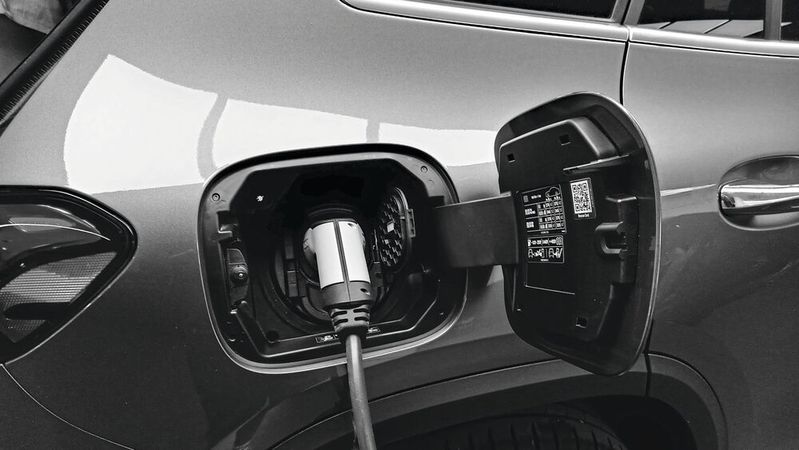
During AC charging, the mains voltage must first be converted into a DC voltage suitable for the high-voltage battery. This task is handled by the on-board charger, which inevitably incurs losses during power conversion. Added to this are losses in cables, connectors, and the battery itself.
However, this alone does not explain the significant increase in relative losses at low charging power. The key factor is that other vehicle systems remain active during the charging process. Control units must monitor the charging process, communication and battery management stay active, and the 12-volt on-board network also needs to be powered. The ADAC cites a power demand of about 100 to 300 W for this.
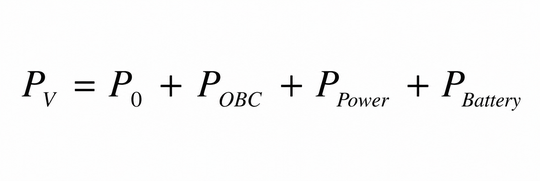
This creates a second loss component in addition to the power-dependent losses, which can at least approximately be considered as a base load. Simplified, the power loss can therefore be viewed as the sum of different components:
(Image: ChatGPT (OpenAI))
Here, PV represents the power loss, P0 denotes the base load required by the vehicle during charging, POBC describes the losses of the on-board charger, while PCable and PBattery summarize the losses in cables and the battery, respectively.
P0 in particular fundamentally changes the perspective. A largely constant power loss weighs more heavily the lower the transmitted charging power is.
This can be illustrated with a simple example. If the vehicle electronics and auxiliary consumers require a constant 250 W during charging, this already accounts for more than ten percent of the transmitted power at a charging power of 2.3 kW. At 11 kW, however, it is only about two percent.
Time is even more critical. To deliver the same amount of energy to the battery, the charging process takes significantly longer at lower power. A base load of 250 W active for ten hours requires 2.5 kWh. However, if the charging process takes only two hours, this energy demand drops to 0.5 kWh.
The losses in the actual power path can simultaneously increase when higher currents flow. However, for the overall system, this does not necessarily mean lower efficiency. The reduced energy demand of time-dependent auxiliary consumers can more than compensate for this effect.
This is precisely where a significant difference lies between the efficiency of a converter and the energy efficiency of an entire charging process. An on-board charger has an efficiency curve based on its output power. The vehicle, on the other hand, also has consumers whose energy demand depends on the duration of the charging process.
Date: 08.12.2025
Naturally, we always handle your personal data responsibly. Any personal data we receive from you is processed in accordance with applicable data protection legislation. For detailed information please see our privacy policy.
Consent to the use of data for promotional purposes
I hereby consent to Vogel Communications Group GmbH & Co. KG, Max-Planck-Str. 7-9, 97082 Würzburg including any affiliated companies according to §§ 15 et seq. AktG (hereafter: Vogel Communications Group) using my e-mail address to send editorial newsletters. A list of all affiliated companies can be found here
Newsletter content may include all products and services of any companies mentioned above, including for example specialist journals and books, events and fairs as well as event-related products and services, print and digital media offers and services such as additional (editorial) newsletters, raffles, lead campaigns, market research both online and offline, specialist webportals and e-learning offers. In case my personal telephone number has also been collected, it may be used for offers of aforementioned products, for services of the companies mentioned above, and market research purposes.
Additionally, my consent also includes the processing of my email address and telephone number for data matching for marketing purposes with select advertising partners such as LinkedIn, Google, and Meta. For this, Vogel Communications Group may transmit said data in hashed form to the advertising partners who then use said data to determine whether I am also a member of the mentioned advertising partner portals. Vogel Communications Group uses this feature for the purposes of re-targeting (up-selling, cross-selling, and customer loyalty), generating so-called look-alike audiences for acquisition of new customers, and as basis for exclusion for on-going advertising campaigns. Further information can be found in section “data matching for marketing purposes”.
In case I access protected data on Internet portals of Vogel Communications Group including any affiliated companies according to §§ 15 et seq. AktG, I need to provide further data in order to register for the access to such content. In return for this free access to editorial content, my data may be used in accordance with this consent for the purposes stated here. This does not apply to data matching for marketing purposes.
Right of revocation
I understand that I can revoke my consent at will. My revocation does not change the lawfulness of data processing that was conducted based on my consent leading up to my revocation. One option to declare my revocation is to use the contact form found at https://contact.vogel.de. In case I no longer wish to receive certain newsletters, I have subscribed to, I can also click on the unsubscribe link included at the end of a newsletter. Further information regarding my right of revocation and the implementation of it as well as the consequences of my revocation can be found in the data protection declaration, section editorial newsletter.
Why PV Charging Creates a Conflict of Interest
This correlation becomes particularly interesting during PV surplus charging. Energetically, it initially seems sensible to adjust the vehicle's charging power to the currently available solar output. Instead of feeding electricity into the grid, as much of it as possible is stored directly in the vehicle.
From the perspective of the charging process, however, a significant reduction in power can be disadvantageous. The ADAC simulated this case with a three-phase charging power of 4.1 kW. The measured losses ranged between 8.0 and 12.8 percent, exceeding those during charging with higher wall box power.
This creates a conflict between two different optimization goals. On one hand, as much locally generated energy as possible should be used directly. On the other hand, at low charging power, the relative share of constant vehicle power required during the charging process increases.
However, this does not mean that PV surplus charging is fundamentally inefficient energetically. What is critical is which system boundary is considered. Those who focus solely on the efficiency between the wall box and battery may arrive at a different optimum than those who include self-consumption, grid feed-in, and electricity purchase in the overall balance.
The Home Installation Is Also Part of the System
Another loss mechanism occurs with the household socket. The electrical supply line, especially with long cable runs or older installations, can make a significant contribution. The ADAC points out that losses in the home installation must also be taken into account. In contrast, losses in the charging cable, vehicle high-voltage cables, and battery were comparatively low during the examined AC charging processes.
A wall box therefore not only improves safety and charging performance but also reduces line losses with its appropriately sized electrical supply line. Additionally, the significantly shorter charging time plays a role. The ADAC attributes the lower overall losses during wall box charging primarily to the fact that the vehicle electronics need to operate for a shorter period of time.
For AC charging, this initially results in a relatively clear picture: under the conditions studied, the relative overall losses decrease significantly with increasing charging power. However, the loss balance changes fundamentally during fast charging.
During DC Charging, the Converter Moves Out of the Vehicle
During DC fast charging, the on-board charger no longer performs the actual AC/DC conversion. The conversion of grid energy into direct current already takes place in the charging station. The vehicle receives a direct current voltage, which is passed on to the high-voltage battery via the appropriate charging and safety technology.
This also shifts the system boundary. The ADAC determined average losses of around three percent for the conversion in the fast charging station. At high charging powers, another factor becomes significant: the temperature of the battery.
Lithium-ion cells can only accept high charging powers within specific temperature ranges. If the battery is too cold, it needs to be heated. Conversely, high thermal stress may require cooling. The energy required for this does not end up as usable energy in the cells.
In the ADAC measurements, simply heating the battery caused additional energy losses of two to eight percent. Overall, the determined energy losses during DC charging ranged between five and 15 percent, depending on the conditions.
Preconditioning Shifts Energy Consumption
This creates another interesting effect during fast charging. Modern electric vehicles can precondition their battery while driving to a fast charging station. As a result, the battery reaches the optimal temperature for high charging power before the charging stop, reducing charging time. However, the energy does not disappear from the overall balance.
The ADAC points out that warming up during the drive does reduce the additional heating demand at the charging station, but the vehicle's energy consumption increases accordingly on the way there. Preconditioning therefore primarily saves time and not necessarily energy.
This demonstrates how strongly the result depends on the chosen system boundary. If only the energy between the charging station and the battery is considered, a preconditioned vehicle can appear very efficient. However, if the energy for prior temperature regulation is included, the balance changes.
The Highest Converter Efficiency Is Not Automatically the System Optimum
The measurements thus reveal a fundamental problem in evaluating charging losses. A single efficiency rating only describes one operating point or a part of the system. In contrast, the actually required energy must consider power, operating time, auxiliary consumers, line losses, and thermal management together.
During AC charging, time-dependent losses increasingly dominate at low power. A higher charging power shortens the operating time of the vehicle electronics and can thereby reduce overall losses. In contrast, during DC fast charging, the vehicle-side AC/DC converter becomes less significant, while battery temperature and thermal management take on greater importance. The key question is therefore not whether slow or fast charging is fundamentally more efficient. What matters is which losses increase with power and which with time.
This is precisely where the actual optimization problem arises. For high overall efficiency, a charging system must not only operate its power path with minimal losses but also prevent auxiliary systems from consuming energy over extended periods. The most energy-efficient operating point of an electric car is therefore where conversion, transmission, and battery losses on the one hand, and time-dependent auxiliary consumers and thermal management on the other, together reach a minimum.



:quality(80)/p7i.vogel.de/wcms/eb/2b/eb2bd1b8487afe577b37363cd02f16ff/0113143253v1.jpeg "In our China Market Insider, we regularly provide you with relevant information straight from China. (Image:© Eisenhans - stock.adobe.com)")
:quality(80)/p7i.vogel.de/wcms/dd/b8/ddb8edc98c49b384734ab2432b297eb5/adobestock-1913662309--irene-stock-adobe-com-ki-generiertv1.jpeg "Rotary joints are used in grippers and swivel mechanisms to allow assemblies to rotate or swivel smoothly relative to one another, even under very high loads (illustrative image). (Source: Irene - stock.adobe.com / KI-generiert)")
:quality(80)/p7i.vogel.de/wcms/d1/ef/d1ef6b6f7d4543f7999980bacccaf22b/0133499261v1.jpeg "As the growing imbalance in trade relations with China continues to widen, the EU Chamber of Commerce foresees a day when trade with China will have to be seriously reevaluated ... (Image: AI-generated)")
:quality(80)/p7i.vogel.de/wcms/fe/1f/fe1fa5ee713f94deaba963dc24c3abc5/0133299273v1.jpeg "The Flexistar enables highly flexible production of laser-welded tubes thanks to its tool-free clamping system. (Image:Because Technology, LLC)")
:quality(80)/p7i.vogel.de/wcms/60/ef/60ef4f07e4829b2c2929befc0f353c58/0133511729v1.jpeg "Humanoid robots can match human performance in certain tasks. (Image:Gemini / AI-generated)")
:quality(80)/p7i.vogel.de/wcms/2e/99/2e99726b522e4b35b690e25eb6a42643/0133463991v1.jpeg "Robotics: In AMR applications, connection technology must reliably transmit power, signals, and data despite vibration and shock loads—in very confined spaces and in a way that allows for regular maintenance. (Image:Hyperever)")
:quality(80)/p7i.vogel.de/wcms/d0/18/d01801e3d5dbd7bc9d0b4f60408b630c/0133468429v1.jpeg "Quality requirements for film packaging are on the rise. At the same time, many companies are turning to recyclable film materials, which, however, have their own challenges. Fraunhofer researchers have therefore developed a fast system that detects problems in real time. (Image:Fraunhofer IKTS)")
:quality(80)/p7i.vogel.de/wcms/b1/06/b106cf44923ce39565c3264982fd20eb/0133414574v1.jpeg "Robots Build Robots: At the new Ubtech factory, automated systems even handle parts of the material supply and logistics for the production of humanoid robots. (Image:Ubtech)")
:quality(80)/p7i.vogel.de/wcms/c0/52/c052f405eb55fc3d08c4837e77206fc0/adobestock-2021845957--aucartstudio-stock-adobe-com-ki-generiertv1.jpeg "An innovation from China to combat extreme summer heat: A novel coating lowers temperatures. (Source: © AucArtStudio – stock.adobe.com_AI-generated)")
:quality(80)/p7i.vogel.de/wcms/66/a7/66a7b78159caeacce57136529688799f/0133503398v1.jpeg "Sunlight Makes Stone! These stone blocks weren't made the traditional way. Instead, they were additively manufactured from sand using a laser. In the future, however, the laser is set to be replaced by concentrated sunlight—if the startup Addisol is successful... (Image:Addisol / F. Fiedler)")
:quality(80)/p7i.vogel.de/wcms/72/b9/72b995c2c8d812c5e2115cbef31e035a/0133462727v1.jpeg "Eggl manufactures center hoods that are precisely tailored to each cooking island—whether standard size or custom shape. They are made entirely of stainless steel and are individually customized in terms of size and filter arrangement. (Image:SPI)")
:quality(80)/p7i.vogel.de/wcms/13/5d/135dfae6229ceaf5c55467a43e8f7257/adobestock-1879961393--ardi-stock-adobe-com-ki-generiertv1.jpeg "Annoying chatterboxes or awkward silences in response to questions—a moderator should specifically prepare for difficult situations in order to navigate them effectively. (Image:ardi - stock.adobe.com_AI-generated)")
:quality(80)/p7i.vogel.de/wcms/aa/a2/aaa2c6dd2daa24b485cddbf9297590c0/0133467318v1.jpeg "Battery Monitoring: Battery monitoring using electrochemical impedance spectroscopy offers several advantages. (Image:TI)")
:quality(80)/p7i.vogel.de/wcms/39/b2/39b21bf03be1683831862239a369987c/0133469638v1.jpeg "Data from autonomous vehicles and robots operating autonomously is in high demand, and Ruqi wants to capitalize on this. (Image:Ruqi Mobility)")
:quality(80)/p7i.vogel.de/wcms/8a/bb/8abbb6217220595edc1549ac9b84f307/0133429906v1.jpeg "The IAA in Hanover showcased the ambitions of Chinese commercial vehicle manufacturers in Europe. (Image:Wehner - VCG)")
:quality(80)/p7i.vogel.de/wcms/0c/53/0c5313ef91c14b6df0d0996efc33c8ad/jpg03568-bearbeitetv1.jpeg "The category winners of the 2027 German Car of the Year award. (Source: GCOTY)")
:quality(80)/p7i.vogel.de/wcms/28/28/2828c5261714321afb0bab67bf771823/0133353387v1.jpeg "The 130-meter-long China Zorrilla draws its power from a battery system with a capacity of more than 40 MWh. Eight electric motors drive an equal number of water jets. (Image:Incat Australia Pty Ltd)")
:quality(80)/p7i.vogel.de/wcms/48/15/4815da27c45973ca629a99b375ac3aef/0133509585v1.jpeg "Ventuno Q RoadTest: Designed to help the Element14 community gain practical insights from real-world tests using the Ventuno Q. (Image:Farnell/Element14)")
:quality(80)/p7i.vogel.de/wcms/17/2b/172bd132f9febdfcbcedba292ad0504d/aufmacherv1.jpeg "Micro-Epsilon offers a wide range of IO-Link-compatible sensors. (Source: Micro-Epsilon Messtechnik GmbH & Co. KG)")
:quality(80)/p7i.vogel.de/wcms/ca/b4/cab46fd26d19d6a2febca032048200b6/0133471827v1.jpeg "Photonics SDK for C and Python: Computational operations are now abstracted as standard mathematical functions. (Image:Q.ANT)")
:quality(80)/p7i.vogel.de/wcms/16/a8/16a83b69fc74edb2ea0446cdd52d77a0/26c0162-508v1.jpeg "Vattenfall and Wireless Car aim to offer automated charging processes: without a card or charging app. (Source: Mercedes-Benz)")
:quality(80)/p7i.vogel.de/wcms/ab/e9/abe9da01f02db1651d56da5da5cbef9a/0127889253v1.jpeg "Current wallboxes offer an appealing design with compact construction and high functionality. (Image:Phoenix Contact)")
:quality(80)/p7i.vogel.de/wcms/69/7d/697dff24afd22de602c8167be514d0b6/0127408417v1.jpeg "Infineon launches the 100 V CoolGaN Automotive transistor family G1. (Image:Infineon)")