Researchers in Milan have developed a real-time metric to measure visual and cognitive distraction while driving. The tests are conducted in a simulator.
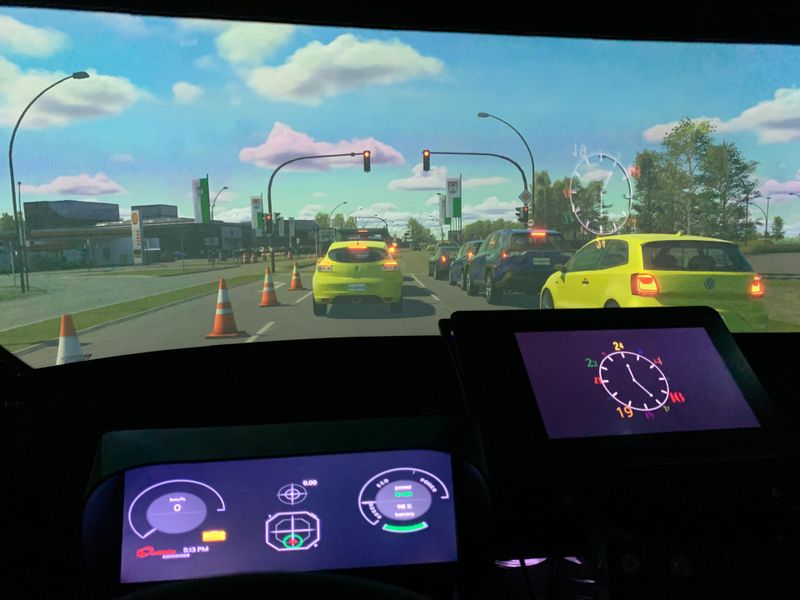
The cockpit view during a test drive in the simulator.
(Source: Uccello et al., IEEE OJITS 2026)
Distraction while driving is one of the most common causes of accidents worldwide. As more driver-assistance systems and semi-automated features are installed, the number of secondary activities that drivers engage in while driving is increasing. Legislators are responding: UNECE Regulation No. 171 requires Driver Control Assistance Systems (DCAS) to monitor driver attention; and Euro NCAP’s Roadmap 2030 calls for systems capable of detecting cognitive distraction.
Existing driver monitoring systems (DMS) typically rely on camera-based eye-tracking and thus primarily detect visual distractions. If a secondary task also requires mental processing—such as reading and calculating values on a display—experts refer to this as visual-cognitive distraction. It is considered particularly difficult to quantify because it cannot be determined solely by eye-tracking data.
A research team at the Politecnico di Milano has developed a new metric for this purpose: VICODEV, which stands for “VIsual-COgnitive Distraction through Eye-tracking and Vehicular measurements.” The study, published in the journal IEEE Open Journal of Intelligent Transportation Systems, combines vehicle and eye-tracking data into a single, continuous distraction index—derived from experiments conducted in a dynamic driving simulator.
The Test Setup
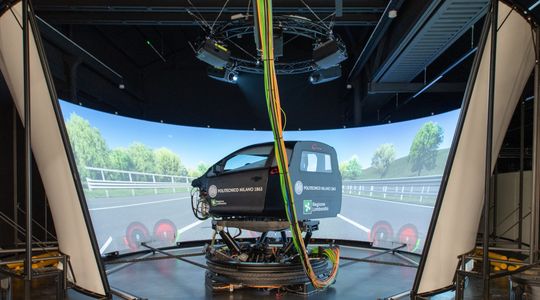
The “DiM400” driving simulator was developed by the manufacturer VI Grade in collaboration with the Politecnico di Milano. The university has been operating it in its in-house “DriSMi” laboratory since 2021. The two-stage motion system—a cable-guided platform for horizontal movement (4 × 4 meters, ±60 degrees of yaw) and a Hexalift with six degrees of freedom up to 30 hertz—is supplemented by eight shakers for high-frequency vibrations up to 200 Hz.
A 270-degree projection, active seat belts, an active brake pedal, and a cockpit based on a real vehicle frame provide a realistic driving experience; system latency is less than 20 milliseconds.
The Polytechnic University of Milan operates a dynamic driving simulator—a joint development by the university and the company VI Grade.
(Source: Uccello et al., IEEE OJITS 2026)
In the simulator, 35 inexperienced drivers—21 men, 14 women, aged 19 to 30—drove a 4.1-kilometer (2.5-mile) route modeled after a neighborhood in Wolfsburg (Germany), with 107 simulated vehicles. To keep the actual driving task consistent, the participants continuously followed a vehicle ahead of them in the left lane. This was intended to ensure that any differences between the test phases were attributable solely to distraction and not to changing traffic conditions.
Tests Too Dangerous for the Road
An experiment of this kind would be unacceptable due to the deliberate and repeated distractions encountered in real-world traffic. The simulator, on the other hand, made it possible to present all 35 participants with exactly the same distraction protocol—repeated five times—under identical road, traffic, and lighting conditions—a level of control and repeatability that real-world test drives cannot provide. At the same time, driving behavior, eye movements, and physiological signals had to be recorded in precise synchronization so that they could later be assigned to the individual driving phases.
Distraction Using the Clock Task
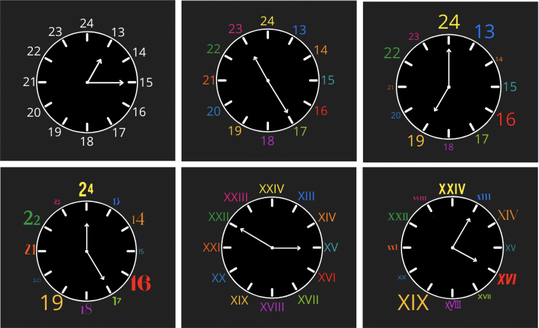
The established “Clock Task” was used as a targeted distraction. Six clocks appeared on a tablet mounted in the dashboard; the drivers had to add up the times displayed and call them out aloud. The color, font, and size of the clocks varied to increase the visual and cognitive load. Five such 45-second distraction phases alternated with equally long phases of normal driving.
An example of the six clocks from the “Clock Task,” whose values the participants had to add up in their heads. Different types of numerals and colors made the task even more difficult.
(Source: Uccello et al., IEEE OJITS 2026)
Throughout the entire drive, the system synchronously recorded data from multiple sources: An instrumented steering wheel developed at the Politecnico measured grip force, while eye-tracking glasses tracked eye movements; an electrocardiogram and a 65-channel electroencephalogram were also running simultaneously. Because the simulator’s virtual CAN network runs in a real-time database, all signals could be precisely assigned to specific driving phases after the fact.
From 21 to 5 metrics
In total, the researchers recorded 21 vehicle-related, behavioral, and physiological metrics. Twelve of these showed statistically significant differences between normal and distracted driving. For the Vicodev Index, the team selected five of these parameters that can be measured in real time using production vehicle sensors: the standard deviation of lateral deviation from the center of the lane (SDLP), the standard deviation of steering wheel grip force, the proportion of time spent looking away from the road, the rate of rapid eye movements, and the average duration of slow eye movements.
Date: 08.12.2025
Naturally, we always handle your personal data responsibly. Any personal data we receive from you is processed in accordance with applicable data protection legislation. For detailed information please see our privacy policy.
Consent to the use of data for promotional purposes
I hereby consent to Vogel Communications Group GmbH & Co. KG, Max-Planck-Str. 7-9, 97082 Würzburg including any affiliated companies according to §§ 15 et seq. AktG (hereafter: Vogel Communications Group) using my e-mail address to send editorial newsletters. A list of all affiliated companies can be found here
Newsletter content may include all products and services of any companies mentioned above, including for example specialist journals and books, events and fairs as well as event-related products and services, print and digital media offers and services such as additional (editorial) newsletters, raffles, lead campaigns, market research both online and offline, specialist webportals and e-learning offers. In case my personal telephone number has also been collected, it may be used for offers of aforementioned products, for services of the companies mentioned above, and market research purposes.
Additionally, my consent also includes the processing of my email address and telephone number for data matching for marketing purposes with select advertising partners such as LinkedIn, Google, and Meta. For this, Vogel Communications Group may transmit said data in hashed form to the advertising partners who then use said data to determine whether I am also a member of the mentioned advertising partner portals. Vogel Communications Group uses this feature for the purposes of re-targeting (up-selling, cross-selling, and customer loyalty), generating so-called look-alike audiences for acquisition of new customers, and as basis for exclusion for on-going advertising campaigns. Further information can be found in section “data matching for marketing purposes”.
In case I access protected data on Internet portals of Vogel Communications Group including any affiliated companies according to §§ 15 et seq. AktG, I need to provide further data in order to register for the access to such content. In return for this free access to editorial content, my data may be used in accordance with this consent for the purposes stated here. This does not apply to data matching for marketing purposes.
Right of revocation
I understand that I can revoke my consent at will. My revocation does not change the lawfulness of data processing that was conducted based on my consent leading up to my revocation. One option to declare my revocation is to use the contact form found at https://contact.vogel.de. In case I no longer wish to receive certain newsletters, I have subscribed to, I can also click on the unsubscribe link included at the end of a newsletter. Further information regarding my right of revocation and the implementation of it as well as the consequences of my revocation can be found in the data protection declaration, section editorial newsletter.
A multivariate analysis of variance and a canonical discriminant analysis determined the extent to which each variable contributed to the linearly combined index—SDLP and the duration of slow eye movements proved to be the most influential factors.
Validation
In a cross-validation across the five repetitions, Vicodev achieved an average hit rate of 99.47 percent and an accuracy of 95.2 percent. By comparison: Lane deviation alone achieved an accuracy of only about 61 percent, while time spent looking away from the road alone achieved 86.5 percent.
A second validation, in which one test subject at a time was completely excluded from the training dataset, yielded a median AUC value— “area under the curve”—of 82.9 percent and confirmed that the index identifies consistent patterns across different drivers rather than merely reflecting the individual characteristics of specific test subjects.
Conclusion and Outlook
Physiological signals such as EEG and ECG were deliberately excluded from the final index, as they cannot currently be reliably measured in production vehicles. However, the study shows that heart rate variability, for example, also reacts significantly to induced distraction—a potential starting point for future systems supplemented by wearables.
The authors also emphasize that their findings currently apply only to the group of young, inexperienced drivers studied and to the clock task used. Further studies involving other age groups and different tasks are planned.
For the automotive industry, this work provides a methodological building block toward the cognitive distraction detection systems required by Euro NCAP starting in 2030 —developed and validated in a simulation environment that provides the necessary controlled, repeatable, and safe test conditions.
Lorenzo Uccello, M.Sc., Ph.D. candidate in the Department of Mechanical Engineering at the Politecnico di Milano. His research focuses on driver assistance systems, automated driving, and human-machine interaction. Corrado La Russa, M.Sc. Graduate of the mechanical engineering program with a focus on automotive engineering and motorsports at the Politecnico di Milano. As part of his master’s thesis at the DriSMi driving simulator, he investigated the monitoring of driver status using an instrumented steering wheel and eye tracking. Prof. Dr. Massimiliano Gobbi, Full Professor of Mechanical Engineering at the Politecnico di Milano. His research interests include automotive engineering, the optimization of complex systems, and mechatronics. Prof. Dr. Gianpiero Mastinu, Full Professor at the Politecnico di Milano specializing in road and rail vehicles. He is a co-founder of the university’s research laboratory for dynamic driving simulation and focuses on vehicle development, vehicle dynamics, and experimental vehicle testing.



:quality(80)/p7i.vogel.de/wcms/51/1b/511b420dbcc296aec09e3bffb051b8a8/0133581587v1.jpeg "The cables connect numerous machine components—often in confined spaces. (Image:Helu)")
:quality(80)/p7i.vogel.de/wcms/b5/67/b5676f3bfb36251ed31f9a0cccf650b6/0133167827v1.jpeg "Thanks to JumboFlex Generation 2, employees can effortlessly move wheelchairs weighing as much as 40 kilograms. (Image:Lard)")
:quality(80)/p7i.vogel.de/wcms/5e/c6/5ec615b7a51440f668259f2af9158cb9/0132654694v1.jpeg "Strategic Partnerships in Industry: As buyers and restructuring partners, Chinese investors are increasingly helping to preserve jobs in Germany. (Image: ©Anatolii Rymarchuk - stock.adobe.com)")
:quality(80)/p7i.vogel.de/wcms/eb/2b/eb2bd1b8487afe577b37363cd02f16ff/0113143253v1.jpeg "In our China Market Insider, we regularly provide you with relevant information straight from China. (Image:© Eisenhans - stock.adobe.com)")
:quality(80)/p7i.vogel.de/wcms/c7/05/c70542511e0824ee491f7b55e21fa429/0133598424v1.jpeg "In logistics, AI is often implemented only on a case-by-case basis; data is stored in separate systems, and inventory levels, status values, and priorities are not defined consistently. (Image: ©m-project - stock.adobe.com)")
:quality(80)/p7i.vogel.de/wcms/3a/9c/3a9c1fd546e1f041b86bb1d03cf39101/0133610524v1.jpeg "The Mason W-01 combines industrial-grade humanoid hardware, Physical AI-based perception, and autonomous task planning. (Image:Nova X Robotics)")
:quality(80)/p7i.vogel.de/wcms/d0/74/d074ae5d5d705b841b63107b20f9d8c2/699711-xpeng-iron-01-79661c-original-1788864313v1.png "(Source: XPeng Motors (Germany) GmbH)")
:quality(80)/p7i.vogel.de/wcms/60/ef/60ef4f07e4829b2c2929befc0f353c58/0133511729v1.jpeg "Humanoid robots can match human performance in certain tasks. (Image:Gemini / AI-generated)")
:quality(80)/p7i.vogel.de/wcms/3d/ff/3dff5e51c24b30c8dc37c1d024887157/0133602931v1.jpeg "Just a few years ago, SpaceX specialists were working on the world’s largest rocket—the Starship. Now, Elon Musk’s company has reached a milestone during a test flight: Earth’s orbit! But there was also a downside... (Image: SpaceX)")
:quality(80)/p7i.vogel.de/wcms/55/06/5506709cc56afcc7301c9d3319e19114/2026-03-08-aerospike-09-980x551v1.jpeg "The engine was developed using Noyron, the computer-aided design model for the LEAP 71. Noyron uses fundamental physical principles, engineering logic, and manufacturing specifications to design independently, without human intervention. (Source: LEAP 71)")
:quality(80)/p7i.vogel.de/wcms/b6/1f/b61f4081bab96d308e87eebaeb756c4f/pm4526-1v1.jpeg "Call for Innovative Ideas: The 2027 Manus Award will once again recognize unique projects featuring lubrication-free polymer plain bearings. (Source: Igus SE & Co. KG)")
:quality(80)/p7i.vogel.de/wcms/c0/52/c052f405eb55fc3d08c4837e77206fc0/adobestock-2021845957--aucartstudio-stock-adobe-com-ki-generiertv1.jpeg "An innovation from China to combat extreme summer heat: A novel coating lowers temperatures. (Source: © AucArtStudio – stock.adobe.com_AI-generated)")
:quality(80)/p7i.vogel.de/wcms/78/ab/78abbfbab0565fabb19efe637aea30e8/nio-power-swap-station-4-china-guangzhou-2024-1400x933-jpgv1.webp "Nio and Geely are collaborating on battery replacement for electric cars. (Source: Nio)")
:quality(80)/p7i.vogel.de/wcms/2e/58/2e58c664e733dd182666606f850c5da4/0133400664v1.jpeg "The IM6 is sort of the crossover version of the IM5. (Image:MG Motor)")
:quality(80)/p7i.vogel.de/wcms/40/5f/405f41f4075e8798878011f0932a8195/0133509065v1.jpeg "Caruso has integrated Hyundai into its platform. (Image:Hyundai)")
:quality(80)/p7i.vogel.de/wcms/06/98/06989beb3f95b8fb06d71190c86cffde/tabletv1.jpeg "The cockpit view during a test drive in the simulator. (Source: Uccello et al., IEEE OJITS 2026)")
:quality(80)/p7i.vogel.de/wcms/f6/9f/f69f7aad844f2f2c369ee012505f3e37/0133630806v1.jpeg "Even though prices for DRAM and NAND memory remain high due to strong demand and limited capacity, the market appears to be showing the first signs of a slowing boom. Consequently, investors are becoming increasingly skeptical about how much longer the AI boom can sustain the ongoing upward trend in the memory market. (Image:Dall-E / AI-generated)")
:quality(80)/p7i.vogel.de/wcms/c0/e9/c0e91df681b13f3a8f37badeae0a32b3/0133619268v1.jpeg "AMD CEO Lisa Hsu (left) and World Labs founder Dr. Fei-Fei Li (right) at the signing of the letter of intent. AMD plans to acquire World Labs, a startup specializing in AI “world models,” for $8.2 billion. (Image:World Labs)")
:quality(80)/p7i.vogel.de/wcms/ed/b1/edb1335d07debd3de7ae5a2fb74b571a/0133546658v1.jpeg "Securing digital infrastructure is not just about technical risks, but increasingly also about origin, supply chains, and political requirements. (Image:Dall-E / AI-generated)")
:quality(80)/p7i.vogel.de/wcms/22/f0/22f07d1635c733a29049fff5b1b8ccc8/0133601916v1.jpeg "AI models from various providers have been causing quite a stir lately because they’ve done things they weren’t supposed to—or so they say! Now, in light of recent incidents, the company “OpenAI” has decided against releasing a new AI model... (Image: AI-generated)")
:fill(fff,0)/images.vogel.de/vogelonline/companyimg/76800/76895/65.jpg "FAULHABER_120mm.jpg ()")
:quality(80):fill(efefef,0)/p7i.vogel.de/wcms/6a/9f/6a9fa9db99087/comsol-ebook-battery-design-coverbild.jpeg "COMSOL_Ebook Battery Design_Coverbild")
:quality(80)/p7i.vogel.de/wcms/0d/c2/0dc2a9ad450ecb1f6ef0b35642930135/0127717468v1.jpeg "The miniaturized maphera sensor node without housing captures an ECG. Through two interconnected circuit boards, the individual sensor nodes can be adapted for additional applications. (Image:Fraunhofer IIS / Stephan Göb)")
:quality(80)/p7i.vogel.de/wcms/17/e4/17e49b36addd1f4c52f83fbf17c283b5/org-blobs-user-response-file-output-528ce347-e0de-4ba7-b658-13b8d0094427-file-1784187263841-jpgv1.jpeg "Many drivers are distracted by screens and mobile phones. Today's common vehicle warnings fall short, according to the verdict of several experts. (Image:)")