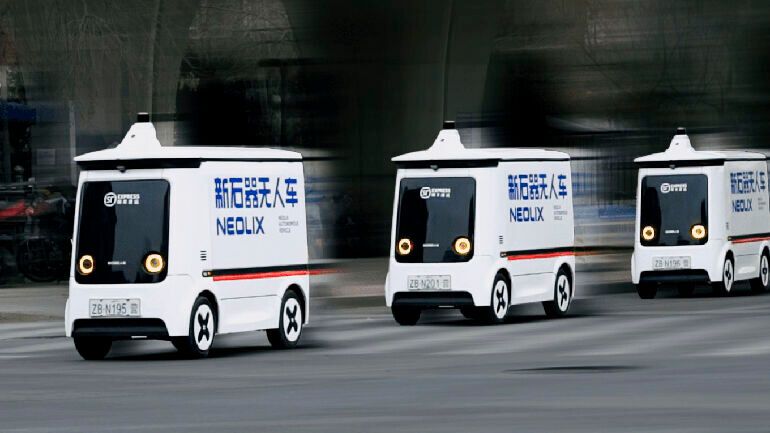
The commercialization of autonomous driving is just beginning on a large scale in China. Interestingly, it is not the robotaxis, which have dominated headlines for years, that are now taking to the streets. Instead, it is "robovans" for package delivery.
Autonomous logistics is booming in China. Manufacturers of robovans like Neolix, Zelos, or Minieye are increasingly forming partnerships, including with delivery services.
(Image: Neolix)
The latest example of concrete scaling comes from Minieye and DiDi Delivery. The former is a developer of autonomous driving systems, and the latter is a major delivery service under the Didi Group. Both entered into a partnership on July 13. Minieye and the operator of DiDi Delivery have "signed a strategic cooperation agreement to jointly accelerate the commercialization of autonomous urban logistics at Level 4," as reported by the Chinese automotive portal Gasgoo. At automation level 4, vehicles operate entirely without human drivers within a designated service area.
Minieye brings its production-ready Level 4 delivery vans from the "Bamboo" series into this partnership, along with software and technical support. Such fleets are already operating in 18 Chinese cities. According to the company, the latest model, T5 Pro, operates without high-resolution maps, significantly reducing the cost of expansion into new cities. DiDi Delivery contributes its delivery platform with intelligent dispatching, but most importantly, a steady stream of customer orders. The driverless transport is ordered via the Didi app.
Here, a complete ecosystem for the "last mile" of urban logistics is currently emerging. The development and production of the electric, autonomous delivery vehicles, their approval, and their commercial operation can be smoothly coordinated. Pilot projects thus turn into "large-scale commercial services," writes the automotive portal.
It starts in the southern Chinese city of Foshan, where the Chancheng district is the third partner to clear roads and build the infrastructure. The model being tested there is intended to be replicated city by city.
Vehicle Production Already in Large-Scale Manufacturing
"Level 4 autonomous delivery vehicles are entering a phase of accelerated commercial deployment," comments the Chinese business portal Guandian. Competitors of Minieye, such as Rino.ai, Neolix, and Zelos, are also already mass-producing their vehicles and forging similar alliances. This marks the emergence of a business model that commercially enables the deployment of autonomous driving technology and consequently supports the scaling of this technology in practice.
Unlike courier companies that would have to build and operate their own autonomous fleets, DiDi Delivery already has a complete, mature freight platform with established customers, while Minieye provides the vehicles and driving technology. Together, this forms a modern logistics ecosystem that operates without the relatively expensive van drivers and without diesel emissions. The ecological impact of this emerging development, not just the economic one, is also likely to be significant and measurable in the near future.
As early as January this year, a similar announcement indicated that the industry is on the move. This deal was even bigger. Zelos, a startup for autonomous driving, acquired the Robovan business of Cainiao, the logistics subsidiary of the Alibaba Group. In return, Cainiao became a shareholder, ceased the development of its own vehicles, and granted the new partner access to its nationwide logistics network, according to Chinese trade media.
This is how the first unicorn of the new delivery industry emerged. Zelos is valued at more than ten billion yuan, equivalent to around 1.2 billion euros. Observers compared the acquisition to a "snake swallowing an elephant." Together, Zelos and another competitor, the second-largest provider Neolix, now control around 90 percent of the Chinese Robovan market. "Autonomous logistics is the only Level 4 application that has demonstrated a viable commercial revenue model," writes the blog "Guangzi Zhixing," which specializes in autonomous driving.
The Use of Robovans Pays Off
The fact that Robovans are currently outpacing Robotaxis has several reasons. For one, Robovans are significantly cheaper than Robotaxis. Their routes are more predictable, and the savings in labor costs can therefore be calculated more quickly. Additionally, the regulatory environment is simpler for autonomously driving delivery vehicles than for Robotaxis, as stricter safety requirements apply to passenger transportation.
Neither elaborate crash tests nor airbags are an issue for the cargo vehicles. The cycles of development, testing, and certification are therefore shorter.
Date: 08.12.2025
Naturally, we always handle your personal data responsibly. Any personal data we receive from you is processed in accordance with applicable data protection legislation. For detailed information please see our privacy policy.
Consent to the use of data for promotional purposes
I hereby consent to Vogel Communications Group GmbH & Co. KG, Max-Planck-Str. 7-9, 97082 Würzburg including any affiliated companies according to §§ 15 et seq. AktG (hereafter: Vogel Communications Group) using my e-mail address to send editorial newsletters. A list of all affiliated companies can be found here
Newsletter content may include all products and services of any companies mentioned above, including for example specialist journals and books, events and fairs as well as event-related products and services, print and digital media offers and services such as additional (editorial) newsletters, raffles, lead campaigns, market research both online and offline, specialist webportals and e-learning offers. In case my personal telephone number has also been collected, it may be used for offers of aforementioned products, for services of the companies mentioned above, and market research purposes.
Additionally, my consent also includes the processing of my email address and telephone number for data matching for marketing purposes with select advertising partners such as LinkedIn, Google, and Meta. For this, Vogel Communications Group may transmit said data in hashed form to the advertising partners who then use said data to determine whether I am also a member of the mentioned advertising partner portals. Vogel Communications Group uses this feature for the purposes of re-targeting (up-selling, cross-selling, and customer loyalty), generating so-called look-alike audiences for acquisition of new customers, and as basis for exclusion for on-going advertising campaigns. Further information can be found in section “data matching for marketing purposes”.
In case I access protected data on Internet portals of Vogel Communications Group including any affiliated companies according to §§ 15 et seq. AktG, I need to provide further data in order to register for the access to such content. In return for this free access to editorial content, my data may be used in accordance with this consent for the purposes stated here. This does not apply to data matching for marketing purposes.
Right of revocation
I understand that I can revoke my consent at will. My revocation does not change the lawfulness of data processing that was conducted based on my consent leading up to my revocation. One option to declare my revocation is to use the contact form found at https://contact.vogel.de. In case I no longer wish to receive certain newsletters, I have subscribed to, I can also click on the unsubscribe link included at the end of a newsletter. Further information regarding my right of revocation and the implementation of it as well as the consequences of my revocation can be found in the data protection declaration, section editorial newsletter.
Currently, there is a sort of gold rush in this segment of Chinese mobility, which also has an unpleasant side effect for manufacturers. Just like in other growth sectors of the Chinese economy with intense competition, a fierce price war has broken out here as well. Some models of these driverless delivery vehicles now cost only 15,000 to 20,000 yuan (2,100 to 2,800 US dollars), roughly 1,800 to 2,400 euros, according to the Chinese specialist portal Weike Wang. A few years ago, they cost several hundred thousand yuan.
Autonomous delivery vans thus cost barely more than conventional electric transporters. Since driver wages are also eliminated during operation, the purchase costs can quickly be amortized by fleet operators.
In addition, the technical requirements for these package boxes on wheels are not as high as for autonomous taxis, for example. Currently common models can carry about 1,000 kg of cargo and cover around 200 km, as observed at the Beijing Auto Show.
Tough Competition: Loss-Making Deals Are Being Accepted
Due to all these factors, the commercialization of this vehicle type has accelerated significantly in the first half of this year in the People's Republic. While only 5,100 autonomous logistics vehicles were sold across China in 2024, the number will be significantly higher this year. For 2026, market research firm Zos Automotive Research forecasts 100,000 to 150,000 deliveries.
Zelos has been operating a fleet of more than 20,000 vehicles in over 300 cities across 20 countries since its acquisition of Cainiao. Neolix, according to its own statements, plans to deliver more than 50,000 vehicles this year alone. Minieye, on the other hand, has received around 8,000 orders for its Bamboo robovans and aims to have 10,000 vehicles in operation by the end of the year.
It is no longer the technological features of the vehicles that determine the success or failure of the manufacturers. The competition is currently shifting to the alliances and ecosystems they can build.
Behind ZELOS stands the giant platform company Alibaba. Among Neolix's shareholders are the internet giant Tencent and the Chinese taxi platform Didi, along with partnerships with JD Logistics and China Post.
The major express logistics company SF Express (Shunfeng) holds around 25 percent of the contender Rino.ai, another manufacturer of autonomous freight vehicles. And Minieye formed an alliance with the parcel service ZTO Express through a cross-shareholding at the end of May. "While the Robovan companies openly compete in the market, the real competition is increasingly happening behind the scenes, among their powerful strategic backers," comments Guangzi Zhixing.
"The race in 2026 is no longer about who can deliver the most vehicles. It's about who can provide the best operational experience to customers at the lowest cost," the tech portal Weike Wang quotes Neolix founder Yu Enyuan.
This is another reason for the price war. Some manufacturers are currently selling their vehicles below production cost just to expand their fleets, reports Weike Wang, citing industry sources.
The companies are therefore accepting loss-making deals while hoping to ultimately be among the winners of an expected elimination competition. This is how the Chinese economy operates in many areas. However, it is fascinating to observe this dynamic from the very beginning and, in a sense, in fast motion for autonomous driving. (se)



:quality(80)/p7i.vogel.de/wcms/eb/2b/eb2bd1b8487afe577b37363cd02f16ff/0113143253v1.jpeg "In our China Market Insider, we regularly provide you with relevant information straight from China. (Image:© Eisenhans - stock.adobe.com)")
:quality(80)/p7i.vogel.de/wcms/dd/b8/ddb8edc98c49b384734ab2432b297eb5/adobestock-1913662309--irene-stock-adobe-com-ki-generiertv1.jpeg "Rotary joints are used in grippers and swivel mechanisms to allow assemblies to rotate or swivel smoothly relative to one another, even under very high loads (illustrative image). (Source: Irene - stock.adobe.com / KI-generiert)")
:quality(80)/p7i.vogel.de/wcms/d1/ef/d1ef6b6f7d4543f7999980bacccaf22b/0133499261v1.jpeg "As the growing imbalance in trade relations with China continues to widen, the EU Chamber of Commerce foresees a day when trade with China will have to be seriously reevaluated ... (Image: AI-generated)")
:quality(80)/p7i.vogel.de/wcms/fe/1f/fe1fa5ee713f94deaba963dc24c3abc5/0133299273v1.jpeg "The Flexistar enables highly flexible production of laser-welded tubes thanks to its tool-free clamping system. (Image:Because Technology, LLC)")
:quality(80)/p7i.vogel.de/wcms/60/ef/60ef4f07e4829b2c2929befc0f353c58/0133511729v1.jpeg "Humanoid robots can match human performance in certain tasks. (Image:Gemini / AI-generated)")
:quality(80)/p7i.vogel.de/wcms/2e/99/2e99726b522e4b35b690e25eb6a42643/0133463991v1.jpeg "Robotics: In AMR applications, connection technology must reliably transmit power, signals, and data despite vibration and shock loads—in very confined spaces and in a way that allows for regular maintenance. (Image:Hyperever)")
:quality(80)/p7i.vogel.de/wcms/d0/18/d01801e3d5dbd7bc9d0b4f60408b630c/0133468429v1.jpeg "Quality requirements for film packaging are on the rise. At the same time, many companies are turning to recyclable film materials, which, however, have their own challenges. Fraunhofer researchers have therefore developed a fast system that detects problems in real time. (Image:Fraunhofer IKTS)")
:quality(80)/p7i.vogel.de/wcms/b1/06/b106cf44923ce39565c3264982fd20eb/0133414574v1.jpeg "Robots Build Robots: At the new Ubtech factory, automated systems even handle parts of the material supply and logistics for the production of humanoid robots. (Image:Ubtech)")
:quality(80)/p7i.vogel.de/wcms/c0/52/c052f405eb55fc3d08c4837e77206fc0/adobestock-2021845957--aucartstudio-stock-adobe-com-ki-generiertv1.jpeg "An innovation from China to combat extreme summer heat: A novel coating lowers temperatures. (Source: © AucArtStudio – stock.adobe.com_AI-generated)")
:quality(80)/p7i.vogel.de/wcms/66/a7/66a7b78159caeacce57136529688799f/0133503398v1.jpeg "Sunlight Makes Stone! These stone blocks weren't made the traditional way. Instead, they were additively manufactured from sand using a laser. In the future, however, the laser is set to be replaced by concentrated sunlight—if the startup Addisol is successful... (Image:Addisol / F. Fiedler)")
:quality(80)/p7i.vogel.de/wcms/72/b9/72b995c2c8d812c5e2115cbef31e035a/0133462727v1.jpeg "Eggl manufactures center hoods that are precisely tailored to each cooking island—whether standard size or custom shape. They are made entirely of stainless steel and are individually customized in terms of size and filter arrangement. (Image:SPI)")
:quality(80)/p7i.vogel.de/wcms/13/5d/135dfae6229ceaf5c55467a43e8f7257/adobestock-1879961393--ardi-stock-adobe-com-ki-generiertv1.jpeg "Annoying chatterboxes or awkward silences in response to questions—a moderator should specifically prepare for difficult situations in order to navigate them effectively. (Image:ardi - stock.adobe.com_AI-generated)")
:quality(80)/p7i.vogel.de/wcms/aa/a2/aaa2c6dd2daa24b485cddbf9297590c0/0133467318v1.jpeg "Battery Monitoring: Battery monitoring using electrochemical impedance spectroscopy offers several advantages. (Image:TI)")
:quality(80)/p7i.vogel.de/wcms/39/b2/39b21bf03be1683831862239a369987c/0133469638v1.jpeg "Data from autonomous vehicles and robots operating autonomously is in high demand, and Ruqi wants to capitalize on this. (Image:Ruqi Mobility)")
:quality(80)/p7i.vogel.de/wcms/8a/bb/8abbb6217220595edc1549ac9b84f307/0133429906v1.jpeg "The IAA in Hanover showcased the ambitions of Chinese commercial vehicle manufacturers in Europe. (Image:Wehner - VCG)")
:quality(80)/p7i.vogel.de/wcms/0c/53/0c5313ef91c14b6df0d0996efc33c8ad/jpg03568-bearbeitetv1.jpeg "The category winners of the 2027 German Car of the Year award. (Source: GCOTY)")
:quality(80)/p7i.vogel.de/wcms/48/15/4815da27c45973ca629a99b375ac3aef/0133509585v1.jpeg "Ventuno Q RoadTest: Designed to help the Element14 community gain practical insights from real-world tests using the Ventuno Q. (Image:Farnell/Element14)")
:quality(80)/p7i.vogel.de/wcms/17/2b/172bd132f9febdfcbcedba292ad0504d/aufmacherv1.jpeg "Micro-Epsilon offers a wide range of IO-Link-compatible sensors. (Source: Micro-Epsilon Messtechnik GmbH & Co. KG)")
:quality(80)/p7i.vogel.de/wcms/ca/b4/cab46fd26d19d6a2febca032048200b6/0133471827v1.jpeg "Photonics SDK for C and Python: Computational operations are now abstracted as standard mathematical functions. (Image:Q.ANT)")
:quality(80)/p7i.vogel.de/wcms/92/b2/92b2ed5299cde450c0764f4f64468395/0133505895v1.jpeg "The \"Iris 100\" test system for high-precision volume production of microLEDs uses a spectrometer and a high-resolution camera. (Image:Teradyne)")
:fill(fff,0)/p7i.vogel.de/companies/69/de/69de1b7403b0d/simtos-logo.jpeg "simtos-logo (SIMTOS)")
:quality(80)/p7i.vogel.de/wcms/3d/eb/3deb6f2d8f50c49bc556b05663da42b5/0131918763v1.jpeg "Mobileye aims to launch its own robotaxis in 2027. (Image:Mobileye)")
:quality(80)/p7i.vogel.de/wcms/05/d3/05d39704bff2ef7463349e208c095fa9/0128367551v1.jpeg "At the beginning of December, a robotaxi from the mobility service provider Hello hit two pedestrians in Zhuzhou, China. (Image:Hello)")
:quality(80)/p7i.vogel.de/wcms/61/eb/61eb2c9fe2ec3295593bd63ebc610f59/0130504331v1.jpeg "Headquarters of the Chinese truck start-up Zeron. (Image:Jiangsu 01 Automobile Technology/Screen shot)")