In many companies, PLC code is the worst-managed software in the entire organization. When one of several PLCs from different manufacturers fails, a search begins in many companies. There’s another way: DevOps serves as a central platform where PLC projects from all manufacturers are version-controlled. AI-powered code analysis replaces hours of searching.
There's a lot of talk about AI in manufacturing and logistics. Most of the time, the focus is on predictive maintenance or quality inspection using image recognition. These are valid applications. But they start at a very high level.
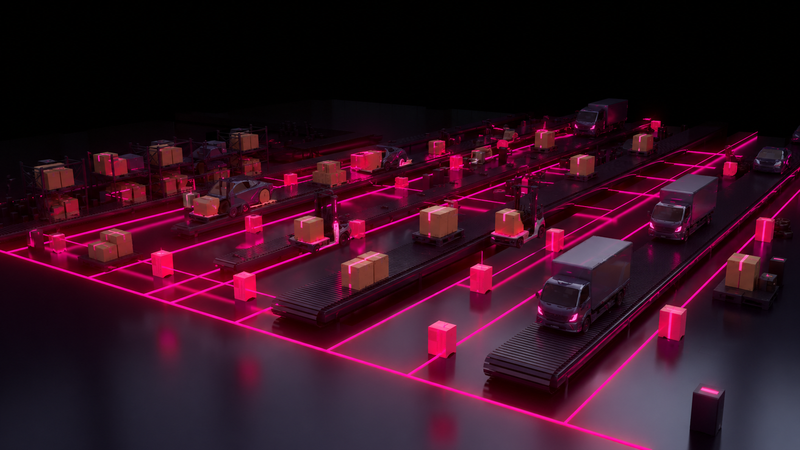
(Image: Software-Defined Automation)
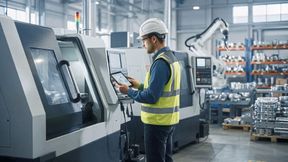
Anyone operating a production facility or distribution center today typically uses control systems from three, four, or sometimes even six different manufacturers—Siemens alongside Rockwell, alongside Beckhoff, alongside Omron. This has evolved over time, line by line, expansion by expansion. This is true in manufacturing as well as in conveyor technology, sorting systems, or automated order picking. Each manufacturer brings its own development environment. Its own way of saving projects. Its own backup mechanism—if there is one at all.
This works as long as nothing goes wrong. It becomes a problem when something does go wrong. A control system fails. A production line comes to a standstill. Sorting operations halt at a logistics facility. Someone asks: What software version was running on this system? Who made the last change? Is there a backup, and if so, from when? In many companies, this is where the search begins—on laptops, on network drives, sometimes on USB drives. The backup may exist, but no one knows for sure whether it matches the system’s current state.
This is not an isolated case. It is the norm in an industry that still relies on methods for managing its most critical software that were phased out in the IT sector fifteen years ago.
What Industrial DevOps Means in Practice
DevOps has been established in the IT world for years. Software teams version their code, automate tests and deployments, and have rollback mechanisms and audit trails. Not because it’s trendy, but because it’s essential once software reaches a certain level of complexity. This layer is missing in automation. In many companies, PLC code is the worst-managed software in the entire organization. Yet it controls production. Or the conveyor systems. Or the entire intralogistics of a distribution center.
Central Platform for PLC Projects from All Manufacturers
Industrial DevOps applies the core principles of IT to the OT world. Not on a one-to-one basis, because a production line is not a web server and a sorting system is not an application server. But the basic idea is the same: Every change is documented. Every state is recoverable. Every access event is traceable.
Specifically, this means: A central platform where PLC projects from all manufacturers are versioned. Automated backups that don’t depend on someone remembering to do them. A change history that shows who changed what and when. And a recovery process that takes minutes, not hours.
Spot the Differences in Seconds
At Eisenmann, a plant engineering firm with control projects spanning various manufacturers, one thing in particular has changed since the implementation: the speed of version comparisons. Whereas in the past, two project versions had to be reviewed block by block, differences are now identified in seconds. It may sound like a minor detail, but in everyday practice, it’s the difference between a structured shift handoff and one where knowledge is lost.
Where AI Actually Starts to Help
There's a lot of talk about AI in manufacturing and logistics. Most of the time, the focus is on predictive maintenance or quality inspection using image recognition. These are valid applications. But they start at a very high level.
There’s a level beneath that which is less visible but still takes up an enormous amount of time: understanding existing code. In many companies, there are control programs that have been running for years, have been modified multiple times, and that no one fully understands anymore. The colleague who wrote them has retired. The documentation is three versions out of date. And every time someone needs to make a change, the same process begins: reading, understanding, and reconstructing. Whether it’s a bottling line or the control system for a high-bay warehouse, the problem is the same.
AI searches, Humans Think
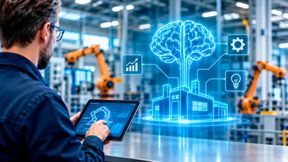
This is exactly where AI-powered code analysis comes in. Not as a replacement for an engineer’s judgment, but as a tool that handles the groundwork. You feed in two project versions. What comes out is a clear summary: what has changed, why it likely changed, and what impact it might have. It doesn’t eliminate the need to think. But it saves you from spending hours searching before you can even start thinking.
Date: 08.12.2025
Naturally, we always handle your personal data responsibly. Any personal data we receive from you is processed in accordance with applicable data protection legislation. For detailed information please see our privacy policy.
Consent to the use of data for promotional purposes
I hereby consent to Vogel Communications Group GmbH & Co. KG, Max-Planck-Str. 7-9, 97082 Würzburg including any affiliated companies according to §§ 15 et seq. AktG (hereafter: Vogel Communications Group) using my e-mail address to send editorial newsletters. A list of all affiliated companies can be found here
Newsletter content may include all products and services of any companies mentioned above, including for example specialist journals and books, events and fairs as well as event-related products and services, print and digital media offers and services such as additional (editorial) newsletters, raffles, lead campaigns, market research both online and offline, specialist webportals and e-learning offers. In case my personal telephone number has also been collected, it may be used for offers of aforementioned products, for services of the companies mentioned above, and market research purposes.
Additionally, my consent also includes the processing of my email address and telephone number for data matching for marketing purposes with select advertising partners such as LinkedIn, Google, and Meta. For this, Vogel Communications Group may transmit said data in hashed form to the advertising partners who then use said data to determine whether I am also a member of the mentioned advertising partner portals. Vogel Communications Group uses this feature for the purposes of re-targeting (up-selling, cross-selling, and customer loyalty), generating so-called look-alike audiences for acquisition of new customers, and as basis for exclusion for on-going advertising campaigns. Further information can be found in section “data matching for marketing purposes”.
In case I access protected data on Internet portals of Vogel Communications Group including any affiliated companies according to §§ 15 et seq. AktG, I need to provide further data in order to register for the access to such content. In return for this free access to editorial content, my data may be used in accordance with this consent for the purposes stated here. This does not apply to data matching for marketing purposes.
Right of revocation
I understand that I can revoke my consent at will. My revocation does not change the lawfulness of data processing that was conducted based on my consent leading up to my revocation. One option to declare my revocation is to use the contact form found at https://contact.vogel.de. In case I no longer wish to receive certain newsletters, I have subscribed to, I can also click on the unsubscribe link included at the end of a newsletter. Further information regarding my right of revocation and the implementation of it as well as the consequences of my revocation can be found in the data protection declaration, section editorial newsletter.
A second approach goes even further: code generation from natural language. An engineer describes a control sequence in words and receives IEC 61131-3-compliant Structured Text in return, including variable declarations and function blocks. It’s not a finished program, but a working foundation that significantly speeds up the start of a new project.
OT Security: No Longer Optional
An issue that many companies still treat as an IT problem, even though it has long been an OT problem: firmware vulnerabilities in control components. This applies just as much to manufacturing sites as it does to highly automated logistics centers, where a compromised conveyor belt controller can bring the entire flow of goods to a standstill.
The number of known vulnerabilities in industrial control systems is rising. At the same time, most companies lack a systematic process for comparing their installed firmware against current CVE databases. They are aware that the issue exists, but they do not know which of their own devices are affected.
An automated comparison that matches known vulnerabilities from OT-specific CVE databases with the firmware actually installed provides a foundation here. It’s not a guarantee, but it does provide a structured overview on which decisions can be based—for audits, compliance assessments, and prioritizing updates.
A Realistic Start
If you’re considering Industrial DevOps, you don’t have to overhaul your entire operation all at once. A pragmatic first step is a pilot system—a production line, a sorting system, or a conveyor section. Significant enough that the effort is worthwhile. Manageable enough to allow for learning. And representative enough that the insights can be applied to other locations.
Three questions every company should ask itself: Can we determine in less than a minute which software version is currently running on our most critical system? Can we restore the system to a known good state within ten minutes after a failure? And can we show an auditor what changes were made to which control system over the past three months?
Anyone who answers "yes" to all three questions has done their homework. Anyone who hasn't knows where to start.
*Josef Waltl is the founder and CEO of Software Defined Automation.
About Software-Defined Automation
The company Software Defined Automation offers an Industrial DevOps platform that standardizes PLC backup, version control, documentation, and secure remote access across different manufacturers. Headquartered in Boston, the company has a branch office in Munich.