Verifiable MilestoneQuantum Echoes: Quantum Algorithm 13,000 Times Faster Than Supercomputer
From
Sebastian Gerstl | Translated by AI
3 min Reading Time
The team at Google Quantum AI has designed an algorithm for quantum computers that, according to a study, significantly outperforms supercomputers for certain tasks for the first time.
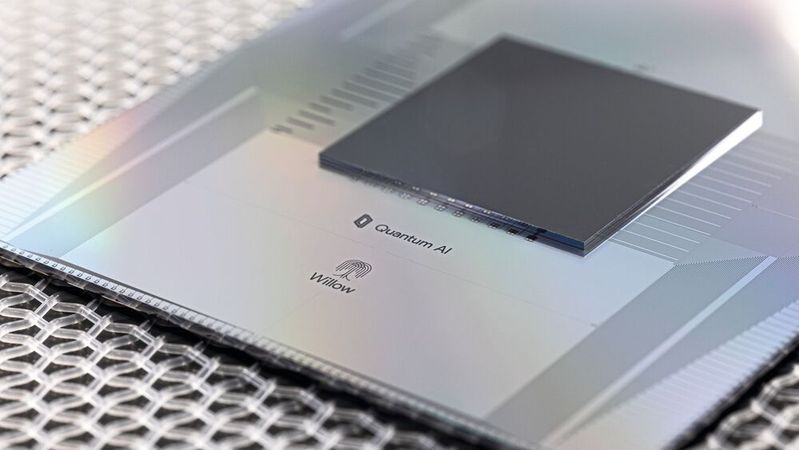
Google's quantum computer chip "Willow," with its 105 qubits, served as the basis for the calculations with the algorithm "Quantum Echoes."
(Image: Google)
It is not the first time that Google has claimed to have achieved quantum supremacy. This time, however, the claims are backed by verifiable research: According to a study published in the journal Nature, quantum computers using the specially developed Quantum Echoes algorithm can significantly outperform supercomputers in certain computational tasks—being up to 13,000 times faster in some cases. For the first time, this achieves a verifiable quantum advantage for a scientifically relevant computational task—a crucial difference from earlier, often criticized demonstrations.
The method is based on a so-called Out-of-Time-Order Correlator (OTOC) and was executed on Google’s 105-qubit processor Willow. According to the study, it was able to perform a complex quantum dynamics simulation about 13,000 times faster than the fastest known classical algorithm on the Frontier supercomputer. Specifically, the quantum computer took around two hours for a calculation that would have taken Frontier more than three years. This not only surpasses previous benchmarks but also brings the quantum computer closer to practical applications for the first time.
Previous demonstrations of "Quantum Supremacy"—such as in 2019 with the Sycamore chip—suffered from accusations of being detached from reality. At that time, the focus was on abstract tasks with no practical use, which were, in part, later surpassed by improved classical algorithms. Quantum Echoes, on the other hand, meets two crucial criteria: it addresses a physically relevant problem, and the results can be verified by other quantum computers or experimental methods, such as Nuclear Magnetic Resonance (NMR).
Journey into the Past
The functionality of the algorithm resembles a time-reversal experiment. First, a quantum system is developed in a specific direction, then deliberately disturbed—such as by specifically adjusting a qubit—and subsequently guided backward through the original operations.
By comparing forward and backward development, measurable interferences arise in the system. These "echoes" are extremely sensitive to the smallest changes in the system and provide precise information about the dynamics and structure within the model.
In the current study, Google used this method in collaboration with research teams from the USA, Canada, the United Kingdom, and Australia to analyze molecular structures within the scope of nuclear magnetic resonance (NMR). The algorithm served as a kind of "molecular ruler" to determine atomic distances with high precision.
Verifiable, Reproducible Results
In contrast to classical NMR, Quantum Echoes enabled a more accurate mapping of spin interactions over greater distances within a molecule—an effect that is either computationally intensive or no longer feasible to model classically. While the current experiments were still limited to small molecules with 15 to 28 atoms—still manageable for classical computers—the direction is clear: with improved hardware and error correction, significantly more complex structures could follow.
Another hallmark of success: the results are reproducible. Other research institutions with comparable quantum hardware could run the algorithm and validate the findings—a fundamental step toward scientific validation in quantum computing.
The researchers see Quantum Echoes not only as a useful tool for fundamental research but also for potential applications in drug development, catalyst research, or the development of new battery materials.
In the long term, the method could also be used in the field of quantum sensing. Google refers to this as the "Quantum Scope"—an instrument designed to make quantum information as usable as microscopes or telescopes make classical information.
Real Practical Applicability Within the Next Five Years?
Despite the successes, the challenge remains great. The complexity of molecules and quantum systems grows exponentially, and the current hardware—including Google's Willow—is far from achieving the necessary scaling for universal applications.
Google itself continues to pursue a clear roadmap: the next milestone is the construction of a fault-tolerant logical qubit. Only with such qubits can large, stable quantum computers for practical tasks become a reality.
Date: 08.12.2025
Naturally, we always handle your personal data responsibly. Any personal data we receive from you is processed in accordance with applicable data protection legislation. For detailed information please see our privacy policy.
Consent to the use of data for promotional purposes
I hereby consent to Vogel Communications Group GmbH & Co. KG, Max-Planck-Str. 7-9, 97082 Würzburg including any affiliated companies according to §§ 15 et seq. AktG (hereafter: Vogel Communications Group) using my e-mail address to send editorial newsletters. A list of all affiliated companies can be found here
Newsletter content may include all products and services of any companies mentioned above, including for example specialist journals and books, events and fairs as well as event-related products and services, print and digital media offers and services such as additional (editorial) newsletters, raffles, lead campaigns, market research both online and offline, specialist webportals and e-learning offers. In case my personal telephone number has also been collected, it may be used for offers of aforementioned products, for services of the companies mentioned above, and market research purposes.
Additionally, my consent also includes the processing of my email address and telephone number for data matching for marketing purposes with select advertising partners such as LinkedIn, Google, and Meta. For this, Vogel Communications Group may transmit said data in hashed form to the advertising partners who then use said data to determine whether I am also a member of the mentioned advertising partner portals. Vogel Communications Group uses this feature for the purposes of re-targeting (up-selling, cross-selling, and customer loyalty), generating so-called look-alike audiences for acquisition of new customers, and as basis for exclusion for on-going advertising campaigns. Further information can be found in section “data matching for marketing purposes”.
In case I access protected data on Internet portals of Vogel Communications Group including any affiliated companies according to §§ 15 et seq. AktG, I need to provide further data in order to register for the access to such content. In return for this free access to editorial content, my data may be used in accordance with this consent for the purposes stated here. This does not apply to data matching for marketing purposes.
Right of revocation
I understand that I can revoke my consent at will. My revocation does not change the lawfulness of data processing that was conducted based on my consent leading up to my revocation. One option to declare my revocation is to use the contact form found at https://contact.vogel.de. In case I no longer wish to receive certain newsletters, I have subscribed to, I can also click on the unsubscribe link included at the end of a newsletter. Further information regarding my right of revocation and the implementation of it as well as the consequences of my revocation can be found in the data protection declaration, section editorial newsletter.
"We believe that within the next five years, we will be able to solve real problems that are inaccessible to classical computers," said Hartmut Neven, Head of Google Quantum AI. An ambitious goal—but for the first time, it no longer feels purely theoretical.
(sg)
Future-Proof Authentication with Universal RFID Readers



:quality(80)/p7i.vogel.de/wcms/ba/ec/baecd2e3783dee11913096f7d58e1232/bild-1-kammerer-kgt-f-r-elektrozylinder-300dpi-2000px-printv1.jpeg "Kammerer ball screw for use in an electric cylinder (Source: Kammerer)")
:quality(80)/p7i.vogel.de/wcms/51/1b/511b420dbcc296aec09e3bffb051b8a8/0133581587v1.jpeg "The cables connect numerous machine components—often in confined spaces. (Image:Helu)")
:quality(80)/p7i.vogel.de/wcms/b5/67/b5676f3bfb36251ed31f9a0cccf650b6/0133167827v1.jpeg "Thanks to JumboFlex Generation 2, employees can effortlessly move wheelchairs weighing as much as 40 kilograms. (Image:Lard)")
:quality(80)/p7i.vogel.de/wcms/5e/c6/5ec615b7a51440f668259f2af9158cb9/0132654694v1.jpeg "Strategic Partnerships in Industry: As buyers and restructuring partners, Chinese investors are increasingly helping to preserve jobs in Germany. (Image: ©Anatolii Rymarchuk - stock.adobe.com)")
:quality(80)/p7i.vogel.de/wcms/aa/3e/aa3e2603a812f8e7d33c00ba8ae28c9f/0133507886v1.jpeg "With the Iggy Rob, igus is bringing a humanoid robot into factories for a price of 47,999 euros ($54,718). (Image: igus)")
:quality(80)/p7i.vogel.de/wcms/92/64/92645c64ffbb6980976d39102388d120/0113143253v1.jpeg "In our China Market Insider, we regularly provide you with relevant information straight from China. (Image:© Eisenhans - stock.adobe.com)")
:quality(80)/p7i.vogel.de/wcms/c7/05/c70542511e0824ee491f7b55e21fa429/0133598424v1.jpeg "In logistics, AI is often implemented only on a case-by-case basis; data is stored in separate systems, and inventory levels, status values, and priorities are not defined consistently. (Image: ©m-project - stock.adobe.com)")
:quality(80)/p7i.vogel.de/wcms/3a/9c/3a9c1fd546e1f041b86bb1d03cf39101/0133610524v1.jpeg "The Mason W-01 combines industrial-grade humanoid hardware, Physical AI-based perception, and autonomous task planning. (Image:Nova X Robotics)")
:quality(80)/p7i.vogel.de/wcms/9c/16/9c16e4aa02594fe4bf82ead736562b07/directhop1-scaledv1.jpeg "Light as a feather, but without feathers: The University of Washington's robot, which weighs just one gram, uses a bionic direct-drive system to catapult itself into the air with centimeter-level precision. (Source: Mark Stone/University of Washington)")
:quality(80)/p7i.vogel.de/wcms/e7/94/e794290f265afbd0ffc7a06c4fe9d425/adobestock-1887113836--hypnotics-14-stock-adobe-com-ki-generiertv1.jpeg "In both autonomous driving and industrial production, there is growing skepticism as to whether full autonomy is always desirable. (Source: © Hypnotics 14 – stock.adobe.com / AI-generated)")
:quality(80)/p7i.vogel.de/wcms/a8/71/a8712e5c6ef536228444ab5275cedfe2/adobestock-340905887--gorodenkoff-stock-adobe-comv1.jpeg "A new position paper outlines the conditions that the business community, academia, and policymakers must jointly establish in order to ensure the long-term viability of industry in Germany and Europe. (Source: © Gorodenkoff – stock.adobe.com)")
:quality(80)/p7i.vogel.de/wcms/7d/eb/7deb25ca674fa4c781a9d1fab083f7cf/parker-entwicklungszentrum-hresv1.jpeg "The centerpiece of the Parker Center for Drive and Control Technology in Offenbach is the exhibition area. (Source: Parker Hannifin)")
:quality(80)/p7i.vogel.de/wcms/f8/90/f890fc4b08048472b9b4b436a2da442b/ai-catl-sodium-batteries-vs-lithium-revolutionv1.jpeg "CATL has often faced criticism because of its high market share. This time, a government ministry is stepping in—indirectly. (Image:CATL)")
:quality(80)/p7i.vogel.de/wcms/78/ab/78abbfbab0565fabb19efe637aea30e8/nio-power-swap-station-4-china-guangzhou-2024-1400x933-jpgv1.webp "Nio and Geely are collaborating on battery replacement for electric cars. (Source: Nio)")
:quality(80)/p7i.vogel.de/wcms/2e/58/2e58c664e733dd182666606f850c5da4/0133400664v1.jpeg "The IM6 is sort of the crossover version of the IM5. (Image:MG Motor)")
:quality(80)/p7i.vogel.de/wcms/40/5f/405f41f4075e8798878011f0932a8195/0133509065v1.jpeg "Caruso has integrated Hyundai into its platform. (Image:Hyundai)")
:quality(80)/p7i.vogel.de/wcms/67/3d/673d8f6f14bd030b53b61800a0aeb06d/0133548286v1.jpeg "Overview: If even a single critical component is missing, the entire production process can come to a standstill. Proactive procurement is intended to mitigate such bottlenecks early on. (Image:Dall-E / AI-generated)")
:quality(80)/p7i.vogel.de/wcms/b3/8d/b38d7e914a0a51c24db7e93c8a8420e2/0133672676v1.jpeg "Figure 1: Today, the AT cut is most commonly used for quartz crystals. The double-twisted SC cut further enhances the stability and aging resistance of OCXO oscillators. (Image:Q-Tech)")
:quality(80)/p7i.vogel.de/wcms/40/34/4034915f85470ad8264659267e4f02d0/0133655653v1.jpeg "Cariad, Volkswagen's software subsidiary, continues to struggle. Now, another round of layoffs has been announced, which will result in the loss of many jobs ... (Image:Cariad)")
:quality(80)/p7i.vogel.de/wcms/e4/2a/e42af12e2a0816bb3d25fac9932903e9/0133646920v1.jpeg "TSMC's U.S. headquarters in Arizona: According to various media reports, the world's largest contract semiconductor manufacturer may be planning to build up to six additional fabs in the state of Texas. (Image:TSMC)")
:quality(80):fill(efefef,0)/p7i.vogel.de/wcms/67/ae/67ae0b9ac31f8/elatec-wp-universal-reader.png "Elatec WP Universal Reader")
:quality(80)/p7i.vogel.de/wcms/2e/be/2ebe7a3fd5bc91773110a9b66e3e95cf/86592347v1.jpeg "Quantum computers exploit quantum mechanical effects such as superposition and entanglement to deliver enormous computing power. (Image:public domain)")
:quality(80)/p7i.vogel.de/wcms/39/a1/39a18cdea7b691ee2a10f62729589a16/0127916607v1.jpeg "A glimpse between the racks of Jupiter. (Image:Research Center Jülich / Sascha Kreklau)")