Test drive reportNew Opel Frontera: Heritage and SUV united in compact format
By
Alexander Sellei/sp-x | Translated by AI
4 min Reading Time
Opel has revived the Frontera. It succeeds the Crossland as a mild hybrid or electric car with up to seven seats. However, all-wheel drive is nowhere to be found.
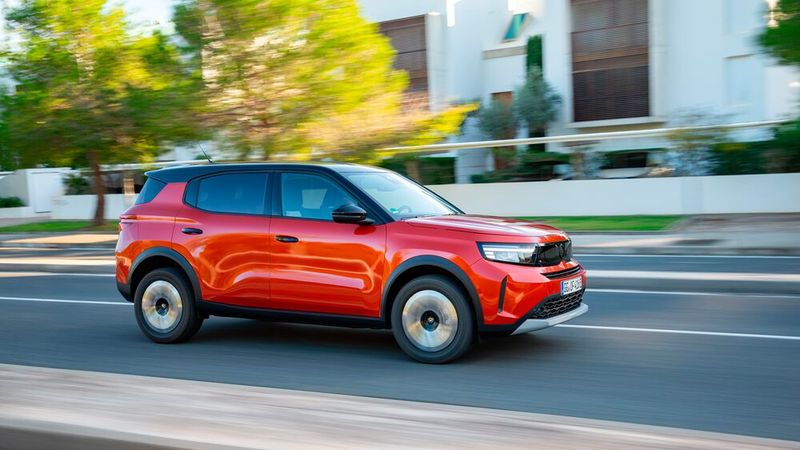
On the occasion of the brand's 125th anniversary, Opel is now reviving the Frontera from the 90s.
(Image: Opel)
While the parent company Stellantis finds itself in turbulent waters after the hasty departure of CEO Tavares, Opel has recently experienced a favorable development. For the brand's 125th anniversary, Opel is reviving the cult 4x4 Frontera from the 90s. Despite its storied off-road heritage, all-wheel drive is not available. The new generation shares with the original Frontera its angular appearance and high utility at an affordable price. It starts at 24,000 euros (approx. 25.229 USD) with the mild hybrid, while the E-Frontera starts at 29,000 euros (approx. 30.485 USD).
The new model with an old name replaces the Opel Crossland and belongs to the popular compact SUV class, where numerous competitors such as the Skoda Karoq or the Nissan Qashqai abound. Opel makes use of the Smart-Car platform for the small and compact class from the Stellantis group, already used for Citroën models like the ë-C3 or C3 Aircross. The platform has been developed with a focus on electric cars but can also be equipped with hybrid drives.
The 4.39-meter long and 1.64-meter high SUV (approx. 14.4 ft long and 5,4 ft high) has a wheelbase of 2.67 meters (approx. 8,8 ft), which means very good space utilization with sufficient head and legroom in the back seat. Among the interesting options is an additional third row of seats for 800 euros extra (approx. 841 USD), transforming the five-seater into a seven-seater. However, this is reserved for the hybrid powertrains.
The trunk with a double loading floor offers 460 liters of storage space. Folding down the split rear seat (60:40) increases this to up to 1,600 liters. Similar to bicycle saddles, the front seats have a center groove as standard. This distributes weight better over the sitting bones during longer journeys and reduces pressure on the tailbone.
Not suitable for long trips
The electric Frontera initially comes with only one battery option. At 44 kWh, it is somewhat modest, offering the vehicle a range of up to 300 km (approx. 186 miles), which is insufficient for longer trips. A long-range variant with a larger battery for up to 400 km (approx. 249 miles) of range is planned for next year. The performance of the 83 kW electric SUV doesn't quite make the grade within the quartet. Acceleration from a standstill to 100 km/h (approx. 62 miles/h) takes a sluggish twelve seconds, and it tops out at 140 km/h (approx. 87 miles/h).
The consumption is stated at a realistic 18.5 kWh per 100 km (approx. 62 miles/h), which is average for a vehicle of this weight class (1,344 kg). A standard charge from 20 to 80 percent battery capacity is completed in just under 26 minutes. The small battery charges at a maximum power of 100 kW (DC). For AC charging, only a single-phase onboard charger is standard. Therefore, the three-phase device with 11 kW charging capacity is highly recommended for an additional 400 euros (420,48 USD).
While the Rüsselsheim engineers were constrained by Stellantis in terms of technical components, the designers had mostly free rein with the aesthetics. Even more than its predecessor, the Crossland, or its model siblings Mokka and Grandland, Opel positions the Frontera visually towards an SUV. This is particularly evident in the profile, with the vertical front and angular rear. At the front, the compact car unmistakably displays the current brand face with the black panel, full LED headlights, and the Opel lightning bolt.
Detox in the equipment
To keep the entry price well below 30,000 euros (31.536 USD), Opel adopted a strict hand in economizing the interior. Opel itself calls this equipment detox, stating that they focus purely on the essentials. As a result, the interior is rather spartan. However, due to the clear interior design, this is not immediately apparent. A key that must be inserted and turned to start the car seems quite outdated for a modern electric vehicle. Opel also emphasizes the economical use of resources, as the Frontera is 95 percent made from recyclable materials, and the interior is completely free of animal leather.
Date: 08.12.2025
Naturally, we always handle your personal data responsibly. Any personal data we receive from you is processed in accordance with applicable data protection legislation. For detailed information please see our privacy policy.
Consent to the use of data for promotional purposes
I hereby consent to Vogel Communications Group GmbH & Co. KG, Max-Planck-Str. 7-9, 97082 Würzburg including any affiliated companies according to §§ 15 et seq. AktG (hereafter: Vogel Communications Group) using my e-mail address to send editorial newsletters. A list of all affiliated companies can be found here
Newsletter content may include all products and services of any companies mentioned above, including for example specialist journals and books, events and fairs as well as event-related products and services, print and digital media offers and services such as additional (editorial) newsletters, raffles, lead campaigns, market research both online and offline, specialist webportals and e-learning offers. In case my personal telephone number has also been collected, it may be used for offers of aforementioned products, for services of the companies mentioned above, and market research purposes.
Additionally, my consent also includes the processing of my email address and telephone number for data matching for marketing purposes with select advertising partners such as LinkedIn, Google, and Meta. For this, Vogel Communications Group may transmit said data in hashed form to the advertising partners who then use said data to determine whether I am also a member of the mentioned advertising partner portals. Vogel Communications Group uses this feature for the purposes of re-targeting (up-selling, cross-selling, and customer loyalty), generating so-called look-alike audiences for acquisition of new customers, and as basis for exclusion for on-going advertising campaigns. Further information can be found in section “data matching for marketing purposes”.
In case I access protected data on Internet portals of Vogel Communications Group including any affiliated companies according to §§ 15 et seq. AktG, I need to provide further data in order to register for the access to such content. In return for this free access to editorial content, my data may be used in accordance with this consent for the purposes stated here. This does not apply to data matching for marketing purposes.
Right of revocation
I understand that I can revoke my consent at will. My revocation does not change the lawfulness of data processing that was conducted based on my consent leading up to my revocation. One option to declare my revocation is to use the contact form found at https://contact.vogel.de. In case I no longer wish to receive certain newsletters, I have subscribed to, I can also click on the unsubscribe link included at the end of a newsletter. Further information regarding my right of revocation and the implementation of it as well as the consequences of my revocation can be found in the data protection declaration, section editorial newsletter.
A dual-screen display, each with a ten-inch diagonal, provides information about the drive and the vehicle, with the optional central display slightly angled towards the driver. The standard equipment includes only a central smartphone holder. It's frustrating that functionality has been cut here as well, and even the average consumption cannot be displayed.
In addition to touch and voice controls, there are only a few physical buttons, such as for climate control. At least the smartphone can also charge wirelessly optionally. Features of the base Frontera Edition include a manual air conditioning system, 16-inch steel wheels, and the most important assistance systems. The higher trim line, Frontera GS, offers 17-inch alloy wheels, automatic climate control, and an infotainment system with a central display for an additional 3,500 euros (3.679,20 USD).
For those not yet ready to switch to an electric car, there are alternatively two cheaper combustion engine variants, costing approximately 5,000 or 3,200 euros (5.256 or 3.363,84 USD) less, with either 74 kW/100 hp or 100 kW/136 hp. Both feature a 1.2-liter turbocharged petrol engine, paired with a six-speed dual-clutch transmission, and receive electric support from a 48-volt system. In city traffic, when rolling from light to light, the car can also travel short distances purely electrically.



:quality(80)/p7i.vogel.de/wcms/4c/af/4cafbff8a06028a7250e03626a7e6afb/0132939283v1.jpeg "Behind the acronym Clasco is a project based on laser processing techniques, aiming to enable the reliable and application-specific post-processing of even complex metal parts produced by 3D printers. TU Dresden took the lead... (Image:German Materials Society)")
:quality(80)/p7i.vogel.de/wcms/cf/fc/cffc25779317b5b1e42cba9cfcd52bbc/0132927530v1.jpeg "The analysts were wrong again, as Japan was able to increase its export volume far more than predicted. Here are some numbers and facts about Nippon's economic situation... (Image:AI-generated)")
:quality(80)/p7i.vogel.de/wcms/6f/12/6f122ac26fd08f621f7b14f421fc435c/0132930817v1.jpeg "The Federal Statistical Office has taken a closer look at the first half of 2026 in terms of trade. Among other findings, it revealed that China is once again Germany's top trading partner... (Image:AI-generated)")
:quality(80)/p7i.vogel.de/wcms/3c/26/3c2635fb73f283b2d0e6ede46a2c2f9f/0113143253v1.jpeg "In our China Market Insider, we regularly provide you with relevant information directly from China. (Image:© Eisenhans - stock.adobe.com)")
:quality(80)/p7i.vogel.de/wcms/05/e7/05e7017a2699ef15b513bfd2e18431fb/digitaler-planungszwilling-bildv1.png "The author explains here why the digital twin only becomes a planning tool when it follows a clear decision-making question. (Source: T&O Group/AI-generated)")
:quality(80)/p7i.vogel.de/wcms/07/b3/07b368b6d067acdbb49c1e88b0cd8e9d/0131022521v1.jpeg "The seven-axis collaborative robot from Yamaha Motor is equipped with Harting connectors. (Image:Yamaha Motor)")
:quality(80)/p7i.vogel.de/wcms/dc/64/dc64212882d6898cd5b44fcbeb5aedbb/image1v1.jpeg "The cobots from Rheinmetall Yardstick Robotics use all-in-one servo drives from Synapticon. (Image: Rheinmetall Yardstick Robotics) (Image:)")
:quality(80)/p7i.vogel.de/wcms/a7/38/a73840cb81da9dc3c503f4c04bf66b96/0132892768v1.jpeg "Unitree's IPO symbolizes the high expectations for humanoid robots and embodied AI. (Image:Dall-E / AI-generated)")
:quality(80)/p7i.vogel.de/wcms/c8/a1/c8a170f594765cecbdafbc139b96d91a/0132860586v1.jpeg "V-shaped grooves, known as riblets, are directly incorporated into the paint. They reduce overall drag by 50 percent, resulting in significant fuel savings. (Image:Trumpf)")
:quality(80)/p7i.vogel.de/wcms/c9/80/c98042b5898cde9670b4c3ae1efbc656/adobestock-165496610v1.jpeg "In just 45 days, the team from Stauff India completely renewed the hydraulic piping of a steel plant. The key factor here was the right pipe connection system. (Source: Stauff)")
:quality(80)/p7i.vogel.de/wcms/41/fc/41fc456ff1ff8f30807924663e8df127/img-0942v1.jpeg "In industrial additive manufacturing, the production strategy must influence the design from the very beginning. (Source: Materialise)")
:quality(80)/p7i.vogel.de/wcms/44/fe/44fe86a16c26c09bb363b3671bf0b930/0132847771v1.jpeg "CoreTechnologie (CT) points out that the 3D printing software 4D_Additive has been equipped with additional application possibilities. Here you can learn more about what the new version 1.8 can do – such as generating complex lattice structures or optimizing faulty data ... (Image:CT)")
:quality(80)/p7i.vogel.de/wcms/d1/42/d142e0e90738d0335c4ed7936f030e6a/0132948392v1.jpeg "Its production was long delayed, but now Tesla's electric truck Semi is being built in the USA. If the Elon Musk company has its way, it will soon also be seen on Europe's roads... (Image: Tesla)")
:quality(80)/p7i.vogel.de/wcms/a4/19/a419e31b91a2da68d3b59afed58dc31c/26c0194-001v1.jpeg "The Mercedes VLE will soon also be produced in China, local media report. (Image:Mercedes-Benz AG)")
:quality(80)/p7i.vogel.de/wcms/16/2f/162ff38606f0034832fbaadea1829933/precision-measurement-labv1.jpeg "In car manufacturing, much revolves around precision. This is evaluated, among other things, in the precision measurement laboratory. (Source: Geely)")
:quality(80)/p7i.vogel.de/wcms/5b/88/5b88d94e6a43f2b857462cd1921f7386/0132281427v1.jpeg "The eTurbo solves a well-known turbocharger problem: by combining an exhaust gas turbocharger and a permanently excited synchronous motor into a highly integrated core assembly, the compressor achieves sufficient speed even when the exhaust energy is actually not yet sufficient. (Image: BorgWarner)")
:quality(80)/p7i.vogel.de/wcms/65/74/6574fcb9fb6b589ef577767613f5397c/0132928076v1.jpeg "Compact and standardized: CubeSats enable cost-effective space missions and are increasingly serving as a platform for testing new technologies—from sensors and communications to innovative power supply systems. (Image:City Labs, Inc.)")
:quality(80)/p7i.vogel.de/wcms/07/f6/07f6c430c86bf0d5d915268b881ada49/0132895094v1.jpeg "FOUP wafer cassette for 300-mm semiconductor manufacturing in TSMC's Fab 12. (Image:TSMC)")
:quality(80)/p7i.vogel.de/wcms/59/25/59258a3771bf03dd3461d0378884464d/0132928076v1.jpeg "Compact and standardized: CubeSats enable cost-effective space missions and increasingly serve as platforms for testing new technologies—from sensors and communication to innovative energy supply systems. (Image: City Labs, Inc.)")
:quality(80)/p7i.vogel.de/wcms/22/82/22826566c11220ed61efac5982fb94a2/0132896083v1.jpeg "Electrodes made from paper and copper paste deliver comparable signal quality to the established gold standard. They perform significantly better in all environmental impact analyses. (Image:Screentec)")
:quality(80)/p7i.vogel.de/wcms/31/77/3177ea32a603bb43a9db2f9d295c5e7e/0121592874v1.jpeg "Following the Dacia Spring, Citroen ë-C3, and Renault 5 E-Tech Electric, Hyundai is now also entering the affordable battery business with the Inster. (Image:Hyundai)")
:quality(80)/p7i.vogel.de/wcms/bc/dc/bcdc22bd76428a116fba8e8e378141b5/0122088390v1.jpeg "Almost like a smaller Mustang Mach-E: The closed front clearly indicates the E-drive of the Puma Gen-E. (Image:Ford)")
:quality(80)/p7i.vogel.de/wcms/86/a0/86a06d81ddab0c07f0ec4639af23c2a0/0122144259v1.jpeg "Among the interesting options is an additional third row of seats for 800 euros extra, transforming the five-seater into a seven-seater.(Image: Opel)")
:quality(80)/p7i.vogel.de/wcms/a7/eb/a7eb7b82b54f84190672985c0dedcc3a/0122144049v1.jpeg "The trunk with a double loading floor offers 460 liters of storage space.(Image: Opel)")
:quality(80)/p7i.vogel.de/wcms/0d/3b/0d3bb61754660e2b7949234509c9db42/0122144053v1.jpeg "Folding down the split rear seat (60:40) increases this to up to 1,600 liters.(Image: Opel)")
:quality(80)/p7i.vogel.de/wcms/2f/ab/2fabd85fae6b1126d401e171fbd273a2/0122144260v1.jpeg "Opel relies on the Smart Car platform for the small and compact class from the Stellantis Group.(Image: Opel)")
:quality(80)/p7i.vogel.de/wcms/ed/02/ed023b1fdf0ce9dab50436c68c21d572/40f910458b38205d15ba8dc67a2d7b5be0b33010v1.jpeg "Volkswagen has launched the ID Cross, an electric SUV positioned above the VW Polo. (Image: Volkswagen)")
:quality(80)/p7i.vogel.de/wcms/22/e7/22e7227ac563535b03b4f46ba6dd94bc/5d6a4f3364bcacb32b52e149013491ac421da841v1.jpeg "Xpeng is bringing its smallest model to date, the L03, to Europe. (Image:Xpeng)")