Berylls by AlixPartners Top-100 Supplier Study 2026Automotive Suppliers Struggle with Declining Revenues And Weak Margins
From
Stefanie Eckardt | Translated by AI
5 min Reading Time
Global vehicle production increased by around four percent to 92.9 million vehicles in 2025. However, the 100 largest automotive suppliers were unable to benefit from this, as highlighted by the latest edition of the Berylls by AlixPartners Top-100 Supplier Study.
Globally, the supplier industry is struggling. The reasons are unfavorable exchange rates, weaker demand for electric vehicles outside of China, and increasing geopolitical and economic pressures.
(Image: freely licensed on Pixabay)
Global vehicle production is rising, but automotive suppliers are struggling with declining revenues and weak margins. The 15th edition of the Berylls by AlixPartners Top-100 Supplier Study revealed that, despite increased global vehicle production last year, the 100 largest suppliers faced declining revenues. The cumulative revenue dropped by 2.2 percent to €1,061 billion. The main causes were unfavorable exchange rates, weaker demand for electric vehicles outside of China, and increasing geopolitical and economic pressures.
The ten largest automakers also recorded declining revenues and a massive drop in profitability. The transformation is particularly evident in the rise of Chinese companies, which are increasingly shaping the pace of innovation and market structure in the industry, as Dr. Jan Dannenberg, Partner and Managing Director as well as Co-Leader of the DACH region at AlixPartners, explains: "Although more vehicles were produced globally in 2025 than in the previous year, growth was unevenly distributed. While China expanded its production by double digits and now accounts for around 30 percent of global vehicle manufacturing, production volumes in Europe, the USA, and South Korea stagnated or declined. However, the higher production figures did not automatically result in increased revenues for suppliers. Around 62 of the top 100 supplier companies had to accept revenue declines. Even without negative exchange rate effects, growth would have been minimal."
At the same time, the vehicle mix increasingly shifted towards more affordable compact and mid-range models, particularly in the Chinese market, which also negatively affected the revenues of automakers and suppliers.
Worse Profitability
Furthermore, the profitability of the industry is deteriorating according to the study. The average margin of the ten largest vehicle manufacturers fell from 6.9 to 4.2 percent. Individual companies like Stellantis even plunged deep into the loss zone.
The supplier industry was not spared from this development either. The average margin of the Top 100 suppliers dropped from 5.8 to 5.2 percent. Companies with high dependency on electromobility were particularly affected. Fluctuating demand, delayed vehicle launches, and political uncertainties led to significant write-offs and overcapacities.
Strong Competition From China
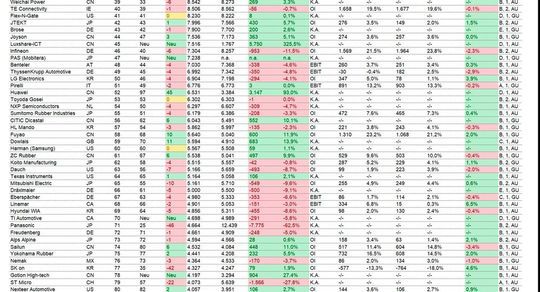
In addition, Chinese companies are growing significantly faster than their international competitors. While the leading suppliers worldwide grew by an average of just under six percent annually over the past five years, Chinese companies achieved average growth rates of around 16 percent per year. Furthermore, new technology leaders in the field of autonomous driving and software-based mobility are emerging in China. Companies such as Huawei, Horizon Robotics, and Momenta are investing heavily in future technologies and benefiting from clear industrial policy support.
The structural advantage of China is not only based on innovation but also on long-term lower production costs. Since the year 2000, producer prices in China have risen significantly more slowly than in Germany or the USA. As a result, Chinese suppliers today have substantial cost advantages compared to their western competitors.
Top-100 Supplier Study 2026 by Berylls by AlixPartners: Ranks 39 to 80
(Image: Berylls by AlixPartners)
Inconsistent E-mobility Strategy Harms Supplier Industry
The development of electromobility is becoming increasingly uneven. While Chinese manufacturers are consistently pursuing their electric strategy, Western automakers are significantly delaying numerous battery-electric programs, as the study highlighted. U.S. and South Korean manufacturers are particularly affected. At the same time, many Western carmakers are extending the lifespans of their combustion engine platforms to better utilize existing production facilities and secure liquidity in the short term. The withdrawal of government subsidies—especially in the U.S.—has further exacerbated this development. This creates significant pressures for suppliers who have already made substantial investments in electromobility. Production capacities remain underutilized for longer periods, capital is tied up for extended durations, and financing costs rise.
Carmakers Exert Pressure
In light of declining profits, automakers are increasingly focusing on cost reductions. Particularly affected is the material expenditure—and thus the supplier industry. "The result is tougher price negotiations, longer claiming processes, and more restrictive support for struggling suppliers. At the same time, it is evident that technologically demanding segments are better able to defend their profitability. Semiconductor manufacturers remain by far the most profitable segment in the industry," emphasizes Dr. Jürgen Simon, Partner at Berylls by AlixPartners. High entry barriers, technological complexity, and geopolitical dependencies continue to grant them significant negotiating power over automakers. In contrast, providers of interchangeable standard components are coming under increasing pressure.
Date: 08.12.2025
Naturally, we always handle your personal data responsibly. Any personal data we receive from you is processed in accordance with applicable data protection legislation. For detailed information please see our privacy policy.
Consent to the use of data for promotional purposes
I hereby consent to Vogel Communications Group GmbH & Co. KG, Max-Planck-Str. 7-9, 97082 Würzburg including any affiliated companies according to §§ 15 et seq. AktG (hereafter: Vogel Communications Group) using my e-mail address to send editorial newsletters. A list of all affiliated companies can be found here
Newsletter content may include all products and services of any companies mentioned above, including for example specialist journals and books, events and fairs as well as event-related products and services, print and digital media offers and services such as additional (editorial) newsletters, raffles, lead campaigns, market research both online and offline, specialist webportals and e-learning offers. In case my personal telephone number has also been collected, it may be used for offers of aforementioned products, for services of the companies mentioned above, and market research purposes.
Additionally, my consent also includes the processing of my email address and telephone number for data matching for marketing purposes with select advertising partners such as LinkedIn, Google, and Meta. For this, Vogel Communications Group may transmit said data in hashed form to the advertising partners who then use said data to determine whether I am also a member of the mentioned advertising partner portals. Vogel Communications Group uses this feature for the purposes of re-targeting (up-selling, cross-selling, and customer loyalty), generating so-called look-alike audiences for acquisition of new customers, and as basis for exclusion for on-going advertising campaigns. Further information can be found in section “data matching for marketing purposes”.
In case I access protected data on Internet portals of Vogel Communications Group including any affiliated companies according to §§ 15 et seq. AktG, I need to provide further data in order to register for the access to such content. In return for this free access to editorial content, my data may be used in accordance with this consent for the purposes stated here. This does not apply to data matching for marketing purposes.
Right of revocation
I understand that I can revoke my consent at will. My revocation does not change the lawfulness of data processing that was conducted based on my consent leading up to my revocation. One option to declare my revocation is to use the contact form found at https://contact.vogel.de. In case I no longer wish to receive certain newsletters, I have subscribed to, I can also click on the unsubscribe link included at the end of a newsletter. Further information regarding my right of revocation and the implementation of it as well as the consequences of my revocation can be found in the data protection declaration, section editorial newsletter.
Global Supply Chains in Significant Transformation
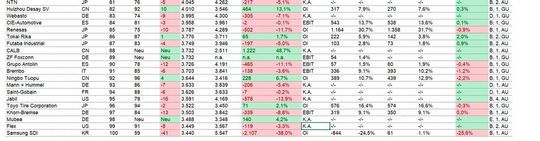
The escalating trade conflict between Europe and the United States significantly strained transatlantic supply flows in 2025. Both imports and exports declined sharply. At the same time, European companies lost market share in China and India, while Asia's exports to Europe increased. India is increasingly emerging as a strategic winner in the global realignment. Numerous suppliers are investing in new plants and development centers there. Government support programs and local value creation requirements are further accelerating this trend.
Germany, on the other hand, is experiencing a significant reduction in industrial capacities. Several plant closures, extensive job cuts, and a lack of new investments highlight the structural pressure on the location. Dr. Jan Dannenberg explains: "In the last eight years, around 100,000 jobs have been lost in the German automotive industry. This trend cannot be stopped in the coming years. And Germany is dismantling locations that are being newly established elsewhere. We are now talking about a reduction in value creation in our industry by 20 to 25 percent. The next three to five years will be bitter for the German supplier industry, especially for medium-sized companies that have not yet strongly internationalized their business."
Top-100 Supplier Study 2026 by Berylls by AlixPartners: Ranks 81 to 100.
(Image: Berylls by AlixPartners)
New Technologies Require Investments
The transformation of the industry requires significant investments in new technologies, production networks, and digitalization. At the same time, declining margins and rising financing costs are making access to capital more difficult. Dr. Alexander Timmer comments: "While the stock markets partially recovered in 2025 and many suppliers recorded significant share price gains, banks and debt capital providers remain cautious. The industry is thus caught in a tension between necessary transformation and limited financial flexibility."
Quick Adaptability as a Success Factor
In the coming years, flexibility, regional presence, and technological innovation will determine the success of suppliers. The industry is increasingly moving towards "Local for Local": production and supply chains are being regionalized to reduce trade risks and ensure customer proximity. At the same time, Chinese automakers are creating new business opportunities for Western suppliers through their international expansion. However, the critical challenge remains financing the transformation. Successful suppliers will therefore need to focus their portfolios, divest non-strategic business areas, and systematically reduce their capital commitment.
Top 10 Suppliers
In 2025, Bosch and Denso held positions 1 and 2 as in 2024. The first surprise came at position 3, which was taken by CATL, improving by 4 places compared to 2024. This was followed by Hyundai Mobis and Magna, which swapped places. Unchanged in position 6 is ZF Friedrichshafen. Aisin improved by one place compared to 2024 and now holds position 7. This is followed by Forvia, Michelin, and Hasco.



:quality(80)/p7i.vogel.de/wcms/dd/92/dd928ba2e2956aa2bfff4888af8b08f8/photo--1v1.jpeg "Catalog product for extreme operating conditions: The new NRTVG guide carriage from Bosch Rexroth withstands extreme environmental conditions. (Source: Bosch Rexroth AG)")
:quality(80)/p7i.vogel.de/wcms/5a/9e/5a9e57e26964ba5c9d8719a9ee520bb3/0133310195v1.jpeg "Germany and the United Arab Emirates have signed an agreement to stand shoulder to shoulder in times of crisis. This will bring Germany many billions, to say the least.
From left: Sheikh Mohammed bin Sajed al-Nahjan and Federal Chancellor Friedrich Merz. (Image:dpa / K. Nietfeld)")
:quality(80)/p7i.vogel.de/wcms/ce/96/ce964ee3cbd875e63a809c3df1d2b01e/0133312918v1.jpeg "Do you also have a branch in China and are looking for a local partner there with whom you can work to strengthen your market position? If so, time is running out, as a survey by the German Chamber of Foreign Trade in Beijing reveals ... (Image: AI-generated)")
:quality(80)/p7i.vogel.de/wcms/a0/94/a09489b453e958dc8ffd85accab2aaf3/0130556732v1.jpeg "Mutares supported two of its portfolio companies to help them strengthen their position. It worked out perfectly. Now both have been sold. Read here to find out exactly what this is all about... (Image:Mutares)")
:quality(80)/p7i.vogel.de/wcms/81/dc/81dc63ed24c562521413023779495e7d/chris-kramerv1.jpeg "Chris Kramar, Director and General Manager of OEM Solutions for Germany, Austria, and Switzerland at Dell Technologies (Source: Dell Technologies)")
:quality(80)/p7i.vogel.de/wcms/bb/f5/bbf5342f532debc1bd7c09c2b9a0bf42/0133176497v1.jpeg "Over the past two years, AI has emerged as the most important growth driver in the industry. (Image: ©Gorodenkoff - stock.adobe.com)")
:quality(80)/p7i.vogel.de/wcms/01/61/01615a0939754c41e9d2c8971bf0b38a/web-image-kuka-kmf-1500p-300-dpi-1v1.jpeg "Thanks to its design, the KMF 1500P-CB is suitable for the stable and flexible handling of closed and open pallets. (Source: Kuka)")
:quality(80)/p7i.vogel.de/wcms/0b/ef/0bef343dfe1c7f83a1be01e7e83cc5ac/delta-fabrikv1.jpeg "Autonomous mobile manipulation robots can perform a wide range of tasks in a modern factory, from loading machines to quality control. (Image:Delta)")
:quality(80)/p7i.vogel.de/wcms/f4/3d/f43d1f4297d9ae0cd1b6d2adfcb5ffe1/0133276470v1.jpeg "Simulation: Electric arcs in the electrical industry, including associated field simulation. (Image:CADFEM)")
:quality(80)/p7i.vogel.de/wcms/1d/fb/1dfbb415cd837102a33ce21ecf052ec3/0133277411v1.jpeg "LED drivers: LED circuit boards connect the light fixture to the electronics. During design, the operating current, forward voltage, and temperature must be taken into account across the entire operating range. (Image: ©Maria - stock.adobe.com)")
:quality(80)/p7i.vogel.de/wcms/80/8a/808a0eccf49a2a4fe560bd1998506ef9/0133308770v1.jpeg "Just like that, the supports are gone! High-speed footage of the automated, ultrasound-based process for removing optimized support structures from additively manufactured metal parts. It will be presented for the first time at Formnext from November 17 to 20. (Image:Fraunhofer IAPT)")
:quality(80)/p7i.vogel.de/wcms/be/4d/be4d7294d3d171468dc0b83efa4f442c/0133268906v1.jpeg "Here, two experts from Lufthansa Technik are applying the “AeroSHARK” coating to an aircraft. Until now, Boeing has been using this coating, which mimics the skin structure of sharks. Now Airbus also wants to use it to make its aircraft more fuel-efficient. (Image:Lufthansa Technik)")
:quality(80)/p7i.vogel.de/wcms/39/86/398641ac031ac48fd402c27ffe4f0e0d/zf-screenshot-2026-09-09-131739v1.png "The decarbonization of commercial vehicles will be a key topic at IAA Transportation next week. ZF is advocating for a more technology-neutral approach. (Image:ZF)")
:quality(80)/p7i.vogel.de/wcms/94/1e/941e22de0ec2d22e9619c469ec79292b/20260731163822591v1.jpeg "The Chinese government wants its automakers to adhere to certain rules of conduct when operating abroad. (Image:Sany Truck)")
:quality(80)/p7i.vogel.de/wcms/33/f6/33f69ba076b4f655d74bd6788cf5c4a0/0133305882v1.jpeg "As they move toward production readiness, the BMW iX5 Hydrogen prototypes are undergoing an extensive testing program. (Image:BMW)")
:quality(80)/p7i.vogel.de/wcms/bb/02/bb02989aac1291557168fb36afc42343/0133288089v1.jpeg "In China, automakers will be held liable in the future if traffic rules are violated while in autonomous driving mode and, for example, an accident occurs. (Image:Created with AI)")
:quality(80)/p7i.vogel.de/wcms/6c/a6/6ca6c6410e051401d5596d5cc6dfa277/0133283570v1.jpeg "From Core to Platform: With MIPS, ARC, and RISC-V, competition is shifting from individual processor IP blocks to integrated compute platforms for specialized applications. (Image:Dall-E / AI-generated)")
:quality(80)/p7i.vogel.de/wcms/73/17/73174a2afe684fa12d7d6a57b29b20e2/0133305506v1.jpeg "AI data centers are a key driver of direct current technologies. (Image:Pixabay / Brian Penny / AI-generated)")
:quality(80)/p7i.vogel.de/wcms/08/b2/08b2ce49b6d6d11d5953064bb0a62f37/0133308791v1.jpeg "If what Anthropics is accusing its Chinese AI competitors of is true, then the industry is in for quite a shakeup! At stake is nothing less than Chinese AI systems—such as Kimi and Deepseek—that were actually trained indirectly using U.S. AI systems. (Image: AI-generated)")
:quality(80)/p7i.vogel.de/wcms/c4/b5/c4b5badd67b0037f23c1d69806a13d16/0133216860v1.jpeg "Fascinating Technology: ASML's NXE3800E EUV machine. (Image:ASML)")

:quality(80)/p7i.vogel.de/wcms/5a/40/5a40f9a0f2694fd5ba3fcda47c7efc60/0128999689v1.jpeg "The SOP for the electric Macan (here at the Porsche plant in Leipzig) has been postponed multiple times. This is common for new electric cars in Europe and a problem for local suppliers, according to a recent Berylls study. (Image:Porsche AG)")
:quality(80)/p7i.vogel.de/wcms/cb/8a/cb8aab1fe9a873fe13cbd94f1ecea71f/0131680106v1.jpeg "Huawei more than quintupled its automotive sales in 2024—and was profitable for the first time. Pictured: The Aito M9 in the flagship store in Shanghai. (Image:Huawei)")