A new rack-and-pinion system makes it possible to use battery-powered elevators in wind turbines as early as the tower installation phase—starting from the very first meters. A patented process solves a key challenge related to tolerances and transitions. The concept is particularly well-suited for tall towers.
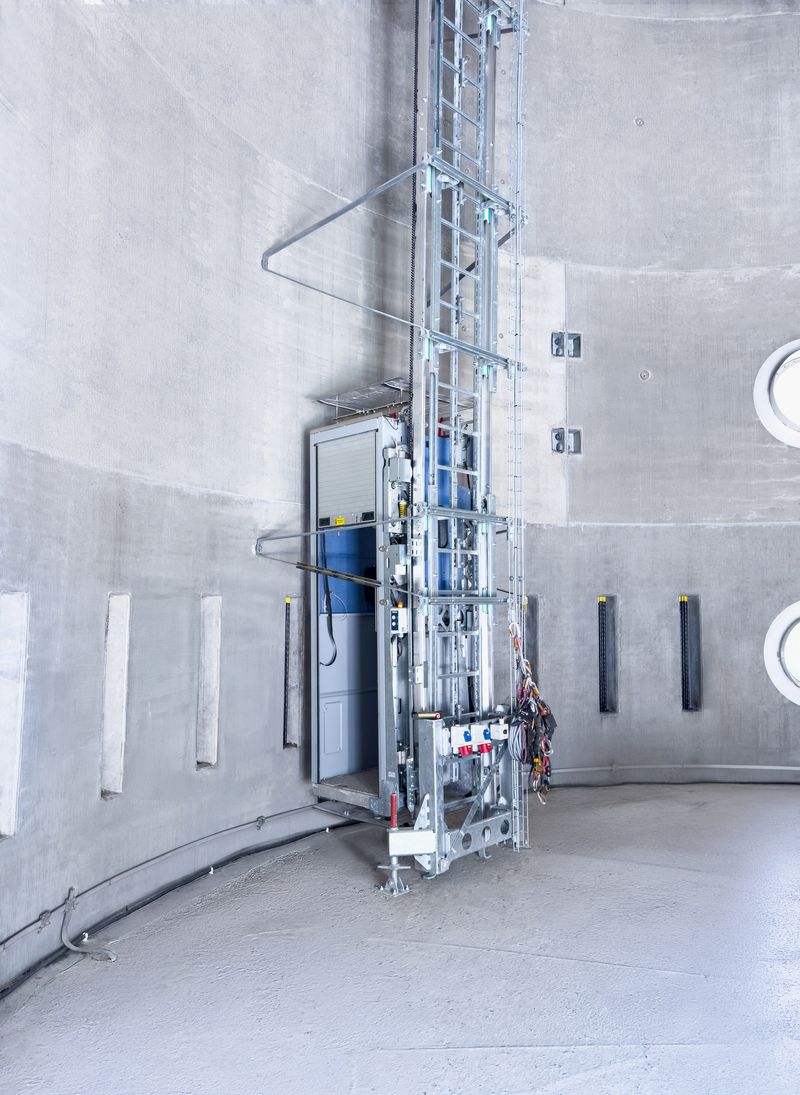
According to the manufacturer, the battery-powered lift for wind turbines sets new standards in safety, availability, and efficiency.
(Source: Geda GmbH)
With the battery-powered SH 250 W lift, Geda has developed a new elevator system for wind turbines that improves the safe transport of people and materials to the turbine and to intermediate levels. Every modern wind turbine requires a transport system in the tower. The new lift operates on lithium-ion batteries, is designed for travel heights of up to 210 meters (689 feet), and features a state-of-the-art remote maintenance system as well as numerous safety features. The lift can accommodate two people and materials.
Start Using the Elevator as Early as the Installation Phase
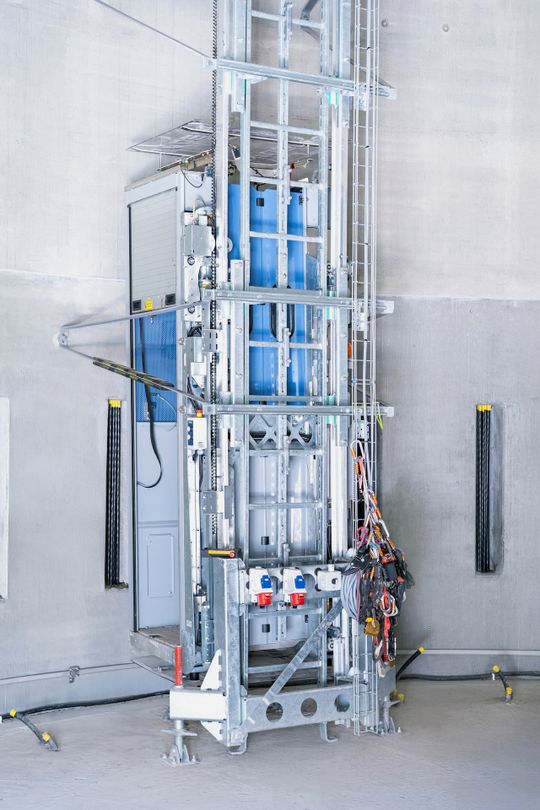
The elevator uses a rack-and-pinion drive system.
(Source: Geda)
The new battery-powered rack-and-pinion lift can be used right from the first meter: This is made possible by ladder sections with a rack-and-pinion system, whose guide profiles start at the ground and extend upward as the tower is erected. As a result, in many cases, the time-consuming and physically demanding task of climbing is eliminated during the installation phase. This makes the work considerably easier, reduces risks, and supports more efficient workflows on the construction site.
Conventional rope hoists, on the other hand, cannot be used until the tower is fully erected and the ropes for the traveling winch have been attached at the top. In addition, they often cannot be used until the entire system has been inspected and approved.
The Lift is Easy to Transport, Install, and Replace
Once the circuit path has been installed, the lift can be easily moved into the tower. A special transport frame allows for both upright and horizontal transport. Inside the tower, the machine can be set up horizontally using a collapsible tubular frame. Service and replacement were taken into account from the very beginning: The machine can be rolled onto the transport frame, detached from the guide system, and removed ergonomically. This also makes it possible to remove the machine later, even after more than 25 years, with minimal effort.
Challenges with Taller Wind Turbines
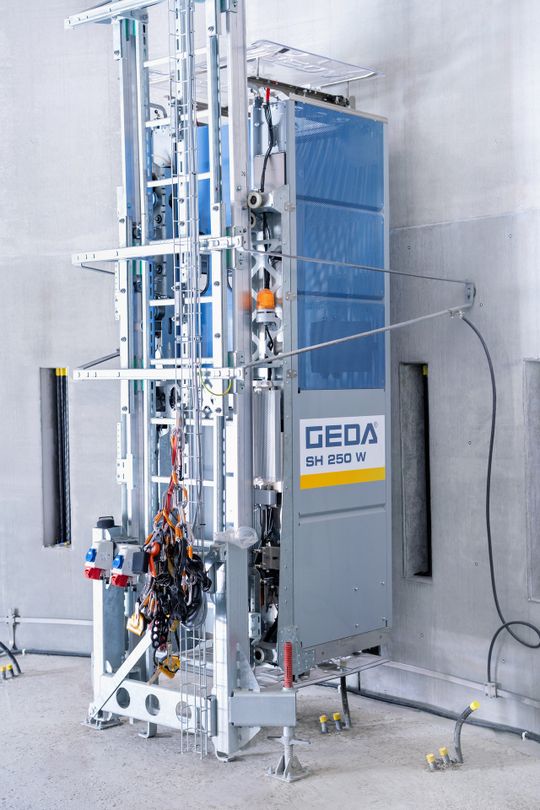
The elevator is particularly well-suited for large wind turbines.
(Source: Geda)
As modern wind turbines grow taller, the demands placed on transportation systems increase. Taller towers are economically attractive because airflows at higher altitudes are more uniform and laminar (i.e., less turbulent). At the same time, however, tower deflections and mechanical stresses increase. At a tower height of around 200 meters (656 feet), the deflection can be approximately two meters in both directions.
Conventional rope elevators are increasingly reaching their technical limits in this regard: Tower vibrations can cause ropes to strike internal structures, become damaged, or become tangled. Replacement intervals and maintenance work also lead to downtime. Furthermore, the safety cable for personnel cannot be fully inspected before reaching the upper section of the tower. The battery-powered rack-and-pinion lift avoids these system-related drawbacks. For taller towers, this solution becomes increasingly attractive from both an economic and technical standpoint.
Remote Maintenance and Image-Based Fault Diagnosis Increase Availability
The elevator system features various digital functions that help prevent unplanned downtime. These include online remote maintenance, a touchscreen display in the elevator car, and image-based fault diagnosis. Operators and service teams can remotely check the elevator’s operational status even before a service call. Visual instructions help less experienced users with operation and troubleshooting.
Elevator with a Modular Overall Design
The product’s strength lies not in any single component, but in the combination of numerous coordinated solutions. These include the resource-efficient guidance system: The manufacturer does not use traditional cross-bracing here; instead, it achieves the required stiffness through the connections to the exterior wall that are necessary anyway.
The car has also been redesigned: An H-shaped layout allows passengers to step into the elevator from below, all the way into the car and beyond. The entry guard can be opened ergonomically with a light kick when boarding from above and automatically swings upward out of the way. Special components were developed for the central charge controller for bidirectional charging and discharging, as well as for the drive system, since suitable solutions were not available in this performance class.
Date: 08.12.2025
Naturally, we always handle your personal data responsibly. Any personal data we receive from you is processed in accordance with applicable data protection legislation. For detailed information please see our privacy policy.
Consent to the use of data for promotional purposes
I hereby consent to Vogel Communications Group GmbH & Co. KG, Max-Planck-Str. 7-9, 97082 Würzburg including any affiliated companies according to §§ 15 et seq. AktG (hereafter: Vogel Communications Group) using my e-mail address to send editorial newsletters. A list of all affiliated companies can be found here
Newsletter content may include all products and services of any companies mentioned above, including for example specialist journals and books, events and fairs as well as event-related products and services, print and digital media offers and services such as additional (editorial) newsletters, raffles, lead campaigns, market research both online and offline, specialist webportals and e-learning offers. In case my personal telephone number has also been collected, it may be used for offers of aforementioned products, for services of the companies mentioned above, and market research purposes.
Additionally, my consent also includes the processing of my email address and telephone number for data matching for marketing purposes with select advertising partners such as LinkedIn, Google, and Meta. For this, Vogel Communications Group may transmit said data in hashed form to the advertising partners who then use said data to determine whether I am also a member of the mentioned advertising partner portals. Vogel Communications Group uses this feature for the purposes of re-targeting (up-selling, cross-selling, and customer loyalty), generating so-called look-alike audiences for acquisition of new customers, and as basis for exclusion for on-going advertising campaigns. Further information can be found in section “data matching for marketing purposes”.
In case I access protected data on Internet portals of Vogel Communications Group including any affiliated companies according to §§ 15 et seq. AktG, I need to provide further data in order to register for the access to such content. In return for this free access to editorial content, my data may be used in accordance with this consent for the purposes stated here. This does not apply to data matching for marketing purposes.
Right of revocation
I understand that I can revoke my consent at will. My revocation does not change the lawfulness of data processing that was conducted based on my consent leading up to my revocation. One option to declare my revocation is to use the contact form found at https://contact.vogel.de. In case I no longer wish to receive certain newsletters, I have subscribed to, I can also click on the unsubscribe link included at the end of a newsletter. Further information regarding my right of revocation and the implementation of it as well as the consequences of my revocation can be found in the data protection declaration, section editorial newsletter.
The battery-powered rack-and-pinion lift enhances safety, availability, and efficiency in the operation of modern wind turbines. It improves transportation within the tower, from the installation phase through to long-term service operations.



:quality(80)/p7i.vogel.de/wcms/88/91/88915656ec26bd5f6e79ce0e523dd33b/0131576263v1.jpeg "Dr. Volker Nilles is CEO of Arburg GmbH + Co KG. In this role, he leads the six-member executive team and, since the beginning of the year, has been responsible for steering the course of the manufacturer of injection molding machines and digital systems for plastics processing. The family-owned company, based in Loßburg, employs approximately 3,400 people worldwide and has a history spanning more than 100 years. (Image: Arburg GmbH + Co. KG)")
:quality(80)/p7i.vogel.de/wcms/81/d4/81d47ab5407c961b55233009313ac9d2/0133075510v1.jpeg "Small, but designed for demanding applications: KSK demonstrates that the diameter of ball screws says nothing about their load-carrying capacity. (Image:Arkero)")
:quality(80)/p7i.vogel.de/wcms/6b/80/6b80bac3b1b33a0e3bc17849bef4ba59/0133171618v1.jpeg "With its portal solution for the MAK 4 Evolution UD swivel-bending machine, Schröder enables the fully automated production of sheet-metal enclosures. (Image:Schröder Group)")
:quality(80)/p7i.vogel.de/wcms/a0/1d/a01ddede6a787a4844122c2f42cfbce9/0133067101v1.jpeg "In solar module manufacturing, lasers are used for tasks such as patterning, drilling, and cutting delicate layers. Precise energy delivery is crucial to avoid damaging adjacent areas. (Image:Dall-E / AI-generated)")
:quality(80)/p7i.vogel.de/wcms/13/2d/132df0ce425eb46f046ffe1065912b19/699704-he-xiaopeng-und-iron-36d230-original-1788864307v1.png "He Xiaopeng hangs an employee ID badge around the neck of the humanoid \"IRON,\" as part of the team. (Source: Xpeng)")
:quality(80)/p7i.vogel.de/wcms/cc/80/cc8031ca517f9ff98cec245efa899b25/0133211591v1.jpeg "The two CEOs of the companies: Max Mauri of Seco and David Reger of Neura. (Image:Neura Robotics)")
:quality(80)/p7i.vogel.de/wcms/ae/eb/aeeb20bb1bf0e6226c35d50b11551a89/0133237319v1.jpeg "At ArcelorMittal Bremen, steel coils are cut to size using blades, a process that takes place at high speed. This makes it difficult to ensure the quality of both the product and the blades. However, TS Sensors and Selmatec have now developed a real-time system ... (Image:AT Sensors)")
:quality(80)/p7i.vogel.de/wcms/ee/de/eedeb235bb6ee164059ea34e6bea795f/0132989868v1.jpeg "From a small Irish bakery to a major manufacturer with expansion plans: Processes can only be scaled through real-time data transparency. (Image:West-Bake)")
:quality(80)/p7i.vogel.de/wcms/6e/1a/6e1ac5a0f1f7b4e9d0b42d34ab3fc47b/geda-sh250w-1v1.jpeg "According to the manufacturer, the battery-powered lift for wind turbines sets new standards in safety, availability, and efficiency. (Source: Geda GmbH)")
:quality(80)/p7i.vogel.de/wcms/45/20/45208dbb0868aa49d32ded081173ebdb/siemens-sarla-aviation-01v1.jpeg "To ensure that data does not remain isolated in individual departments or systems, three companies are leveraging the Digital Thread with Siemens solutions. (Source: Sarla Aviation)")
:quality(80)/p7i.vogel.de/wcms/92/e9/92e9f029ef416e02b6f0b772b39c30df/limbitless-stratasys-zacharyv1.jpeg "The renewed focus of the expanded partnership between Stratasys and Limbitless is on sustainability, education, and improved access to 3D-printed prosthetics. (Source: Stratasys)")
:quality(80)/p7i.vogel.de/wcms/01/f1/01f16ebdc19b9cbde5bc1a7f421f9174/csm-a264340-web-1440-d0360d8de9v1.webp "At the 2026 Dutch Grand Prix in late August, two filtration systems developed by TU Berlin were used in top-level motorsports for the first time. (Source: Audi Revolut F1 Team)")
:quality(80)/p7i.vogel.de/wcms/00/ad/00adb77750d3b28827e3739e6812f803/manuel-mengelkoch-director-sales-operations-volvo-trucks-2v1.jpeg "Manuel Mengelkoch is Director of Sales Operations at Volvo Trucks Germany. (Source: Volvo Trucks)")
:quality(80)/p7i.vogel.de/wcms/9e/fa/9efac6ebae50b1cad8fdb76e3877e692/ex60-global-media-drive-in-barcelona-kleinv1.jpeg "In 2025, electric cars will cost about one-third less to operate in Europe than vehicles with internal combustion engines. (Source: Volvo)")
:quality(80)/p7i.vogel.de/wcms/f3/d5/f3d5d5a330ab5425c90e6a37d23627ba/jag-f-type-heritage60edition-21my-091220-09v1.jpeg "Jaguar Land Rover is cutting 4,000 jobs. (Source: Jaguar Land Rover)")
:quality(80)/p7i.vogel.de/wcms/9e/6e/9e6eadbb44711dca055482f29b651ca9/0133192930v1.jpeg "At Automechanika, Stellantis' SUSTAINera business unit is introducing a remanufactured NOx sensor. (Image:Stellantis)")
:quality(80)/p7i.vogel.de/wcms/c4/b5/c4b5badd67b0037f23c1d69806a13d16/0133216860v1.jpeg "Fascinating Technology: ASML's NXE3800E EUV machine. (Image:ASML)")
:quality(80)/p7i.vogel.de/wcms/7c/57/7c5719c462b2973564651ca5e472bb58/0133230109v1.jpeg "Prototype of the Diamond Spin Quantum Computer: Users can operate it using the Fujitsu Hybrid Quantum Computing Platform, even without any additional specialized knowledge. (Image:Fujitsu)")
:quality(80)/p7i.vogel.de/wcms/87/96/879685114467b0fe5a43f25923787762/set-explosion-2000pxv1.jpeg "Not explosive, but safe: The new KDS-Rail Fire Safety Kit. (Source: Conta-Clip)")
:quality(80)/p7i.vogel.de/wcms/a4/4e/a44e89f5d47d037ca5d0c870b8dabc65/0133203720v1.jpeg "Transparent DC charging connector from Lapp featuring the vSECC.InPlug communication controller board from Vector (Image:Vector Informatics)")
:fill(fff,0)/p7i.vogel.de/companies/69/88/69882c428938e/tmts2026-ticec-banner-en-2000px.png "tmts2026-ticec-banner-en-2000px (https://www.tmts.tw/en)")
:fill(fff,0)/p7i.vogel.de/companies/69/de/69de1b7403b0d/simtos-logo.jpeg "simtos-logo (SIMTOS)")
:quality(80)/p7i.vogel.de/wcms/26/17/2617cacc2f5cf8f3061336ec0b562732/wind-drivetrain-bridge-7500x4215v1v1.jpeg "Conflicting design objectives: On the one hand, gearboxes in wind turbines should deliver more and more power, but on the other hand they must not become larger so that they can be transported cost-effectively. (Image:Flender)")
:quality(80)/p7i.vogel.de/wcms/26/17/2617cacc2f5cf8f3061336ec0b562732/wind-drivetrain-bridge-7500x4215v1v1.jpeg "Conflicting design objectives: On the one hand, gearboxes in wind turbines should deliver more and more power, but on the other hand they must not become larger so that they can be transported cost-effectively. (Image:Flender)")
:quality(80)/p7i.vogel.de/wcms/c3/be/c3be858b644b6f52c83ea025a6f596ad/0130477152v1.jpeg "With the \"DUO\" version of the \"POWER-Skate XL\", loads can be moved in all directions. (Image:HTS)")