Antimatter research at CERNCMOS Sensors from the Smartphone for High-Energy Physics
By
Hendrik Härter | Translated by AI
3 min Reading Time
A team from TU Munich (Germany) has developed a high-precision detector for CERN from commercially available smartphone photo sensors. This enables the annihilation of antiprotons to be measured in real-time with sub-micrometer resolution for the first time.
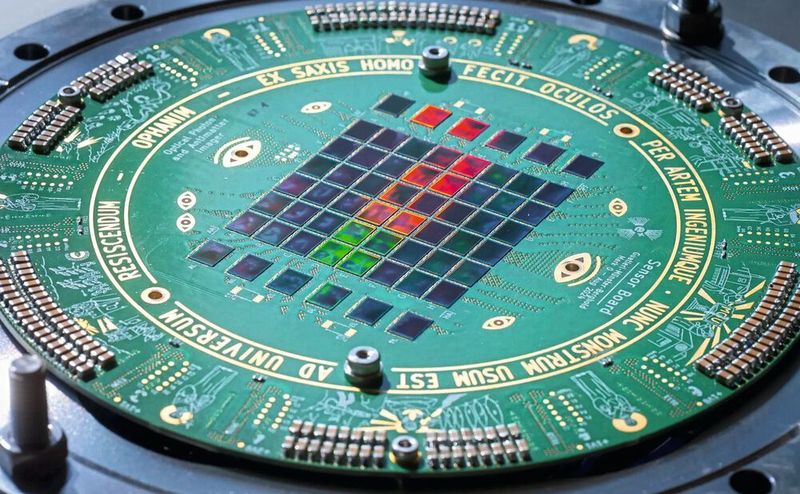
Antimatter research at CERN: The optical antimatter imager with the 60 photo sensors extracted from cell phones.
(Image: Andreas Heddergott / TUM)
With a custom-developed megapixel array based on modified CMOS camera sensors from smartphones, a team from the Technical University of Munich (TUM) provides new precision for the antimatter experiment AEgIS at CERN. The technology allows annihilation events of antiprotons to be located with micrometer accuracy—a crucial step toward measuring the gravity of antimatter.
When antimatter meets matter, annihilation occurs—a complete conversion of mass into energy, accompanied by characteristic particle tracks. The AEgIS experiment (Antihydrogen Experiment: Gravity, Interferometry, Spectroscopy) at CERN is specifically investigating how antihydrogen behaves in Earth's gravitational field. The central question: Does antimatter fall under gravity just like normal matter—or are there differences?
To detect these effects, the AEgIS team generates a horizontal beam of antihydrogen atoms. These pass through a so-called Moiré interferometer—a detector setup consisting of multiple grid structures arranged one behind the other. If antihydrogen is slightly deflected downward under the influence of Earth's gravity, the interference patterns change. The location of the subsequent annihilation—where the anti-atom interacts with matter—is the key variable for the gravitational experiments.
60 Modified CMOS Sensors
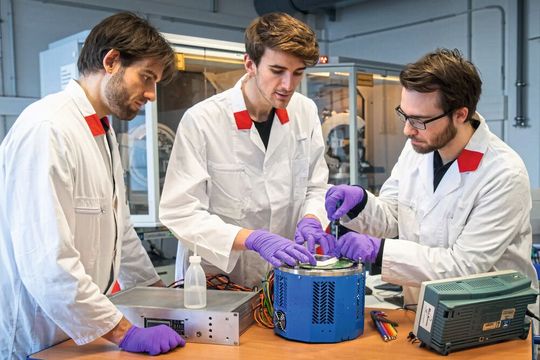
The detector was designed and built by Dr. Francesco Guatieri, Michael Berghold, and Markus Münster (from left) at the FRM II of TUM.
(Image: Andreas Heddergott / TUM)
This is where the new detector OPHANIM (Optical Photon and Antimatter Imager) comes into play: a large array of 60 smartphone camera sensors, with a total of 3,840 megapixels. Developed and optimized at the FRM II research reactor of TUM, the system detects the charged pions produced during the decay with an unprecedented lateral resolution of 0.6 µm. For comparison: Previously used emulsion detectors achieved a maximum of about 20 µm, but only offline and with considerable analysis effort. In contrast, OPHANIM delivers real-time data in high resolution.
The CMOS image sensors, originally designed for mobile devices, were specifically modified: color layers and microlenses used in smartphones for image optimization were removed to use the sensor substrates directly for detecting charged particle tracks. Thanks to the submicrometer pixel density, these sensors are particularly suitable for tracking decay products with extremely short ranges.
Sensors from a Smartphone
"For AEgIS, we require detection with the highest spatial precision—CMOS sensors from smartphones provide this in a more technically and economically feasible way than many specialized detector types," explains project leader Dr. Francesco Guatieri from TUM. "The challenge was in adapting the sensors to the specific requirements of high-energy physics."
The success of this technology transfer is also due to the interdisciplinary collaboration between particle physics, microelectronics, and applied sensor technology. Master's students from the TUM School of Engineering and Design were directly involved in the development and characterization of the sensor arrays. The result is a modular detector that not only supports AEgIS but is also suitable for other applications in precision measurement and imaging techniques.
Scientific Significance of AEgIS
Gravity is so far the only fundamental interaction whose effect on antimatter has not been experimentally confirmed. A measurable difference in the free fall of antihydrogen—even in the range of a few micrometers—would raise fundamental questions about the symmetry of natural laws and the validity of the theory of general relativity. The AEgIS experiment is one of the few attempts worldwide to approach this question experimentally.
With OPHANIM, the collaboration now has a precision instrument that allows real-time tracking on a micrometer basis—with components that were originally intended for mobile camera systems. An impressive example of how consumer electronics can spur fundamental research. (heh)
Date: 08.12.2025
Naturally, we always handle your personal data responsibly. Any personal data we receive from you is processed in accordance with applicable data protection legislation. For detailed information please see our privacy policy.
Consent to the use of data for promotional purposes
I hereby consent to Vogel Communications Group GmbH & Co. KG, Max-Planck-Str. 7-9, 97082 Würzburg including any affiliated companies according to §§ 15 et seq. AktG (hereafter: Vogel Communications Group) using my e-mail address to send editorial newsletters. A list of all affiliated companies can be found here
Newsletter content may include all products and services of any companies mentioned above, including for example specialist journals and books, events and fairs as well as event-related products and services, print and digital media offers and services such as additional (editorial) newsletters, raffles, lead campaigns, market research both online and offline, specialist webportals and e-learning offers. In case my personal telephone number has also been collected, it may be used for offers of aforementioned products, for services of the companies mentioned above, and market research purposes.
Additionally, my consent also includes the processing of my email address and telephone number for data matching for marketing purposes with select advertising partners such as LinkedIn, Google, and Meta. For this, Vogel Communications Group may transmit said data in hashed form to the advertising partners who then use said data to determine whether I am also a member of the mentioned advertising partner portals. Vogel Communications Group uses this feature for the purposes of re-targeting (up-selling, cross-selling, and customer loyalty), generating so-called look-alike audiences for acquisition of new customers, and as basis for exclusion for on-going advertising campaigns. Further information can be found in section “data matching for marketing purposes”.
In case I access protected data on Internet portals of Vogel Communications Group including any affiliated companies according to §§ 15 et seq. AktG, I need to provide further data in order to register for the access to such content. In return for this free access to editorial content, my data may be used in accordance with this consent for the purposes stated here. This does not apply to data matching for marketing purposes.
Right of revocation
I understand that I can revoke my consent at will. My revocation does not change the lawfulness of data processing that was conducted based on my consent leading up to my revocation. One option to declare my revocation is to use the contact form found at https://contact.vogel.de. In case I no longer wish to receive certain newsletters, I have subscribed to, I can also click on the unsubscribe link included at the end of a newsletter. Further information regarding my right of revocation and the implementation of it as well as the consequences of my revocation can be found in the data protection declaration, section editorial newsletter.
Future-Proof Authentication with Universal RFID Readers



:quality(80)/p7i.vogel.de/wcms/0b/cd/0bcd6d502ffcd087c4fc12b7b760b3ce/0133317507v2v1.jpeg "The new Multi Center from J.G. Weisser. (Image:J.G. Weisser)")
:quality(80)/p7i.vogel.de/wcms/6a/ef/6aef8ea2d02622844db469c705a21222/0133322968v1v1.jpeg "Canada and the U.S. have been locked in a trade dispute ever since Donald Trump was re-elected as U.S. president. In the long run, however, Canada could end up being the loser. That is why the country is turning more toward its trading partner, the EU. Something very special is set to emerge... (Image:AI-generated)")
:quality(80)/p7i.vogel.de/wcms/dd/92/dd928ba2e2956aa2bfff4888af8b08f8/photo--1v1.jpeg "Catalog product for extreme operating conditions: The new NRTVG guide carriage from Bosch Rexroth withstands extreme environmental conditions. (Source: Bosch Rexroth AG)")
:quality(80)/p7i.vogel.de/wcms/5a/9e/5a9e57e26964ba5c9d8719a9ee520bb3/0133310195v1.jpeg "Germany and the United Arab Emirates have signed an agreement to stand shoulder to shoulder in times of crisis. This will bring Germany many billions, to say the least.
From left: Sheikh Mohammed bin Sajed al-Nahjan and Federal Chancellor Friedrich Merz. (Image:dpa / K. Nietfeld)")
:quality(80)/p7i.vogel.de/wcms/81/dc/81dc63ed24c562521413023779495e7d/chris-kramerv1.jpeg "Chris Kramar, Director and General Manager of OEM Solutions for Germany, Austria, and Switzerland at Dell Technologies (Source: Dell Technologies)")
:quality(80)/p7i.vogel.de/wcms/bb/f5/bbf5342f532debc1bd7c09c2b9a0bf42/0133176497v1.jpeg "Over the past two years, AI has emerged as the most important growth driver in the industry. (Image: ©Gorodenkoff - stock.adobe.com)")
:quality(80)/p7i.vogel.de/wcms/01/61/01615a0939754c41e9d2c8971bf0b38a/web-image-kuka-kmf-1500p-300-dpi-1v1.jpeg "Thanks to its design, the KMF 1500P-CB is suitable for the stable and flexible handling of closed and open pallets. (Source: Kuka)")
:quality(80)/p7i.vogel.de/wcms/0b/ef/0bef343dfe1c7f83a1be01e7e83cc5ac/delta-fabrikv1.jpeg "Autonomous mobile manipulation robots can perform a wide range of tasks in a modern factory, from loading machines to quality control. (Image:Delta)")
:quality(80)/p7i.vogel.de/wcms/98/73/98731d23cbd95ff22391993a74cfefbf/mit-bifurcatedcircuits-01-pressv1.jpeg "A sample of the variety of configurations that Bifur circuits can form. (Source: Courtesy of the researchers)")
:quality(80)/p7i.vogel.de/wcms/f4/3d/f43d1f4297d9ae0cd1b6d2adfcb5ffe1/0133276470v1.jpeg "Simulation: Electric arcs in the electrical industry, including associated field simulation. (Image:CADFEM)")
:quality(80)/p7i.vogel.de/wcms/1d/fb/1dfbb415cd837102a33ce21ecf052ec3/0133277411v1.jpeg "LED drivers: LED circuit boards connect the light fixture to the electronics. During design, the operating current, forward voltage, and temperature must be taken into account across the entire operating range. (Image: ©Maria - stock.adobe.com)")
:quality(80)/p7i.vogel.de/wcms/80/8a/808a0eccf49a2a4fe560bd1998506ef9/0133308770v1.jpeg "Just like that, the supports are gone! High-speed footage of the automated, ultrasound-based process for removing optimized support structures from additively manufactured metal parts. It will be presented for the first time at Formnext from November 17 to 20. (Image:Fraunhofer IAPT)")
:quality(80)/p7i.vogel.de/wcms/fe/a8/fea8f62ea056f3c5334931f38cb80c76/0133324887v1v1.jpeg "It's flying off the shelves! The ID.Polo electric compact car seems to be living up to Volkswagen's expectations. After all, there are already more than 30,000 orders. The three sister models are also selling well... (Image:Volkswagen)")
:quality(80)/p7i.vogel.de/wcms/cb/00/cb0048b5a5df1a016d82aafa60aab9a9/35fa3e8bcf12df84fcc0b7ade728c03dv1.jpeg "Xiaomi has unveiled four new models. The large SUVs all have a gasoline engine to charge the battery. (Image:Xiaomi)")
:quality(80)/p7i.vogel.de/wcms/6c/f3/6cf31c04485bcabbf3e7c0f605dd9986/iaa2026-bosch-sdv-truckv1.jpeg "In commercial vehicles as well, vehicle functions that were previously distributed are now being consolidated onto central computing platforms—for example, for the cockpit or vehicle domains—and software and hardware are being consistently decoupled. (Source: Bosch)")
:quality(80)/p7i.vogel.de/wcms/21/59/21592b60cc226c533272207ee4b1562c/25dt244-001v1.jpeg "Daimler Truck is showcasing the Actros with several powertrain options at the IAA Transportation; the focus is on battery-electric and hydrogen-powered systems. (Source: Daimler Truck)")
:quality(80)/p7i.vogel.de/wcms/b4/85/b48565f20a330043d0cd8c5f708f779f/0133316091v2v1.jpeg "The open Chiisai standard supports the cross-vendor development of HALs, middleware, and embedded software for small microcontrollers. (Image:Vector Informatics)")
:quality(80)/p7i.vogel.de/wcms/6c/a6/6ca6c6410e051401d5596d5cc6dfa277/0133283570v1.jpeg "From Core to Platform: With MIPS, ARC, and RISC-V, competition is shifting from individual processor IP blocks to integrated compute platforms for specialized applications. (Image:Dall-E / AI-generated)")
:quality(80)/p7i.vogel.de/wcms/73/17/73174a2afe684fa12d7d6a57b29b20e2/0133305506v1.jpeg "AI data centers are a key driver of direct current technologies. (Image:Pixabay / Brian Penny / AI-generated)")
:quality(80)/p7i.vogel.de/wcms/08/b2/08b2ce49b6d6d11d5953064bb0a62f37/0133308791v1.jpeg "If what Anthropics is accusing its Chinese AI competitors of is true, then the industry is in for quite a shakeup! At stake is nothing less than Chinese AI systems—such as Kimi and Deepseek—that were actually trained indirectly using U.S. AI systems. (Image: AI-generated)")
:quality(80):fill(efefef,0)/p7i.vogel.de/wcms/67/ae/67ae0b9ac31f8/elatec-wp-universal-reader.png "Elatec WP Universal Reader")
:quality(80)/p7i.vogel.de/wcms/30/76/3076278d4a7b51a5c566581a20135afc/54963580015-cdcb4657c5-k-2047x1151v1v1.jpeg "The Nancy Grace Roman space telescope was completed in the largest clean room at NASA's Goddard Space Flight Center. It is due to be launched into space in September 2026. (Image:NASA/Jolearra Tshiteya / CC BY 4.0)")
:quality(80)/p7i.vogel.de/wcms/d8/f8/d8f8fc64e23a1ed726fc8ac7ab697747/0129101600v1.jpeg "A new imaging technology makes it possible to detect early signs of heart disease through the skin. This opens up new markets for portable imaging systems. (Image:freely licensed)")