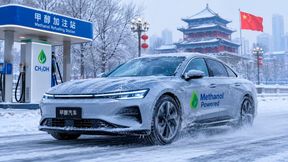
A cold start at minus 40 degrees is no problem for this car. The Chinese automaker Geely claims that and therefore presented its new sedan “Galaxy Xingyao EF” right away in cold Shenyang in northern China. The technology is something new, at least for mass-produced passenger cars. The car is a methanol-gasoline plug-in hybrid.
A cold start at minus 40 degrees is said to be no problem for methanol-gasoline plug-in hybrids. One of those leading the way here is Geely.
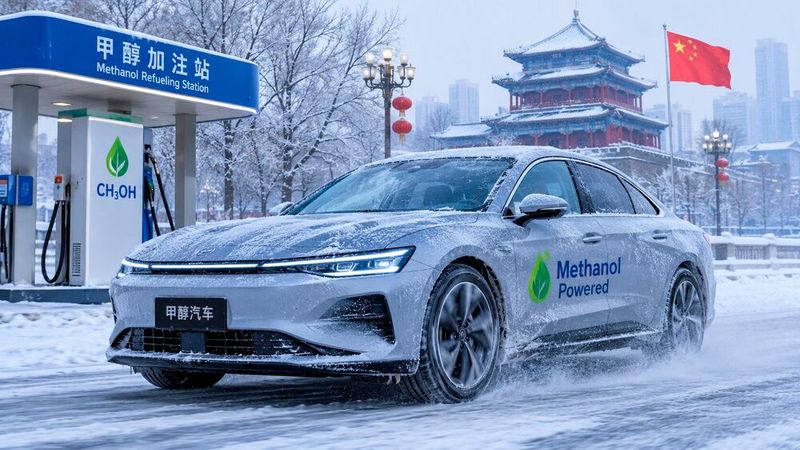
(Image: AI-generated)
The tank can be filled with either methanol or gasoline, and with any mixture of the two fuels—from zero to one hundred percent—through the same filler neck. In addition, there is a battery that can be recharged externally.
So the car is a plug-in hybrid electric vehicle (PHEV). When the battery is empty, it can not only be driven on gasoline like normal PHEVs, but also additionally on methanol or a methanol-gasoline blend. Methanol has a freezing point of minus 97.6 degrees. Therefore, it does not freeze even in places where it gets bitterly cold in winter. If the battery’s performance drops at extreme temperatures, the engine should still be able to start without any problems, according to Geely. With this model, that is completely possible without any preheating, Geely says.
Methanol has been in the spotlight for quite some time
Chinese manufacturers have been experimenting with methanol for more than a decade. Between 2012 and 2018, the Ministry of Industry in Beijing approved pilot projects in Shanghai and in several provinces. Geely has been experimenting since 2005 with building internal combustion engines for methanol, initially focusing on trucks..
Geely now wants to introduce the technology in the mass market for passenger cars as well. The company proceeded step by step and cautiously. Even before the first Galaxy Xingyao 6 EF vehicles were available in retail on 3 November, coinciding with the model’s market launch, the automaker had entered into partnerships with taxi companies and ride-hailing service providers and had 6,000 of the new cars tested in everyday commercial use.
According to its own statements, Geely has invested more than ten billion yuan—around 1.3 billion euros—into the development of its methanol technology since 2005. One of the well-known problems has always been that methanol attacks lines and other engine components. In the Galaxy Xingyao 6 EF, novel materials that protect against corrosion caused by methanol are now said to have been used for all components that come into contact with the fuel. In addition, Geely’s engineers have developed special lubricants and additives intended to protect seals and plastics.
Among the innovations in this car is also an AI agent which, in cooperation with sensors, determines the methanol concentration and passes it on to the engine’s control systems. These then adjust injection and ignition timing to the respective fuel mixture. Closed-loop combustion control and automatic control of the interaction between the internal combustion engine and the electric motor ensure that nothing has to be set manually, no matter what has ended up in the tank.
Advantage: low costs
Despite all the technology, the car is not expensive. That would no longer be possible in China nowadays. The introductory prices for three different variants range between 76,800 and 96,800 yuan, which corresponds to around 10,400 and 13,100 euros, respectively.
In operation, the new powertrain is also intended to be inexpensive. For operation exclusively on methanol, Geely cites fuel costs from 0.20 yuan (about 0.027 euros) per kilometer. This calculation is based on consumption of 6.7 liters per 100 kilometers, a low battery state of charge, and low methanol prices. With favorable public charging rates, the energy costs are thus roughly on a par with those of an electric car. With cheap household electricity at a private wallbox, however, driving in China is even cheaper.
For target groups in cold regions, however, range is even more important, as at temperatures below minus 20 degrees Celsius it still shrinks noticeably in purely battery-electric vehicles. Like operating costs, it depends on the methanol-to-gasoline ratio in the tank, but either way it is impressive. The range in battery-only mode is 130 or 230 kilometers for the Galaxy Xingyao 6 EF, depending on the version. That allows many commuters to drive to work purely on electric power. With a full methanol tank and a fully charged battery, the range is up to 1,250 kilometers in the CLTC test, according to Geely.
Date: 08.12.2025
Naturally, we always handle your personal data responsibly. Any personal data we receive from you is processed in accordance with applicable data protection legislation. For detailed information please see our privacy policy.
Consent to the use of data for promotional purposes
I hereby consent to Vogel Communications Group GmbH & Co. KG, Max-Planck-Str. 7-9, 97082 Würzburg including any affiliated companies according to §§ 15 et seq. AktG (hereafter: Vogel Communications Group) using my e-mail address to send editorial newsletters. A list of all affiliated companies can be found here
Newsletter content may include all products and services of any companies mentioned above, including for example specialist journals and books, events and fairs as well as event-related products and services, print and digital media offers and services such as additional (editorial) newsletters, raffles, lead campaigns, market research both online and offline, specialist webportals and e-learning offers. In case my personal telephone number has also been collected, it may be used for offers of aforementioned products, for services of the companies mentioned above, and market research purposes.
Additionally, my consent also includes the processing of my email address and telephone number for data matching for marketing purposes with select advertising partners such as LinkedIn, Google, and Meta. For this, Vogel Communications Group may transmit said data in hashed form to the advertising partners who then use said data to determine whether I am also a member of the mentioned advertising partner portals. Vogel Communications Group uses this feature for the purposes of re-targeting (up-selling, cross-selling, and customer loyalty), generating so-called look-alike audiences for acquisition of new customers, and as basis for exclusion for on-going advertising campaigns. Further information can be found in section “data matching for marketing purposes”.
In case I access protected data on Internet portals of Vogel Communications Group including any affiliated companies according to §§ 15 et seq. AktG, I need to provide further data in order to register for the access to such content. In return for this free access to editorial content, my data may be used in accordance with this consent for the purposes stated here. This does not apply to data matching for marketing purposes.
Right of revocation
I understand that I can revoke my consent at will. My revocation does not change the lawfulness of data processing that was conducted based on my consent leading up to my revocation. One option to declare my revocation is to use the contact form found at https://contact.vogel.de. In case I no longer wish to receive certain newsletters, I have subscribed to, I can also click on the unsubscribe link included at the end of a newsletter. Further information regarding my right of revocation and the implementation of it as well as the consequences of my revocation can be found in the data protection declaration, section editorial newsletter.
At the beginning of November, the methanol price in Shenyang was 2.98 yuan (about 0.4 euros) per liter. The total distance of 1,250 kilometers therefore costs motorists at the gas station checkout an estimated 210 yuan (about 28 euros). Electricity costs for the battery are added on top. If the tank is filled completely with gasoline, the sedan touted as a family car is said to be able to travel up to 1,880 kilometers on one tankful—again including a full battery charge. Filling up once is said to take around three minutes.
Disadvantage: limited availability
A bottleneck for the market success of the new car is the availability of methanol, which is still very limited. Although China’s central government explicitly supports its use, there are only about 1,400 methanol filling stations. “Whether methanol-electric hybrid technology, after being tested in commercial use, will also manage to enter the family car market depends above all on whether there are enough methanol filling stations within customers’ everyday radius of movement and what feedback the first private owners give,” the business newspaper Huaxia Shibao quoted auto expert Zhai Qiang as saying. “The most important task remains to speed up the expansion of methanol refueling infrastructure,” he continued to emphasize. Geely founder Li Shufu, known in Germany as a major shareholder in the Mercedes-Benz Group, is also advocating for this.
Li Shufu has been lobbying in China for years for the construction of more methanol filling stations, also so that corresponding trucks from Geely’s commercial vehicle division Farizon have a better chance in the market. Trucks whose routes are reasonably predictable have been available for years with methanol powertrains.
Manageable risk?
Critics of methanol point out that it is toxic. Direct contact through the skin and respiratory tract can lead to severe poisoning and blindness. Geely claims the risk is manageable. And also that gasoline and diesel are not exactly non-toxic either.
How environmentally friendly methanol is depends on how it is produced. With 115 million tonnes per year, China has the world’s largest methanol production capacity. However, just under 80 percent of it is still produced from coal (as of the end of 2025).
There are initial plants in China in which “green methanol” is produced from sustainable biomass, for example from wood residues or agricultural waste. A second ecologically responsible route uses hydrogen obtained via water electrolysis using renewable electricity, which is then converted into methanol together with CO₂. All of this is being expanded, which, however, takes time. For 2025, media reports spoke of available production capacities of 320,000 tonnes per year.
Shape energy security independently
Proponents of the new propulsion type, such as Li Shufu, therefore also argue on the basis of the country’s energy security. They say that anyone who does not want to be dependent on foreign oil or gas supplies and still wants to ensure mobility in very cold and remote regions would already have to promote methanol now as a third technological path alongside electric and hybrid driving.
It is probably above all thanks to the vision and tenacity of Geely’s founder that Chinese car buyers now also have the option, for their private cars, to fill the tank with methanol while at the same time driving electrically as much as possible.