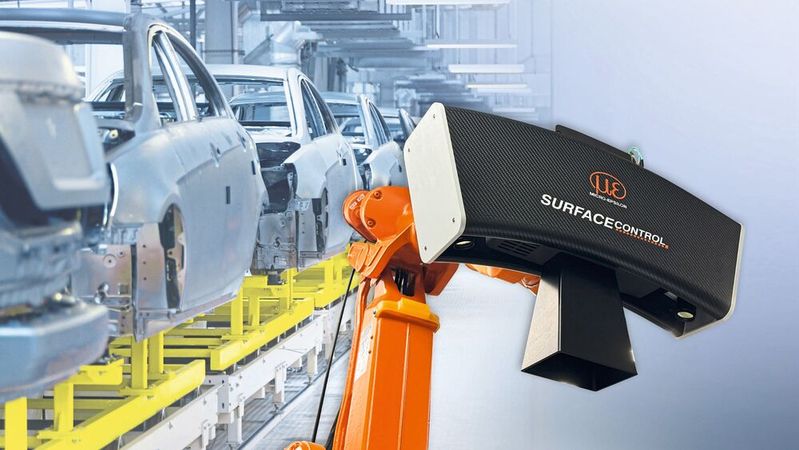
The robot-based SurfaceControl inspection system from Micro-Epsilon for fully automated surface inspection detects dents, bumps, and pimples on raw car bodies. The system provides quantitative geometric features for rework, quality evaluation, and process optimization and impresses with high area coverage—even in edge areas.
With SurfaceControl Automotive, Micro-Epsilon offers a robot-based inspection system for fully automated surface inspection of raw car bodies (body-in-white).
(Image: Micro-Epsilon)
In body-in-white production, the foundation for stable paint quality is established. If surface or geometry defects go unnoticed, they often lead to costly rework, additional audit loops, or scrap later on. Since many issues originate in early process steps, late detection involves significant analysis efforts. The quality lever, therefore, lies in standardized inline inspection that works reliably, independent of subjective factors. With the Surfacecontrol Automotive inspection system, Micro-Epsilon addresses precisely this need: the complete system—comprising sensors, robotics, computer, software, and interface package—is custom-configured and enables highly precise, reproducible detection and localization of various surface defects. The number of sensors and robotics can be flexibly scaled to meet different cycle times and throughput requirements.
Stripe Light Projection Provides True 3D Data
Raw car bodies predominantly reflect light diffusely. Therefore, Surfacecontrol Automotive uses 3D sensors that capture the surface geometry through fringe projection. From the measurement data, a 3D point cloud is generated, making local shape deviations visible—not just as a purely optical impression, but based on measurable 3D characteristics. The system detects shape defects with high precision and reproducibility and evaluates them objectively.
A key feature of the measurement system is the true 3D reconstruction of defects. Each defect is assigned geometric attributes—such as diameter, area, and height. Classification is performed considering adjustable tolerances. The data is stored in an XML file and can be integrated into existing quality assurance systems. The results can also be forwarded to customer-specific interfaces. This allows the inspection system to provide a quantitative description of deviations with reliable metrics. It supports consistent assessment of defect severity and lays the foundation for targeted rework and process optimization. Typical types of defects that occur in body-in-white inspection include, among others:
Bumps, dents, notches
Pimples, waviness, pressure marks, sink marks
Cracks, run-off edges, necking, and sink-in areas
Furthermore, the raw car bodies can be inspected for various testing characteristics such as shape or distortion.
Fast Project Planning and CAD-Based Simulation
For process-reliable operations, planning the measurement positions is crucial. Surfacecontrol Automotive supports modern simulation methods based on the CAD model of the raw car body. Fields of view, measurement distances, and potential shadowing can be analyzed during the planning phase; sensor positions and movement sequences are virtually optimized without the need for physical prototypes.
This reduces setup effort and increases planning reliability: Critical areas are identified early, testing strategies are realistically evaluated, and integration into existing production lines is significantly simplified. Additionally, the system can be adapted more quickly to new models and variants, which is a clear advantage in production facilities with high model diversity.
Surface Coverage as a Success Factor
For an inline inspection to truly replace manual visual checks, it must also cover areas that are the most challenging to inspect in practice: right up to the edge, on design lines, and in severely curved areas such as door handle recesses. Surfacecontrol Automotive achieves an outstanding surface coverage of at least 97% of the outer surface, reliably capturing even recessed areas. This high coverage is not only a quality feature but also has a direct impact on production: defect-free inspected raw car bodies can be passed directly to the painting process without manual visual inspection. At the same time, rework becomes more manageable, as defects are precisely localized and described in their characteristics.
Reproducible Inspection Process
In series production, not every deviation is automatically a defect. Component-specific tolerances—including those on movable parts such as flaps, doors, or hoods—are common and must be accounted for in the inspection process. Surfacecontrol Automotive uses a learning method with AI-based algorithms for this purpose: from datasets of defect-free reference parts, a Digital Master is created that defines the "good condition." Based on this, relevant local shape defects are detected while permissible deviations are tolerated.
Date: 08.12.2025
Naturally, we always handle your personal data responsibly. Any personal data we receive from you is processed in accordance with applicable data protection legislation. For detailed information please see our privacy policy.
Consent to the use of data for promotional purposes
I hereby consent to Vogel Communications Group GmbH & Co. KG, Max-Planck-Str. 7-9, 97082 Würzburg including any affiliated companies according to §§ 15 et seq. AktG (hereafter: Vogel Communications Group) using my e-mail address to send editorial newsletters. A list of all affiliated companies can be found here
Newsletter content may include all products and services of any companies mentioned above, including for example specialist journals and books, events and fairs as well as event-related products and services, print and digital media offers and services such as additional (editorial) newsletters, raffles, lead campaigns, market research both online and offline, specialist webportals and e-learning offers. In case my personal telephone number has also been collected, it may be used for offers of aforementioned products, for services of the companies mentioned above, and market research purposes.
Additionally, my consent also includes the processing of my email address and telephone number for data matching for marketing purposes with select advertising partners such as LinkedIn, Google, and Meta. For this, Vogel Communications Group may transmit said data in hashed form to the advertising partners who then use said data to determine whether I am also a member of the mentioned advertising partner portals. Vogel Communications Group uses this feature for the purposes of re-targeting (up-selling, cross-selling, and customer loyalty), generating so-called look-alike audiences for acquisition of new customers, and as basis for exclusion for on-going advertising campaigns. Further information can be found in section “data matching for marketing purposes”.
In case I access protected data on Internet portals of Vogel Communications Group including any affiliated companies according to §§ 15 et seq. AktG, I need to provide further data in order to register for the access to such content. In return for this free access to editorial content, my data may be used in accordance with this consent for the purposes stated here. This does not apply to data matching for marketing purposes.
Right of revocation
I understand that I can revoke my consent at will. My revocation does not change the lawfulness of data processing that was conducted based on my consent leading up to my revocation. One option to declare my revocation is to use the contact form found at https://contact.vogel.de. In case I no longer wish to receive certain newsletters, I have subscribed to, I can also click on the unsubscribe link included at the end of a newsletter. Further information regarding my right of revocation and the implementation of it as well as the consequences of my revocation can be found in the data protection declaration, section editorial newsletter.
The result is a reproducible inspection process that can be quickly adapted in parameter settings to customer standards, model changes, or plant specifics. Especially during the launch of new car bodies or model variants, this quick adaptability is a crucial component for stabilizing inline inspection operations and standardizing quality standards across the entire corporation.
Powerful Software Tools
In addition to the metrology hardware, the inspection system includes a powerful software platform with tools for data analysis. Key components are the generation of a Digital Master from datasets of defect-free reference parts, as well as additional analysis tools such as the Digital Sanding Block and the Digital Light Tunnel for individual part analysis. For line assessments, measurement and classification results are provided in various views—from the 3D view of the car body to plant-specific visualizations such as butterfly images or coverage analyses. Integrated auditing features support transparent approval and traceability of evaluations.
Robust Against Position and Alignment Tolerances
Series production involves variability: a raw car body does not always arrive at the inspection cell in an identical position. Therefore, Surfacecontrol Automotive features an integrated 6D offset correction to automatically compensate for positional and orientation deviations. Geometric features are captured, the spatial position is calculated, and the sensor paths are adjusted accordingly. The result is fast, precise, and repeatable measurements without manual recalibration. The 6D offset correction enhances process reliability by ensuring the inspection strategy remains stable despite tolerances, maintaining high coverage even in everyday production.
Scalability and Global Rollout
Surfacecontrol Automotive is customized for clients but designed for transferability in operation. Quick adjustment options in the error detection parameter settings make it easier to transfer to other plants and new models. Additionally, error classification can be specifically optimized by using AI-based algorithms. This allows established inspection processes and validated quality standards to be rolled out across the entire corporation without starting anew each time. Combined with standardized result delivery—such as in XML format—a foundation is created for cross-site quality comparisons and a unified language in defect assessment.
Comprehensive Concept from Body-In-White to Painting
For many OEM projects, it's not just the measurement technology that matters but the overall solution. Micro-Epsilon offers project planning as a general contractor: from robot setup and planning to integration into existing controls, implementation of data and software interfaces, as well as service and maintenance packages.
An additional benefit arises from the integrated tool and software landscape: Surfacecontrol Automotive uses the same software platform as Reflectcontrol Automotive for painted car bodies. Combining both systems enables the implementation of a consistent inspection concept from body-in-white to painting. The results can be overlaid to maintain consistent quality assessments throughout the entire production process and enable upstream analyses. An initial OEM project with a leading automaker has already been successfully implemented—since then, the entire factory's production has been inspected using the system.
Conclusion: Surface Inspection Provides Quantitative Defect Data
Surfacecontrol Automotive enables fully automated, objective surface inspection in body-in-white production, delivering quantitative defect data instead of subjective visual assessments. Extensive surface coverage, including edge areas and design lines, 6D offset correction, and CAD-based simulation ensure a reliable and fast inline inspection process. Powerful analysis tools and transferable parameter settings support standardized inspection processes and targeted rework. Combined with Reflectcontrol Automotive, a seamless inspection from body-in-white to painting is achieved.



:quality(80)/p7i.vogel.de/wcms/eb/2b/eb2bd1b8487afe577b37363cd02f16ff/0113143253v1.jpeg "In our China Market Insider, we regularly provide you with relevant information straight from China. (Image:© Eisenhans - stock.adobe.com)")
:quality(80)/p7i.vogel.de/wcms/dd/b8/ddb8edc98c49b384734ab2432b297eb5/adobestock-1913662309--irene-stock-adobe-com-ki-generiertv1.jpeg "Rotary joints are used in grippers and swivel mechanisms to allow assemblies to rotate or swivel smoothly relative to one another, even under very high loads (illustrative image). (Source: Irene - stock.adobe.com / KI-generiert)")
:quality(80)/p7i.vogel.de/wcms/d1/ef/d1ef6b6f7d4543f7999980bacccaf22b/0133499261v1.jpeg "As the growing imbalance in trade relations with China continues to widen, the EU Chamber of Commerce foresees a day when trade with China will have to be seriously reevaluated ... (Image: AI-generated)")
:quality(80)/p7i.vogel.de/wcms/fe/1f/fe1fa5ee713f94deaba963dc24c3abc5/0133299273v1.jpeg "The Flexistar enables highly flexible production of laser-welded tubes thanks to its tool-free clamping system. (Image:Because Technology, LLC)")
:quality(80)/p7i.vogel.de/wcms/60/ef/60ef4f07e4829b2c2929befc0f353c58/0133511729v1.jpeg "Humanoid robots can match human performance in certain tasks. (Image:Gemini / AI-generated)")
:quality(80)/p7i.vogel.de/wcms/2e/99/2e99726b522e4b35b690e25eb6a42643/0133463991v1.jpeg "Robotics: In AMR applications, connection technology must reliably transmit power, signals, and data despite vibration and shock loads—in very confined spaces and in a way that allows for regular maintenance. (Image:Hyperever)")
:quality(80)/p7i.vogel.de/wcms/d0/18/d01801e3d5dbd7bc9d0b4f60408b630c/0133468429v1.jpeg "Quality requirements for film packaging are on the rise. At the same time, many companies are turning to recyclable film materials, which, however, have their own challenges. Fraunhofer researchers have therefore developed a fast system that detects problems in real time. (Image:Fraunhofer IKTS)")
:quality(80)/p7i.vogel.de/wcms/b1/06/b106cf44923ce39565c3264982fd20eb/0133414574v1.jpeg "Robots Build Robots: At the new Ubtech factory, automated systems even handle parts of the material supply and logistics for the production of humanoid robots. (Image:Ubtech)")
:quality(80)/p7i.vogel.de/wcms/c0/52/c052f405eb55fc3d08c4837e77206fc0/adobestock-2021845957--aucartstudio-stock-adobe-com-ki-generiertv1.jpeg "An innovation from China to combat extreme summer heat: A novel coating lowers temperatures. (Source: © AucArtStudio – stock.adobe.com_AI-generated)")
:quality(80)/p7i.vogel.de/wcms/66/a7/66a7b78159caeacce57136529688799f/0133503398v1.jpeg "Sunlight Makes Stone! These stone blocks weren't made the traditional way. Instead, they were additively manufactured from sand using a laser. In the future, however, the laser is set to be replaced by concentrated sunlight—if the startup Addisol is successful... (Image:Addisol / F. Fiedler)")
:quality(80)/p7i.vogel.de/wcms/72/b9/72b995c2c8d812c5e2115cbef31e035a/0133462727v1.jpeg "Eggl manufactures center hoods that are precisely tailored to each cooking island—whether standard size or custom shape. They are made entirely of stainless steel and are individually customized in terms of size and filter arrangement. (Image:SPI)")
:quality(80)/p7i.vogel.de/wcms/13/5d/135dfae6229ceaf5c55467a43e8f7257/adobestock-1879961393--ardi-stock-adobe-com-ki-generiertv1.jpeg "Annoying chatterboxes or awkward silences in response to questions—a moderator should specifically prepare for difficult situations in order to navigate them effectively. (Image:ardi - stock.adobe.com_AI-generated)")
:quality(80)/p7i.vogel.de/wcms/aa/a2/aaa2c6dd2daa24b485cddbf9297590c0/0133467318v1.jpeg "Battery Monitoring: Battery monitoring using electrochemical impedance spectroscopy offers several advantages. (Image:TI)")
:quality(80)/p7i.vogel.de/wcms/39/b2/39b21bf03be1683831862239a369987c/0133469638v1.jpeg "Data from autonomous vehicles and robots operating autonomously is in high demand, and Ruqi wants to capitalize on this. (Image:Ruqi Mobility)")
:quality(80)/p7i.vogel.de/wcms/8a/bb/8abbb6217220595edc1549ac9b84f307/0133429906v1.jpeg "The IAA in Hanover showcased the ambitions of Chinese commercial vehicle manufacturers in Europe. (Image:Wehner - VCG)")
:quality(80)/p7i.vogel.de/wcms/0c/53/0c5313ef91c14b6df0d0996efc33c8ad/jpg03568-bearbeitetv1.jpeg "The category winners of the 2027 German Car of the Year award. (Source: GCOTY)")
:quality(80)/p7i.vogel.de/wcms/48/15/4815da27c45973ca629a99b375ac3aef/0133509585v1.jpeg "Ventuno Q RoadTest: Designed to help the Element14 community gain practical insights from real-world tests using the Ventuno Q. (Image:Farnell/Element14)")
:quality(80)/p7i.vogel.de/wcms/17/2b/172bd132f9febdfcbcedba292ad0504d/aufmacherv1.jpeg "Micro-Epsilon offers a wide range of IO-Link-compatible sensors. (Source: Micro-Epsilon Messtechnik GmbH & Co. KG)")
:quality(80)/p7i.vogel.de/wcms/ca/b4/cab46fd26d19d6a2febca032048200b6/0133471827v1.jpeg "Photonics SDK for C and Python: Computational operations are now abstracted as standard mathematical functions. (Image:Q.ANT)")
:quality(80)/p7i.vogel.de/wcms/92/b2/92b2ed5299cde450c0764f4f64468395/0133505895v1.jpeg "The \"Iris 100\" test system for high-precision volume production of microLEDs uses a spectrometer and a high-resolution camera. (Image:Teradyne)")
:fill(fff,0)/images.vogel.de/vogelonline/companyimg/76800/76895/65.jpg "FAULHABER_120mm.jpg ()")
:fill(fff,0)/p7i.vogel.de/companies/69/de/69de1b7403b0d/simtos-logo.jpeg "simtos-logo (SIMTOS)")
:quality(80)/p7i.vogel.de/wcms/3b/f4/3bf40fee213e6a5621b85935d15c9416/0131054891v1.jpeg "The integrated 6D offset correction automatically compensates for position and location tolerances of the car body. Geometric features are recorded, the position in space is calculated, and the sensor movement paths are adjusted accordingly.(Image: Micro-Epsilon)")
:quality(80)/p7i.vogel.de/wcms/d8/b2/d8b2f168402aef29c650cd451f689769/0131054889v1.jpeg "Author Konrad Steinhuber, Product Manager for Measurement and Inspection Systems at Micro-Epsilon Messtechnik GmbH & Co. KG.(Image: Micro-Epsilon)")
:quality(80)/p7i.vogel.de/wcms/2e/cf/2ecfa4d493875ce2f90d04ebc0b8ff93/0131054873v1.jpeg "In the inspection cell, SurfaceControl Automotive inspects raw car bodies fully automatically and provides reproducible 3D defect data for rework, quality evaluation, and process optimization.(Image: Micro-Epsilon)")
:quality(80)/p7i.vogel.de/wcms/55/9c/559c7999c52fef4d78255d796898fb80/0131054867v1.jpeg "The evaluation is carried out objectively based on 3D features such as height, area, and diameter.(Image: Micro-Epsilon)")
:quality(80)/p7i.vogel.de/wcms/60/eb/60ebe43de41f833157b476b2e1641811/0130090160v1.jpeg "The Surface Control Automotive measuring system from Micro-Epsilon automatically detects dents, scratches and other surface defects on body shells. (Image:Micro-Epsilon)")
:quality(80)/p7i.vogel.de/wcms/8b/2a/8b2aa1706944495814db6ec30efd5cb2/0129190693v1.jpeg "With sensors for thickness, position, temperature and 3D geometry, Micro-Epsilon enables precise automation. (Picture:Micro-Epsilon)")