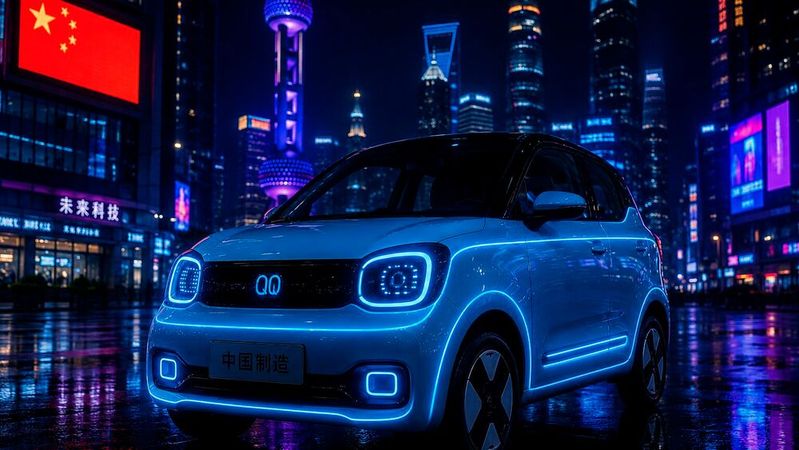
The blue car lights that recently dominated China's streetscape have been banned. These refer to the slim blue light strips on the exterior of the car body that illuminate when a car's ADAS driver assistance is activated. As of July 27, newly registered car models may no longer feature such lights.
The Chinese government plans to ban the so-called "Automated Driving System Marker Lamps" on new vehicles. They are distracting and can, among other things, dazzle other drivers.
(Image: created with AI)
The Ministry of Industry and Information Technology (MIIT) has sent a decree to China's automobile manufacturers stating that the blue lights violate the national lighting standard GB4785, reports the auto portal CNEVPOST. Although there is no official announcement yet, bloggers are sharing screenshots of the decree.
Officially, they are called "Automated Driving System Marker Lamp," also known as ADAS lights in German. The first Chinese manufacturer to install them as standard was Li Auto in its SUV Li L9. Since its market launch in August 2022, more than a dozen Chinese brands have followed suit, including Xpeng, Nio, Xiaomi, BYD, and Aito.
Lights Distract
Originally, this idea came from Stuttgart (Germany). In 2015, Mercedes equipped its concept car F015 with colored exterior lights that could signal various driving modes. Blue indicated autonomous driving. Critics, however, complained that the blue lights were too bright and would distract other drivers. On some models, the blue lights are positioned exactly at the eye level of following drivers. It was said that this was distracting at night and especially in rainy conditions. "Some of these lights are brighter than taillights. Some dazzle the drivers behind and create potential safety risks. This is clearly inappropriate," wrote Ma Lin, Vice President of Nio, on social media.
Misunderstanding Autonomy Level
Another frequent criticism was that other drivers often thought these cars were already fully autonomous. In reality, however, this is still rare in China. Most sold assistance systems are still at "Level 2," where the driver remains fully responsible and must be able to intervene at any time. "Some people become curious when they see the blue light. They intentionally follow the car or try to cut in front of it," the Chinese science portal Zhongguo Keji Wang quotes an expert. The lights thus increase the likelihood of accidents, according to auto expert Zhang Xiang from the North China University of Technology. "The current use of blue indicator lights is excessive and poses potential safety risks," the China Automotive Standardization Research Institute (CASRI) stated on its official WeChat account on July 29, 2026.
Therefore, the national standards committee for the automotive industry has now begun revising the lighting standard GB 4785, CASRI wrote. The current version technically only permits the colors white, red, and yellow. However, blue was not explicitly prohibited until now. For manufacturers, the blue lights were also a marketing gimmick. The misconception that these were already cars with Level 3 ADAS seemed quite welcome. Now, however, everyone pledged to immediately comply with the new directive. "We have taken note of the reports. We will strictly adhere to the relevant national regulations and await further guidance from the authorities," Geely wrote.
At Epicland, the new car brand by Dongfeng and Huawei, they went even further. "As soon as we received this urgent notification, our team immediately took action and implemented the required measures in accordance with national regulations," wrote CEO Zeng Qinglin.
Recognizing the Disadvantages of New Technologies in Everyday Life
Indirectly, this debate about the "small blue lights," as they are called in China, is a sign of how quickly autonomous driving is currently spreading in China. The MIIT expects higher automation levels to be commercially deployed on a large scale by 2030 at the latest. Navigation-based assistance in urban traffic will then become standard equipment in new cars.
That a period of "unchecked growth" is tolerated in the automotive industry before regulations are eventually tightened is a fairly common pattern in China. Features like recessed door handles, one-pedal driving, highly unconventional steering wheels, and gear shifting via touchscreens were allowed to spread unchecked for years before regulatory authorities intervened. In most cases, certain disadvantages of the new technologies were only noticed during everyday use.
Date: 08.12.2025
Naturally, we always handle your personal data responsibly. Any personal data we receive from you is processed in accordance with applicable data protection legislation. For detailed information please see our privacy policy.
Consent to the use of data for promotional purposes
I hereby consent to Vogel Communications Group GmbH & Co. KG, Max-Planck-Str. 7-9, 97082 Würzburg including any affiliated companies according to §§ 15 et seq. AktG (hereafter: Vogel Communications Group) using my e-mail address to send editorial newsletters. A list of all affiliated companies can be found here
Newsletter content may include all products and services of any companies mentioned above, including for example specialist journals and books, events and fairs as well as event-related products and services, print and digital media offers and services such as additional (editorial) newsletters, raffles, lead campaigns, market research both online and offline, specialist webportals and e-learning offers. In case my personal telephone number has also been collected, it may be used for offers of aforementioned products, for services of the companies mentioned above, and market research purposes.
Additionally, my consent also includes the processing of my email address and telephone number for data matching for marketing purposes with select advertising partners such as LinkedIn, Google, and Meta. For this, Vogel Communications Group may transmit said data in hashed form to the advertising partners who then use said data to determine whether I am also a member of the mentioned advertising partner portals. Vogel Communications Group uses this feature for the purposes of re-targeting (up-selling, cross-selling, and customer loyalty), generating so-called look-alike audiences for acquisition of new customers, and as basis for exclusion for on-going advertising campaigns. Further information can be found in section “data matching for marketing purposes”.
In case I access protected data on Internet portals of Vogel Communications Group including any affiliated companies according to §§ 15 et seq. AktG, I need to provide further data in order to register for the access to such content. In return for this free access to editorial content, my data may be used in accordance with this consent for the purposes stated here. This does not apply to data matching for marketing purposes.
Right of revocation
I understand that I can revoke my consent at will. My revocation does not change the lawfulness of data processing that was conducted based on my consent leading up to my revocation. One option to declare my revocation is to use the contact form found at https://contact.vogel.de. In case I no longer wish to receive certain newsletters, I have subscribed to, I can also click on the unsubscribe link included at the end of a newsletter. Further information regarding my right of revocation and the implementation of it as well as the consequences of my revocation can be found in the data protection declaration, section editorial newsletter.
Blue exterior lights are also being discussed in other countries. For example, vehicle regulation working groups at the United Nations are addressing the issue. A consensus has not yet been reached.
In China, it is generally expected that many manufacturers will initially deactivate the blue ADAS lights remotely through over-the-air software updates (OTA). Once Level 3 autonomy vehicles hit the market, they may legally return.



:quality(80)/p7i.vogel.de/wcms/51/1b/511b420dbcc296aec09e3bffb051b8a8/0133581587v1.jpeg "The cables connect numerous machine components—often in confined spaces. (Image:Helu)")
:quality(80)/p7i.vogel.de/wcms/b5/67/b5676f3bfb36251ed31f9a0cccf650b6/0133167827v1.jpeg "Thanks to JumboFlex Generation 2, employees can effortlessly move wheelchairs weighing as much as 40 kilograms. (Image:Lard)")
:quality(80)/p7i.vogel.de/wcms/5e/c6/5ec615b7a51440f668259f2af9158cb9/0132654694v1.jpeg "Strategic Partnerships in Industry: As buyers and restructuring partners, Chinese investors are increasingly helping to preserve jobs in Germany. (Image: ©Anatolii Rymarchuk - stock.adobe.com)")
:quality(80)/p7i.vogel.de/wcms/eb/2b/eb2bd1b8487afe577b37363cd02f16ff/0113143253v1.jpeg "In our China Market Insider, we regularly provide you with relevant information straight from China. (Image:© Eisenhans - stock.adobe.com)")
:quality(80)/p7i.vogel.de/wcms/aa/3e/aa3e2603a812f8e7d33c00ba8ae28c9f/0133507886v1.jpeg "With the Iggy Rob, igus is bringing a humanoid robot into factories for a price of 47,999 euros ($54,718). (Image: igus)")
:quality(80)/p7i.vogel.de/wcms/92/64/92645c64ffbb6980976d39102388d120/0113143253v1.jpeg "In our China Market Insider, we regularly provide you with relevant information straight from China. (Image:© Eisenhans - stock.adobe.com)")
:quality(80)/p7i.vogel.de/wcms/c7/05/c70542511e0824ee491f7b55e21fa429/0133598424v1.jpeg "In logistics, AI is often implemented only on a case-by-case basis; data is stored in separate systems, and inventory levels, status values, and priorities are not defined consistently. (Image: ©m-project - stock.adobe.com)")
:quality(80)/p7i.vogel.de/wcms/3a/9c/3a9c1fd546e1f041b86bb1d03cf39101/0133610524v1.jpeg "The Mason W-01 combines industrial-grade humanoid hardware, Physical AI-based perception, and autonomous task planning. (Image:Nova X Robotics)")
:quality(80)/p7i.vogel.de/wcms/e7/94/e794290f265afbd0ffc7a06c4fe9d425/adobestock-1887113836--hypnotics-14-stock-adobe-com-ki-generiertv1.jpeg "In both autonomous driving and industrial production, there is growing skepticism as to whether full autonomy is always desirable. (Source: © Hypnotics 14 – stock.adobe.com / AI-generated)")
:quality(80)/p7i.vogel.de/wcms/a8/71/a8712e5c6ef536228444ab5275cedfe2/adobestock-340905887--gorodenkoff-stock-adobe-comv1.jpeg "A new position paper outlines the conditions that the business community, academia, and policymakers must jointly establish in order to ensure the long-term viability of industry in Germany and Europe. (Source: © Gorodenkoff – stock.adobe.com)")
:quality(80)/p7i.vogel.de/wcms/7d/eb/7deb25ca674fa4c781a9d1fab083f7cf/parker-entwicklungszentrum-hresv1.jpeg "The centerpiece of the Parker Center for Drive and Control Technology in Offenbach is the exhibition area. (Source: Parker Hannifin)")
:quality(80)/p7i.vogel.de/wcms/3d/ff/3dff5e51c24b30c8dc37c1d024887157/0133602931v1.jpeg "Just a few years ago, SpaceX specialists were working on the world’s largest rocket—the Starship. Now, Elon Musk’s company has reached a milestone during a test flight: Earth’s orbit! But there was also a downside... (Image: SpaceX)")
:quality(80)/p7i.vogel.de/wcms/78/ab/78abbfbab0565fabb19efe637aea30e8/nio-power-swap-station-4-china-guangzhou-2024-1400x933-jpgv1.webp "Nio and Geely are collaborating on battery replacement for electric cars. (Source: Nio)")
:quality(80)/p7i.vogel.de/wcms/2e/58/2e58c664e733dd182666606f850c5da4/0133400664v1.jpeg "The IM6 is sort of the crossover version of the IM5. (Image:MG Motor)")
:quality(80)/p7i.vogel.de/wcms/40/5f/405f41f4075e8798878011f0932a8195/0133509065v1.jpeg "Caruso has integrated Hyundai into its platform. (Image:Hyundai)")
:quality(80)/p7i.vogel.de/wcms/06/98/06989beb3f95b8fb06d71190c86cffde/tabletv1.jpeg "The cockpit view during a test drive in the simulator. (Source: Uccello et al., IEEE OJITS 2026)")
:quality(80)/p7i.vogel.de/wcms/40/34/4034915f85470ad8264659267e4f02d0/0133655653v1.jpeg "Cariad, Volkswagen's software subsidiary, continues to struggle. Now, another round of layoffs has been announced, which will result in the loss of many jobs ... (Image:Cariad)")
:quality(80)/p7i.vogel.de/wcms/e4/2a/e42af12e2a0816bb3d25fac9932903e9/0133646920v1.jpeg "TSMC's U.S. headquarters in Arizona: According to various media reports, the world's largest contract semiconductor manufacturer may be planning to build up to six additional fabs in the state of Texas. (Image:TSMC)")
:quality(80)/p7i.vogel.de/wcms/de/8c/de8c694e560ce8e8d7d43fa5b91917b3/0133668420v1.jpeg "Open-source AI tools: DeepSeek and Huawei are making programming tools for Ascend processors available, with the aim of simplifying development, chip communication, and AI computations on Huawei's hardware—and thereby intensifying competition with Nvidia. (Image:Dall-E / AI-generated)")
:quality(80)/p7i.vogel.de/wcms/86/25/8625a62499a6e70e629a2ddde2f01dcb/0133671173v1.jpeg "\"OpenAI\" has repeatedly experienced problems in which AI models have accessed the internet without authorization in order to carry out their tasks. The company has now fired three people whom it no longer trusts ... (Image:AI-generated)")
:fill(fff,0)/images.vogel.de/vogelonline/companyimg/76800/76895/65.jpg "FAULHABER_120mm.jpg ()")
:quality(80)/p7i.vogel.de/wcms/82/96/82961738cb293632baedba8990f899cd/0132689974v1.jpeg "Autonomous logistics is booming in China. Manufacturers of robovans like Neolix, Zelos, or Minieye are increasingly forming partnerships, including with delivery services. (Image:Neolix)")
:quality(80)/p7i.vogel.de/wcms/0d/fa/0dfa36cc955d965ddbee4792024f86a9/0127681489v1.jpeg "ZF offers vehicle manufacturers ADAS hardware and software solutions, including testing, validation, and homologation. Together with Horizon Robotics, the supplier is now developing a new driver assistance system that is set to launch in China in 2026. (Image:ZF Group)")
:quality(80)/p7i.vogel.de/wcms/ff/c1/ffc1457ec58153ed7cbec2db2b18325f/d-20changan-deepal-s07-4032x2266v1v1.jpeg "Logo of the Chinese car brand Changan. The manufacturer is one of only two in China to have received a license for level 3 assistance systems. (Image:Wehner/VCG)")