New hardware, proprietary models, racks for customer data centers, and an agent stack aim to tie the development and operation of AI systems more closely to AWS. For developers in industry and embedded environments, this offers a lot, but also introduces new dependencies.
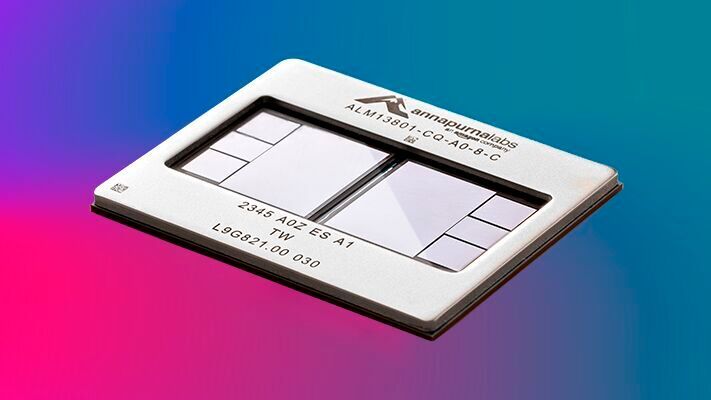
Trainium 3: With its own AI accelerator built on the 3-nm process, AWS aims to become more independent from Nvidia and scale training workloads more efficiently.
(Image: Amazon)
AWS is using its in-house re:Invent 2025 conference to position itself not just as a cloud provider but as a full AI infrastructure supplier. With Trainium3, AWS introduces the third generation of its AI accelerators. The chips are manufactured using TSMC's 3-nm process and are integrated into the new Trn3 UltraServers, which connect up to 144 Trainium3 chips. According to AWS, these systems deliver more than four times the performance of the previous Trainium2 generation while reducing energy consumption by around 40 percent. The system targets training and inference workloads for large language models, mixture-of-experts architectures, and long-context handling.
Strategically important point for the semiconductor world: AWS is trying to reduce its reliance solely on Nvidia GPUs. Trainium3, as a dedicated accelerator, directly competes with Google's TPUs and GPU clusters based on H100 or Blackwell cards. At the same time, AWS remains a major Nvidia customer but uses its own chips as a price-performance lever.
In parallel, AWS is introducing the Graviton5, the fifth generation of its Arm server CPUs. The chip offers up to 192 cores, approximately five times larger L3 cache capacity, and is expected to deliver up to 25 percent more computing power in EC2-M9g instances compared to Graviton4. For workloads such as EDA, simulation, databases, or big data analysis, this could be highly relevant for electronics developers, as compile times and simulation runs can be executed more cost-effectively and faster on Graviton instances.
Nova 2: AWS Catches Up in the LLM Race
In its model stack, AWS aims to keep pace with OpenAI, Google, and Anthropic with the Nova-2 family. Nova 2 Lite, Pro, Sonic, and Omni cover different use cases: Lite addresses cost-sensitive standard workloads, Pro targets complex reasoning and serves as a "teacher" model for smaller variants, Sonic handles real-time speech interaction, and Omni integrates text, image, video, and audio processing into a single model. All models run on Amazon Bedrock and can be enriched with proprietary data or further customized using Nova Forge.
Bedrock positions itself as a counteroffer to Azure OpenAI Services or Vertex AI. For embedded and electronics companies, this means they can build AI functions—such as service assistance, code generation, document analysis, or edge device management—on AWS model families without having to train their own foundation models.
AI Factories: Cloud Stack in Own Data Center
On the topic of data sovereignty: With the new AI Factories, AWS provides dedicated AI infrastructure directly in the customer's data center. Companies provide space, power, and network, while AWS delivers and operates complete racks with Trainium3 UltraServers and Nvidia GPUs, including network infrastructure, storage, and services like Bedrock and SageMaker.
From the perspective of regulated industries, including many electronics and automation customers, this is significant: sensitive production, development, or device data does not leave the company's own data center, yet a scalable AI stack is available. AWS positions AI Factories as a sovereign mini-region, particularly suited for industrial countries with strict data residency requirements and critical infrastructure regulations.
Frontier Agents: Autonomous AI "Employees"
The fourth focus is called "Frontier Agents." AWS describes this as a new class of autonomous AI agents that are not limited to answering individual prompts but are designed to carry out projects over hours or days. In the first wave, AWS introduces three: the Kiro Autonomous Agent as a virtual developer, a Security Agent, and a DevOps Agent. They are built on Bedrock AgentCore, which provides storage functions, policies, and automated quality tests for agents.
Date: 08.12.2025
Naturally, we always handle your personal data responsibly. Any personal data we receive from you is processed in accordance with applicable data protection legislation. For detailed information please see our privacy policy.
Consent to the use of data for promotional purposes
I hereby consent to Vogel Communications Group GmbH & Co. KG, Max-Planck-Str. 7-9, 97082 Würzburg including any affiliated companies according to §§ 15 et seq. AktG (hereafter: Vogel Communications Group) using my e-mail address to send editorial newsletters. A list of all affiliated companies can be found here
Newsletter content may include all products and services of any companies mentioned above, including for example specialist journals and books, events and fairs as well as event-related products and services, print and digital media offers and services such as additional (editorial) newsletters, raffles, lead campaigns, market research both online and offline, specialist webportals and e-learning offers. In case my personal telephone number has also been collected, it may be used for offers of aforementioned products, for services of the companies mentioned above, and market research purposes.
Additionally, my consent also includes the processing of my email address and telephone number for data matching for marketing purposes with select advertising partners such as LinkedIn, Google, and Meta. For this, Vogel Communications Group may transmit said data in hashed form to the advertising partners who then use said data to determine whether I am also a member of the mentioned advertising partner portals. Vogel Communications Group uses this feature for the purposes of re-targeting (up-selling, cross-selling, and customer loyalty), generating so-called look-alike audiences for acquisition of new customers, and as basis for exclusion for on-going advertising campaigns. Further information can be found in section “data matching for marketing purposes”.
In case I access protected data on Internet portals of Vogel Communications Group including any affiliated companies according to §§ 15 et seq. AktG, I need to provide further data in order to register for the access to such content. In return for this free access to editorial content, my data may be used in accordance with this consent for the purposes stated here. This does not apply to data matching for marketing purposes.
Right of revocation
I understand that I can revoke my consent at will. My revocation does not change the lawfulness of data processing that was conducted based on my consent leading up to my revocation. One option to declare my revocation is to use the contact form found at https://contact.vogel.de. In case I no longer wish to receive certain newsletters, I have subscribed to, I can also click on the unsubscribe link included at the end of a newsletter. Further information regarding my right of revocation and the implementation of it as well as the consequences of my revocation can be found in the data protection declaration, section editorial newsletter.
In parallel, AWS is launching Nova Act, a service specifically designed for browser and UI automation. Developers define workflows, Nova Act controls applications in the browser, calls APIs, and escalates to humans when necessary. According to AWS, these agents achieve a success rate of around 90 percent in early workloads. This is particularly exciting for industrial and electronic environments where manual work is still required on web portals, PLM systems, cloud consoles, or support tools. (mc)
Secure and Compliant Authentication in Laboratories



:quality(80)/p7i.vogel.de/wcms/eb/2b/eb2bd1b8487afe577b37363cd02f16ff/0113143253v1.jpeg "In our China Market Insider, we regularly provide you with relevant information straight from China. (Image:© Eisenhans - stock.adobe.com)")
:quality(80)/p7i.vogel.de/wcms/dd/b8/ddb8edc98c49b384734ab2432b297eb5/adobestock-1913662309--irene-stock-adobe-com-ki-generiertv1.jpeg "Rotary joints are used in grippers and swivel mechanisms to allow assemblies to rotate or swivel smoothly relative to one another, even under very high loads (illustrative image). (Source: Irene - stock.adobe.com / KI-generiert)")
:quality(80)/p7i.vogel.de/wcms/d1/ef/d1ef6b6f7d4543f7999980bacccaf22b/0133499261v1.jpeg "As the growing imbalance in trade relations with China continues to widen, the EU Chamber of Commerce foresees a day when trade with China will have to be seriously reevaluated ... (Image: AI-generated)")
:quality(80)/p7i.vogel.de/wcms/fe/1f/fe1fa5ee713f94deaba963dc24c3abc5/0133299273v1.jpeg "The Flexistar enables highly flexible production of laser-welded tubes thanks to its tool-free clamping system. (Image:Because Technology, LLC)")
:quality(80)/p7i.vogel.de/wcms/60/ef/60ef4f07e4829b2c2929befc0f353c58/0133511729v1.jpeg "Humanoid robots can match human performance in certain tasks. (Image:Gemini / AI-generated)")
:quality(80)/p7i.vogel.de/wcms/2e/99/2e99726b522e4b35b690e25eb6a42643/0133463991v1.jpeg "Robotics: In AMR applications, connection technology must reliably transmit power, signals, and data despite vibration and shock loads—in very confined spaces and in a way that allows for regular maintenance. (Image:Hyperever)")
:quality(80)/p7i.vogel.de/wcms/d0/18/d01801e3d5dbd7bc9d0b4f60408b630c/0133468429v1.jpeg "Quality requirements for film packaging are on the rise. At the same time, many companies are turning to recyclable film materials, which, however, have their own challenges. Fraunhofer researchers have therefore developed a fast system that detects problems in real time. (Image:Fraunhofer IKTS)")
:quality(80)/p7i.vogel.de/wcms/b1/06/b106cf44923ce39565c3264982fd20eb/0133414574v1.jpeg "Robots Build Robots: At the new Ubtech factory, automated systems even handle parts of the material supply and logistics for the production of humanoid robots. (Image:Ubtech)")
:quality(80)/p7i.vogel.de/wcms/c0/52/c052f405eb55fc3d08c4837e77206fc0/adobestock-2021845957--aucartstudio-stock-adobe-com-ki-generiertv1.jpeg "An innovation from China to combat extreme summer heat: A novel coating lowers temperatures. (Source: © AucArtStudio – stock.adobe.com_AI-generated)")
:quality(80)/p7i.vogel.de/wcms/66/a7/66a7b78159caeacce57136529688799f/0133503398v1.jpeg "Sunlight Makes Stone! These stone blocks weren't made the traditional way. Instead, they were additively manufactured from sand using a laser. In the future, however, the laser is set to be replaced by concentrated sunlight—if the startup Addisol is successful... (Image:Addisol / F. Fiedler)")
:quality(80)/p7i.vogel.de/wcms/72/b9/72b995c2c8d812c5e2115cbef31e035a/0133462727v1.jpeg "Eggl manufactures center hoods that are precisely tailored to each cooking island—whether standard size or custom shape. They are made entirely of stainless steel and are individually customized in terms of size and filter arrangement. (Image:SPI)")
:quality(80)/p7i.vogel.de/wcms/13/5d/135dfae6229ceaf5c55467a43e8f7257/adobestock-1879961393--ardi-stock-adobe-com-ki-generiertv1.jpeg "Annoying chatterboxes or awkward silences in response to questions—a moderator should specifically prepare for difficult situations in order to navigate them effectively. (Image:ardi - stock.adobe.com_AI-generated)")
:quality(80)/p7i.vogel.de/wcms/aa/a2/aaa2c6dd2daa24b485cddbf9297590c0/0133467318v1.jpeg "Battery Monitoring: Battery monitoring using electrochemical impedance spectroscopy offers several advantages. (Image:TI)")
:quality(80)/p7i.vogel.de/wcms/39/b2/39b21bf03be1683831862239a369987c/0133469638v1.jpeg "Data from autonomous vehicles and robots operating autonomously is in high demand, and Ruqi wants to capitalize on this. (Image:Ruqi Mobility)")
:quality(80)/p7i.vogel.de/wcms/8a/bb/8abbb6217220595edc1549ac9b84f307/0133429906v1.jpeg "The IAA in Hanover showcased the ambitions of Chinese commercial vehicle manufacturers in Europe. (Image:Wehner - VCG)")
:quality(80)/p7i.vogel.de/wcms/0c/53/0c5313ef91c14b6df0d0996efc33c8ad/jpg03568-bearbeitetv1.jpeg "The category winners of the 2027 German Car of the Year award. (Source: GCOTY)")
:quality(80)/p7i.vogel.de/wcms/48/15/4815da27c45973ca629a99b375ac3aef/0133509585v1.jpeg "Ventuno Q RoadTest: Designed to help the Element14 community gain practical insights from real-world tests using the Ventuno Q. (Image:Farnell/Element14)")
:quality(80)/p7i.vogel.de/wcms/17/2b/172bd132f9febdfcbcedba292ad0504d/aufmacherv1.jpeg "Micro-Epsilon offers a wide range of IO-Link-compatible sensors. (Source: Micro-Epsilon Messtechnik GmbH & Co. KG)")
:quality(80)/p7i.vogel.de/wcms/ca/b4/cab46fd26d19d6a2febca032048200b6/0133471827v1.jpeg "Photonics SDK for C and Python: Computational operations are now abstracted as standard mathematical functions. (Image:Q.ANT)")
:quality(80)/p7i.vogel.de/wcms/92/b2/92b2ed5299cde450c0764f4f64468395/0133505895v1.jpeg "The \"Iris 100\" test system for high-precision volume production of microLEDs uses a spectrometer and a high-resolution camera. (Image:Teradyne)")
:fill(fff,0)/images.vogel.de/vogelonline/companyimg/76800/76895/65.jpg "FAULHABER_120mm.jpg ()")
:fill(fff,0)/p7i.vogel.de/companies/69/88/69882c428938e/tmts2026-ticec-banner-en-2000px.png "tmts2026-ticec-banner-en-2000px (https://www.tmts.tw/en)")
:fill(fff,0)/p7i.vogel.de/companies/69/de/69de1b7403b0d/simtos-logo.jpeg "simtos-logo (SIMTOS)")
:quality(80):fill(efefef,0)/p7i.vogel.de/wcms/67/ac/67acb931a438c/elatec-wp-gmp.png "Elatec WP GMP")
:quality(80)/p7i.vogel.de/wcms/ba/18/ba1847eab1dcf1acb8f6c2d741c9a7b0/0131777880v1.jpeg "Agentive AI: The future of AI in EDA lies not in copilots but in the orchestration of many processes. (Image: Siemens EDA)")
:quality(80)/p7i.vogel.de/wcms/61/fc/61fcf95f5cca15494ad18343901ae585/0130317237v1.jpeg "With the AGI CPU, Arm says it is taking a \"historic step\": With the processor aimed at AI in data centers, the company is presenting itself for the first time as a provider of its own chips, not just as a pure IP licensor. (Image:Arm)")