New ModelsAudi A2 E-Tron: Prices, Range, and Technology at a Glance
By
Peter Eck/SP-X | Translated by AI
5 min Reading Time
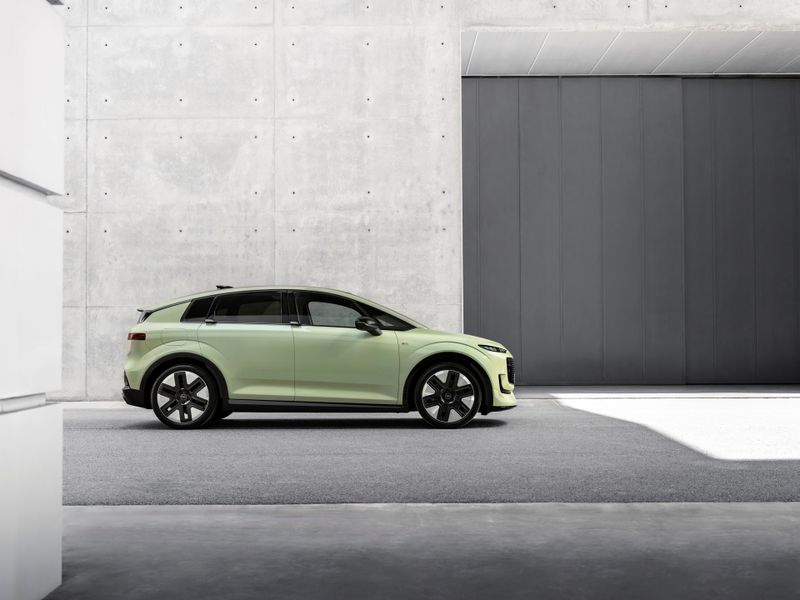
Nearly 30 years after the original A2 flopped, Audi is bringing the name back as an electric car. The compact model aims to win over buyers with its clever design—but comes with Audi’s typically long list of optional extras.
The A2 E-Tron is in a completely different league than the car that gave it its name, which was introduced nearly 30 years ago.
(Source: Audi)
In the late 1990s, the A2—which had been introduced at that time—proved to be a flop despite its high efficiency. Now Audi is reviving the name and introducing the A2 E-Tron as a fully electric car in the upper compact class. The 4.32-meter-long (14.17-foot) five-door model is available for order immediately, with deliveries set to begin in December. Prices start at 38,200 euros ($44,312) for the version with 125 kW/170 PS and a battery with a gross capacity of 52 kWh.
The base price alone shows that Audi is positioning its new electric vehicle with great confidence, even though it is also seen as the brand’s new entry-level model, intended not only to attract new customers but also to retain existing ones.
The A2 e-tron is in a completely different league than the car that inspired its name, which was introduced nearly 30 years ago. Nevertheless, the Audi designers have incorporated some visual cues from the original. The roofline, which slopes sharply toward the rear, and the transition to the sleek rear end with its high-mounted spoiler are particularly reminiscent of the “predecessor.” That spoiler was positioned to the centimeter at the same height—which Audi considers optimal—as on the original A2. For Jakob Hirzel, this is a sign that “they did a very good job back then, too,” as the exterior designer comments with a wink.
From every angle, the A2 E-Tron looks very clean and uncluttered, with clearly defined surfaces and no unnecessary frills. However, due to the 2⁄3 to 1⁄3 split between the body and the greenhouse, the side windows at the rear and the rear window are rather small. In addition, the rear windows can only be opened about halfway due to the wheel arches that protrude into the door openings.
Eye-Catching Door Handles
The front is dominated by a wide black panel—somewhat modeled after the earlier Single-Frame grille—behind which various sensors for the driver-assistance systems are primarily concealed. At the upper edge of the panel, in its outermost corners, the main headlights are concealed behind a rectangular glass panel; above them, the daytime running lights are housed in a narrow slit.
One striking feature is Audi’s solution for the door handles, which are designed as small wings that open when touched. To lock the doors, a light touch on the sensor surface is all it takes. An integrated energy storage system is designed to ensure that the doors can still be opened even if the vehicle’s electronics fail—for example, after an accident.
A great deal of attention to detail has gone into the interior. For the first time, Audi’s patented “Fidlock” fastening system is being used. It combines magnets with a mechanical fastening mechanism, ensuring that objects—such as a cup holder—not only stay securely in place but also snap into position precisely. There are two such mounting points in the front and three in the trunk. One can be used, for example, to secure a tension strap, and a cable charging pouch can be attached to two of these points on the left side of the trunk, which, at just under 400 liters, is of average size. Dacia has a similar system called “YouClip”—though without magnets.
The trunk capacity can be expanded to a practical 1,330 liters by folding down the rear seats. Hidden under the front hood is a small "frunk" with a capacity of 13 liters.
All-wheel drive isn't included yet, but it will likely be added later. All A2 models will initially be rear-wheel drive.
Audi relies on the rugged, safe, and affordable LFP battery (lithium iron phosphate). Among other things, it has the advantage of being able to be charged to 100 percent without long-term loss of performance and can withstand more charging cycles without degradation. Compared to the nickel-manganese-cobalt or nickel-cobalt-aluminum batteries more commonly used in the premium segments, the range is slightly shorter for batteries of the same size.
Date: 08.12.2025
Naturally, we always handle your personal data responsibly. Any personal data we receive from you is processed in accordance with applicable data protection legislation. For detailed information please see our privacy policy.
Consent to the use of data for promotional purposes
I hereby consent to Vogel Communications Group GmbH & Co. KG, Max-Planck-Str. 7-9, 97082 Würzburg including any affiliated companies according to §§ 15 et seq. AktG (hereafter: Vogel Communications Group) using my e-mail address to send editorial newsletters. A list of all affiliated companies can be found here
Newsletter content may include all products and services of any companies mentioned above, including for example specialist journals and books, events and fairs as well as event-related products and services, print and digital media offers and services such as additional (editorial) newsletters, raffles, lead campaigns, market research both online and offline, specialist webportals and e-learning offers. In case my personal telephone number has also been collected, it may be used for offers of aforementioned products, for services of the companies mentioned above, and market research purposes.
Additionally, my consent also includes the processing of my email address and telephone number for data matching for marketing purposes with select advertising partners such as LinkedIn, Google, and Meta. For this, Vogel Communications Group may transmit said data in hashed form to the advertising partners who then use said data to determine whether I am also a member of the mentioned advertising partner portals. Vogel Communications Group uses this feature for the purposes of re-targeting (up-selling, cross-selling, and customer loyalty), generating so-called look-alike audiences for acquisition of new customers, and as basis for exclusion for on-going advertising campaigns. Further information can be found in section “data matching for marketing purposes”.
In case I access protected data on Internet portals of Vogel Communications Group including any affiliated companies according to §§ 15 et seq. AktG, I need to provide further data in order to register for the access to such content. In return for this free access to editorial content, my data may be used in accordance with this consent for the purposes stated here. This does not apply to data matching for marketing purposes.
Right of revocation
I understand that I can revoke my consent at will. My revocation does not change the lawfulness of data processing that was conducted based on my consent leading up to my revocation. One option to declare my revocation is to use the contact form found at https://contact.vogel.de. In case I no longer wish to receive certain newsletters, I have subscribed to, I can also click on the unsubscribe link included at the end of a newsletter. Further information regarding my right of revocation and the implementation of it as well as the consequences of my revocation can be found in the data protection declaration, section editorial newsletter.
A Range of just Over 640 kilometers
The A2 E-Tron achieves a range of between 420 and 640 kilometers (261 and 398 miles, thanks in part to its cW value of 0.24—an outstanding figure for a vehicle in this class. The latter range is reserved for the 170-kW version and is only available when the S-Line package with 19-inch Aero tires and sport suspension is ordered. The 140 kW version has the lowest WLTP consumption at 12.8 kWh per 100 kilometers (20.6 kWh per 100 miles).
The results for charging power vary. They range from a somewhat disappointing 100 and 105 kW for the two less powerful powertrains to an acceptable 183 kW for the two more powerful ones. Nevertheless, depending on the version, the batteries should be able to recharge from 10 to 80 percent within 24 to 28 minutes. Almost as important for everyday use: an additional 200 kilometers (124 miles) of range should be available after just ten minutes of charging.
A Long List of Extra Charges Despite a High Base Price
As is always the case with German premium brands, not only are the prices high, but the list of optional extras will also be very long. Among other things, a heat pump must be ordered as an add-on for all trim levels. Optional features include, among others, a panoramic glass roof, a head-up display, LED taillights, a sport suspension, power-adjustable seats, and the Vehicle-to-Load function. Standard equipment, on the other hand, includes the driver and center displays (11.9 and 12.8 inches) housed in a unit oriented toward the driver, navigation, a rearview camera, and inductive, actively cooled smartphone charging.
The first impression of the new Audi A2 e-tron—formed without even driving it—is impressive. The clean design, the spacious interior with several innovative features, and the wide range of powertrains and battery sizes are all pluses. Unsurprisingly, the biggest drawback—aside from the meager charging performance in the base models—is the Ingolstadt-based (Germany)automaker’s pricing and extra-cost structure.



:quality(80)/p7i.vogel.de/wcms/a0/94/a09489b453e958dc8ffd85accab2aaf3/0130556732v1.jpeg "Mutares supported two of its portfolio companies to help them strengthen their position. It worked out perfectly. Now both have been sold. Read here to find out exactly what this is all about... (Image:Mutares)")
:quality(80)/p7i.vogel.de/wcms/88/91/88915656ec26bd5f6e79ce0e523dd33b/0131576263v1.jpeg "Dr. Volker Nilles is CEO of Arburg GmbH + Co KG. In this role, he leads the six-member executive team and, since the beginning of the year, has been responsible for steering the course of the manufacturer of injection molding machines and digital systems for plastics processing. The family-owned company, based in Loßburg, employs approximately 3,400 people worldwide and has a history spanning more than 100 years. (Image: Arburg GmbH + Co. KG)")
:quality(80)/p7i.vogel.de/wcms/81/d4/81d47ab5407c961b55233009313ac9d2/0133075510v1.jpeg "Small, but designed for demanding applications: KSK demonstrates that the diameter of ball screws says nothing about their load-carrying capacity. (Image:Arkero)")
:quality(80)/p7i.vogel.de/wcms/6b/80/6b80bac3b1b33a0e3bc17849bef4ba59/0133171618v1.jpeg "With its portal solution for the MAK 4 Evolution UD swivel-bending machine, Schröder enables the fully automated production of sheet-metal enclosures. (Image:Schröder Group)")
:quality(80)/p7i.vogel.de/wcms/13/2d/132df0ce425eb46f046ffe1065912b19/699704-he-xiaopeng-und-iron-36d230-original-1788864307v1.png "He Xiaopeng hangs an employee ID badge around the neck of the humanoid \"IRON,\" as part of the team. (Source: Xpeng)")
:quality(80)/p7i.vogel.de/wcms/cc/80/cc8031ca517f9ff98cec245efa899b25/0133211591v1.jpeg "The two CEOs of the companies: Max Mauri of Seco and David Reger of Neura. (Image:Neura Robotics)")
:quality(80)/p7i.vogel.de/wcms/ae/eb/aeeb20bb1bf0e6226c35d50b11551a89/0133237319v1.jpeg "At ArcelorMittal Bremen, steel coils are cut to size using blades, a process that takes place at high speed. This makes it difficult to ensure the quality of both the product and the blades. However, TS Sensors and Selmatec have now developed a real-time system ... (Image:AT Sensors)")
:quality(80)/p7i.vogel.de/wcms/ee/de/eedeb235bb6ee164059ea34e6bea795f/0132989868v1.jpeg "From a small Irish bakery to a major manufacturer with expansion plans: Processes can only be scaled through real-time data transparency. (Image:West-Bake)")
:quality(80)/p7i.vogel.de/wcms/be/4d/be4d7294d3d171468dc0b83efa4f442c/0133268906v1.jpeg "Here, two experts from Lufthansa Technik are applying the “AeroSHARK” coating to an aircraft. Until now, Boeing has been using this coating, which mimics the skin structure of sharks. Now Airbus also wants to use it to make its aircraft more fuel-efficient. (Image:Lufthansa Technik)")
:quality(80)/p7i.vogel.de/wcms/6e/1a/6e1ac5a0f1f7b4e9d0b42d34ab3fc47b/geda-sh250w-1v1.jpeg "According to the manufacturer, the battery-powered lift for wind turbines sets new standards in safety, availability, and efficiency. (Source: Geda GmbH)")
:quality(80)/p7i.vogel.de/wcms/45/20/45208dbb0868aa49d32ded081173ebdb/siemens-sarla-aviation-01v1.jpeg "To ensure that data does not remain isolated in individual departments or systems, three companies are leveraging the Digital Thread with Siemens solutions. (Source: Sarla Aviation)")
:quality(80)/p7i.vogel.de/wcms/92/e9/92e9f029ef416e02b6f0b772b39c30df/limbitless-stratasys-zacharyv1.jpeg "The renewed focus of the expanded partnership between Stratasys and Limbitless is on sustainability, education, and improved access to 3D-printed prosthetics. (Source: Stratasys)")
:quality(80)/p7i.vogel.de/wcms/99/9f/999f4972c3c4cbb69c30830e80dedd4e/dacia-spring-exterioradriencortesi-001v1.jpeg "Dacia has developed a successor to the Spring electric compact car. (Source: Dacia)")
:quality(80)/p7i.vogel.de/wcms/a4/b6/a4b6fc6ca18008acda9ff06c711555e9/a264385-largev1.jpeg "The A2 E-Tron is in a completely different league than the car that gave it its name, which was introduced nearly 30 years ago. (Source: Audi)")
:quality(80)/p7i.vogel.de/wcms/12/33/1233e00dd83a287e5225169847b22799/0133224119v1.jpeg "The path to the software-defined vehicle leads from control modules and wiring harnesses to a centralized, networked E/E architecture. (Image:Dall-E / AI-generated)")
:quality(80)/p7i.vogel.de/wcms/00/ad/00adb77750d3b28827e3739e6812f803/manuel-mengelkoch-director-sales-operations-volvo-trucks-2v1.jpeg "Manuel Mengelkoch is Director of Sales Operations at Volvo Trucks Germany. (Source: Volvo Trucks)")
:quality(80)/p7i.vogel.de/wcms/c4/b5/c4b5badd67b0037f23c1d69806a13d16/0133216860v1.jpeg "Fascinating Technology: ASML's NXE3800E EUV machine. (Image:ASML)")
:quality(80)/p7i.vogel.de/wcms/7c/57/7c5719c462b2973564651ca5e472bb58/0133230109v1.jpeg "Prototype of the Diamond Spin Quantum Computer: Users can operate it using the Fujitsu Hybrid Quantum Computing Platform, even without any additional specialized knowledge. (Image:Fujitsu)")
:quality(80)/p7i.vogel.de/wcms/87/96/879685114467b0fe5a43f25923787762/set-explosion-2000pxv1.jpeg "Not explosive, but safe: The new KDS-Rail Fire Safety Kit. (Source: Conta-Clip)")
:quality(80)/p7i.vogel.de/wcms/a4/4e/a44e89f5d47d037ca5d0c870b8dabc65/0133203720v1.jpeg "Transparent DC charging connector from Lapp featuring the vSECC.InPlug communication controller board from Vector (Image:Vector Informatics)")
:quality(80)/p7i.vogel.de/wcms/99/9f/999f4972c3c4cbb69c30830e80dedd4e/dacia-spring-exterioradriencortesi-001v1.jpeg "Dacia has developed a successor to the Spring electric compact car. (Source: Dacia)")
:quality(80)/p7i.vogel.de/wcms/f7/9e/f79eb21ac246cb5ae9f4413400c8f8f7/0129006331v1.jpeg "The range of electric cars has grown significantly compared to 2024. At the same time, prices have dropped sharply. (Image:Hyundai)")
:quality(80)/p7i.vogel.de/wcms/2d/5f/2d5f81bd5feb70c74f082a13717bbbdb/audi-a6-sprawitz-14bv1.jpeg "The Audi A6 E-tron impresses ... but also comes at a high cost. Our test car is priced at nearly 100,000 euros. (Image:Sven Prawitz/Vogel Communications Group)")
:quality(80)/p7i.vogel.de/wcms/fe/42/fe4244aa6dd62fa159188f7268ed32e9/a264389-largev1.jpeg "The Audi A2 E-tron's design is reminiscent of the original model. Take, for example, the roof, which slopes sharply toward the rear.(Source: Audi)")
:quality(80)/p7i.vogel.de/wcms/b9/c1/b9c19bd3e988053fc2f717ca177bf04e/a264390-largev1.jpeg "The front is dominated by a wide black panel, which appears to be modeled somewhat after the earlier single-frame grille.(Source: Audi)")
:quality(80)/p7i.vogel.de/wcms/96/e9/96e97a430296fa43a20278da3eea64d6/a264379-largev1.jpeg "A lot of attention to detail went into the interior.(Source: Audi)")
:quality(80)/p7i.vogel.de/wcms/7c/0b/7c0beaf2bf75edcf92ea8bbc51416863/a264380-largev1.jpeg "Audi has developed a versatile mounting system for cup holders and much more—similar to Dacia's “YouClip.”(Source: Audi)")
:quality(80)/p7i.vogel.de/wcms/d5/49/d549f4999960da7667d46c23e68f31b9/denza-z9gt-03detail-062v1.jpeg "Some companies in China are competing to offer the shortest charging time. (Image:BYD)")
:quality(80)/p7i.vogel.de/wcms/e8/ed/e8ed1f2f0c367c524a3b302809c7653d/a263975-largev1.jpeg "Audi reveals the first images of the A2 prototype. The production model is set to be delivered later in 2026. (Source: Audi AG)")
:quality(80)/p7i.vogel.de/wcms/22/e7/22e7227ac563535b03b4f46ba6dd94bc/5d6a4f3364bcacb32b52e149013491ac421da841v1.jpeg "Xpeng is bringing its smallest model to date, the L03, to Europe. (Image:Xpeng)")