Mechanical VibrationsA "Vibrating" Memory for Quantum Computers
By
Florian Meyer, ETH Zurich | Translated by AI
5 min Reading Time
When it comes to storage, quantum computers are still reaching their limits. A research team at ETH Zurich has now developed a new approach: mechanical vibrations instead of electromagnetic storage. The innovative "vibrating" memory promises to store significantly more information in a smaller space.
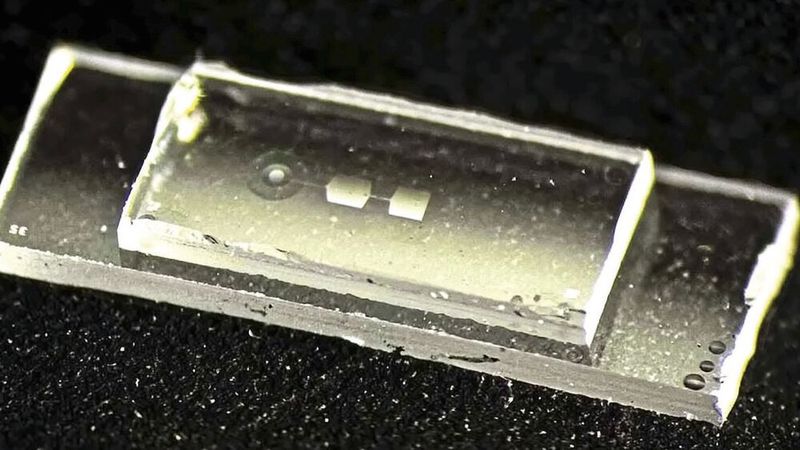
The quantum chip developed at ETH Zurich contains so-called mechanical resonators—tiny components that begin to vibrate when storing information. The chip is about 7.5 millimeters long, 2.5 millimeters wide, and 1 millimeter high (approx. 0.30 by 0.10 by 0.04 inches), roughly as wide as a small fingernail.
(Image: Hybrid Quantum Systems Group / ETH Zurich)
"This computer works almost like a guitar," describes ETH Zurich regarding the new approach. Quantum physicist Yiwen Chu and her team at ETH Zurich use tiny vibrations to store and process information. These behave similarly to the vibrations of strings that produce tones on a guitar.
What sounds like music is actually quantum physics. The vibrations with which Chu and her team work cannot be heard: they occur deep inside a quantum chip and are used to store quantum information.
These vibrations are needed so that Chu's quantum computer can perform its calculations as efficiently as possible and flexibly access a memory. "The interplay between the processing unit and the memory creates a crucial foundation for establishing quantum computers as a powerful and reliable tool for calculations that are not possible with conventional computers," says Yiwen Chu.
The physics professor conducts research on quantum information and quantum computer architectures. Recently, her team and she presented a new approach in the scientific journal "Science," which separates computation much more clearly from memory compared to many existing quantum computer models that tightly link computation and storage.
Quantum Memory Modeled After Digital Design
To achieve this, Chu and her team have developed a new quantum computer architecture that deliberately draws inspiration from classical digital computers: in these, a central processing unit (CPU) processes the data, which is stored separately in a random-access memory (RAM). The computer architecture determines how the individual components of a computer are arranged to process data as efficiently as possible.
In Chu's approach, a so-called superconducting qubit takes on the role of the central processing and control unit, similar to the processor (CPU) in a digital computer. At the same time, the information to be processed is temporarily stored in a quantum memory, making it available during the calculation. "In our quantum memory, however, the information is not stored electromagnetically, as is usually the case today, but in the form of mechanical vibrations," says Chu.
To perform a calculation, the qubit accesses a piece of information—that is, a vibration!—in the quantum memory, processes and modifies it, and then stores it back there. "Specifically, our quantum chip contains so-called mechanical resonators. These are tiny components that begin to vibrate when storing," says Chu.
Each Vibration Stores information
Like the strings of a guitar, which produce different tones depending on their vibrations, the resonators can also vibrate in many different ways—in physics, this is referred to as vibrational modes. In the language of computer science, these modes correspond to the number of available memory slots. This means: each type of vibration stores different information.
Within the vibrational modes, different vibrational states can also be realized. This refers to the specific state of a vibration in which the information is stored in a way that allows it to be flexibly retrieved and stored again.
In terms of information theory, these states correspond to the respective content of the memory locations. However, in quantum physics, these states represent the crucial difference from a guitar—and also from a digital computer: the vibrations of a string follow the laws of classical physics, which describe our everyday world. In the quantum chip, however, the laws of quantum mechanics apply, explaining the behavior of the smallest particles. There, states can superpose and become entangled simultaneously—a both-and situation that classical physics does not know. Digital computers also work only with two clearly distinct states: 0 or 1.
Date: 08.12.2025
Naturally, we always handle your personal data responsibly. Any personal data we receive from you is processed in accordance with applicable data protection legislation. For detailed information please see our privacy policy.
Consent to the use of data for promotional purposes
I hereby consent to Vogel Communications Group GmbH & Co. KG, Max-Planck-Str. 7-9, 97082 Würzburg including any affiliated companies according to §§ 15 et seq. AktG (hereafter: Vogel Communications Group) using my e-mail address to send editorial newsletters. A list of all affiliated companies can be found here
Newsletter content may include all products and services of any companies mentioned above, including for example specialist journals and books, events and fairs as well as event-related products and services, print and digital media offers and services such as additional (editorial) newsletters, raffles, lead campaigns, market research both online and offline, specialist webportals and e-learning offers. In case my personal telephone number has also been collected, it may be used for offers of aforementioned products, for services of the companies mentioned above, and market research purposes.
Additionally, my consent also includes the processing of my email address and telephone number for data matching for marketing purposes with select advertising partners such as LinkedIn, Google, and Meta. For this, Vogel Communications Group may transmit said data in hashed form to the advertising partners who then use said data to determine whether I am also a member of the mentioned advertising partner portals. Vogel Communications Group uses this feature for the purposes of re-targeting (up-selling, cross-selling, and customer loyalty), generating so-called look-alike audiences for acquisition of new customers, and as basis for exclusion for on-going advertising campaigns. Further information can be found in section “data matching for marketing purposes”.
In case I access protected data on Internet portals of Vogel Communications Group including any affiliated companies according to §§ 15 et seq. AktG, I need to provide further data in order to register for the access to such content. In return for this free access to editorial content, my data may be used in accordance with this consent for the purposes stated here. This does not apply to data matching for marketing purposes.
Right of revocation
I understand that I can revoke my consent at will. My revocation does not change the lawfulness of data processing that was conducted based on my consent leading up to my revocation. One option to declare my revocation is to use the contact form found at https://contact.vogel.de. In case I no longer wish to receive certain newsletters, I have subscribed to, I can also click on the unsubscribe link included at the end of a newsletter. Further information regarding my right of revocation and the implementation of it as well as the consequences of my revocation can be found in the data protection declaration, section editorial newsletter.
This ability to superimpose or entangle states opens up additional computational pathways for quantum computing. The great promise of quantum computers is, therefore, that they will one day solve certain particularly complex tasks more efficiently than classical computers—or even solve problems that classical computers fail to address.
More Vibrations, More Memory
For quantum computers to compute and store reliably, researchers must precisely control and manipulate these states. This is achievable when the processing unit and memory are well-coupled.
With Chu, it works like this: The resonators store the respective information in a specific vibrational state. When the qubit retrieves information from the quantum memory, it processes and changes this vibrational state and then stores it back.
Until now, many quantum computer models have combined electromagnetic memory with superconducting qubits, as both—individually and in combination—are well-researched and have proven their effectiveness. Electromagnetic memory technologies allow quantum states to be read, modified, and controlled with high precision. Their drawback, however, is that they are comparatively large and require a lot of space—this could hinder the advancement of experimental laboratory devices into market-ready quantum computers for research and industry. This is where Chu steps in.
Mechanical resonators, on the other hand, are significantly smaller and more compact. They also offer greater storage capacity because they include many different vibrational modes, allowing them to store more information simultaneously than electromagnetic memory. Additionally, they keep quantum states stable for longer without the vibration decaying and information being lost. This extends the storage time.
Innovative Computer Architecture Passes Stress Test
In her study published in the journal Science, Chu has now experimentally demonstrated for the first time that mechanical resonators can effectively couple and combine with superconducting qubits to perform computations. She provides proof of feasibility: oscillating memory can be a promising alternative to electromagnetic approaches.
Whether her approach will prevail now depends on how well it can be scaled. The newly designed quantum chip must also function reliably in larger quantum computing systems with expanded computational capabilities. Chu's team is continuing their research on this. The team has already provided a fundamental proof in the published study: their approach of embedding qubits and resonators into a new computer architecture handles not only simple computational tasks but also more complex ones.
The research group tested the computational ability of their approach, among other things, on two key problems that are among the most important computational methods in quantum computing: the quantum Fourier transform and period finding.
"The quantum Fourier transform is a fundamental computational method required for many quantum algorithms. The algorithm we implemented for period finding demonstrates how this method can be used," explains Igor Kladaric, a doctoral student in Chu's team and co-author of the publication.
Both methods require a quantum computing system that can precisely control, store, and reliably interlink many quantum states simultaneously. If successful, a quantum computer is considered fundamentally capable of computing – and Chu's approach achieves exactly that.
Chu's quantum computing system masters all the fundamental computational steps needed to theoretically perform any quantum computation. This demonstrates that the team's approach is fundamentally suitable as a universally applicable and programmable quantum computer.
The path is still long to a sufficiently powerful and reliable quantum computer that can be used in research and industry. However, Chu's approach points in a promising direction along this path.



:quality(80)/p7i.vogel.de/wcms/d1/ef/d1ef6b6f7d4543f7999980bacccaf22b/0133499261v1.jpeg "As the growing imbalance in trade relations with China continues to widen, the EU Chamber of Commerce foresees a day when trade with China will have to be seriously reevaluated ... (Image: AI-generated)")
:quality(80)/p7i.vogel.de/wcms/fe/1f/fe1fa5ee713f94deaba963dc24c3abc5/0133299273v1.jpeg "The Flexistar enables highly flexible production of laser-welded tubes thanks to its tool-free clamping system. (Image:Because Technology, LLC)")
:quality(80)/p7i.vogel.de/wcms/1b/5a/1b5ac72f83db4dbee3ff91e51bc398f4/0133496095v1.jpeg "BASF announces that it will take the next step toward producing the polyurethane precursor MDI in India ... (Image:BASF)")
:quality(80)/p7i.vogel.de/wcms/3f/cf/3fcfa390902944ffcf24e7fe973cc3ee/0133486258v1.jpeg "Do you need to create secure connections on structures using blind rivets, but space is tight? Then you should take a closer look at the Universalgrip from Gesipa ... (Image: Gesipa)")
:quality(80)/p7i.vogel.de/wcms/2e/99/2e99726b522e4b35b690e25eb6a42643/0133463991v1.jpeg "Robotics: In AMR applications, connection technology must reliably transmit power, signals, and data despite vibration and shock loads—in very confined spaces and in a way that allows for regular maintenance. (Image:Hyperever)")
:quality(80)/p7i.vogel.de/wcms/d0/18/d01801e3d5dbd7bc9d0b4f60408b630c/0133468429v1.jpeg "Quality requirements for film packaging are on the rise. At the same time, many companies are turning to recyclable film materials, which, however, have their own challenges. Fraunhofer researchers have therefore developed a fast system that detects problems in real time. (Image:Fraunhofer IKTS)")
:quality(80)/p7i.vogel.de/wcms/b1/06/b106cf44923ce39565c3264982fd20eb/0133414574v1.jpeg "Robots Build Robots: At the new Ubtech factory, automated systems even handle parts of the material supply and logistics for the production of humanoid robots. (Image:Ubtech)")
:quality(80)/p7i.vogel.de/wcms/38/79/38799bfbbccd938b64c67068cfa68780/0133329362v1.jpeg "What exactly enables machines to act on their own? (Image:Shutterstock)")
:quality(80)/p7i.vogel.de/wcms/66/a7/66a7b78159caeacce57136529688799f/0133503398v1.jpeg "Sunlight Makes Stone! These stone blocks weren't made the traditional way. Instead, they were additively manufactured from sand using a laser. In the future, however, the laser is set to be replaced by concentrated sunlight—if the startup Addisol is successful... (Image:Addisol / F. Fiedler)")
:quality(80)/p7i.vogel.de/wcms/72/b9/72b995c2c8d812c5e2115cbef31e035a/0133462727v1.jpeg "Eggl manufactures center hoods that are precisely tailored to each cooking island—whether standard size or custom shape. They are made entirely of stainless steel and are individually customized in terms of size and filter arrangement. (Image:SPI)")
:quality(80)/p7i.vogel.de/wcms/13/5d/135dfae6229ceaf5c55467a43e8f7257/adobestock-1879961393--ardi-stock-adobe-com-ki-generiertv1.jpeg "Annoying chatterboxes or awkward silences in response to questions—a moderator should specifically prepare for difficult situations in order to navigate them effectively. (Image:ardi - stock.adobe.com_AI-generated)")
:quality(80)/p7i.vogel.de/wcms/ca/46/ca462051dfb9a1fb37ca4053762af9df/org-blobs-user-response-file-output-908c701c-3b37-491e-bb5c-35fc3d336575-plugin-output-call-182851v1.png "Through extreme compression, high-energy lasers transform simple plastics into high-purity nanodiamonds. What was once used in planetary physics is now opening up entirely new possibilities for quantum sensors, novel catalysts, and extremely hard materials. (Illustrative image) (Source: VCG / AI-generated)")
:quality(80)/p7i.vogel.de/wcms/27/c9/27c917e021a143e590dee34a9f481978/0133504594v1.jpeg "In 2025, there were more electric cars among new registrations in the EU than ever before. (Image: ©Halfpoint - stock.adobe.com)")
:quality(80)/p7i.vogel.de/wcms/8c/ac/8cacd1d41ac023ec1f2bf81c623d1776/tesla-cybercab-75-1v1.jpeg "Tesla plans to use an electric motor that does not contain rare earth elements in the Cybercab. (Image:Tesla)")
:quality(80)/p7i.vogel.de/wcms/12/f0/12f022d493c7d7a39e2ab411953c37f3/mg-1253v1.jpeg "The Æthon solar cars in the foreground and the Adelie in the background on the racetrack in Zolder. (Source: Team Sonnenwagen)")
:quality(80)/p7i.vogel.de/wcms/5d/70/5d70b7d3a05d5a99821b172db63569be/0133485094v1.jpeg "Volkswagen continues to face financial difficulties. Although cost-cutting measures are already underway, the situation hasn't improved much. Further layoffs may be on the horizon. In addition, the Wolfsburg-based company plans to accelerate the implementation of its overall measures. (Image:Volkswagen)")
:quality(80)/p7i.vogel.de/wcms/11/2e/112eabc5fb41e1a401f0e93e9326ef51/0133489329v1.jpeg "A sandbox limits the actions an AI agent can take, but it is not an impenetrable barrier. Only multiple independent layers of protection prevent an escape from immediately granting access to production systems. (Image:freely licensed)")
:quality(80)/p7i.vogel.de/wcms/18/ba/18bae45f9e6f7cacc203d56f3bc26e3c/0133455937v1.jpeg "Google did not make the incidents public until after receiving an inquiry from the “Wall Street Journal.” (Image:Google)")
:quality(80)/p7i.vogel.de/wcms/65/58/655895abe42a598e146fe47baf7c54db/0133441212v1.jpeg "Wukong, a 72-qubit quantum processor manufactured by Origin Quantum. (Image:Origin Quantum)")
:quality(80)/p7i.vogel.de/wcms/63/68/6368c6e0861d6e25bbd25a8878ca5973/newsimage427467v1.jpeg "How can individual manipulated AI agents influence the decisions of entire networks? A new theoretical model shows the conditions under which misinformation spreads. (Source: CISPA)")
:quality(80)/p7i.vogel.de/wcms/2e/be/2ebe7a3fd5bc91773110a9b66e3e95cf/86592347v1.jpeg "Quantum computers exploit quantum mechanical effects such as superposition and entanglement to deliver enormous computing power. (Image:public domain)")
:quality(80)/p7i.vogel.de/wcms/8c/e3/8ce30ed8425b19e1e9d5bf949aa8e392/0131552486v1.jpeg "The same sheep image, encrypted with conventional random numbers (center) and with the ETH researchers' certified random numbers (right). With perfect randomness, only statistical noise remains visible. (Image:ETH Zurich)")