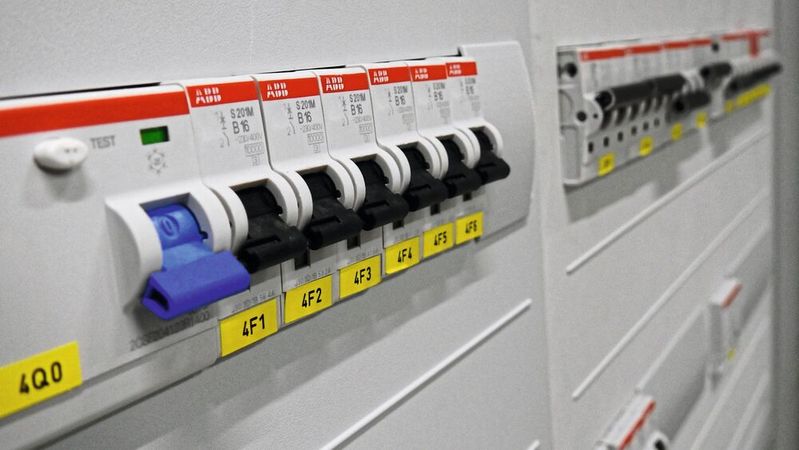
In recent years, the time-tested electromechanical circuit breaker has finally been digitized. New smart variants are more robust, last longer, and, above all, create opportunities to measure electricity in smart factories or buildings.
Smart circuit breakers: They enable control over electricity consumption.
The enthusiasm for intelligent circuit breakers is clearly reflected in their rapid market acceptance. The global market for intelligent circuit breakers was already valued at $2.9 billion in 2023 and, according to Astute Analytica India, is expected to grow to just over $7 billion by 2032, representing an impressive average annual growth rate of 10.3 percent.
While much of this growth is driven by use in industrial environments, the potential savings in terms of efficiency are becoming increasingly hard to ignore in the smart home market as well.
Smart Advantages
As intelligent circuit breakers are semiconductor switching devices, they replace mechanical relays with electronic components. The devices feature wireless connectivity that transmits both operational and control data, allowing the breakers to be remotely monitored and switched on or off. Zigbee and Thread are commonly used connectivity solutions.
Smart circuit breakers can also respond to short circuits a hundred times faster than their electromechanical counterparts, shutting down faults in just a few microseconds.
Smart switches also have a longer lifespan compared to their electromechanical counterparts.
The increased robustness and performance enhancements are enough to justify the use of smart circuit breakers. However, smart switches can also do things that their electromechanical predecessors simply cannot, such as functioning as electrical submeters – providing electricity consumption data at the circuit level.
Facility managers in the industry can use this data to create accurate electricity consumption maps and design more efficient configurations for their power distribution networks: "Is this circuit fully utilized? If not, do I still have enough capacity to connect additional devices?"
Smart switches can also contribute to a predictive maintenance program by detecting anomalies in power consumption, which could indicate early on that adjustments, repairs, or device replacements may be necessary.
The fact that connected intelligent breakers can provide consumption data, combined with the ability to switch them on and off (locally or remotely), makes them valuable tools for commercial property owners and production facility managers aiming to reduce energy consumption and save costs. The breakers’ data can be relied upon to provide accurate insights into energy usage at any given moment as well as over time. Additionally, since they are bidirectional, it is possible to shut off consumers that are not needed at a specific time.
These capabilities have led to the widespread adoption of intelligent circuit breakers in industrial applications. In factories and other industrial settings, only a few machines (sometimes even just a single one) are connected to a specific circuit. This makes it easy to match power conditions and energy consumption trends with behavior, from a specific production hall to an individual machine—depending on what is being powered by the respective circuit.
The same benefits can also be realized in smart buildings and smart homes.
Smart Circuit Breakers for Households
There are only a few household consumers that draw significantly more electricity than most others. These include heating, ventilation, and air conditioning (HVAC) systems, washer-dryers, dishwashers, pool pumps, and chargers for electric vehicles (EV chargers). It is no coincidence that all these systems typically have their own household circuits.
In the past, homeowners rarely needed to monitor or control specific circuits in their homes; monthly electricity bills were sufficient. This is beginning to change as various factors are forcing homeowners to become more aware of their electricity consumption habits.
Some stress factors are general in nature, such as growing environmental concerns, while others are specific, like experiencing rolling brownouts or being surprised by the costs of upgrading a household's electrical system to support an EV charger.
In addition, monthly household electricity bills are becoming increasingly unpredictable as utility companies shift to variable pricing strategies.
Date: 08.12.2025
Naturally, we always handle your personal data responsibly. Any personal data we receive from you is processed in accordance with applicable data protection legislation. For detailed information please see our privacy policy.
Consent to the use of data for promotional purposes
I hereby consent to Vogel Communications Group GmbH & Co. KG, Max-Planck-Str. 7-9, 97082 Würzburg including any affiliated companies according to §§ 15 et seq. AktG (hereafter: Vogel Communications Group) using my e-mail address to send editorial newsletters. A list of all affiliated companies can be found here
Newsletter content may include all products and services of any companies mentioned above, including for example specialist journals and books, events and fairs as well as event-related products and services, print and digital media offers and services such as additional (editorial) newsletters, raffles, lead campaigns, market research both online and offline, specialist webportals and e-learning offers. In case my personal telephone number has also been collected, it may be used for offers of aforementioned products, for services of the companies mentioned above, and market research purposes.
Additionally, my consent also includes the processing of my email address and telephone number for data matching for marketing purposes with select advertising partners such as LinkedIn, Google, and Meta. For this, Vogel Communications Group may transmit said data in hashed form to the advertising partners who then use said data to determine whether I am also a member of the mentioned advertising partner portals. Vogel Communications Group uses this feature for the purposes of re-targeting (up-selling, cross-selling, and customer loyalty), generating so-called look-alike audiences for acquisition of new customers, and as basis for exclusion for on-going advertising campaigns. Further information can be found in section “data matching for marketing purposes”.
In case I access protected data on Internet portals of Vogel Communications Group including any affiliated companies according to §§ 15 et seq. AktG, I need to provide further data in order to register for the access to such content. In return for this free access to editorial content, my data may be used in accordance with this consent for the purposes stated here. This does not apply to data matching for marketing purposes.
Right of revocation
I understand that I can revoke my consent at will. My revocation does not change the lawfulness of data processing that was conducted based on my consent leading up to my revocation. One option to declare my revocation is to use the contact form found at https://contact.vogel.de. In case I no longer wish to receive certain newsletters, I have subscribed to, I can also click on the unsubscribe link included at the end of a newsletter. Further information regarding my right of revocation and the implementation of it as well as the consequences of my revocation can be found in the data protection declaration, section editorial newsletter.
To handle rising demand, increasingly drastic demand peaks, and other grid factors that make grid management a constant challenge, utilities are applying pricing strategies aimed at smoothing consumption. By charging more for household electricity during peak load times and less outside of them, utilities create incentives for private users to shift their use of the most energy-intensive devices to off-peak times.
In response to increasingly extreme heat waves, more people are installing air conditioners (AC) and running them for longer periods. Utility companies may raise prices to encourage customers to moderate their air conditioner usage, thus preventing or mitigating brownouts.
For homeowners, installing smart circuit breakers is one of the few practical mechanisms available to understand their electricity consumption in real-time and take control of their own power usage.
The Possibilities for Households in Europe
Europe, with a market share of over 40 percent, is already the leading regional market for smart circuit breakers, and the region is expected to experience the strongest growth by 2032.
This reflects a broader pursuit of energy efficiency, grid modernization, and the integration of renewable energy sources into the power grid.
In this context, the residential segment is gaining increasing importance as the energy transition in Europe transforms how households generate, store, and manage electricity. Support for smart homes is growing, particularly for the adoption of decentralized energy systems such as rooftop solar panels and battery storage, which require compact, intelligent circuit breakers. This trend aligns well with the smart grid efforts of regional utilities. The data provided by smart homes, including information from intelligent circuit breakers, is highly valuable for utilities as they work to manage power loads more effectively.
Smart meters are becoming increasingly popular across Europe, although progress still varies from market to market. According to the European Commission, 54 percent of European households had a smart meter by the end of 2021, and in 13 EU countries, market penetration had already exceeded 80 percent by the end of 2022.
In Germany, the adoption of smart meters is accelerating due to a legal framework that expands the mandatory installation for defined user groups starting in 2025, with expansion targets set through 2030 and beyond. This is expected to boost demand for smart grid-compatible components such as intelligent circuit breakers. As energy consumption in households becomes more visible and more closely linked to variable supply and pricing, the value of monitoring and controlling consumption at the circuit level will increase.
At the same time, adoption is likely to depend on practical considerations. The costs of upgrades and the difficulty of retrofitting existing installations will remain hurdles in some cases, and the familiarity of installers with smart circuit breaker technologies is also likely to influence the pace of adoption.
Conclusion
There is no question that intelligent circuit breakers in residential settings are practical and essential for making homes more energy-efficient. As with most advancements, the final say lies with market forces required to bring the technology to widespread adoption. However, the arguments for intelligent circuit breakers moving beyond the factory floor into households are compelling and are already revolutionizing grid infrastructure and monitoring in many countries.
*Mark Beecham is Senior Manager Product Marketing at Silicon Labs.



:quality(80)/p7i.vogel.de/wcms/eb/2b/eb2bd1b8487afe577b37363cd02f16ff/0113143253v1.jpeg "In our China Market Insider, we regularly provide you with relevant information straight from China. (Image:© Eisenhans - stock.adobe.com)")
:quality(80)/p7i.vogel.de/wcms/d1/ef/d1ef6b6f7d4543f7999980bacccaf22b/0133499261v1.jpeg "As the growing imbalance in trade relations with China continues to widen, the EU Chamber of Commerce foresees a day when trade with China will have to be seriously reevaluated ... (Image: AI-generated)")
:quality(80)/p7i.vogel.de/wcms/fe/1f/fe1fa5ee713f94deaba963dc24c3abc5/0133299273v1.jpeg "The Flexistar enables highly flexible production of laser-welded tubes thanks to its tool-free clamping system. (Image:Because Technology, LLC)")
:quality(80)/p7i.vogel.de/wcms/1b/5a/1b5ac72f83db4dbee3ff91e51bc398f4/0133496095v1.jpeg "BASF announces that it will take the next step toward producing the polyurethane precursor MDI in India ... (Image:BASF)")
:quality(80)/p7i.vogel.de/wcms/60/ef/60ef4f07e4829b2c2929befc0f353c58/0133511729v1.jpeg "Humanoid robots can match human performance in certain tasks. (Image:Gemini / AI-generated)")
:quality(80)/p7i.vogel.de/wcms/2e/99/2e99726b522e4b35b690e25eb6a42643/0133463991v1.jpeg "Robotics: In AMR applications, connection technology must reliably transmit power, signals, and data despite vibration and shock loads—in very confined spaces and in a way that allows for regular maintenance. (Image:Hyperever)")
:quality(80)/p7i.vogel.de/wcms/d0/18/d01801e3d5dbd7bc9d0b4f60408b630c/0133468429v1.jpeg "Quality requirements for film packaging are on the rise. At the same time, many companies are turning to recyclable film materials, which, however, have their own challenges. Fraunhofer researchers have therefore developed a fast system that detects problems in real time. (Image:Fraunhofer IKTS)")
:quality(80)/p7i.vogel.de/wcms/b1/06/b106cf44923ce39565c3264982fd20eb/0133414574v1.jpeg "Robots Build Robots: At the new Ubtech factory, automated systems even handle parts of the material supply and logistics for the production of humanoid robots. (Image:Ubtech)")
:quality(80)/p7i.vogel.de/wcms/c0/52/c052f405eb55fc3d08c4837e77206fc0/adobestock-2021845957--aucartstudio-stock-adobe-com-ki-generiertv1.jpeg "An innovation from China to combat extreme summer heat: A novel coating lowers temperatures. (Source: © AucArtStudio – stock.adobe.com_AI-generated)")
:quality(80)/p7i.vogel.de/wcms/66/a7/66a7b78159caeacce57136529688799f/0133503398v1.jpeg "Sunlight Makes Stone! These stone blocks weren't made the traditional way. Instead, they were additively manufactured from sand using a laser. In the future, however, the laser is set to be replaced by concentrated sunlight—if the startup Addisol is successful... (Image:Addisol / F. Fiedler)")
:quality(80)/p7i.vogel.de/wcms/72/b9/72b995c2c8d812c5e2115cbef31e035a/0133462727v1.jpeg "Eggl manufactures center hoods that are precisely tailored to each cooking island—whether standard size or custom shape. They are made entirely of stainless steel and are individually customized in terms of size and filter arrangement. (Image:SPI)")
:quality(80)/p7i.vogel.de/wcms/13/5d/135dfae6229ceaf5c55467a43e8f7257/adobestock-1879961393--ardi-stock-adobe-com-ki-generiertv1.jpeg "Annoying chatterboxes or awkward silences in response to questions—a moderator should specifically prepare for difficult situations in order to navigate them effectively. (Image:ardi - stock.adobe.com_AI-generated)")
:quality(80)/p7i.vogel.de/wcms/aa/a2/aaa2c6dd2daa24b485cddbf9297590c0/0133467318v1.jpeg "Battery Monitoring: Battery monitoring using electrochemical impedance spectroscopy offers several advantages. (Image:TI)")
:quality(80)/p7i.vogel.de/wcms/39/b2/39b21bf03be1683831862239a369987c/0133469638v1.jpeg "Data from autonomous vehicles and robots operating autonomously is in high demand, and Ruqi wants to capitalize on this. (Image:Ruqi Mobility)")
:quality(80)/p7i.vogel.de/wcms/8a/bb/8abbb6217220595edc1549ac9b84f307/0133429906v1.jpeg "The IAA in Hanover showcased the ambitions of Chinese commercial vehicle manufacturers in Europe. (Image:Wehner - VCG)")
:quality(80)/p7i.vogel.de/wcms/0c/53/0c5313ef91c14b6df0d0996efc33c8ad/jpg03568-bearbeitetv1.jpeg "The category winners of the 2027 German Car of the Year award. (Source: GCOTY)")
:quality(80)/p7i.vogel.de/wcms/17/2b/172bd132f9febdfcbcedba292ad0504d/aufmacherv1.jpeg "Micro-Epsilon offers a wide range of IO-Link-compatible sensors. (Source: Micro-Epsilon Messtechnik GmbH & Co. KG)")
:quality(80)/p7i.vogel.de/wcms/ca/b4/cab46fd26d19d6a2febca032048200b6/0133471827v1.jpeg "Photonics SDK for C and Python: Computational operations are now abstracted as standard mathematical functions. (Image:Q.ANT)")
:quality(80)/p7i.vogel.de/wcms/92/b2/92b2ed5299cde450c0764f4f64468395/0133505895v1.jpeg "The \"Iris 100\" test system for high-precision volume production of microLEDs uses a spectrometer and a high-resolution camera. (Image:Teradyne)")
:quality(80)/p7i.vogel.de/wcms/f3/d8/f3d870d8f31a5a5110449c929ea3e641/0133470449v1.jpeg "The new Nexora sensor family from Teledyne e2v: These CMOS image sensors combine BSI technology with a global shutter and are available in 12- and 16-megapixel versions. (Image:Teledyne)")
:fill(fff,0)/p7i.vogel.de/companies/69/88/69882c428938e/tmts2026-ticec-banner-en-2000px.png "tmts2026-ticec-banner-en-2000px (https://www.tmts.tw/en)")
:quality(80)/p7i.vogel.de/wcms/ff/e5/ffe5e4cedd694ab4d6f56e75457c6753/sentron-3qd2-sccb-ultra-fast-reaction-dev1.jpeg "A key innovation in the new portfolio is the semiconductor circuit breaker Sentron 3QD2. Thanks to semiconductor technology and intelligent protection algorithms, it enables ultra-fast disconnection of short-circuit currents in the microsecond range – up to 1,000 times faster than conventional systems. (Image:Siemens)")
:quality(80)/p7i.vogel.de/wcms/48/71/4871462eff61cbe2897297d90af45145/0133016766v1.jpeg "Contactors vs. High-Current Relays: Contactors are considered the “kings” of high-current switching. However, high-current relays are now also making their mark in this area. (Image:Omron)")
:quality(80)/p7i.vogel.de/wcms/2a/2a/2a2a10fc0bba59cf59816abb8fecfd42/0132450232v1.jpeg "In addition to global crises and high customer demands, mechanical engineers must respond to rising energy prices and data-driven processes. (Image:Gemini / AI-generated)")