Schneto AG specializes in bar turning and has both multi-spindle and single-spindle automatic lathes. The batch sizes are large and process reliability is one of the key factors in production.
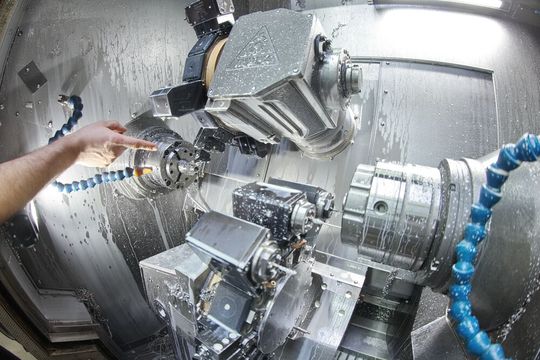
View of a turning center on which the new indexable inserts and tool holders from Kyocera were being used during the SMM editorial team's visit.
(Image: Matthias Böhm)
There is currently an increasing number of inquiries for the machining of 1.4404, a ductile stainless steel with the property of producing long whirling chips during turning. Due to this chip behavior, the specialists at Schneto AG were looking for a new tool solution. Together with Vischer & Bolli AG, they tested indexable inserts from Kyocera, which proved to be a resounding machining success.
With 1.4404 instead of 1.4305, the bar material only differs by two numbers. However, for turning operations, this change in material represents a "huge challenge within the production process", as Michael Baumann, Managing Director of Schneto AG, explains to the SMM editorial team.
Schneto AG: 30 employees, 14 CNC turning centers
30 employees at Schneto AG have to keep a machine tool park of 14 CNC turning centers running around the clock. In addition to several single- and twin-spindle CNC automatic lathes, the machine park also includes three CNC multi-spindle automatic lathes. There are also high-precision automatic lathes for hard and precision turning. As a contract manufacturer, Schneto AG operates flexibly and focuses on customer requirements, as Michael Baumann emphasizes: "As a contract manufacturer, we have to process the materials that we receive as part of customer orders. There have been continuous changes here in recent years. Stainless steels in particular have a significant impact on production and process reliability. In the past, some of our customers switched from stainless 1.4305 (short-breaking free-cutting steel) to the stainless alloy 1.4404." The material 1.4404 is a stainless alloy that is not optimized for machinability. It is a pure construction material that is designed for specific applications with correspondingly positive design properties, but with negative effects on the machining behavior. It is important to know that in both turning and drilling—unlike milling—chip formation is crucial when it comes to process reliability. In the case of turning, short-breaking chips are crucial so that the machine can run with minimal operator intervention. Process reliability plays an important role in terms of both quality and cost-effectiveness. With multi-spindle machines, nothing works without process reliability; components made of 1.4404 could previously only be manufactured on multi-spindle machines with restrictions.
Lead and Sulphur Reduce the Ductility of the Material
In order to achieve good machinability, small amounts of lead and/or sulphur are alloyed into the free-cutting steels. These alloying elements reduce the ductility (toughness) of the material and are responsible for the formation of short-breaking chips during turning. However, both sulphur and lead influence the material characteristics and weldability. A similar trend can be observed in the field of brass alloys. Due to the increasing demand for lead-free brass components, which also exhibit long-chipping machining behavior, tool and machining specialists are required to develop appropriate solutions.
How does this Manifest Itself in Everyday Life?
Fabrizio Liberatore, Head of Sales and Technology at Schneto AG: "Previously, we were able to turn components made of stainless free-cutting steel such as 1.4305 on both single-spindle and multi-spindle machines in a reliable and low-operation process. When our customers switched to 1.4404, we were practically no longer able to produce the components on multi-spindle machines with our previous tools. Tool wear increased and long flowing chips disrupted the turning process. Time and again, we had to interrupt the process because chips were getting caught. The amount of work involved was enormous and process reliability was definitely no longer guaranteed. With multi-spindle machines, that's the worst case scenario. When we switched to single-spindle machines with these components, the situation only became more manageable to a limited extent. Production costs rose massively because our employees had to constantly monitor the process and intervene. We had to find a solution."
"Kyocera? I thought he Wanted to sell me a Printer"
"And it was at this point that a bit of coincidence certainly came into play when Niklaus Isenegger, technical sales consultant at Vischer & Bolli AG, visited us and introduced us to the new indexable inserts from Kyocera. When he mentioned Kyocera, I thought he was trying to sell me a printer. I didn't know Kyocera as a tool manufacturer and today I have to say that this was a real knowledge gap from a machining point of view," says Henryk Huhn, application engineer at Schneto AG. Fabian Wettstein, Managing Director of Vischer & Bolli AG: "We know Kyocera as a printer manufacturer, where they are active in advertising. However, Kyocera has never really advertised its tool segment in Switzerland. And in fact, Kyocera has little presence as a tool manufacturer in Switzerland. In recent years, we have been able to convince more and more customers of the advantages of Kyocera technology. But our commitment goes far beyond technical expertise—we see ourselves as genuine brand ambassadors. Through targeted market development, the Kyocera brand is continuously gaining awareness and trust. Our aim is not just to deliver innovation and quality, but to make them tangible. That is why we have to position ourselves technologically. And the users who use our Kyocera tools very quickly recognize that they are operating in the top segment of machining with these tools." Niklaus Isenegger adds: "This means that if we can convince our customers to run tests, then there is a high probability that we will go into production with Kyocera tools, as in this case at Schneto, where we were able to break down open doors after the first test runs, which was really pleasing."
Date: 08.12.2025
Naturally, we always handle your personal data responsibly. Any personal data we receive from you is processed in accordance with applicable data protection legislation. For detailed information please see our privacy policy.
Consent to the use of data for promotional purposes
I hereby consent to Vogel Communications Group GmbH & Co. KG, Max-Planck-Str. 7-9, 97082 Würzburg including any affiliated companies according to §§ 15 et seq. AktG (hereafter: Vogel Communications Group) using my e-mail address to send editorial newsletters. A list of all affiliated companies can be found here
Newsletter content may include all products and services of any companies mentioned above, including for example specialist journals and books, events and fairs as well as event-related products and services, print and digital media offers and services such as additional (editorial) newsletters, raffles, lead campaigns, market research both online and offline, specialist webportals and e-learning offers. In case my personal telephone number has also been collected, it may be used for offers of aforementioned products, for services of the companies mentioned above, and market research purposes.
Additionally, my consent also includes the processing of my email address and telephone number for data matching for marketing purposes with select advertising partners such as LinkedIn, Google, and Meta. For this, Vogel Communications Group may transmit said data in hashed form to the advertising partners who then use said data to determine whether I am also a member of the mentioned advertising partner portals. Vogel Communications Group uses this feature for the purposes of re-targeting (up-selling, cross-selling, and customer loyalty), generating so-called look-alike audiences for acquisition of new customers, and as basis for exclusion for on-going advertising campaigns. Further information can be found in section “data matching for marketing purposes”.
In case I access protected data on Internet portals of Vogel Communications Group including any affiliated companies according to §§ 15 et seq. AktG, I need to provide further data in order to register for the access to such content. In return for this free access to editorial content, my data may be used in accordance with this consent for the purposes stated here. This does not apply to data matching for marketing purposes.
Right of revocation
I understand that I can revoke my consent at will. My revocation does not change the lawfulness of data processing that was conducted based on my consent leading up to my revocation. One option to declare my revocation is to use the contact form found at https://contact.vogel.de. In case I no longer wish to receive certain newsletters, I have subscribed to, I can also click on the unsubscribe link included at the end of a newsletter. Further information regarding my right of revocation and the implementation of it as well as the consequences of my revocation can be found in the data protection declaration, section editorial newsletter.
New Tools Enable Productivity Boosts
Fabrizio Liberatore: "As a supplier company, we have to constantly develop our machining technology. New tool developments are the easiest way for us to generate productivity boosts with relatively little investment. That's why we are in constant contact with our tool suppliers and evaluate their new developments. When Niklaus Isenegger made the appointment with us, there was the aforementioned problem of unresolved chip breakage when machining 1.4404."
Perfect Chip Breaking—Process-Safe for Triple Tool Life
"Then everything happened very quickly. I like testing, and Niklaus Isenegger had brought me some tool holders including indexable inserts. The indexable inserts from Kyocera were simply outstanding in several respects. Firstly, they produced reliable chip breaking during both roughing and finishing. Secondly, we were able to triple the tool life in some cases compared to the indexable inserts previously used. And best of all, the Kyocera indexable inserts are also cheaper than those of the competition. Everything was just right. At the moment, we are perfectly on track with Kyocera in terms of machining technology," explains Henryk Huhn. Fabian Wettstein says about chip breaking: "Chip breaking is achieved on the one hand by the macro and micro geometry. You have to shape and compress the chip specifically so that it breaks safely. On the other hand, it depends on the cooling holes in the tool holders, through which the cutting zone is cooled very precisely and directly with high cooling lubricant pressure both on the main cutting edge and on the flank faces. On the one hand, this ensures rapid cooling and, on the other, reduces the ductility of the chip, which also promotes chip breaking."
Reliable Chip Management and Fewer Tool Changes
Fabrizio Liberatore: "For us, such tool technology developments are absolutely crucial because we can take the strain off the machine operators. They now have to intervene less frequently in the process because chip management is once again guaranteed by the chip breaker and because the tools only have to be changed half as often. This instantly increases process reliability and productivity. With the new indexable inserts, we can once again manufacture within an acceptable cost framework." Henryk Huhn adds: "It wasn't just the 1.4404 stainless steel that caused us headaches. The machining problems regarding chip breaking were very similar with the hot-work tool steel 1.2714 (5NiCrMoV7). With this material, too, we were able to achieve optimum chip breaking with double the tool life using the indexable inserts from Kyocera. We are currently using the CNMG and DMNG insert geometries, both negative insert geometries. The chip breaking is excellent for both roughing and finishing inserts. We had also tested Viper geometries from Kyocera in this context, but could not detect any improvement in surface quality. Negative insert geometries have twice as many cutting edges as the viper geometries, which reduces costs."
New Substrate and high Performance Coatings
Fabian Wettstein: "The indexable inserts have a very high cutting ability. Kyocera has developed a new ultra-fine grain substrate that is very homogeneous, so that very small cutting radii can be precision sintered. In addition, you can choose from PVD or CVD coatings that are perfectly designed for the material to be machined."
Optimum Cutting Values in the Vischer & Bolli web Store
Henryk Huhn: "Apart from the fact that the Kyocera tools do an excellent job for us, I have to praise the Vischer & Bolli website at this point. As a user, I always have to get to grips with the cutting data and potential tool life. That is ultimately our know-how. However, when new tools are used, I first have to use the manufacturer's recommended cutting data as a guide. Some manufacturers specify values of 10 to 300 cutting meters (approx. 33 to 984 ft) at a feed rate of 0.1 to 0.4 mm/rev. These are fantasy values. If I could run cutting values of 200 m/min (approx. 656 ft/min) in 1.4404, that would be great, but if this massively reduces the tool life and/or the chips don't break, we don't benefit from the high cutting values. Vischer & Bolli provide excellent, material-specific reference values, which are also very clearly documented. Specifically, Vischer & Bolli specifies a reference value of 120 cutting meters (approx. 394 ft) at a feed rate of two tenths for the material 1.4404—and it works." "Such broad cutting data ranges don't help the user. This is part of our expertise, which we have consistently stored in the data and continuously adapt. The machine operator can start with these values and approach their optimum. Depending on the chip volume, series size, etc., the individual values vary," adds Fabian Wettstein. Fabrizio Liberatore: "Finally, I would like to emphasize that the collaboration with Vischer & Bolli in this application was extremely professional and structured. We will certainly continue to rely on Vischer & Bolli's expertise for future manufacturing projects and I am sure that we won't have to ask them again if they want to sell us a printer."



:quality(80)/p7i.vogel.de/wcms/a0/47/a04725ef9bd09fb6c9341a1bea1b5d93/0130443083v1.jpeg "Here, a type of plastic pallet is produced by thermoforming (vacuum forming or deep drawing) at the corresponding division of New England Plastics in the USA. This division, which specializes in so-called liners, is now part of Ringmetall ... (Image:New England Plastics)")
:quality(80)/p7i.vogel.de/wcms/e3/42/e342b3c593ea92d56604d3be969e9c9a/0130437231v1.jpeg "Daimler Truck will be building even more trucks at its Czech plant in Cheb in the future. This is because it is now being expanded for strategic cost-saving reasons ... (Image:Daimler Truck)")
:quality(80)/p7i.vogel.de/wcms/23/99/23992bf2dcdc432c9b7209c34a4a7c48/0129733089v1.jpeg "Stork relies on the modular Neoswiss turning system from Iscar to shorten the set-up times for its sliding headstock lathes and work more productively. (Image:Iscar)")
:quality(80)/p7i.vogel.de/wcms/7d/e2/7de2923434b2f1a78ba5482d8d335269/0113143253v1.jpeg "In our China Market Insider we regularly provide you with relevant information directly from China. (Image:© Eisenhans - stock.adobe.com)")
:quality(80)/p7i.vogel.de/wcms/b7/36/b736dfebc16c42d6901d0d0e1f390493/3d-druck-20factory-20--20ki-20generiert-1920x1079v1.png "(Source: AI-generated)")
:quality(80)/p7i.vogel.de/wcms/79/b2/79b21aad663f4a7bd4472afc1c1afc62/0130433994v1.jpeg "Mission Joyride: The free-flying robot (shown here in the rendering) will relieve the ISS crew of logistics tasks from 2027 with its two mechanical arms. (Image:Icarus Robotics)")
:quality(80)/p7i.vogel.de/wcms/6b/45/6b4546fa6ebf305c3660326909363f32/0130437089v1.jpeg "Industrial AI in action: Rockwell Automation presents practical solutions for self-controlling production systems at the Hannover Messe. (Image:Rainer Jensen, Deutsche Messe)")
:quality(80)/p7i.vogel.de/wcms/78/e9/78e9188c25a8a94e67c34c9bf8ffe495/visual-agile-20robots-20and-20google-20deepmind-20partner-20to-20bring-20intelligence-20to-20robotics-2500x1406v1v1.jpeg "Together, the partners are developing adaptable, intelligent robots for a wide range of applications (Image:Agile Robots SE)")
:quality(80)/p7i.vogel.de/wcms/59/a2/59a2b11f0aa1b700eff02addd5de8703/adobestock-1788280853--c2-a9-20satria-20-e2-80-93-20stock-adobe-com-5081x2860v1v1.jpeg "Quantum computers require extreme cooling to temperatures close to absolute zero in order to keep qubits stable. (Image:satria - stock.adobe.com)")
:quality(80)/p7i.vogel.de/wcms/62/5f/625f41e87ebfef156a98c8e6393e32fd/0130211654v1.jpeg "Axial flux motors have some advantages over radial flux motor—but their production is currently still expensive. (Image:RWTH Aachen University)")
:quality(80)/p7i.vogel.de/wcms/f6/ae/f6aec4f6241b36ed5e3a990ac9176b42/0130429460v1.jpeg "Verne, Pony.ai and Uber want to launch a robotaxi service in Europe. (Image:Verne)")
:quality(80)/p7i.vogel.de/wcms/d7/88/d788699f2974708a332baa4e7a62fa9e/0130438967v1.jpeg "Skoda is withdrawing from China. The brand has produced well over three million vehicles there. (Image:Skoda car)")
:quality(80)/p7i.vogel.de/wcms/b0/43/b043b86899837532aad62d63368a917a/0130371361v1.jpeg "Skoda leaves the chinese market.
(Image:Skoda)")
:quality(80)/p7i.vogel.de/wcms/c3/c4/c3c4ce270b083eeac55654148611f064/0130237945v1.jpeg "China is not giving up on hydrogen, but is intensifying its efforts. (Image:freely licensed from Pixabay)")
:quality(80)/p7i.vogel.de/wcms/ee/09/ee09acbd6dc896df25affaa9e871e6e5/0130440053v1.jpeg "IMS chip module for simple system integration into an ion mobility spectrometer. (Image:Fraunhofer IPMS)")
:quality(80)/p7i.vogel.de/wcms/10/6c/106cd22de5f68a0f74639d654827228c/0130345302v1.jpeg "Made in India: According to the India Electronics and Semiconductor Association (IESA), the country should be able to produce between 75 and 80 million chips by the beginning of 2027, once the plants currently under construction become operational. (Image:Pixabay (Montage: Sebastian Gerstl))")
:quality(80)/p7i.vogel.de/wcms/a5/ed/a5ed6fda029d362732a293d6b19d74c4/0130444216v1.jpeg "Thirteen executives from the Chinese chip industry have drawn up a plan to achieve an 80% self-sufficiency rate for semiconductors by 2030. (Image:Maxim_Kazmin - stock.adobe.com)")
:quality(80)/p7i.vogel.de/wcms/31/a6/31a646018b34d8e0a44bfc8bf17837f6/0130361632v1.jpeg "For many companies, PFAS are considered indispensable in electronics production. (Image:freely licensed)")
:fill(fff,0)/images.vogel.de/vogelonline/companyimg/76800/76895/65.jpg "FAULHABER_120mm.jpg ()")
:quality(80)/p7i.vogel.de/wcms/4d/5c/4d5c98a2395a7de7181c923a42238c72/0123057794v1.jpeg "View of the machining process: The main cutting edge of the Kyocera indexable insert cannot be seen due to the arrangement of the turning tool.(Image: Matthias Böhm)")
:quality(80)/p7i.vogel.de/wcms/c8/3f/c83f2044e1bd13a41e32c4df44226286/0122954181v1.jpeg "View of a turning center on which the new indexable inserts and tool holders from Kyocera were being used during the SMM editorial team's visit.(Image: Matthias Böhm)")
:quality(80)/p7i.vogel.de/wcms/30/94/309476c1ac8269249cfe4be152232f2a/0122952410v1.jpeg "Niklaus Isenegger (left, Technical Sales Consultant, Vischer & Bolli AG), Henryk Huhn (center, Application Engineer Schneto AG) and Fabian Wettstein (Management, Vischer & Bolli AG) are very satisfied with the machining results of the new Kyocera indexable inserts.(Image: Matthias Böhm)")
:quality(80)/p7i.vogel.de/wcms/eb/cf/ebcfae6eef28b907bffc7ded2ae06851/0122952052v1.jpeg "Fabrizio Liberatore (left, Head of Sales and Technology, Schneto AG) appreciates the professional collaboration with production specialist Niklaus Isenegger from Vischer & Bolli AG.(Image: Matthias Böhm)")
:quality(80):fill(efefef,0)/p7i.vogel.de/wcms/67/ad/67adf92d254d2/elatec-wp-smart-factory.png "Elatec WP Smart Factory")
:quality(80)/p7i.vogel.de/wcms/d6/8e/d68ef2feb221883f28f9e55f39baed08/0124337731v1.jpeg "Sandvik Coromant expands CoroCut 2 with the new and updated -GL and -CR geometries. (Image:Sandvik Coromant)")
:quality(80)/p7i.vogel.de/wcms/3c/63/3c638914e2a9609cba95a835ca346692/0124883810v1.jpeg "Adapted cutting geometries provide a high level of process reliability when machining lead-free materials. (Image:Horn/Sauermann)")