Car DesigningRolls-Royce Customizations: An Exclusive Designer Task
Source:
sp-x | Translated by AI
5 min Reading Time
Four Cars in a Scant Decade: As a coachbuilding designer for Rolls-Royce's most exclusive vehicles, Alex Innes has perhaps the most extraordinary job in his profession – and one with a future.
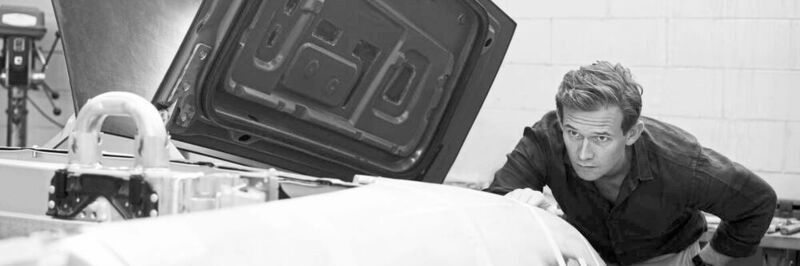
Designer Alex Innes is responsible for the exclusive customizations at Rolls-Royce.
(Picture: Rolls Royce Rolls Royce)
These days, anyone searching for a job as an auto designer on major job portals will come across dozens of offers, mostly from industry suppliers. Infotainment interfaces, buttons and switches, or frunk covers are the content that aspiring designers can expect to work on in the coming years. Additionally, BMW, as the only manufacturer on the portal, is looking for a creative force to enhance display graphics. Every beginning is indeed challenging – and sometimes long, long, boring until it eventually comes to designing a car. Except for Alex Innes: The Briton still can't quite believe his luck today, 14 years after starting his first job: "I was just in the right place at the right time." And that place is called Rolls-Royce. Even as an auto design student at Coventry University, he was able to convince partners of his ideas in several discussions. "The brand should become bolder, younger, more emotional," says Innes – and certainly sell a few more than the 500 vehicles per year back then.
Many customizations planned for the coming years
The youthful applicant apparently embodied as a person exactly what the cars themselves were yet to become. A suit jacket made of fine fabric, but also a leather wristband, a smartwatch, a T-shirt, and a three-day beard: This was not the world of awe-inspiring cathedrals like the Phantom in 2008 – but precisely the world of the new customer generation in California, China, or Arabia. And for them, the brand from the BMW Group needed a face.
The wiry designer Innes seems to fit better with today's Rolls-Royce lineup, including the sporty two-door Wraith, the convertible Dawn, or the SUV Cullinan—especially with statements like the deep black "Black Badge" editions. The 37-year-old has worked on various aspects of all these new Rolls models – almost ironically, coinciding with the tenfold increase in sales of the most exclusive vehicles in the entire range: the customizations. In these cases, even the bodywork is redesigned. Made by Alex Innes, the Head of Coachbuilding. Many such unique creations are set to be produced in the coming years.
Designed four unique creations so far
There is one "Sweptail" and three "Boattail": Only four vehicles have been designed from scratch with this highest level of effort for special customers. It's not so much about the double-digit million sum that such a unique creation costs the owner. Money is usually not an issue for the upscale clientele that desires a Rolls – and for mahogany root wood, real gold accents, built-in bars, porcelain inlays, gun cabinets, or rolling cinemas, the high-end Rolls-Royce customers are willing to add another hundred thousand euros to the purchase prices. On the other hand, a completely new body is a wish that even Rolls-Royce may not want to fulfill for everyone: "All car designers must anticipate what consumers will want in four or five years. I can only do it hand in hand with the client; almost like an architect when building a villa." However, the result should fit both the customer and the future image of Rolls-Royce. "Therefore, we are looking for people who are deeply connected to the brand," explains Innes, the special effort that every other manufacturer has avoided so far.
Inspired by architecture and shipbuilding
His initial dialogue partners in the quest for a distinctive form are the participants of the "Whisper" program. The approximately 120 Rolls-Royce Whisperers worldwide already regularly get a sneak peek into where the creative journey at Rolls-Royce is headed. Many of these individuals, who often already own a few products from Goodwood in their own garages, contribute their own ideas. From a carbon-fiber folding stool in the rear to the curve of the fenders.
Less ostentation, more "post-opulent" is the line that Innes sets for the brand. He embraces such ideas, translates them into drawings on the whiteboard or tablet and models in clay – and ultimately into a unique form for the dream vehicle. "Certainly, my enthusiasm for architecture and shipbuilding also inspires me," says the designer. Take the Boattail, for example: The classic stern of a luxurious J-Class sailing yacht reflects the preferences of the typical Rolls-Royce clientele – but it also harks back to vehicles from the manufacturer in the Roaring Twenties. "It's important for us to connect to cars from our history," says Innes. After all, the brand's history is a value that new competitors from Asia or the USA cannot replicate.
E-Mobility: Innes is looking forward to fewer constraints
But of course, success in the future is inconceivable without electrification and digitally connected, autonomously driving cars, even at Rolls-Royce. The days of the twelve-cylinder mountain under the hood are numbered, and with the Spectre, the first electric car is also set to enter series production in Goodwood. Body designer Innes is excited about "significantly fewer constraints for us designers." In a way, the brand can return to its roots. In 1903, Henry Royce initially started by manufacturing the chassis components – frame, engine, transmission, axles, brakes, and wheels – along with the temple-like radiator grille and the "Spirit of Ecstasy" figurine on top. Customers then took the chassis to coachbuilders who added the body, seats, interior trim, or dashboard.
Innes says that the skateboard-like electric platforms now make a similar division of labor possible again. His team is expected to take on the tasks that were traditionally handled by external bodybuilders in the past.
Date: 08.12.2025
Naturally, we always handle your personal data responsibly. Any personal data we receive from you is processed in accordance with applicable data protection legislation. For detailed information please see our privacy policy.
Consent to the use of data for promotional purposes
I hereby consent to Vogel Communications Group GmbH & Co. KG, Max-Planck-Str. 7-9, 97082 Würzburg including any affiliated companies according to §§ 15 et seq. AktG (hereafter: Vogel Communications Group) using my e-mail address to send editorial newsletters. A list of all affiliated companies can be found here
Newsletter content may include all products and services of any companies mentioned above, including for example specialist journals and books, events and fairs as well as event-related products and services, print and digital media offers and services such as additional (editorial) newsletters, raffles, lead campaigns, market research both online and offline, specialist webportals and e-learning offers. In case my personal telephone number has also been collected, it may be used for offers of aforementioned products, for services of the companies mentioned above, and market research purposes.
Additionally, my consent also includes the processing of my email address and telephone number for data matching for marketing purposes with select advertising partners such as LinkedIn, Google, and Meta. For this, Vogel Communications Group may transmit said data in hashed form to the advertising partners who then use said data to determine whether I am also a member of the mentioned advertising partner portals. Vogel Communications Group uses this feature for the purposes of re-targeting (up-selling, cross-selling, and customer loyalty), generating so-called look-alike audiences for acquisition of new customers, and as basis for exclusion for on-going advertising campaigns. Further information can be found in section “data matching for marketing purposes”.
In case I access protected data on Internet portals of Vogel Communications Group including any affiliated companies according to §§ 15 et seq. AktG, I need to provide further data in order to register for the access to such content. In return for this free access to editorial content, my data may be used in accordance with this consent for the purposes stated here. This does not apply to data matching for marketing purposes.
Right of revocation
I understand that I can revoke my consent at will. My revocation does not change the lawfulness of data processing that was conducted based on my consent leading up to my revocation. One option to declare my revocation is to use the contact form found at https://contact.vogel.de. In case I no longer wish to receive certain newsletters, I have subscribed to, I can also click on the unsubscribe link included at the end of a newsletter. Further information regarding my right of revocation and the implementation of it as well as the consequences of my revocation can be found in the data protection declaration, section editorial newsletter.
Fundamentals like software remain unchanged
However, in these new times, despite all the customization, the usual approvals from regulatory authorities around the world are still required – maintaining a close connection with the engineers at the parent company, BMW. This is likely one reason why Innes has recently moved to Munich with his wife and two daughters. Because fundamentals such as crash structures, software, or drivetrain are off-limits even for the most creative designer and his luxury clients. For a technical base model of his creations, like the current Phantom, there has already been a worldwide approval from authorities, and this configuration cannot be altered. With a closer spatial connection to the developers in the company, Innes can further enhance his understanding of these constraints. Does this impact creative freedom? "The customers will prevent that," says Innes, beaming like a child in a candy store. "That's one of the most enjoyable things about bodybuilding – we can realize anything." Well, almost anything.



:quality(80)/p7i.vogel.de/wcms/a0/47/a04725ef9bd09fb6c9341a1bea1b5d93/0130443083v1.jpeg "Here, a type of plastic pallet is produced by thermoforming (vacuum forming or deep drawing) at the corresponding division of New England Plastics in the USA. This division, which specializes in so-called liners, is now part of Ringmetall ... (Image:New England Plastics)")
:quality(80)/p7i.vogel.de/wcms/e3/42/e342b3c593ea92d56604d3be969e9c9a/0130437231v1.jpeg "Daimler Truck will be building even more trucks at its Czech plant in Cheb in the future. This is because it is now being expanded for strategic cost-saving reasons ... (Image:Daimler Truck)")
:quality(80)/p7i.vogel.de/wcms/23/99/23992bf2dcdc432c9b7209c34a4a7c48/0129733089v1.jpeg "Stork relies on the modular Neoswiss turning system from Iscar to shorten the set-up times for its sliding headstock lathes and work more productively. (Image:Iscar)")
:quality(80)/p7i.vogel.de/wcms/7d/e2/7de2923434b2f1a78ba5482d8d335269/0113143253v1.jpeg "In our China Market Insider we regularly provide you with relevant information directly from China. (Image:© Eisenhans - stock.adobe.com)")
:quality(80)/p7i.vogel.de/wcms/b7/36/b736dfebc16c42d6901d0d0e1f390493/3d-druck-20factory-20--20ki-20generiert-1920x1079v1.png "(Source: AI-generated)")
:quality(80)/p7i.vogel.de/wcms/79/b2/79b21aad663f4a7bd4472afc1c1afc62/0130433994v1.jpeg "Mission Joyride: The free-flying robot (shown here in the rendering) will relieve the ISS crew of logistics tasks from 2027 with its two mechanical arms. (Image:Icarus Robotics)")
:quality(80)/p7i.vogel.de/wcms/6b/45/6b4546fa6ebf305c3660326909363f32/0130437089v1.jpeg "Industrial AI in action: Rockwell Automation presents practical solutions for self-controlling production systems at the Hannover Messe. (Image:Rainer Jensen, Deutsche Messe)")
:quality(80)/p7i.vogel.de/wcms/78/e9/78e9188c25a8a94e67c34c9bf8ffe495/visual-agile-20robots-20and-20google-20deepmind-20partner-20to-20bring-20intelligence-20to-20robotics-2500x1406v1v1.jpeg "Together, the partners are developing adaptable, intelligent robots for a wide range of applications (Image:Agile Robots SE)")
:quality(80)/p7i.vogel.de/wcms/59/a2/59a2b11f0aa1b700eff02addd5de8703/adobestock-1788280853--c2-a9-20satria-20-e2-80-93-20stock-adobe-com-5081x2860v1v1.jpeg "Quantum computers require extreme cooling to temperatures close to absolute zero in order to keep qubits stable. (Image:satria - stock.adobe.com)")
:quality(80)/p7i.vogel.de/wcms/62/5f/625f41e87ebfef156a98c8e6393e32fd/0130211654v1.jpeg "Axial flux motors have some advantages over radial flux motor—but their production is currently still expensive. (Image:RWTH Aachen University)")
:quality(80)/p7i.vogel.de/wcms/f6/ae/f6aec4f6241b36ed5e3a990ac9176b42/0130429460v1.jpeg "Verne, Pony.ai and Uber want to launch a robotaxi service in Europe. (Image:Verne)")
:quality(80)/p7i.vogel.de/wcms/d7/88/d788699f2974708a332baa4e7a62fa9e/0130438967v1.jpeg "Skoda is withdrawing from China. The brand has produced well over three million vehicles there. (Image:Skoda car)")
:quality(80)/p7i.vogel.de/wcms/b0/43/b043b86899837532aad62d63368a917a/0130371361v1.jpeg "Skoda leaves the chinese market.
(Image:Skoda)")
:quality(80)/p7i.vogel.de/wcms/c3/c4/c3c4ce270b083eeac55654148611f064/0130237945v1.jpeg "China is not giving up on hydrogen, but is intensifying its efforts. (Image:freely licensed from Pixabay)")
:quality(80)/p7i.vogel.de/wcms/ee/09/ee09acbd6dc896df25affaa9e871e6e5/0130440053v1.jpeg "IMS chip module for simple system integration into an ion mobility spectrometer. (Image:Fraunhofer IPMS)")
:quality(80)/p7i.vogel.de/wcms/10/6c/106cd22de5f68a0f74639d654827228c/0130345302v1.jpeg "Made in India: According to the India Electronics and Semiconductor Association (IESA), the country should be able to produce between 75 and 80 million chips by the beginning of 2027, once the plants currently under construction become operational. (Image:Pixabay (Montage: Sebastian Gerstl))")
:quality(80)/p7i.vogel.de/wcms/a5/ed/a5ed6fda029d362732a293d6b19d74c4/0130444216v1.jpeg "Thirteen executives from the Chinese chip industry have drawn up a plan to achieve an 80% self-sufficiency rate for semiconductors by 2030. (Image:Maxim_Kazmin - stock.adobe.com)")
:quality(80)/p7i.vogel.de/wcms/31/a6/31a646018b34d8e0a44bfc8bf17837f6/0130361632v1.jpeg "For many companies, PFAS are considered indispensable in electronics production. (Image:freely licensed)")
:quality(80)/p7i.vogel.de/wcms/ad/36/ad36cc68171de059a81ce58ee42eb843/0124999278v1.jpeg "Almost 100 years of car manufacturing separate these two Rolls-Royce Phantoms. (Image:Rolls-Royce)")
:quality(80)/p7i.vogel.de/wcms/ee/99/ee99d84cf159f9362b968f7c587159e2/0124834487v1.jpeg "Pure elegance: European premiere of the concept vehicle Genesis X Gran Convertible in early May in Munich. (Image:Jules Foto Garage)")