Hardly any car has endured as much as the Rolls-Royce Phantom. The series has been around for exactly 100 years now. Time for an anniversary drive.
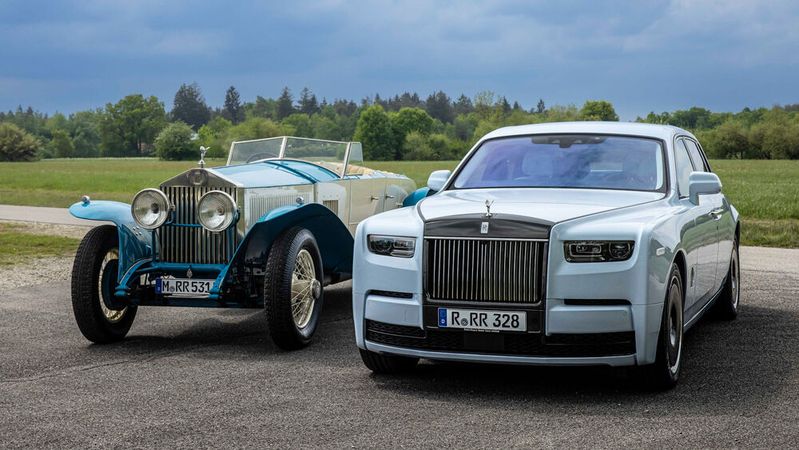
Almost 100 years of car manufacturing separate these two Rolls-Royce Phantoms.
(Image: Rolls-Royce)
The Golf has been around since 1974, the Corolla since 1966, and the Mercedes SL since 1954. But with all due respect, they are youngsters compared to the Rolls-Royce Phantom. This model has been around for a hundred years - it is likely to become by far the oldest car still being built in the world. Although the name has something ethereal, almost fleeting, the car proves to be at least as enduring as Big Ben or Buckingham Palace. And despite the long production time, it remains similarly exclusive. According to the official estimate from Goodwood, no more than 15,000 vehicles are likely to have been built in these 100 years.
The Phantom is the longest-built model of Messrs. Charles Rolls and Henry Royce, but not the oldest. Their history begins in 1906 with the 40/50 H.P. Silver Ghost. The two founders quickly realized that they needed progress if they wanted to defend their newly conquered pinnacle of automobile manufacturing. Instead of further refining the Silver Ghost, they started anew on a blank sheet in 1921 and presented the first of now eight Phantoms in 1925, laying the foundation for a long and successful history.
First Concept Car in Automotive History
In the last 100 years, almost every Phantom has been more or less individualized, making it a unique piece. Especially since Messrs. Rolls and Royce initially only delivered the chassis and left the design of the body to the individual wishes of the customers and the expertise of independent coachbuilders. However, hardly any is as special as our test car for the anniversary drive. Not only because it is 99 years old, but because the "10EX" is one of the first concept cars in automotive history. Instead of the towering, almost stately body of a closed limousine, it rolls out of the sacred halls as a four-seater convertible.
Coachbuilder Barker transformed it into a torpedo on wheels with a wooden frame and metal cladding, following old carriage tradition, thereby expressing a certain lust for speed that is more foreign to the brand today than ever. Although Rolls-Royce now publishes performance values and driving data and no longer sidesteps with a simple "adequate," the British do not partake in the usual arms race in the upper house. Those who have made it into a Rolls-Royce are masters of their own time and need not be rushed by anything or anyone.
155 Kilometers/96 Miles per Hour
It was different with the 10EX. "It's an engineer's car that was tuned for speed," one can read in the chronicle. In doing so, you learn that the developers not only installed a movable radiator shutter, which has only been common in modern cars for a few years. For their measurement drives, they even removed fenders and running boards. With success. Although the 10EX didn't quite achieve the targeted 100 miles per hour, 96 miles or 155 kilometers per hour was not bad for a time when Opel was making a splash with the Laubfrosch. It initially had twelve and later 20 hp and barely managed 60 things.
Back then on the Brooklands oval, they might have been in a hurry. But today it's better to take it slow with the highly polished giant. Not only out of respect for its age and value somewhere at the upper end of the single-digit million scale but especially because its operation requires a certain routine. After a brief introduction to combustion theory, one has to adjust the mixture formation and ignition timing on switches to get the 110 hp inline six-cylinder with a massive 7.7 liters of displacement running. You reach the engine by indecently grabbing the otherwise unapproachable radiator mascot Spirit of Ecstasy by the torso and turning it 90 degrees before opening the metal flaps. Then you must convert the leisurely thumping of the double-ignited cylinders into propulsion and somehow outwit the synchronized four-speed gearbox.
A Lot of Finesse and Power
The first gear is still quite easy to engage since it's done while stationary. After that, it takes a lot of finesse in the interplay with the double-used clutch, the intermediate throttle, and the gear lever hidden somewhere in the knee area, which has an almost delicate gate for such a massive car. As soon as the car is in motion, the first curve comes and teaches one why drivers used to be called chauffeurs. Maneuvering such a colossus with a huge steering wheel in front of the chest around a corner requires strength like a metalworker. If you also have to brake or shift gears, or in the worst case both at the same time, it requires a lot of concentration.
Date: 08.12.2025
Naturally, we always handle your personal data responsibly. Any personal data we receive from you is processed in accordance with applicable data protection legislation. For detailed information please see our privacy policy.
Consent to the use of data for promotional purposes
I hereby consent to Vogel Communications Group GmbH & Co. KG, Max-Planck-Str. 7-9, 97082 Würzburg including any affiliated companies according to §§ 15 et seq. AktG (hereafter: Vogel Communications Group) using my e-mail address to send editorial newsletters. A list of all affiliated companies can be found here
Newsletter content may include all products and services of any companies mentioned above, including for example specialist journals and books, events and fairs as well as event-related products and services, print and digital media offers and services such as additional (editorial) newsletters, raffles, lead campaigns, market research both online and offline, specialist webportals and e-learning offers. In case my personal telephone number has also been collected, it may be used for offers of aforementioned products, for services of the companies mentioned above, and market research purposes.
Additionally, my consent also includes the processing of my email address and telephone number for data matching for marketing purposes with select advertising partners such as LinkedIn, Google, and Meta. For this, Vogel Communications Group may transmit said data in hashed form to the advertising partners who then use said data to determine whether I am also a member of the mentioned advertising partner portals. Vogel Communications Group uses this feature for the purposes of re-targeting (up-selling, cross-selling, and customer loyalty), generating so-called look-alike audiences for acquisition of new customers, and as basis for exclusion for on-going advertising campaigns. Further information can be found in section “data matching for marketing purposes”.
In case I access protected data on Internet portals of Vogel Communications Group including any affiliated companies according to §§ 15 et seq. AktG, I need to provide further data in order to register for the access to such content. In return for this free access to editorial content, my data may be used in accordance with this consent for the purposes stated here. This does not apply to data matching for marketing purposes.
Right of revocation
I understand that I can revoke my consent at will. My revocation does not change the lawfulness of data processing that was conducted based on my consent leading up to my revocation. One option to declare my revocation is to use the contact form found at https://contact.vogel.de. In case I no longer wish to receive certain newsletters, I have subscribed to, I can also click on the unsubscribe link included at the end of a newsletter. Further information regarding my right of revocation and the implementation of it as well as the consequences of my revocation can be found in the data protection declaration, section editorial newsletter.
It may be possible that the high gentlemen in the back on their leather seat could calmly enjoy the drive when the air of the approaching summer gently brushed over their hair. But the grin on the passenger's face seems a bit mocking and schadenfreude-filled in view of the driver's exertions, as much effort is required at the wheel to keep the colossus on course. No wonder it quickly brings sweat to the forehead and seeps into the fabric. Luckily, there are no dignitaries in sight here today, and there is no dress code.
Operating Manual: "Good Luck"
It is only after the successful completion of the drive that museum mechanic Sepp Rothe pulls the handwritten operating manual from the glove compartment in the partition to the rear and points to three pages full of tips on how to start and keep the oldest Phantom in the fleet running. With a broad grin, he points to the last page, where "Good Luck" is written in large letters. The Phantom has undoubtedly had that luck up to today. The 10EX in particular, because it has survived another drive with an amateur at the wheel unscathed in its 99 years. The Phantom in general, because despite all the trials and tribulations, it has stood at the peak of automobile manufacturing for 100 years and is valued accordingly by its makers.
"One hundred years ago, Rolls-Royce launched the first automobile that would become the most impressive and enduring in its history: the Phantom," says brand chief Chris Bronwridge. "Over eight generations, the Phantom has been the most magnificent, desirable automobile in the world – the very best of the best." If the rumors from Goodwood are to be believed, the ninth generation is already in the works, and the car with perhaps the most fleeting name in the entire industry once again demonstrates its durability. But no one would shake Buckingham Palace either.



:quality(80)/p7i.vogel.de/wcms/b0/e1/b0e1cb7972aec0ad967bb087948cde16/0131361412v1.jpeg "Google has enjoyed great success with its AI chip Tensor. Now a new idea has brought the company together with the financial investor Blackstone. For many billions of dollars, the company now wants to build data centers that use the Tensor ... (Image:Google)")
:quality(80)/p7i.vogel.de/wcms/ed/8b/ed8b365dc82b2bdbe2efddca4089c79a/0130059646v1.jpeg "High-feed milling cutter in engagement and when reaching the maximum radial cutting depth. (Image:Walter)")
:quality(80)/p7i.vogel.de/wcms/a0/db/a0dbbf658663393c67520575f3a0e6b4/0131325829v1.jpeg "This is an example of a 3D-printed metal part that can be purchased via the Unionfab platform. The Shanghai-based service provider has now expanded its additive manufacturing capabilities ... (Image:Unionfab)")
:quality(80)/p7i.vogel.de/wcms/fc/a2/fca2d9c7102f10159c10b810e0042395/0131356689v1.jpeg "The Bosch Group has to reinvent itself in many areas. This costs money and, unfortunately, many jobs. To justify these measures, the management also refers to the values that founder Robert Bosch once established for himself ... (Image:Bosch)")
:quality(80)/p7i.vogel.de/wcms/0a/22/0a22ee2682ff6c6907f78c6fb7e65667/0131215395v1.jpeg "The use of robots in day-to-day care is being tested and further developed in pilot projects such as this House of Generations. (Picture:APA-Images / dpa / Waltraud Grubitzsch)")
:quality(80)/p7i.vogel.de/wcms/0a/2c/0a2c8c41b29b1dfe6c1b4ec65a4be595/0131290447v1.jpeg "Quantum computing threatens most current encryption algorithms. (Picture: ©Jori - stock.adobe.com)")
:quality(80)/p7i.vogel.de/wcms/53/7d/537df9b6577cd9d7958cd3dca91efe68/0131287653v1.jpeg "As potential qubits, magnetic vortices in superconductors can open up new perspectives for the design of future quantum systems. (Image:Ioan M. Pop, KIT)")
:quality(80)/p7i.vogel.de/wcms/9e/76/9e76bf161eab01f12786aa800aaa3264/0131292478v1.jpeg "Audun Wickstrand-Iversen is portfolio manager at DNB Fund Disruptive Opportunities (Image:DNB Asset Management)")
:quality(80)/p7i.vogel.de/wcms/7d/b1/7db122e6de5f617d1342bb329eacf69d/adobestock-791450621--c2-a9-20imageflow-20-e2-80-93-20stock-adobe-com-5250x2952v1v1.jpeg "As the number of electric cars increases, so does the demand for lithium-ion batteries and the need for battery recycling technologies (symbolic image) (Image:ImageFlow - stock.adobe.com)")
:quality(80)/p7i.vogel.de/wcms/fc/b6/fcb6e8e646ca2cf11d6fc3d06479dbf5/2026-05-delo-building-photo-2400x1350v1v1.jpeg "Aerial view of the Delo site in Windach including the \"Forum\" and new laboratory building construction projects. (Image:Delo)")
:quality(80)/p7i.vogel.de/wcms/d4/65/d465ab0293db9125763560c71d900c73/adobestock-179817344--c2-a9-20industrieblick-20-e2-80-93-20stock-adobe-com-7611x4279v1v1.jpeg "The global kerosene market is around 100 billion gallons per year. How much influence the alternative aviation fuel could have on this remains to be seen over the next few years. (Image:industrieblick - stock.adobe.com)")
:quality(80)/p7i.vogel.de/wcms/78/10/7810cea1046df8ccf33db854c1bc73ae/img02-dual-monitor-setupv1.jpeg "The requirements for industrial automation solutions are changing rapidly. Systems are becoming more individualized, project lead times shorter - and international standards more complex. (Source: WSCAD)")
:quality(80)/p7i.vogel.de/wcms/1b/cd/1bcd23447de40ef118adfac23c35858f/0123523831v1.jpeg "Ford plants in Cologne-Niehl (Germany) (Image:Ford)")
:quality(80)/p7i.vogel.de/wcms/93/6c/936c08b80da1f39f7cb6038b6328cd67/0131368219v2v1.jpeg "BMW unveiled the Vision Alpina in the garden of the Villa d'Este on Lake Como (Image:SP-X/Mario Hommen)")
:quality(80)/p7i.vogel.de/wcms/b9/aa/b9aaea2caf16e6dc354c06c6ad00a918/0131354665v1.jpeg "The new 100/1000BASE-T1 single-pair Ethernet PHYs from Microchip combine MACsec security, time-critical networking and functional safety. (Image:Microchip)")
:quality(80)/p7i.vogel.de/wcms/fc/a6/fca67934a356cdcaff233b44371f94a9/0131346154v1.jpeg "In order to make its e-car production more independent, Xiaomi will manufacture batteries and electric motors itself in future. The subsidiary Beijing Xiaomi Jingxu Technology has been founded for this purpose. (Image:Xiaomi)")
:quality(80)/p7i.vogel.de/wcms/4f/ef/4fefaa65bb3cf4165e759a280fbc49dd/0131368512v1.jpeg "Crescendo platform from Empower Semiconductor for \"Vertical Power Delivery\" (VPD). According to the news agency Bloomberg and Reuters, Analog Devices is interested in acquiring the manufacturer of power management chips for AI loads in data centers. (Image:Empower Semiconductor)")
:quality(80)/p7i.vogel.de/wcms/e9/72/e972c95b4a060cbd5e07bd2bc7e0a754/0131341947v1.jpeg "Strategic partnership: IONOS and Q.ANT want to work together on photonic computing in the future. (Image:Q.ANT)")
:quality(80)/p7i.vogel.de/wcms/e4/e6/e4e6ed55884470a59a94670bb96ce0ab/0131354452v1.jpeg "Intelligent, networked kitchen appliances such as this French door fridge from Samsung still have a chance on the German market—but not in China. (Image:Samsung)")
:quality(80)/p7i.vogel.de/wcms/40/b2/40b206348d8ee5dc2034ebded5099740/0131355751v1.jpeg "The program is intended to provide simplified access to modern EDA (Electronic Design Automation) software for smaller companies, start-ups and research institutions. (Image:Siemens EDA)")
:fill(fff,0)/images.vogel.de/vogelonline/companyimg/76800/76895/65.jpg "FAULHABER_120mm.jpg ()")
:quality(80)/p7i.vogel.de/wcms/75/bd/75bd1440e4026fa93e9ee3c9269b3e79/0124999248v1.jpeg "From this example, one can guess where the fender got its name.(Image: Rolls-Royce)")
:quality(80)/p7i.vogel.de/wcms/ca/30/ca30e31de1ba4b4293285841579cb3aa/0124999250v1.jpeg "The cockpit of the 10EX certainly deserves the designation \"workplace.\"(Image: Rolls-Royce)")
:quality(80)/p7i.vogel.de/wcms/bc/40/bc4076b50aec48814c9c04a4083130d1/0124999258v1.jpeg "The driver also had to adjust the mixture formation and ignition timing on switches to get the 110 hp inline six-cylinder running.(Image: Rolls-Royce)")
:quality(80)/p7i.vogel.de/wcms/69/7c/697c6eeaba9e943d343c23e1a5c5dc4f/0124999260v1.jpeg "An icon of prosperity, the mascot Emily was already one 100 years ago.(Image: Rolls-Royce)")
:quality(80)/p7i.vogel.de/wcms/02/64/02644a307170638c7df2897e869e815a/0127827991v1.jpeg "Toyota has renewed the Hilux. (Image:Toyota)")
:quality(80)/p7i.vogel.de/wcms/c2/57/c257d627beec10e94252cde72830adf6/0130472803v1.jpeg "With the Twingo E-Tech, Renault is now launching a purely electrically powered new edition of the Twingo small car (Image:Renault)")