At the beginning of May, around 250 car designers, students, professors, and journalists gathered at the internationally attended 3rd Car Design Event in Munich. The conclusion: Everyone is talking about emotions.
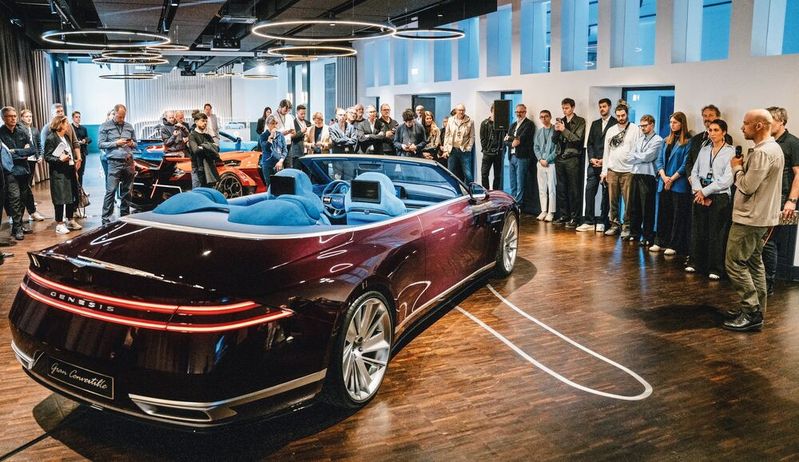
Pure elegance: European premiere of the concept vehicle Genesis X Gran Convertible in early May in Munich.
(Image: Jules Foto Garage)
That design is coming back into focus, with design concepts becoming more refined, emotional, and human-centered, was highlighted at the event held at the Munich Drivers & Business Club. Jens Meiners, an internationally experienced automotive journalist, car enthusiast, and one of the event's co-initiators, summed it up succinctly: "Technology for its own sake is over." International brands such as GM, Genesis, Hyundai and Kia, Lamborghini, Volkswagen, the design studio Pagani, as well as newcomer Slate Auto showcased nearly a dozen studies, concept cars, and production-ready models in Munich that reflect this trend.
"Provoke and Inspire"
Des Sellmeijer, co-initiator and also an automotive journalist, is convinced: "In the era of electromobility, OEMs are once again searching for a competitively differentiating identity. Driving experiences in EVs are becoming more similar, so brands and their products need to impress more strongly with their design." Eduardo Ramirez, Chief Designer of the Hyundai Design Europe Center since June 2024, aims to "inspire and empower designers to think boldly and provide answers that evoke emotions in our customers." Dominic Najafi, Head of GM's Advanced Design Team in Europe, also advocates for a design language that emotionally moves customers: "Our design should provoke and inspire."
What GM specifically implements under this directive was demonstrated by Phil Zak, Chief Designer of the GM brand Chevrolet, using a bright blue-painted Corvette E-Ray as an example. It is the first electrified and all-wheel-drive sports car with the evocative name, launched in 2023. Zak: "Its sophisticated design starts with the color treatment of the body, which draws attention to the exotic proportions of the E-Ray. The interior allows customers to reflect their individual personality through the choice of color options, conveying a refined or dynamic, sporty look and feel."
Grandmaster Paul Braqc: "Simplicity and Elegance"
Among the pioneers of "emotional design" is undoubtedly Paul Bracq, who in the 1960s and 70s served as design lead at Daimler-Benz, BMW, and Peugeot, and was the creator of icons like the 230 SL "Pagoda." The now 91-year-old expressed his support for "simplicity and elegance" in automotive design through a video message to the participants. As a tribute, the BMW Turbo X1 concept car, developed by him in 1973, was showcased.
Genesis: "Emotion-Filled Luxury Brand"
A car that Jens Meiners describes as "pure elegance" was presented by Genesis: the X Grand Convertible, an evolution of the brand's flagship G90. "It is a symbol of this group's strength," Meiners stated. The burgundy concept vehicle with a grape-blue interior was first unveiled alongside a coupe counterpart at the Seoul Mobility Show in early April. In Munich, it celebrated its European debut. According to its own statement, the Hyundai subsidiary is positioning itself as an "emotion-charged luxury brand."
Design VW ID.Every1: "Lively and Likable"
Stefan Wallburg, Head of Exterior Design VW Europe, describes the ID.Every1 show car presented in Munich as a "figure of sympathy." The design conveys "vibrancy," with the headlights, "the eyes," forming a friendly face. According to the company's PR, the production model aims to become "a fully electric €20,000 Volkswagen (approx. 23,000 USD) from Europe for Europe." However, this won't happen before 2027, as Wallburg confirmed.
Hyundai: "Evoking Customers' Emotions"
Lighting technology represents an important element of the new design language. For future fuel cell vehicles, Hyundai designers developed a unique light signature in the form of "+" symbols, featured as a logo on the front and integrated into the headlights. Chief Designer Ramirez explained the concept using the FCEV concept study Initium, which offers a glimpse of the next Nexo generation.
Not entirely new, but certainly a topic with emotional resonance, is sustainability. Just as Genesis incorporates eucalyptus wood, Kia experiments with materials made from cellulose, mushrooms, and recycled old leather in the near-production EV2 electric vehicle concept shown. These innovations are aimed at a "young-minded" clientele, as Nathalie Bucher, Senior Designer for Color, Materials, and Finish (CMF) at Kia Design Europe, explained. The EV2 is set to launch in 2026 as a new entry-level EV model.
Alcantara: Creating a Feel-Good Atmosphere
"Higher comfort demands and the creation of new living spaces in the car" are, according to Eugenio Lolli, CEO of Alcantara, the drivers for innovations in interior design. He highlights the trend toward more feel-good atmospheres in vehicles, combined with rising demands for exclusivity, through which automakers aim to differentiate themselves. Elisa Loddo, CMF designer at Alcantara, presented a sample collection. "The era of cold technologies is over," she also remarked. She showcased interior samples in warm beige and brown tones, as well as high-tech materials with wood, crystal, or metal inserts, some intricately quilted, embroidered, or even knitted.
Date: 08.12.2025
Naturally, we always handle your personal data responsibly. Any personal data we receive from you is processed in accordance with applicable data protection legislation. For detailed information please see our privacy policy.
Consent to the use of data for promotional purposes
I hereby consent to Vogel Communications Group GmbH & Co. KG, Max-Planck-Str. 7-9, 97082 Würzburg including any affiliated companies according to §§ 15 et seq. AktG (hereafter: Vogel Communications Group) using my e-mail address to send editorial newsletters. A list of all affiliated companies can be found here
Newsletter content may include all products and services of any companies mentioned above, including for example specialist journals and books, events and fairs as well as event-related products and services, print and digital media offers and services such as additional (editorial) newsletters, raffles, lead campaigns, market research both online and offline, specialist webportals and e-learning offers. In case my personal telephone number has also been collected, it may be used for offers of aforementioned products, for services of the companies mentioned above, and market research purposes.
Additionally, my consent also includes the processing of my email address and telephone number for data matching for marketing purposes with select advertising partners such as LinkedIn, Google, and Meta. For this, Vogel Communications Group may transmit said data in hashed form to the advertising partners who then use said data to determine whether I am also a member of the mentioned advertising partner portals. Vogel Communications Group uses this feature for the purposes of re-targeting (up-selling, cross-selling, and customer loyalty), generating so-called look-alike audiences for acquisition of new customers, and as basis for exclusion for on-going advertising campaigns. Further information can be found in section “data matching for marketing purposes”.
In case I access protected data on Internet portals of Vogel Communications Group including any affiliated companies according to §§ 15 et seq. AktG, I need to provide further data in order to register for the access to such content. In return for this free access to editorial content, my data may be used in accordance with this consent for the purposes stated here. This does not apply to data matching for marketing purposes.
Right of revocation
I understand that I can revoke my consent at will. My revocation does not change the lawfulness of data processing that was conducted based on my consent leading up to my revocation. One option to declare my revocation is to use the contact form found at https://contact.vogel.de. In case I no longer wish to receive certain newsletters, I have subscribed to, I can also click on the unsubscribe link included at the end of a newsletter. Further information regarding my right of revocation and the implementation of it as well as the consequences of my revocation can be found in the data protection declaration, section editorial newsletter.
Going back to Paul Bracq, the extent to which his commitment to "simplicity" in automotive design can be interpreted was demonstrated by two companies. One of them is Yugo, which is preparing a revival of the model discontinued in 2008. It is intended to be rather spartan but affordable. In Munich, Serbian designer Darko Marceta presented a 1:5 scale model, with a drivable prototype not planned until 2027.
Slate Auto: Less is not Possible, nor Cheaper
The young US company Slate Auto is significantly further along in its development. Trisha Johnson, Chief Designer of the startup founded in 2022, explained the minimalist concept of a $20,000 electric pickup. It doesn’t get simpler: the body panels are made of unpainted gray plastic injection-molded parts, the interior is purely practical, there is no infotainment system or touchscreens, but rather a fairly decent safety package. A press shop or paint shop is not needed in the Slate factory—car manufacturing doesn’t get more cost-efficient. Production is set to begin at the end of 2026.
There's more Slate to explore, but customers will have to reach into the generously stocked extras shelf for that. With the "SUV kit," for example, the two-seater pickup base version can be upgraded to a five-seater SUV. Custom exterior colors are offered as DIY wrap kits. "Unlimited personalization," as the Chief Designer, who previously worked for Volvo, calls it. Reportedly, Jeff Bezos is among the startup's financiers.
AI in Design: Curse or Blessing?
Three universities—Hof, Munich, and Pforzheim (all located in Germany)—as well as the Istituto Europeo di Design (IED) in Turin participated in the event and showcased their work. Prof. Dr. Othmar Wickenheiser, Professor of Transportation Design at the Munich University of Applied Sciences, and Prof. Lutz Fügener, Head of the Design & Mobility program at the Hof University of Applied Sciences, presented projects they are implementing together with their students in collaboration with renowned automotive manufacturers.
It was agreed that AI as a tool greatly simplifies and accelerates workflows in design. This includes AI-supported software, as presented by speakers from Siemens Mobility and Vizcom. The Vizcom software can also adopt the "handwriting" of designers, enabling person-specific AI applications, explained manager Gergely Mihály.
Trisha Johnson from Slate sees AI as nothing less than a "game changer": AI will become an indispensable "tool," making its integration into the work of designers a task crucial for the future. Chevrolet Chief Designer Phil Zak expressed confidence that delegating routine tasks to AI will allow designers more time for creative work. AI can contribute knowledge but can never replace intuition and the specific skills of a designer, Zak said, emphasizing what only humans can master perfectly: "touch, feel, and see." (kt)



:quality(80)/p7i.vogel.de/wcms/45/2e/452ebe27b324cc535db2760946dfd15d/0131742792v1.jpeg "A major advantage of the new system is, on the one hand, the stability of the holder system and, on the other hand, the internal coolant supply directly to the working area. (Image:Horn/Sauermann)")
:quality(80)/p7i.vogel.de/wcms/d1/6c/d16c902c1311170a225c4e1b7db7bd4b/0132073916v1.jpeg "Now there is finally a saw with an XXL rotating table, so that ton-heavy plastic or fiber composite material panels can be cut gently and quickly. It is called FK-6, and it was built by IMA Schelling Precision. Read here what has been done ... (Image:IMA Schelling Precision)")
:quality(80)/p7i.vogel.de/wcms/50/9a/509a5a7e54f038aadfea20d1e98bf3e2/0113143253v1.jpeg "In our China Market Insider, we regularly provide you with relevant information directly from China. (Image:© Eisenhans - stock.adobe.com)")
:quality(80)/p7i.vogel.de/wcms/3f/32/3f3272843333b0e8215db84152362ba8/0132070616v1.jpeg "Linear guides combined with other components form complex systems for automation. (Image:IEF-Werner)")
:quality(80)/p7i.vogel.de/wcms/9d/b0/9db0180b9d22b66c04fe5dba7c288b0e/0131649599v1.jpeg "It may still take some time before this vision becomes reality. And whether workshop robots necessarily need human-like legs is also not certain. (Image: AI-generated)")
:quality(80)/p7i.vogel.de/wcms/e5/0d/e50d800573729eefbdcdcd6ee5211fb8/adobestock-1696648818--c2-a9-20alexander-20-e2-80-93-20stock-adobe-comv1.jpeg "At Limtronik, the use of AI is not based on an isolated innovation project but on a digital infrastructure that has been developed over years. (Source: © Alexander – stock.adobe.com)")
:quality(80)/p7i.vogel.de/wcms/14/dc/14dc9fff54875a06b98592536134e0e3/0131864932v1.jpeg "The complete IO-Link package makes the difference. When the interaction of sensors, powerful masters, and a manufacturer-independent configuration tool is seamless, significantly enhanced machine performance is possible. (Image:Baumer)")
:quality(80)/p7i.vogel.de/wcms/1c/78/1c78ac0aaadd921509594b8b9683853e/adar-one---electronics-480x270v1.jpeg "The world's first safety-certified 3D ultrasonic sensor, ADAR One, introduces a new safety layer for robotics, a certified 3D perceptual foundation that sits beneath any camera, AI stack, or motion system, independently verifying that the space around a robot is safe. (Image: Sonair)")
:quality(80)/p7i.vogel.de/wcms/04/eb/04ebee99febeb716da7782b9e42d78b8/0132051842v1.jpeg "The Basic Day Thermal Management is an essential part of the \"Power of Electronics\" conference and originally evolved from the \"Cooling Days.\" (Image: Stefan Bausewein)")
:quality(80)/p7i.vogel.de/wcms/19/27/1927ccde4c7d25ce6f4e274a06bfc06c/cover-20imagev1.jpeg "Additive manufacturing has established itself as a complementary alternative to traditional machining for automotive tools, offering greater speed and flexibility. (Source: Stratasys)")
:quality(80)/p7i.vogel.de/wcms/15/00/1500298944949437fde0e0ba332eaa3c/adobestock-1898612059v1.jpeg "(Source: Anusa - stock.adobe.com)")
:quality(80)/p7i.vogel.de/wcms/5f/59/5f59f681a45fb2359bb8c8c07d4adb55/siemens-pave360-automotive-01v1.jpeg "Virtual twins, AI-powered tests, and new validation concepts: vehicle development is becoming increasingly software-driven—and is thus gaining speed. (Image: Siemens)")
:quality(80)/p7i.vogel.de/wcms/b6/bb/b6bbb8b6cfc885e28518d42d31efaaa4/org-blobs-user-response-file-output-e3944719-21bc-489b-908d-2e20572fbcf0-file-1782765707127-jpgv1.jpeg "In China, several companies are working on sodium-ion batteries for heavy trucks. (Image: )")
:quality(80)/p7i.vogel.de/wcms/bd/28/bd28688c768b9a6ab0fbfe23bd355643/0132083515v1.jpeg "Europe's car manufacturers may soon have the Chinese competition right on their doorstep! This is because they are increasingly looking for factories in Europe to bypass new additional tariffs on hybrids. BYD will start manufacturing in Hungary this year and likely elsewhere too... (Image: BYD)")
:quality(80)/p7i.vogel.de/wcms/2a/7d/2a7d061766e1b35d02e969606076158e/0132082107v1.jpeg "By separating the drive board and application, the driverless vehicle U-Shift II becomes a versatile multi-talent for shuttle and logistics services. (Image: KIT)")
:quality(80)/p7i.vogel.de/wcms/55/e3/55e36b0fa8130f29e52a6a6030b2ff40/0132081018v1.jpeg "Maintenance before failure instead of repair afterward: Volkswagen is expanding its digital services for commercial vehicle fleets and focusing more on data-driven service processes. (Image: Connected cars)")
:quality(80)/p7i.vogel.de/wcms/52/07/52071244e4b5cc28a8834b26ae30eee6/0132094074v1.jpeg "Symbol image: Photonics. (Image: Dall-E / AI-generated)")
:quality(80)/p7i.vogel.de/wcms/78/66/7866a25d3734c5caed45c3ea0f516dff/0132071151v1.jpeg "Under the name \"Rollable Flex,\" Samsung Display has already presented prototypes of a rollable OLED display. (Image:Samsung Display)")
:quality(80)/p7i.vogel.de/wcms/d4/f9/d4f93e4bfa02c1e6e242d5d8318fbcf5/0132044846v1.jpeg "The South Korean chip manufacturers Samsung and SK Hynix are on the rise. But that is not enough for the country! South Korea's government now aims to invest billions to maintain its leading role in the long term ... (Image: Samsung Electronics)")
:quality(80)/p7i.vogel.de/wcms/fe/e1/fee174199114ed9d7825cc5d8c6da984/0132076430v1.jpeg "Can AI replace classical motor control? Burger Engineering and TH Nürnberg have investigated this. (Image: Burger Engineering / istockphoto.com)")
:fill(fff,0)/p7i.vogel.de/companies/69/88/69882c428938e/tmts2026-ticec-banner-en-2000px.png "tmts2026-ticec-banner-en-2000px (https://www.tmts.tw/en)")
:quality(80)/p7i.vogel.de/wcms/14/1f/141fe67f4c347790fbeed66fbfcc26a8/0124834494v1.jpeg "Less is not possible: Slate pickup and its \"creator\" Trisha Johnson, Chief Designer at Slate Auto.(Image: Jules Foto Garage)")
:quality(80)/p7i.vogel.de/wcms/a4/f4/a4f428c288b310ef97e0d17ee98a652b/0124834490v1.jpeg "Design study VW ID.Every1 and Stefan Wallburg, Head of Exterior Design VW Europe. The charming e-compact car is set to arrive in 2027.(Image: Jules Foto Garage)")
:quality(80)/p7i.vogel.de/wcms/0b/d9/0bd92c639b20b4a2792b25cbe2be843c/0125482541v1.jpeg "Phil Zak, Chief Designer at Chevrolet, presented the Corvette E-Ray, the first sports car with the iconic name featuring all-wheel drive and hybrid propulsion.(Image: Jules Foto Garage)")
:quality(80)/p7i.vogel.de/wcms/fa/09/fa09852eba07cf225db6aef660effc67/0125482545v1.jpeg "Nature-inspired: Kia's EV2 electric concept car with materials made from cellulose, mushrooms, and recycled old leather.(Image: Jules Foto Garage)")
:quality(80):fill(efefef,0)/p7i.vogel.de/wcms/67/ad/67adf4a647532/elatec-wp-machine-authentication.png "Elatec WP Machine Authentication")
:quality(80)/p7i.vogel.de/wcms/52/77/5277ffd9d4c58b06883a546208b10293/0125795463v1.jpeg "Opel brings the Mokka GSE as the more civilian brother of the GSE Rally to the road. (Image:Opel)")
:quality(80)/p7i.vogel.de/wcms/f7/f8/f7f8bcd6f4854df1b6555a0ff951b93e/0131493601v1.jpeg "Kia launches another SUV on the market with the Seltos. (Image:Kia)")