Raspberry Pi is not only extremely popular among makers but is also widely used in industry thanks to FCC certification, a variety of accessories, and a 40-pin header. This article provides information about current products with Raspberry Pi.
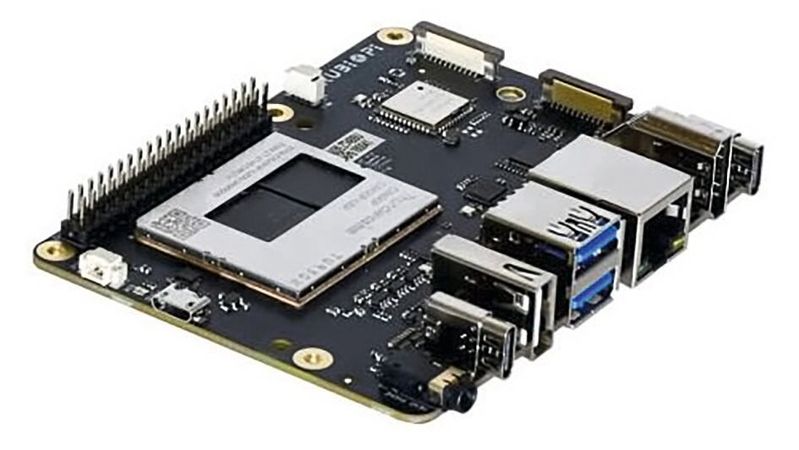
(Image: Thundercomm)
The Raspberry Pi Compute Module 5 (CM5) is the industrial variant of the most powerful Pi, the Raspberry Pi 5 single-board computer. The CM5 is a system-on-module (SoM) with a processor, memory, eMMC flash, and supporting power supply circuits. Previous versions of the Compute Module 5 are already successfully used in professional applications. Although introduced only a few months ago, there are already initial products with the CM5. However, other Pi variants like the SBC Raspberry Pi can also be used in industrial products.
Kontron's Baseboard BL Pi-Tron CM5 for Demanding Applications
Kontron has developed the BL Pi-Tron CM5 industrial board to meet the demand for standard products and an open software environment in the embedded industry.
The BL Pi-Tron CM5 offers high processing power through the CM5 Broadcom SoC BCM2712, a Quadcore Cortex-A76, 64-bit SoC with a 2.4 GHz clock. The board's graphics capabilities include a 4Kp60 HEVC decoder, OpenGL ES 3.1, and Vulkan 1.2, ensuring smooth and high-resolution image rendering.
A special feature of the BL Pi-Tron CM5 is the M.2 B-Key slot with PCIe connectivity, which allows for additional expansion options. Furthermore, the device has high-performance interfaces specifically designed for demanding applications in industrial environments. The range of memory options includes 1 GB to 8 GB LPDDR4-4267 SDRAM with ECC and eMMC flash storage options from 0 GB (CM5 Lite) up to 64 GB. The maximum bandwidth of the eMMC storage is 200 MBps, which is double that of the Compute Module 4. These features combine high processing speeds with large storage capacities. Additionally, the BL Pi-Tron CM5 offers expansion and communication options such as PCIe Gen 2, Wi-Fi 2.4/5 GHz, and Bluetooth 5.0 BLE.
CM5 boosts the Performance of Sharp NEC's MultiSync M And P Series
With the MPi5 Kit from display manufacturer Sharp NEC, based on the Raspberry Pi CM5, users can easily upgrade the computing power of the previous MPi4 kit with the Raspberry Pi CM4. This option is available for the MultiSync series ME1-, M1-, MA1, the MultiSync P5 series, and future models of the MultiSync M and P series. The MPi5 Kit maintains the same configuration as the MPi4, offering 4 GB RAM and 32 GB eMMC, corresponding to a fourfold increase in peak bandwidth speed. Additionally, thanks to Open GL ES 3.1 and Vulkan 1.2, the graphics performance is enhanced.
As Raspberry Pi plans to produce the Compute Module 5 until at least 2036, Sharp/NEC sees it as the perfect upgrade option for its displays, which are designed for long lifespans. Since Sharp/NEC focuses on long-term projects, the MPi4 Kit will continue to be offered.
Sharp/NEC's open-source solutions are accessible to the Raspberry Pi developer community. The fully compatible end-to-end signage solution is suitable for cost-effective applications in retail, passenger information, and menu boards in system catering.
Neumonda's Octopus DRAM Tester Works With RPi Support
Neumonda's latest DRAM test board, codenamed Octopus, consists of six individual tiles, manufactured by Kontron, that simulate a motherboard and are each equipped with an Intel Raptor CPU. A Raspberry Pi controls the test setup and configuration of the Neumonda test samples and stores the test results for final evaluation. On the back of each board, Octopus features sockets for 32 components, which can be replaced by sockets for two modules.
The Octopus is designed for screening DRAM components for memory modules, while the previous tester generation, the Neumonda Rhino Test Board, was developed for testing DRAM components for industrial applications. The Octopus DRAM test board can test at high and low temperatures as well as at low and high speeds, to simulate the speed and noise environment in which DRAM modules will operate.
"About two to three percent of components fail during a DRAM component test," explains Peter Poechmueller, CEO of Neumonda Technology. "However, if only modules are tested, the failure rate is about ten times higher. With our Octopus tester, both the yield and the quality of DRAM modules for industrial use can be significantly improved, especially at cool temperatures."
Octopus is designed for testing DDR4 and DDR5 x8 and x16 components for DRAM modules as well as LPDDR4 and LPDDR5 DRAMs. It can sort out defective or weak DRAM memory chips with precise fault coverage as effectively as any conventional tester used in most backend factories today. The Octopus DRAM Tester is expected to be available from the third quarter.
Date: 08.12.2025
Naturally, we always handle your personal data responsibly. Any personal data we receive from you is processed in accordance with applicable data protection legislation. For detailed information please see our privacy policy.
Consent to the use of data for promotional purposes
I hereby consent to Vogel Communications Group GmbH & Co. KG, Max-Planck-Str. 7-9, 97082 Würzburg including any affiliated companies according to §§ 15 et seq. AktG (hereafter: Vogel Communications Group) using my e-mail address to send editorial newsletters. A list of all affiliated companies can be found here
Newsletter content may include all products and services of any companies mentioned above, including for example specialist journals and books, events and fairs as well as event-related products and services, print and digital media offers and services such as additional (editorial) newsletters, raffles, lead campaigns, market research both online and offline, specialist webportals and e-learning offers. In case my personal telephone number has also been collected, it may be used for offers of aforementioned products, for services of the companies mentioned above, and market research purposes.
Additionally, my consent also includes the processing of my email address and telephone number for data matching for marketing purposes with select advertising partners such as LinkedIn, Google, and Meta. For this, Vogel Communications Group may transmit said data in hashed form to the advertising partners who then use said data to determine whether I am also a member of the mentioned advertising partner portals. Vogel Communications Group uses this feature for the purposes of re-targeting (up-selling, cross-selling, and customer loyalty), generating so-called look-alike audiences for acquisition of new customers, and as basis for exclusion for on-going advertising campaigns. Further information can be found in section “data matching for marketing purposes”.
In case I access protected data on Internet portals of Vogel Communications Group including any affiliated companies according to §§ 15 et seq. AktG, I need to provide further data in order to register for the access to such content. In return for this free access to editorial content, my data may be used in accordance with this consent for the purposes stated here. This does not apply to data matching for marketing purposes.
Right of revocation
I understand that I can revoke my consent at will. My revocation does not change the lawfulness of data processing that was conducted based on my consent leading up to my revocation. One option to declare my revocation is to use the contact form found at https://contact.vogel.de. In case I no longer wish to receive certain newsletters, I have subscribed to, I can also click on the unsubscribe link included at the end of a newsletter. Further information regarding my right of revocation and the implementation of it as well as the consequences of my revocation can be found in the data protection declaration, section editorial newsletter.
Bosch Air Quality Sensor Integrated on an RPi Breakout Board
The BME688 sensor is Bosch's first gas sensor with artificial intelligence and integrated highly linear and highly accurate pressure, humidity, and temperature sensors. The gas sensor can detect volatile organic compounds (VOCs), volatile sulfur compounds (VSCs), and other gases like carbon monoxide and hydrogen in the ppb (parts per billion) range.
Buyzero (pi3g) has now integrated the Bosch BME688 sensor on an I2C breakout board, paying particular attention to good compatibility with the Raspberry Pi: the sensor can be directly mounted on all Raspberry Pi boards from models 1B to 4B and the Zeros thanks to its own header. Buyzero ensured that the BME688 sensor does not end up over the SoC of the Raspberry Pi, as is the case with other solutions, so that the temperature and humidity measurements are not distorted.
Raspberry Pi Alternatives
Raspberry Pi is the best-selling single-board computer, but there are also powerful alternatives from other companies, such as Thundercomm's Rubik Pi 3 and the Maaxboard OSM93 from Avnet Tria. Additionally, these boards also offer support for Raspberry Pi accessories, thanks to features like a 40-pin header.
RUBIK Pi 3: First Qualcomm SOC-based SBC
Thundercomm's Rubik Pi 3 is said to be the first single-board computer based on Qualcomm's system-on-chip (SOC) QCS6490 (Dragonwing). The ultra-compact microcomputer (3.9 × 3.0 inches) delivers 12.5 TOPS of AI inference performance on the device thanks to the powerful QCS6490 processor and supports small voice models with up to 1.8 billion parameters. Rubik Pi 3 features a variety of interfaces and functions, such as USB Type-A (1 x 2.0, 2 x 3.0), USB 3.1 Gen 1 Type-C with DP (4K@60), camera, HDMI OUT (4K@30), 1 Gbit/s Ethernet port, 40-pin header, 0.14 inches headphone jack, Wi-Fi 5, BT 5.2, M.2 M-Key, Micro USB, and RTC.
The Rubik Pi 3 is also compatible with various operating systems (Qualcomm Linux, Android, Windows) and supports Raspberry Pi peripherals, which simplifies development and reduces development costs. Rubik Pi 3 also offers scalability through upward compatibility with Thundercomm's C8550-SOM and downward compatibility with Thundercomm's C5430P-SOM. Thundercomm further provides software and hardware customization services that accelerate the entire lifecycle from development to market launch.
Rubik Pi 3 supports selected models from the Qualcomm AI Hub, enabling a more efficient use and optimization of AI model runtime. With Qualcomm's AI Hub, developers can learn more about the latest tools for downloading pre-optimized AI models as well as optimizing their own models to enhance the SoC's performance. Developers can also easily integrate machine learning models and third-party AI technologies, streamlining their workflows and increasing productivity. Rubik Pi 3 can simultaneously run the four Qualcomm AI Hub models for classification, object detection, pose recognition, and image segmentation offline, simplifying the development and deployment of complex models.
Machine Learning With the Maaxboard OSM93
The Maaxboard OSM93 from Avnet Tria is a single-board computer in the Raspberry Pi form factor with the i.MX-93 SoC from NXP, featuring an integrated AI/ML NPU accelerator, EdgeLock secure enclave, and Energy-Flex architecture, supporting separate processing domains such as the application domain with dual Arm Cortex-A55 cores (1.7 GHz), the real-time domain with Arm's Cortex-M33 core (250 MHz), and the flex domain with Arm's Ethos-U65 NPU (1 GHz). Other resources of the module equipped with the MSC-OSM-SF-IMX93 include 16 GB eMMC storage, LPDDR4 memory (2 GB, 3.7 GT/s) with inline ECC support, RTC, and NXP's power management IC PCA9451.
The board also offers four USB 2.0 interfaces (2 x host type A, 1 x host type C, 1 x device type C), MIPI-DSI display and MIPI-CSI camera interfaces, two 1 Gbit/s Ethernet ports, and two high-speed CAN interfaces. Expansion interfaces include a 40-pin Pi-Hat header, a 6-pin ADC header, and a 6-pin SAI digital audio header (complemented by two onboard PDM microphones). Level-shifted debug UARTs are pinned out for the application and RT cores. The Maaxboard OSM93 is suitable for edge AI applications in industries such as healthcare and home and building automation. (mk)
Future-Proof Authentication with Universal RFID Readers



:quality(80)/p7i.vogel.de/wcms/ee/de/eede0cf3b0da1963c34ae0734d8d2f1d/bild1v1.jpeg "Welding gun used for joining a B-pillar under laboratory conditions at Fraunhofer-IPK. (Source: Fraunhofer-IPK)")
:quality(80)/p7i.vogel.de/wcms/ee/05/ee05e8dcfec352606165f817950b8c14/0131747557v1.jpeg "At the damping system specialist GFM Schiller in Roetgen, this MG machine from Microstep Europe is the second in the series that has been ready for use for some time. Find out here what advantages the metal processor and fabricator has gained with it... (Image:Microstep Europe)")
:quality(80)/p7i.vogel.de/wcms/2c/6d/2c6d7a5269193c22bfb3e1976959626d/0131600867v1.jpeg "A specially developed tool for manufacturing a jaw part has tripled the service life. (Image:HPTec GmbH)")
:quality(80)/p7i.vogel.de/wcms/15/41/154139dec8c82f53675ae6107f118a52/0131579774v1.jpeg "For the machining of large components, DMG Mori has installed a DMU 200 Gantry with a 4,000-millimeter travel path in the X-axis at ACTech. (Image:DMG Mori)")
:quality(80)/p7i.vogel.de/wcms/ff/e5/ffe5e4cedd694ab4d6f56e75457c6753/sentron-3qd2-sccb-ultra-fast-reaction-dev1.jpeg "A key innovation in the new portfolio is the semiconductor circuit breaker Sentron 3QD2. Thanks to semiconductor technology and intelligent protection algorithms, it enables ultra-fast disconnection of short-circuit currents in the microsecond range – up to 1,000 times faster than conventional systems. (Image:Siemens)")
:quality(80)/p7i.vogel.de/wcms/20/95/209552405c9f8f253ad1c6f6678ad967/0131735890v1.jpeg "The Linz start-up Iono Robotics presented \"Workmate\". (Image:APA/Christoph Schlemmer)")
:quality(80)/p7i.vogel.de/wcms/30/60/3060d8c725c89977bc9bf14801f27030/0131677386v1.jpeg "By using AI, leaders gain time for development discussions, perspective work, and personal guidance. This human and personal attention signals appreciation to employees and opens up future opportunities. (Image: ©Md - stock.adobe.com)")
:quality(80)/p7i.vogel.de/wcms/8f/df/8fdfa9abee8e69cb09a8e11393713e51/adobestock-348397404--c2-a9-20monsitj-20-e2-80-93-20stock-adobe-com-6500x3659v1v1.jpeg "(Image: mositj—stock.adobe.com) (Image:mositj - stock.adobe.com)")
:quality(80)/p7i.vogel.de/wcms/60/53/605353de6d79813825434482e7fd7600/ifam-elektrochemisches-verfahren-ermoeglicht-rueckgewinnung-wertvoller-rohstoffev1.png "Special electrodes developed by researchers at Fraunhofer IFAM extract valuable raw materials such as lithium and cobalt from process water during battery recycling. (Source: Fraunhofer IFAM)")
:quality(80)/p7i.vogel.de/wcms/17/f3/17f343848692f8696b90685b210828e9/rupixen-peacock-feather-4505146v1.jpeg "Scientists have been trying for years to replicate these \"structural colors\" of nature. (Source: )")
:quality(80)/p7i.vogel.de/wcms/4c/26/4c26804780be9d4702baf327de0bd9da/0131758767v1.jpeg "Dribbling with a high-tech effect! In the past, sturdy leather was kicked across the pitch. Now the World Cup is approaching, and Covestro doesn't miss the chance to explain that the modern football world cannot do without high-performance plastics – and not just for the ball! (Image:Das Spiel)")
:quality(80)/p7i.vogel.de/wcms/00/97/00977aa0ffc3b55219d0a271fa6c8d05/general-fusion-lm26-7008x3940v1v1.jpeg "General Fusion uses multiphysical simulations to analyze and optimize the behavior of its fusion demonstration plant. (Image:General Fusion)")
:quality(80)/p7i.vogel.de/wcms/93/bb/93bbf829620a14fc0c74005f3a5d5f7f/0131757365v1.jpeg "Germany as an industrial location has lost its attractiveness, as is widely reported. When asked, the CEOs of the three largest car manufacturers in Germany do not see everything as lost yet. However, one should keep an eye on China's export ambitions... (Image: Wrenching worlds)")
:quality(80)/p7i.vogel.de/wcms/70/3f/703f63622d5302e41a107d813a30dbd1/ryu-3165v1.jpeg "Marilia Biill is responsible for colors, materials, and surfaces at Kia in Korea. (Source: Kia)")
:quality(80)/p7i.vogel.de/wcms/bd/53/bd53cae15edadc51e975f866a39dd1da/zwei-20soldaten-20erproben-20einen-20demonstrator-20im-20innovationslabor-20der-20bundeswehr-20in-20erdingv1.jpeg "Mercedes-Benz aims to manufacture mobile systems for drone defense with Tytan Technologies. (Source: Tytan Technologies)")
:quality(80)/p7i.vogel.de/wcms/dc/50/dc5094d75fa6612e6bdc5eee142d234b/bosch-xc-visuals-2024-15574-v03-3-1-10000x5624v1v1.jpeg "Bosch wants to personalize assistance systems. These should be able to react to the driver's driving style. (Image:Bosch)")
:quality(80)/p7i.vogel.de/wcms/97/48/9748ee923663f9486163f0c614a10c64/bild-3v1.png "The Mink Rack-Brush was installed, among other things, in a Stengel server rack. (Source: Mink Brushes)")
:quality(80)/p7i.vogel.de/wcms/62/0b/620b29a305001d3959cb0011b51d79c4/0131773139v2v1.jpeg "Symbolic image: Ennoconn has exceeded the 30-percent voting rights threshold at Kontron and is therefore obliged to make a mandatory offer. (Image: Image)")
:quality(80)/p7i.vogel.de/wcms/ca/de/cadef1e0c1cc7614a9f56e02308e11bb/0131643181v1.jpeg "A consistent view of a function as a whole must combine information from software, sensors, hardware, safety and approvals in one system. (Image:PTC)")
:quality(80)/p7i.vogel.de/wcms/0d/08/0d0875d94935d5c99525843c83ca483a/0131758344v1.jpeg "The Auto Kitting Station from Fuji automates the kitting of feeders with belt reels. (Image:Fuji Europe Corporation)")
:fill(fff,0)/images.vogel.de/vogelonline/companyimg/76800/76895/65.jpg "FAULHABER_120mm.jpg ()")
:quality(80)/p7i.vogel.de/wcms/8a/5f/8a5f67db7850aa14201e236f58872592/0124759433v1.jpeg "Pi-Tron CM5: the Compute Module 5 provides the board with high processing power thanks to the Broadcom SoC BCM2712 with Quadcore Cortex A76.(Image: Kontron)")
:quality(80)/p7i.vogel.de/wcms/cb/a7/cba76c660ca53fa9d47aba18b0d83326/0124750647v1.jpeg "DRAM test board with the code name Octopus: the test board qualifies DRAM components for modules.(Image: Neumonda)")
:quality(80)/p7i.vogel.de/wcms/c8/4a/c84a313ed6b78539988d1cd0a46a1984/0124758127v1.jpeg "Bosch sensor BME688 integrated on an I2C breakout board: The BME688 sensor is Bosch's first gas sensor with artificial intelligence.(Image: Pi3g)")
:quality(80)/p7i.vogel.de/wcms/79/7f/797fc5a3e1548af1e580378d2f519e83/0124758172v1.jpeg "The Maaxboard OSM93 from Avnet Tria: a single-board computer in the Raspberry Pi form factor with the i.MX-93 SoC from NXP featuring an integrated AI/ML NPU accelerator, EdgeLock security enclave, and Energy Flex architecture.(Image: Avnet Tria)")
:quality(80):fill(efefef,0)/p7i.vogel.de/wcms/67/ae/67ae0b9ac31f8/elatec-wp-universal-reader.png "Elatec WP Universal Reader")
:quality(80)/p7i.vogel.de/wcms/8c/1f/8c1f4c5601bc119b2b8b0e6cc1f398f0/0129940257v1.jpeg "Arduino Ventuno Q: Arduino's new AI developer platform addresses the industry. (Image:Arduino)")
:quality(80)/p7i.vogel.de/wcms/e8/e1/e8e192b9934041d353c6379e9ffe608a/0127208377v1.jpeg "Qualcomm buys Arduino and presents AI board Arduino UNO Q for 39 euros. (Image:Qualcomm)")