Siemens is launching the first protection and switching products for industrial DC networks with a semiconductor circuit breaker and a semiconductor switching device. This opens up specific savings potential for machine builders and plant designers—in terms of material, energy, and installation complexity.
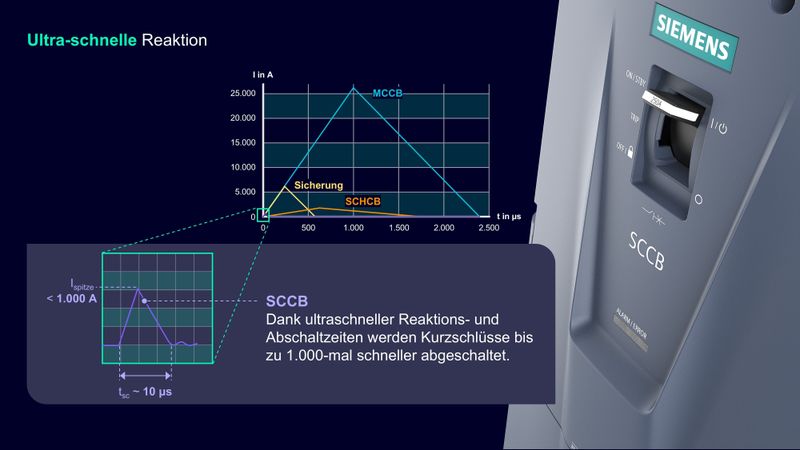
A key innovation in the new portfolio is the semiconductor circuit breaker Sentron 3QD2. Thanks to semiconductor technology and intelligent protection algorithms, it enables ultra-fast disconnection of short-circuit currents in the microsecond range – up to 1,000 times faster than conventional systems.
(Image: Siemens)
Frequency converters, robot drives, servo motors, battery storage— anyone designing machines and systems is already working with components that operate internally on a direct current (DC) basis. Nevertheless, the overarching power supply in manufacturing environments is almost exclusively implemented using alternating current (AC). Every conversion costs energy and requires additional components.
"With the increased use of renewable energies, the expanded use of battery storage, and the trend towards DC-based data centers, the topic is now really gaining momentum," explains Andreas Matthe, CEO Electrical Products at Siemens. The idea is not new: about ten years ago, there were initial attempts to replace transformation stages in industrial power supply with direct current networks. At that time, they primarily failed due to a lack of norms and standards. This obstacle has now been largely removed: In May 2026, a specific draft standard for semiconductor circuit breakers, IEC 60947-10, was published—a crucial step for planning reliability.
Regeneration Becomes a System Advantage
For designers of manufacturing facilities, one aspect is particularly interesting: energy recovery. Robot arms that decelerate, elevators that move downward, servo axes in reverse operation—all these processes generate energy that can be directly buffered and reused in a DC intermediate circuit. In an AC network, this involves significant effort. In a DC network with an integrated battery storage, it is inherent to the system.
The figures Siemens cites for typical production environments with robots—based on the DC for Industry project by ODCA—are remarkable: peak power consumption can be reduced by up to 80 percent when direct current technology is combined with energy recovery and storage. This not only lowers operating costs but also reduces the design requirements for the entire power supply.
Another material advantage is added: DC systems eliminate the need for reactive power compensation and require up to 50 percent less copper for wiring and busbars due to smaller cable cross-sections. The elimination of transformers between voltage levels also significantly reduces material and space requirements.
The Centerpiece: Sentron 3QD2
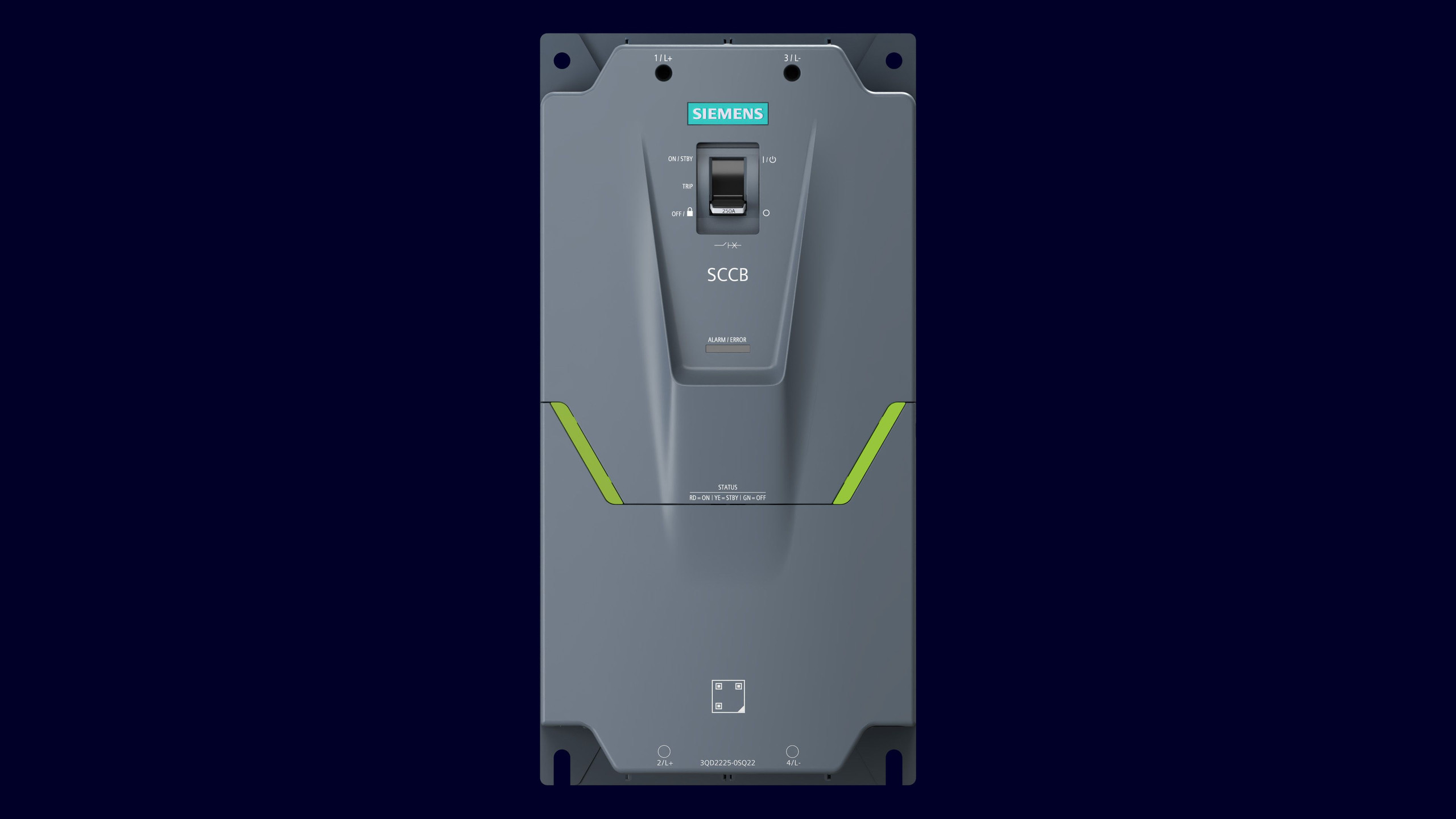
Semiconductor circuit breaker Sentron 3QD2
(Source: Siemens)
The central product of the new DC portfolio is the semiconductor circuit breaker Sentron 3QD2. It is designed for 1,000 V DC and 250 A—a 2-pole device that combines multiple functions in a compact housing: protection, switching, isolation, monitoring, and energy management.
What fundamentally sets it apart from conventional circuit breakers is the switching speed. Dr. Nico Fritsch, Product Lifecycle Manager at Siemens, explains the underlying physical issue: "In DC networks, there is no zero crossing as in AC that we can use to extinguish the arc. We are dealing with extreme current rises of 200 amperes per microsecond—and we must interrupt them in the shortest time possible through semiconductor technology." The comparison Fritsch uses illustrates the scale: an airbag is considered fast—the Sentron 3QD2 switches 2,000 to 3,000 times faster.
The device's configurability is relevant for designers: The rated current can be adjusted via a digital interface to suit the actual application requirements—for instance, reduced from 250 A to 200 A if the connected load permits. This simplifies device management and avoids unnecessary oversizing.
Another important design feature is bidirectionality: The switch detects the reversal of the energy flow direction and operates in both directions. This is not a comfort function but a system requirement—battery storage and regenerative drives actually reverse the energy flow.
Maintenance-Free and Communication-Capable
Compared to mechanical switching devices, semiconductor technology offers a structural advantage: there are no mechanically wear-prone switching contacts and no contact-related aging. This eliminates a classic, contact-related residual lifespan. The Sentron 3QD2 operates maintenance-free in the switching path—an advantage, especially in hard-to-access installation situations or with high switching cycles.
Date: 08.12.2025
Naturally, we always handle your personal data responsibly. Any personal data we receive from you is processed in accordance with applicable data protection legislation. For detailed information please see our privacy policy.
Consent to the use of data for promotional purposes
I hereby consent to Vogel Communications Group GmbH & Co. KG, Max-Planck-Str. 7-9, 97082 Würzburg including any affiliated companies according to §§ 15 et seq. AktG (hereafter: Vogel Communications Group) using my e-mail address to send editorial newsletters. A list of all affiliated companies can be found here
Newsletter content may include all products and services of any companies mentioned above, including for example specialist journals and books, events and fairs as well as event-related products and services, print and digital media offers and services such as additional (editorial) newsletters, raffles, lead campaigns, market research both online and offline, specialist webportals and e-learning offers. In case my personal telephone number has also been collected, it may be used for offers of aforementioned products, for services of the companies mentioned above, and market research purposes.
Additionally, my consent also includes the processing of my email address and telephone number for data matching for marketing purposes with select advertising partners such as LinkedIn, Google, and Meta. For this, Vogel Communications Group may transmit said data in hashed form to the advertising partners who then use said data to determine whether I am also a member of the mentioned advertising partner portals. Vogel Communications Group uses this feature for the purposes of re-targeting (up-selling, cross-selling, and customer loyalty), generating so-called look-alike audiences for acquisition of new customers, and as basis for exclusion for on-going advertising campaigns. Further information can be found in section “data matching for marketing purposes”.
In case I access protected data on Internet portals of Vogel Communications Group including any affiliated companies according to §§ 15 et seq. AktG, I need to provide further data in order to register for the access to such content. In return for this free access to editorial content, my data may be used in accordance with this consent for the purposes stated here. This does not apply to data matching for marketing purposes.
Right of revocation
I understand that I can revoke my consent at will. My revocation does not change the lawfulness of data processing that was conducted based on my consent leading up to my revocation. One option to declare my revocation is to use the contact form found at https://contact.vogel.de. In case I no longer wish to receive certain newsletters, I have subscribed to, I can also click on the unsubscribe link included at the end of a newsletter. Further information regarding my right of revocation and the implementation of it as well as the consequences of my revocation can be found in the data protection declaration, section editorial newsletter.
For service operations, a mechanical disconnect function is nevertheless integrated: In the event of maintenance, the device can be set to the "Off" position and locked with a padlock—standards-compliant and familiar to electricians.
The communication connection is established via a modular interface that is mounted on the side of the DIN rail and seamlessly integrated into Siemens' existing communication portfolio. Alternatively, digital inputs and outputs are available for hardware-based control.
Practical Proof in the Company’s Own Plant
Siemens is the first to use its own switch in its installations: at the new technology campus in Erlangen, the logistics center and the R&D building are partially powered on a DC basis. "The logistics center is a good example, where elevators move up and down, and the recuperation energy can be fed back in," says Matthe. The switch cabinet with a Sentron 3QD2 circuit breaker showcased at the Hannover Messe 2026 is the same one that will later be installed in Erlangen.
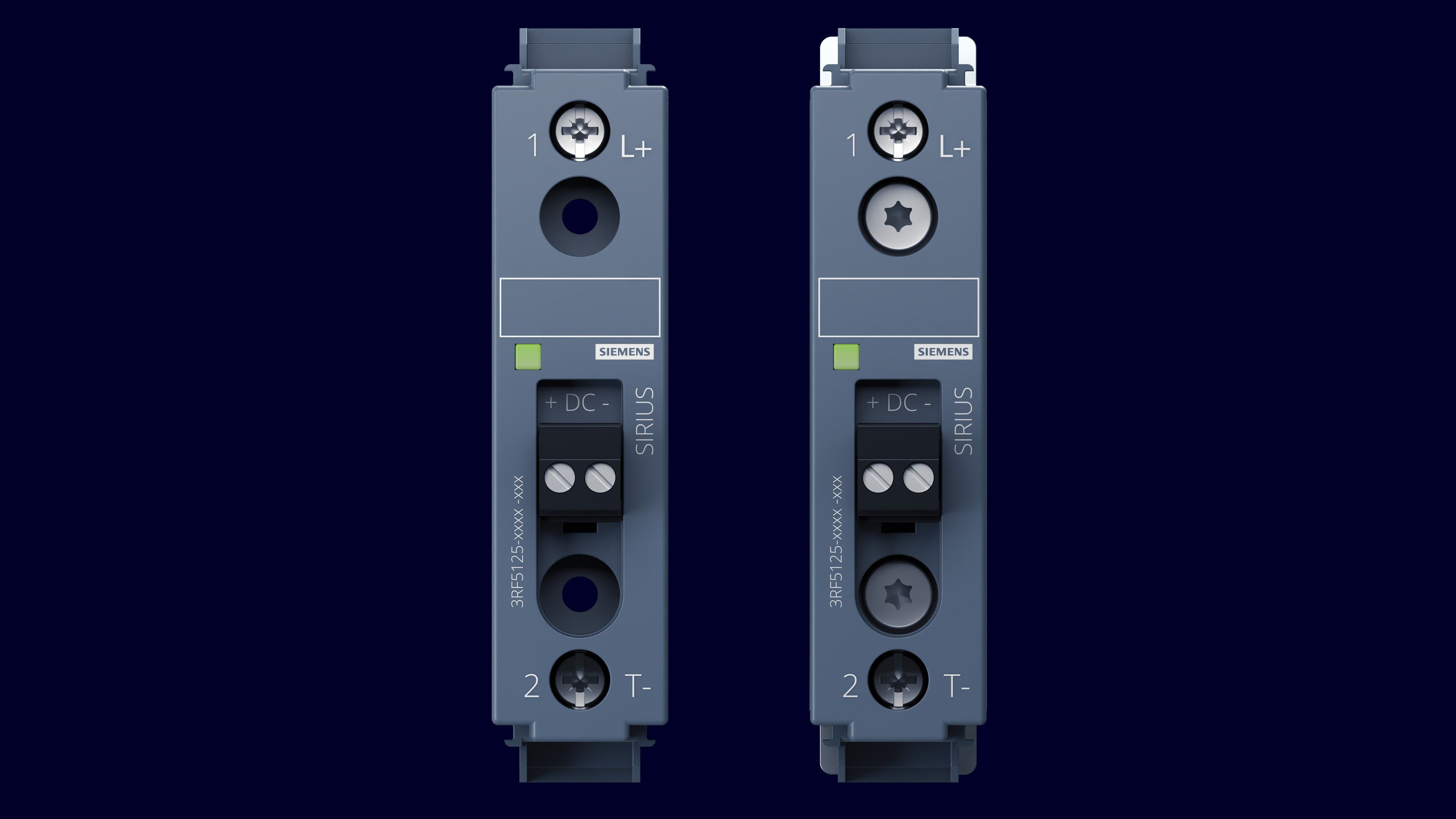
Semiconductor switching device Sirius 3RF5
(Source: Siemens)
The Sentron 3QD2 is complemented by the semiconductor switching device Sirius 3RF5—the first of its kind for DC applications, designed for high-frequency switching of resistive loads. It carries the Siemens EcoTech Label and can be integrated into the low-voltage switchgear Sivacon S8 as well as the busbar trunking systems Sicacon 8PS.
The Sentron 3QD2 is currently in the introduction phase with initial pilot installations; series production as a standard product is planned for the beginning of next year.



:quality(80)/p7i.vogel.de/wcms/d1/ef/d1ef6b6f7d4543f7999980bacccaf22b/0133499261v1.jpeg "As the growing imbalance in trade relations with China continues to widen, the EU Chamber of Commerce foresees a day when trade with China will have to be seriously reevaluated ... (Image: AI-generated)")
:quality(80)/p7i.vogel.de/wcms/fe/1f/fe1fa5ee713f94deaba963dc24c3abc5/0133299273v1.jpeg "The Flexistar enables highly flexible production of laser-welded tubes thanks to its tool-free clamping system. (Image:Because Technology, LLC)")
:quality(80)/p7i.vogel.de/wcms/1b/5a/1b5ac72f83db4dbee3ff91e51bc398f4/0133496095v1.jpeg "BASF announces that it will take the next step toward producing the polyurethane precursor MDI in India ... (Image:BASF)")
:quality(80)/p7i.vogel.de/wcms/3f/cf/3fcfa390902944ffcf24e7fe973cc3ee/0133486258v1.jpeg "Do you need to create secure connections on structures using blind rivets, but space is tight? Then you should take a closer look at the Universalgrip from Gesipa ... (Image: Gesipa)")
:quality(80)/p7i.vogel.de/wcms/2e/99/2e99726b522e4b35b690e25eb6a42643/0133463991v1.jpeg "Robotics: In AMR applications, connection technology must reliably transmit power, signals, and data despite vibration and shock loads—in very confined spaces and in a way that allows for regular maintenance. (Image:Hyperever)")
:quality(80)/p7i.vogel.de/wcms/d0/18/d01801e3d5dbd7bc9d0b4f60408b630c/0133468429v1.jpeg "Quality requirements for film packaging are on the rise. At the same time, many companies are turning to recyclable film materials, which, however, have their own challenges. Fraunhofer researchers have therefore developed a fast system that detects problems in real time. (Image:Fraunhofer IKTS)")
:quality(80)/p7i.vogel.de/wcms/b1/06/b106cf44923ce39565c3264982fd20eb/0133414574v1.jpeg "Robots Build Robots: At the new Ubtech factory, automated systems even handle parts of the material supply and logistics for the production of humanoid robots. (Image:Ubtech)")
:quality(80)/p7i.vogel.de/wcms/38/79/38799bfbbccd938b64c67068cfa68780/0133329362v1.jpeg "What exactly enables machines to act on their own? (Image:Shutterstock)")
:quality(80)/p7i.vogel.de/wcms/66/a7/66a7b78159caeacce57136529688799f/0133503398v1.jpeg "Sunlight Makes Stone! These stone blocks weren't made the traditional way. Instead, they were additively manufactured from sand using a laser. In the future, however, the laser is set to be replaced by concentrated sunlight—if the startup Addisol is successful... (Image:Addisol / F. Fiedler)")
:quality(80)/p7i.vogel.de/wcms/72/b9/72b995c2c8d812c5e2115cbef31e035a/0133462727v1.jpeg "Eggl manufactures center hoods that are precisely tailored to each cooking island—whether standard size or custom shape. They are made entirely of stainless steel and are individually customized in terms of size and filter arrangement. (Image:SPI)")
:quality(80)/p7i.vogel.de/wcms/13/5d/135dfae6229ceaf5c55467a43e8f7257/adobestock-1879961393--ardi-stock-adobe-com-ki-generiertv1.jpeg "Annoying chatterboxes or awkward silences in response to questions—a moderator should specifically prepare for difficult situations in order to navigate them effectively. (Image:ardi - stock.adobe.com_AI-generated)")
:quality(80)/p7i.vogel.de/wcms/ca/46/ca462051dfb9a1fb37ca4053762af9df/org-blobs-user-response-file-output-908c701c-3b37-491e-bb5c-35fc3d336575-plugin-output-call-182851v1.png "Through extreme compression, high-energy lasers transform simple plastics into high-purity nanodiamonds. What was once used in planetary physics is now opening up entirely new possibilities for quantum sensors, novel catalysts, and extremely hard materials. (Illustrative image) (Source: VCG / AI-generated)")
:quality(80)/p7i.vogel.de/wcms/aa/a2/aaa2c6dd2daa24b485cddbf9297590c0/0133467318v1.jpeg "Battery Monitoring: Battery monitoring using electrochemical impedance spectroscopy offers several advantages. (Image:TI)")
:quality(80)/p7i.vogel.de/wcms/39/b2/39b21bf03be1683831862239a369987c/0133469638v1.jpeg "Data from autonomous vehicles and robots operating autonomously is in high demand, and Ruqi wants to capitalize on this. (Image:Ruqi Mobility)")
:quality(80)/p7i.vogel.de/wcms/8a/bb/8abbb6217220595edc1549ac9b84f307/0133429906v1.jpeg "The IAA in Hanover showcased the ambitions of Chinese commercial vehicle manufacturers in Europe. (Image:Wehner - VCG)")
:quality(80)/p7i.vogel.de/wcms/0c/53/0c5313ef91c14b6df0d0996efc33c8ad/jpg03568-bearbeitetv1.jpeg "The category winners of the 2027 German Car of the Year award. (Source: GCOTY)")
:quality(80)/p7i.vogel.de/wcms/11/2e/112eabc5fb41e1a401f0e93e9326ef51/0133489329v1.jpeg "A sandbox limits the actions an AI agent can take, but it is not an impenetrable barrier. Only multiple independent layers of protection prevent an escape from immediately granting access to production systems. (Image:freely licensed)")
:quality(80)/p7i.vogel.de/wcms/18/ba/18bae45f9e6f7cacc203d56f3bc26e3c/0133455937v1.jpeg "Google did not make the incidents public until after receiving an inquiry from the “Wall Street Journal.” (Image:Google)")
:quality(80)/p7i.vogel.de/wcms/65/58/655895abe42a598e146fe47baf7c54db/0133441212v1.jpeg "Wukong, a 72-qubit quantum processor manufactured by Origin Quantum. (Image:Origin Quantum)")
:quality(80)/p7i.vogel.de/wcms/63/68/6368c6e0861d6e25bbd25a8878ca5973/newsimage427467v1.jpeg "How can individual manipulated AI agents influence the decisions of entire networks? A new theoretical model shows the conditions under which misinformation spreads. (Source: CISPA)")
:fill(fff,0)/images.vogel.de/vogelonline/companyimg/76800/76895/65.jpg "FAULHABER_120mm.jpg ()")
:fill(fff,0)/p7i.vogel.de/companies/69/88/69882c428938e/tmts2026-ticec-banner-en-2000px.png "tmts2026-ticec-banner-en-2000px (https://www.tmts.tw/en)")
:quality(80)/p7i.vogel.de/wcms/a1/54/a154402ae8659c12dd65b588055f042a/siemens-intelligence-center-x-2276x1280v1v1.jpeg "By connecting data, models, and workflows on a single, managed foundation, Intelligence Center X aims to enable faster deployment of AI-driven applications and agents. (Image: Siemens)")
:quality(80)/p7i.vogel.de/wcms/b3/22/b32228ff13056ec8422931a4f6c69ad0/0130672660v1.jpeg "0130672660v1 (Image:Stefanie Michel)")
:quality(80)/p7i.vogel.de/wcms/48/71/4871462eff61cbe2897297d90af45145/0133016766v1.jpeg "Contactors vs. High-Current Relays: Contactors are considered the “kings” of high-current switching. However, high-current relays are now also making their mark in this area. (Image:Omron)")