For the first time, companies are planning a direct optical laser link between a satellite in low-Earth orbit (LEO) and a re-entering spacecraft for the year 2027. This partnership sets new benchmarks for European space logistics and presents exciting hardware challenges for communication technology.
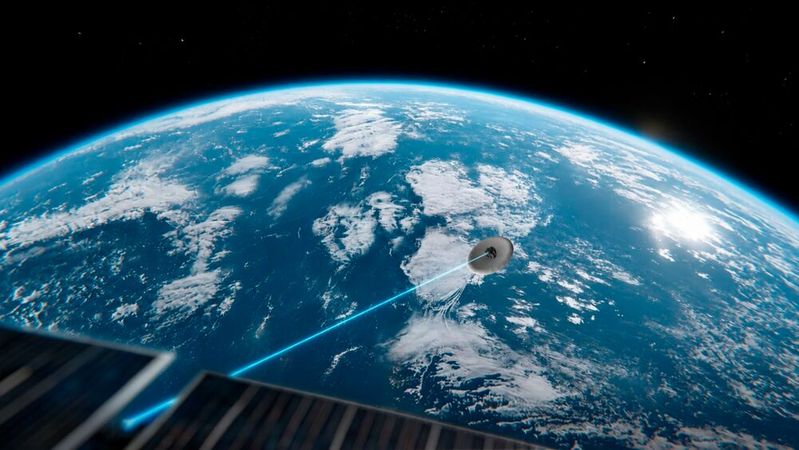
For 2027, two companies are planning for the first time an optical laser communication link to be established directly between a satellite in low-Earth orbit (LEO) and a re-entering spacecraft.
(Image: ATMOS Space Cargo)
Traditional radio communication quickly reaches its physical limits during space missions, especially during the critical reentry into Earth's atmosphere. The plasma gas layer formed during reentry often causes the telemetry connection to break off or become severely disrupted. This is referred to as a radio blackout. For engineers, this often means a painful blind flight until the capsule is physically recovered.
This is where laser communication, also known as free-space optical communications, comes into play. It utilizes highly focused infrared beams, enabling data rates up to 100 times higher than traditional radio signals and being less susceptible to conventional interference.
While laser communication between satellites or from satellites to Earth (ground-to-space) has made significant progress in recent years, the connection between a moving reentry body and an orbiting satellite is uncharted technological territory. For electronics developers and system architects, this means compact, vibration-resistant, and thermally highly resilient optical terminals that must perform reliably in the harsh environment of space and reentry.
PHOENIX 2 meets ATLAS-X
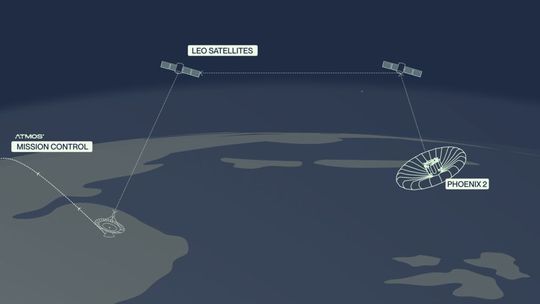
Schematic representation of the joint demonstration mission with LEO satellites, the re-entry vehicle PHOENIX 2, and ground control.
(Image: ATMOS Space Cargo)
Astrolight, a Lithuanian technology company specializing in laser communication solutions, and ATMOS Space Cargo, a provider of commercial cargo return services from orbit, have signed a Memorandum of Understanding (MoU) to bridge this gap. A joint demonstration mission is planned for 2027.
Astrolicht's optical terminal of the ATLAS-X type is to be installed both onboard the LEO test satellite and on the reentry vehicle PHOENIX 2 from ATMOS. The goal is to establish a real-time, optical space-to-space connection and transmit system and payload data at a rate of up to 2.5 Gbit/s. This transmission will occur throughout the entire orbital flight, including the critical phase of atmospheric reentry.
Compact Design and Harsh Environmental Conditions
A central technical challenge in missions of this kind is the so-called SWaP profile, meaning size, weight, and power consumption. Onboard re-entry capsules like PHOENIX, communication components compete heavily with the actual payload and essential subsystems for mass and energy.
The ATLAS-X terminal has been specifically designed as a compact low-SWaP application to integrate an optical high-speed connection into small satellites or capsules, even under strict restrictions.
"Until now, this capability has mostly been tested only under lab-like conditions on Earth. Together with ATMOS Space Cargo, we are now taking it into space," explains Laurynas Mačiulis, CEO of Astrolight. "Our goal is for reentry bodies to connect directly with satellites and future constellations. This way, operators receive maximum data in real-time, making control safer and more scalable."
Strategic Importance for Europe
The cooperation is also driven by Europe's ambition for technological independence in space logistics. So far, the old continent heavily relies on international partners to return cargo from low-Earth orbit. Initiatives like the European Space Agency's (ESA) LEO Cargo Return Services Initiative aim to develop its own capabilities.
With the growing commercial interest in experiments in space, semiconductor manufacturing in microgravity, or the return of critical scientific samples, the demand for continuous telemetry is rapidly increasing. Sebastian Klaus, CEO of ATMOS Space Cargo, emphasizes the importance of the partnership: "As cargo return missions become more autonomous and data-intensive, seamless connectivity throughout the entire mission cycle is essential. Our partnership with Astrolight is a pivotal step in firmly establishing laser communication as a strategic layer for payload monitoring and autonomous reentry within the PHOENIX system."
Date: 08.12.2025
Naturally, we always handle your personal data responsibly. Any personal data we receive from you is processed in accordance with applicable data protection legislation. For detailed information please see our privacy policy.
Consent to the use of data for promotional purposes
I hereby consent to Vogel Communications Group GmbH & Co. KG, Max-Planck-Str. 7-9, 97082 Würzburg including any affiliated companies according to §§ 15 et seq. AktG (hereafter: Vogel Communications Group) using my e-mail address to send editorial newsletters. A list of all affiliated companies can be found here
Newsletter content may include all products and services of any companies mentioned above, including for example specialist journals and books, events and fairs as well as event-related products and services, print and digital media offers and services such as additional (editorial) newsletters, raffles, lead campaigns, market research both online and offline, specialist webportals and e-learning offers. In case my personal telephone number has also been collected, it may be used for offers of aforementioned products, for services of the companies mentioned above, and market research purposes.
Additionally, my consent also includes the processing of my email address and telephone number for data matching for marketing purposes with select advertising partners such as LinkedIn, Google, and Meta. For this, Vogel Communications Group may transmit said data in hashed form to the advertising partners who then use said data to determine whether I am also a member of the mentioned advertising partner portals. Vogel Communications Group uses this feature for the purposes of re-targeting (up-selling, cross-selling, and customer loyalty), generating so-called look-alike audiences for acquisition of new customers, and as basis for exclusion for on-going advertising campaigns. Further information can be found in section “data matching for marketing purposes”.
In case I access protected data on Internet portals of Vogel Communications Group including any affiliated companies according to §§ 15 et seq. AktG, I need to provide further data in order to register for the access to such content. In return for this free access to editorial content, my data may be used in accordance with this consent for the purposes stated here. This does not apply to data matching for marketing purposes.
Right of revocation
I understand that I can revoke my consent at will. My revocation does not change the lawfulness of data processing that was conducted based on my consent leading up to my revocation. One option to declare my revocation is to use the contact form found at https://contact.vogel.de. In case I no longer wish to receive certain newsletters, I have subscribed to, I can also click on the unsubscribe link included at the end of a newsletter. Further information regarding my right of revocation and the implementation of it as well as the consequences of my revocation can be found in the data protection declaration, section editorial newsletter.
If the demonstration in 2027 is successful, it is likely to not only increase acceptance of optical satellite links for commercial and safety-critical applications but also set new standards for reliability and data availability in future European space missions.



:quality(80)/p7i.vogel.de/wcms/14/43/1443db59695f7eed2a338d16d03a6257/26-09-30-st-ber-ab-hunger-games-bild-1v1.jpeg "For “The Hunger Games: On Stage,” drive systems lift and move grandstand sections with a dynamic load of up to 26 metric tons—each section can accommodate up to 112 spectators. (Source: Troubadour at the Canary Wharf Theatre)")
:quality(80)/p7i.vogel.de/wcms/5f/96/5f9606264f35f5979529286a887bbccf/0133859498v1.jpeg "Trumpf Expands Its Portfolio for 2D Laser Cutting (Image:TRUMPF GMBH + CO. KG)")
:quality(80)/p7i.vogel.de/wcms/6d/76/6d7682de33991e539956ed72f7d246a3/vibro-cutv1.jpeg "Hybrid machining uses ultrasonic and oscillation technologies to support traditional machining processes. (Source: VibroCut)")
:quality(80)/p7i.vogel.de/wcms/ed/78/ed786ed6b280ff6c692908f01f715e3d/0113143253v1.jpeg "In our China Market Insider, we regularly provide you with relevant information straight from China. (Image:© Eisenhans - stock.adobe.com)")
:quality(80)/p7i.vogel.de/wcms/a8/0d/a80d9eb978dd47dbd8f390181a039bfc/adobestock-2081783940--design-store-stock-adobe-com-ki-generiertv1.jpeg "We’re showcasing five of the latest innovations for virtual commissioning—from AI copilots and smart browser tools to deep PLC integration. (Source: © Design Store – stock.adobe.com_AI-generated)")
:quality(80)/p7i.vogel.de/wcms/87/88/8788e0b7fd98cca21a9c370ed0f0aa18/0133859688v1.jpeg "The software newly developed at Fraunhofer IWU helps employees reliably
identify parts that do not meet quality requirements. (Image:Fraunhofer IWU)")
:quality(80)/p7i.vogel.de/wcms/4b/7c/4b7c11f510878f154012d04c18a7c3cc/0133798118v1.jpeg "RobCo Becomes a Unicorn: The Munich-based robotics company has reached a valuation of more than one billion U.S. dollars and is driving the next generation of autonomous industrial robotics with Alfie. (Image:RobCo)")
:quality(80)/p7i.vogel.de/wcms/c8/a9/c8a96d5841d508c9e9c609c64168cbaa/0133758997v1.jpeg "Hospital Robotics: Neura Robotics' autonomous healthcare platform is designed to independently transport empty hospital beds between wards and floors. (Image:Neura Robotics)")
:quality(80)/p7i.vogel.de/wcms/8a/c8/8ac8eb7fc2b70f4b72771548e2e2e520/epfl-motor-3v1.jpeg "FiberMotor has a diameter of 1 to 3 mm and consists of two concentric hollow fibers. Each fiber is wrapped in tightly insulated copper wire electrodes that are only slightly thicker than a human hair. (Source: EPFL)")
:quality(80)/p7i.vogel.de/wcms/a7/8a/a78a582a42a96aaaff38bd6b8f97a015/vishal-lal-mit-kernuhrv1.jpeg "It's ticking: Researchers have stabilized the first atomic clock. (Source: PTB)")
:quality(80)/p7i.vogel.de/wcms/36/f9/36f96a206fc408c9a632ce849de1f7fa/newsimage428299v1.jpeg "Polystyrene is used in protective packaging for televisions and electronic devices, in decorative moldings and baseboards for interior home construction, and even in Petri dishes. (Source: Hereon/Marcel Schwickerath)")
:quality(80)/p7i.vogel.de/wcms/90/30/90300137452b00d22f95113eff065ac3/fliehkraftkupplungen-und-bremsen-montage-centrifugal-clutches-and-brakes-assembly-1v1.jpeg "Installation: Centrifugal clutches should always be precisely matched to the machine. (Source: Amsbeck Machine Technology)")
:quality(80)/p7i.vogel.de/wcms/a6/c1/a6c172d92327528ff2036d70ead65036/db2026au00899-largev1.jpeg "The new ID Tiguan will replace the existing ID 4 and ID 5 models. (Image:Volkswagen AG)")
:quality(80)/p7i.vogel.de/wcms/3c/e1/3ce13cf499573490d536bb5741f6fb7f/1-entev1.jpeg "Brand-new, yet quintessentially 2CV: The new 2CV is set to hit the road in two years at the latest. (Image:Citroën)")
:quality(80)/p7i.vogel.de/wcms/50/23/5023ffaefac8f9a47286b368143b88eb/0133801078v1.jpeg "Life isn't exactly a walk in the park for Porsche right now. And now Porsche management is saying that next year will be even worse. Read here to find out why that's supposed to be the case... (Image: Porsche)")
:quality(80)/p7i.vogel.de/wcms/2f/ab/2fabf62cdd2f57cb279e00931c91c869/0133794991v1.jpeg "The Atto 2 SUV is one of BYD's most popular plug-in hybrids. (Image:BYD)")
:quality(80)/p7i.vogel.de/wcms/4c/59/4c59ffe8ca03e2b17250ff39ac57d3a7/0133803993v1.jpeg "Making greater use of plant-based proteins would be beneficial, but they can contain bitter peptides. However, with a new AI, it is now possible to predict their taste in order to specifically produce the right peptides. The image shows the bitter taste receptor pocket with a bound tripeptide (yellowish). (Image:F. Bößl / Leibniz-LSB)")
:quality(80)/p7i.vogel.de/wcms/c4/11/c41181159e23eafeffe6c06b9e496859/0133788141v1.jpeg "Simplicity AI SDK: Silicon Labs has released its AI-powered developer SDK as a public beta, thereby integrating AI assistants into the embedded development process. (Image:Silicon Labs)")
:quality(80)/p7i.vogel.de/wcms/f5/22/f5221ac972f35e5befc24a040ce7b19e/0133841330v1.jpeg "Chip-on-Cell technology: The Dukosis DK8102 measurement chip measures cell voltage and temperature directly at the battery cell and transmits the data to the battery management system. (Image:Dukosi)")
:quality(80)/p7i.vogel.de/wcms/97/5e/975e764c44174e6091b169f1d4682dbf/0133820837v1.jpeg "In SiC superjunction devices, the trench geometry and epitaxial filling influence the trade-off between breakdown voltage and on-resistance. (Image:Dall-E / AI-generated)")
:fill(fff,0)/images.vogel.de/vogelonline/companyimg/76800/76895/65.jpg "FAULHABER_120mm.jpg ()")
:fill(fff,0)/p7i.vogel.de/companies/69/88/69882c428938e/tmts2026-ticec-banner-en-2000px.png "tmts2026-ticec-banner-en-2000px (https://www.tmts.tw/en)")
:quality(80)/p7i.vogel.de/wcms/58/f2/58f220c93ab6a5fc7c8374849430a444/0128247466v1.jpeg "Space satellites: \"Setting up and providing NTN has never been so easy.\" (Image:AI-generated)")
:quality(80)/p7i.vogel.de/wcms/f8/2d/f82d45c2610205e2c0c188968022890d/more-liftoff-power-first-ariane-6-with-four-boosters-launched-4781x2691v1v1.jpeg "The Ariane 6 can be modularly adapted to any mission—either with two or four boosters and a variable payload fairing length. (Image:ESA-M. Pedoussaut)")