Field TestHyundai Ioniq 3—Sporty Only on the Outside
Source:
sp-x | Translated by AI
5 min Reading Time
The compact Hyundai Ioniq 3 is easy to drive and offers a mature driving experience. However, its sporty appearance promises more than the powertrain delivers.
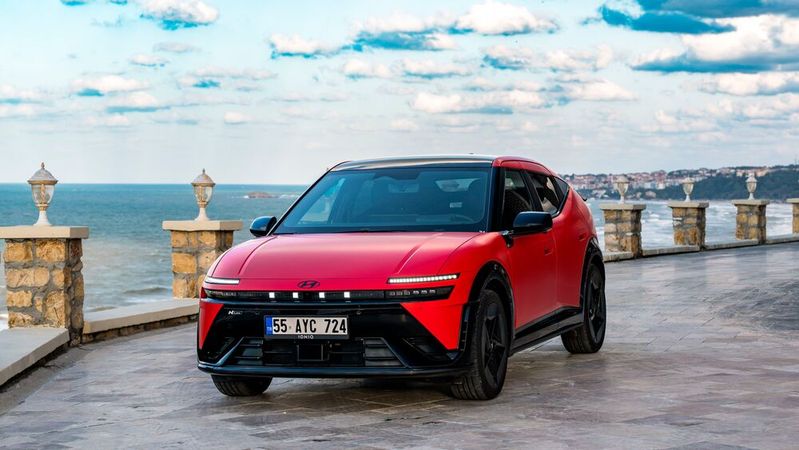
The electric Ioniq 3 is intended to fill the gap between the small Inster and the Kona Electric.
(Image: Hyundai)
Cars from Hungary, Romania, or the Czech Republic no longer surprise anyone. Turkey, on the other hand, isn’t typically thought of as a car-making country. Yet Renault, Fiat, and Hyundai have been manufacturing vehicles there for decades. Just recently, the Koreans invested 260 million euros ($296.4 million) in their plant in Izmit to build their first electric car “Made in Turkey.” The electric Ioniq 3 is intended to fill the gap between the small Inster and the Kona Electric.
A comparison with sister brand Kia seems obvious. However, the “3” here is misleading; its technical counterpart isn’t called the EV 3, but rather the EV 2. Battery sizes and front-mounted motors are largely the same, but the body styles take their own paths. Kia has opted for a small, tall SUV, while Hyundai has gone with a low-slung fastback. At just over 4.15 meters long (13 feet 7 inches) and only 1.50 meters (4 feet 11 inches) high, the Ioniq 3 looks a bit more dynamic than the EV 2.
As with the Inster, however, the Ioniq 3’s appearance is a matter of taste. You have to like its squat rear end with the angled rear window—divided by a spoiler—even if the additional window does improve rear visibility. The roofline runs almost straight over the passengers at first and only slopes downward further back. This provides headroom in the rear and improves aerodynamics. As with the Kia EV 2, there are two battery sizes to choose from: 42 or 61 kWh. With these, the Hyundai officially has a range of up to 344 and 497 kilometers (214 and 309 miles), about ten percent more than the Kia.
More Expensive than the Competition
The Ioniq 3 starts at 28,950 euros ($33,003), which puts it above its European rivals: VW charges at least 25,000 euros ($28,500) more for the ID Polo at a minimum of 25,000 euros ($29,583), while Cupra has announced the entry-level version of the Raval at 25,950 euros ($3,420). The Korean model’s standard equipment includes dual-zone automatic climate control, LED headlights, and a rearview camera. Battery heating and preconditioning—which brings the battery up to temperature before a fast-charging stop—are only available in the Trend version, which costs 3,000 euros ($3,420) more. A heat pump, Matrix LED headlights, and navigation also cost extra—unless you opt for the N-Line versions, which make a bold statement with wheels up to 19 inches in diameter and a synthetic engine sound. The price here starts at 39,650 euros ($45,201), including the large battery, which otherwise costs an additional 4,000 euros ($4,560).
The Ioniq 3 is the first European Hyundai to feature the new “Pleos Connect” infotainment system, which comes with a 12.9-inch or 14.6-inch touchscreen, depending on the trim level. It runs on the Android Automotive operating system. An app store and updates via a cellular connection are designed to expand its functionality. Apple CarPlay and Android Auto are also available wirelessly.
All of this is pretty much standard. What really matters is how easy the system is to use. And in that regard, the Koreans have delivered a solid result. Below the navigation screen, you can arrange your favorite apps however you like; on the left, you’ll find the driver assistance features and the trip computer. At the very bottom are physical climate control buttons, and there’s a separate knob for volume. Particularly handy: A long press on the assistant button on the steering wheel opens a submenu where the speed warning, drowsiness monitoring, and attention assist are already selected. Confirm once, and they’re all turned off. The narrow driver’s display is also a plus. It’s positioned far forward on the windshield, directly in the driver’s field of view, and displays all driving information in a clear, easy-to-read manner. You don’t even miss having an additional head-up display.
A Mature Demeanor
The interior offers plenty of space and ample storage. The center console features two cup holders and a cell phone charging cradle at the top, with space below for stowing small items. The seats are quite comfortable, but could offer more lateral support. A nice touch in the higher-end trims: From the driver’s seat, you can electrically adjust the front passenger seat or recline its backrest. Despite the flat roof, you don’t feel cramped in the back. However, the low bench seat causes rear passengers’ knees to be at a sharp angle.
Date: 08.12.2025
Naturally, we always handle your personal data responsibly. Any personal data we receive from you is processed in accordance with applicable data protection legislation. For detailed information please see our privacy policy.
Consent to the use of data for promotional purposes
I hereby consent to Vogel Communications Group GmbH & Co. KG, Max-Planck-Str. 7-9, 97082 Würzburg including any affiliated companies according to §§ 15 et seq. AktG (hereafter: Vogel Communications Group) using my e-mail address to send editorial newsletters. A list of all affiliated companies can be found here
Newsletter content may include all products and services of any companies mentioned above, including for example specialist journals and books, events and fairs as well as event-related products and services, print and digital media offers and services such as additional (editorial) newsletters, raffles, lead campaigns, market research both online and offline, specialist webportals and e-learning offers. In case my personal telephone number has also been collected, it may be used for offers of aforementioned products, for services of the companies mentioned above, and market research purposes.
Additionally, my consent also includes the processing of my email address and telephone number for data matching for marketing purposes with select advertising partners such as LinkedIn, Google, and Meta. For this, Vogel Communications Group may transmit said data in hashed form to the advertising partners who then use said data to determine whether I am also a member of the mentioned advertising partner portals. Vogel Communications Group uses this feature for the purposes of re-targeting (up-selling, cross-selling, and customer loyalty), generating so-called look-alike audiences for acquisition of new customers, and as basis for exclusion for on-going advertising campaigns. Further information can be found in section “data matching for marketing purposes”.
In case I access protected data on Internet portals of Vogel Communications Group including any affiliated companies according to §§ 15 et seq. AktG, I need to provide further data in order to register for the access to such content. In return for this free access to editorial content, my data may be used in accordance with this consent for the purposes stated here. This does not apply to data matching for marketing purposes.
Right of revocation
I understand that I can revoke my consent at will. My revocation does not change the lawfulness of data processing that was conducted based on my consent leading up to my revocation. One option to declare my revocation is to use the contact form found at https://contact.vogel.de. In case I no longer wish to receive certain newsletters, I have subscribed to, I can also click on the unsubscribe link included at the end of a newsletter. Further information regarding my right of revocation and the implementation of it as well as the consequences of my revocation can be found in the data protection declaration, section editorial newsletter.
The trunk is also large enough for everyday use. In addition to the 320 liters (11.3 cubic feet) in the main compartment, there’s a deep compartment under the floor offering another 120 liters (4.2 cubic feet). It’s handy for storing items separately. However, you’ll have to lift heavy luggage from the depths over the loading sill. And there’s no front trunk.
That mature feel carries over to the road. It’s noticeable that the steering feels a bit heavier than in many other Hyundais. However, it also gives you a good sense of what the front wheels are doing. The suspension is tuned on the softer side, so the Ioniq 3 drives comfortably.
Sporty Look, Smooth Ride
The only thing is that the powertrain doesn't live up to what its sporty looks promise. It delivers decent acceleration and is perfectly adequate for everyday driving. But the sporty-looking N-Line models, with their large wheels, could certainly use a bit more punch. The car definitely has the potential for a true N version.
But with its small lithium iron phosphate battery delivers only 108 kW (145 hp) of power. The 61-kWh battery uses nickel-manganese-cobalt cells and is paired with a 99-kW (133-hp) motor. Depending on the version, the car accelerates to 100 km/h (62 mph) in 8.7 to 9.6 seconds, and its top speed is limited to 170 km/h (106 mph).
Since the Ioniq 3 uses the 400-volt technology standard in this class, the maximum charging power at a fast charger is 119 kW for the smaller battery and 110 kW for the NMC battery. Ideally, charging from 10 to 80 percent takes about half an hour. An 11-kW AC charging capability comes standard. Starting with the Trend trim level, a 22-kW charger is available as an option in the €1,650 (about $1,845) technology package, which also allows for powering external devices.



:quality(80)/p7i.vogel.de/wcms/4b/7f/4b7feb398114331dff3d8b6c5e8dc06a/0133877511v1.jpeg "Brandt GmbH designs, manufactures, and services molds and tools for plastic injection molding, metal die casting, and the processing of LSR (liquid silicone rubber). (Image:Brandt)")
:quality(80)/p7i.vogel.de/wcms/db/23/db2332f08461bb166442018b9644b613/0133890143v1.jpeg "The International Monetary Fund (IMF) has revised some of its earlier forecasts for global economic growth upward. Germany, for example, is expected to grow more strongly in 2026 than previously thought. But the IMF has also taken a look at how things are shaping up in the rest of the world... (Image: AI-generated)")
:quality(80)/p7i.vogel.de/wcms/3b/53/3b53eec6903a838b98425d19f21d25ee/0132416085v1.jpeg "Complex progressive dies serve as the basis for stamped and formed parts—such as the copper outer conductors for sensor elements shown here. They are equipped with bending and embossing dies manufactured on the Kern Micro HD. (Image:Quittenbaum, LLC)")
:quality(80)/p7i.vogel.de/wcms/14/43/1443db59695f7eed2a338d16d03a6257/26-09-30-st-ber-ab-hunger-games-bild-1v1.jpeg "For “The Hunger Games: On Stage,” drive systems lift and move grandstand sections with a dynamic load of up to 26 metric tons—each section can accommodate up to 112 spectators. (Source: Troubadour at the Canary Wharf Theatre)")
:quality(80)/p7i.vogel.de/wcms/b7/95/b795d5fb82459f8a526e880f0698dffa/1-maxon-mind-covershot-landscapev1.jpeg "Claude Jaquemet demonstrates the Maxon Mind demo system. (Source: Maxon)")
:quality(80)/p7i.vogel.de/wcms/be/66/be661616d5250d4c3814a25688f3904b/0133917202v1.jpeg "Neuron AI combines 3D vision, touch, hearing, proprioception, and language—along with memory—into a Perception-Language-Action (PLA) model. Robots can grasp objects they cannot see. (Image:Neura)")
:quality(80)/p7i.vogel.de/wcms/c7/12/c712b688dba2262fa3906e3a4c1d2f7d/humanoide-robotikv1.jpeg "“Find a job that the humanoid can actually do, and understand your processes”—that’s the advice robotics expert Sebastian Prinz gives companies so they can benefit from the technology in the long term. (Source: Fraunhofer IEM / Janosch Gruschczyk)")
:quality(80)/p7i.vogel.de/wcms/05/bc/05bcc7390d30da9c23a829f7e96247e3/koch-glserdepalettierung-nahrungsmittelv1.jpeg "Opportunities for automation using robots can be found in all areas of manufacturing, such as in the palletizing of products. (Image:Koch Industrial Systems, LLC)")
:quality(80)/p7i.vogel.de/wcms/96/89/9689197f666e4aa9bc4a1f395c25d3ef/0133739635v1.jpeg "The 2026 Nobel Prize in Medicine laureates: Karl Deisseroth, Peter Hegemann, and Georg Nagel. (Image:Nobel Prize Outreach)")
:quality(80)/p7i.vogel.de/wcms/8a/c8/8ac8eb7fc2b70f4b72771548e2e2e520/epfl-motor-3v1.jpeg "FiberMotor has a diameter of 1 to 3 mm and consists of two concentric hollow fibers. Each fiber is wrapped in tightly insulated copper wire electrodes that are only slightly thicker than a human hair. (Source: EPFL)")
:quality(80)/p7i.vogel.de/wcms/a7/8a/a78a582a42a96aaaff38bd6b8f97a015/vishal-lal-mit-kernuhrv1.jpeg "It's ticking: Researchers have stabilized the first atomic clock. (Source: PTB)")
:quality(80)/p7i.vogel.de/wcms/36/f9/36f96a206fc408c9a632ce849de1f7fa/newsimage428299v1.jpeg "Polystyrene is used in protective packaging for televisions and electronic devices, in decorative moldings and baseboards for interior home construction, and even in Petri dishes. (Source: Hereon/Marcel Schwickerath)")
:quality(80)/p7i.vogel.de/wcms/0e/0f/0e0fbf3c457f4b983ff9c2cc20de513c/708953-ef6f61c0616f461c9a42f6a0f403a3f8-c8ba35-original-1791536261v1.jpeg "In early October, Xpeng announced the successful production trial of its G9L model at Magna in Graz. (Image:Xpeng)")
:quality(80)/p7i.vogel.de/wcms/43/45/43457e82fb322b30ee6c3f89778f43a0/0133901965v1.jpeg "At the Smart booth in Paris, a crowd of curious visitors has gathered around the new #2. (Image:SP-X/Mario Hommen)")
:quality(80)/p7i.vogel.de/wcms/67/81/678178f79538639668f442090187ca4d/0133862908v1.jpeg "The electric Ioniq 3 is intended to fill the gap between the small Inster and the Kona Electric. (Image:Hyundai)")
:quality(80)/p7i.vogel.de/wcms/41/5c/415c7db1354bd732d6bfaa30fcd386e7/db2025au00399-largev1.jpeg "With the ID Every1 concept car, VW provided a glimpse of its future entry-level model in March 2025. (Source: Volkswagen)")
:quality(80)/p7i.vogel.de/wcms/8a/d1/8ad1fd2d80399dd663a55b44b0953707/0133918510v1.jpeg "Multiple wireless standards on a single platform: Qualcomm's Dragonwing FWA Gen 6 Elite combines 5G Advanced, satellite communications, and Wi-Fi 8 with on-device AI processing for wireless broadband connectivity. (Image:Qualcomm)")
:quality(80)/p7i.vogel.de/wcms/8c/27/8c27323a09724f906aacf549d7cdaf3a/0133923995v1.jpeg "Keysight is working with research institutes to simplify the testing of next-generation semiconductor devices. (Image:Keysight)")
:quality(80)/p7i.vogel.de/wcms/78/92/7892504a95318acd1cd009ce614a33ab/0133939086v1.jpeg "Vishay's nine optical sensors combine an infrared emitter with a PIN photodiode. They enable bidirectional data transmission at speeds of up to 6 Mbit/s, for example in battery management systems for electric vehicles. (Image: Vishay)")
:quality(80)/p7i.vogel.de/wcms/50/81/50811ef8ab18d0626aa6d86dac2c46b4/0133922867v1.jpeg "Encapsulation materials are becoming increasingly important in electronics manufacturing. Particularly in highly integrated chip packages, the requirements for reliability, thermomechanical stability, and processability are rising. (Image:Sumitomo Bakelite)")
:quality(80)/p7i.vogel.de/wcms/68/dd/68dd2a411c5a139bec7370d2c9933cc9/0133862801v1.jpeg "As with the Inster, however, the Ioniq 3’s appearance is a matter of taste. You have to like its stocky rear end with the angled rear window divided by a spoiler, even if the additional window does improve rear visibility.(Image: Hyundai)")
:quality(80)/p7i.vogel.de/wcms/87/64/8764d1e5dfe4b8895e0e5197c14d2937/0133862802v1.jpeg "The Hyundai Ioniq 3 is 4.15 meters long.(Image: Hyundai)")
:quality(80)/p7i.vogel.de/wcms/91/e4/91e49a4f32e4c79f26ffdcfe5dbe6195/0133862910v1.jpeg "The Ioniq 3 is the first European Hyundai to feature the Pleos Connect infotainment system, which includes a 12.9- or 14.6-inch touchscreen and Android Automotive.(Image: Hyundai)")
:quality(80)/p7i.vogel.de/wcms/91/2c/912c63b5300593496598d7be3a8dec20/0133862803v1.jpeg "There are two battery options to choose from: 42 kWh (108 kW/147 PS, up to 344 kilometers of range) and 61 kWh (99 kW/135 PS, up to 497 kilometers).(Image: Hyundai)")
:quality(80)/p7i.vogel.de/wcms/5c/7a/5c7a3c721de3dfdef48ec26e86929622/0128017027v1.jpeg "The Kia K4 succeeds the Ceed. (Image:Kia)")
:quality(80)/p7i.vogel.de/wcms/f7/f8/f7f8bcd6f4854df1b6555a0ff951b93e/0131493601v1.jpeg "Kia launches another SUV on the market with the Seltos. (Image:Kia)")