Smart is going small again: The electric two-seater is back with the new #2. It stays true to the Fortwo concept but offers a longer range, modern technology, and an affordable starting price.
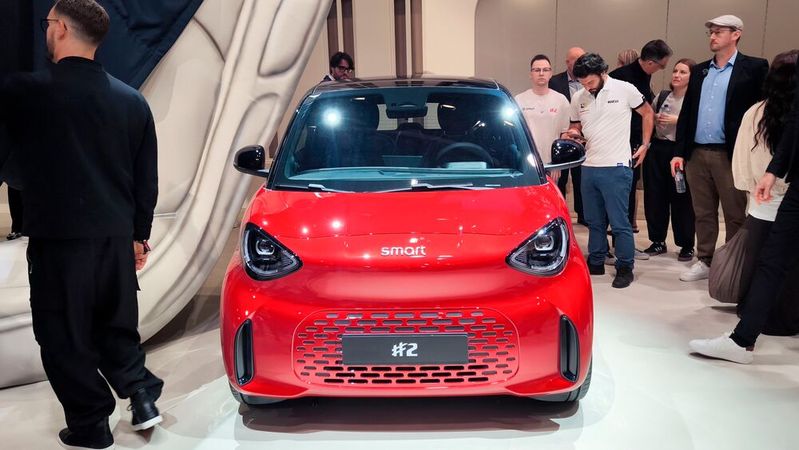
At the Smart booth in Paris, a crowd of curious visitors has gathered around the new #2.
(Image: SP-X/Mario Hommen)
Smart is returning to its roots. After the brand—once known for its exceptionally small city cars—expanded its model lineup in recent years to include increasingly larger vehicles, the classic two-seater, which long served as the brand’s symbol, is now making a comeback. Just how serious Smart is about this return to its roots was also evident at the world premiere of the new #2 at the Paris Motor Show (through October 18).
With former Smart CEO Annette Winkler and Johann Tomforde—one of the masterminds behind the original Smart—two figures who have had a significant impact on the brand’s history were in attendance. Their presence underscored the message: Smart wants to return, at least in part, to the Smart of yesteryear.
Prices start at 19,990 euros ($22,788.60)
Visually and conceptually, this all-electric city car closely follows in the footsteps of the Fortwo, which was discontinued in 2024, but is expected to offer significantly greater practicality for everyday use thanks to modern technology. Smart is also keeping prices down: prices start at 19,990 euros.
The new Smart stays true to the Fortwo’s proven basic concept: The #2 is an ultra-short two-door car with two seats. At 2.75 meters (9 feet) long, it’s only slightly larger than its predecessor, which offers its users enormous advantages when looking for parking in tight downtown areas. This little car also proves to be a breeze to maneuver: With a turning radius of just 6.95 meters (22.8 feet) from curb to curb, the #2 can turn almost on the spot.
It’s clear at first glance that this is a Smart in the best sense of the word. Despite the new ECA platform and the advanced safety cell known as the Tridion Cell Evo, the body—with its short overhangs and familiar proportions—clearly evokes the third-generation Fortwo. The roofline, which takes on a slightly more coupe-like appearance thanks to a visually floating C-pillar, adds a new touch. The characteristic, two-part tailgate has also survived: while the glass panel swings upward, the lower section folds downward.
The typical, drive-system-determined mixed tire setup—with narrower tires in the front and wider ones in the rear—has also remained. Overall, the #2 looks more modern than its predecessors. This is due in large part to the confident, almost assertive look of the standard LED headlights. Together with the equally striking taillights, they give the small car a high-tech appearance.
#2 Gets a Brabus Version
The brand’s sporty side is also set to be revived with the #2. There was already a hint of this at the premiere: It was no coincidence that Brabus CEO Constantin Buschmann was in the audience. Smart promptly announced that it would also offer a Brabus version of the #2 in the future. However, details regarding performance, features, and the market launch of the sporty variant remain to be announced.
There have also been some changes under the hood. A new five-link independent suspension on the rear axle, combined with a low center of gravity and direct steering, is designed to deliver more agile handling without compromising comfort. In addition to city streets, the #2 is also expected to perform well on country roads and highways.
Inside, the Smart blends the familiar with the new. The two seats visually form a continuous bench, with an S-shaped dashboard stretching out in front of them. During a first test sit at the Paris Auto Show, the small two-seater makes a decidedly grown-up impression. Especially in the higher trim levels, the interior looks chic and has been designed with an eye for detail. While plastic still dominates, metal-look accents, stylishly designed air vents, and two integrated displays create an appealing atmosphere. The amount of space is also a pleasant surprise. Despite the compact exterior dimensions, two adults can sit with surprising ease. And even when closing the doors, this little car conveys a sense of solidity: they slam shut with a satisfying “thud.”
Date: 08.12.2025
Naturally, we always handle your personal data responsibly. Any personal data we receive from you is processed in accordance with applicable data protection legislation. For detailed information please see our privacy policy.
Consent to the use of data for promotional purposes
I hereby consent to Vogel Communications Group GmbH & Co. KG, Max-Planck-Str. 7-9, 97082 Würzburg including any affiliated companies according to §§ 15 et seq. AktG (hereafter: Vogel Communications Group) using my e-mail address to send editorial newsletters. A list of all affiliated companies can be found here
Newsletter content may include all products and services of any companies mentioned above, including for example specialist journals and books, events and fairs as well as event-related products and services, print and digital media offers and services such as additional (editorial) newsletters, raffles, lead campaigns, market research both online and offline, specialist webportals and e-learning offers. In case my personal telephone number has also been collected, it may be used for offers of aforementioned products, for services of the companies mentioned above, and market research purposes.
Additionally, my consent also includes the processing of my email address and telephone number for data matching for marketing purposes with select advertising partners such as LinkedIn, Google, and Meta. For this, Vogel Communications Group may transmit said data in hashed form to the advertising partners who then use said data to determine whether I am also a member of the mentioned advertising partner portals. Vogel Communications Group uses this feature for the purposes of re-targeting (up-selling, cross-selling, and customer loyalty), generating so-called look-alike audiences for acquisition of new customers, and as basis for exclusion for on-going advertising campaigns. Further information can be found in section “data matching for marketing purposes”.
In case I access protected data on Internet portals of Vogel Communications Group including any affiliated companies according to §§ 15 et seq. AktG, I need to provide further data in order to register for the access to such content. In return for this free access to editorial content, my data may be used in accordance with this consent for the purposes stated here. This does not apply to data matching for marketing purposes.
Right of revocation
I understand that I can revoke my consent at will. My revocation does not change the lawfulness of data processing that was conducted based on my consent leading up to my revocation. One option to declare my revocation is to use the contact form found at https://contact.vogel.de. In case I no longer wish to receive certain newsletters, I have subscribed to, I can also click on the unsubscribe link included at the end of a newsletter. Further information regarding my right of revocation and the implementation of it as well as the consequences of my revocation can be found in the data protection declaration, section editorial newsletter.
The digital display and control system consists of an 8.8-inch driver display and a central 10.1-inch touchscreen. In addition to 4G cellular connectivity, Wi-Fi, and Bluetooth, there’s an eight-year connectivity package for connected vehicle services. A unique feature is the so-called “Smart Pillar” in the dashboard, to which small everyday accessories and gadgets can be attached. This compact car has also come of age when it comes to driver-assistance systems. Features include adaptive cruise control with a stop-and-go function and a highway assist system.
For the powertrain, Smart is relying on a 60 kW (80-hp)/82 PS rear-mounted motor, just as it did with the electric Fortwo. The #2 accelerates to 100 (62 mph) in 11.6 seconds—one-tenth of a second longer than its predecessor. The top speed has increased from 130 to 140 km/h (81 to 87 mph). This doesn’t turn the two-seater into a sports car, but the performance should certainly be sufficient for everyday urban driving.
Up to 290 kilometers (about 180 miles) of range, DC charging up to 65 kW
The battery promises a significantly greater improvement. Instead of the previous small 17 kWh battery, the vehicle now features a lithium iron phosphate battery with a capacity of approximately 36 kWh mounted in the floor. This increases the WLTP range from 133 to up to 290 kilometers (83 to 180 miles). In terms of driving range, the city car has thus made a remarkable leap. It’s also worth noting that the larger battery doesn’t increase the weight all that much. At 1,140 kilograms (2,513 pounds), the #2 weighs just 55 kilograms (121 pounds) more than its predecessor. However, the payload capacity—at 205 kilograms (452 pounds)—is even lower than before.
Another improvement involves charging. While the old Fortwo could only accept alternating current, the #2 now also supports DC fast charging at up to 65 kW. Under ideal conditions, the battery should charge from 10 to 80 percent in 20 minutes. When plugged into a wallbox, the base model Pure can handle up to 7.4 kW, while the other trim levels can handle 11 kW.
At launch, Smart is offering the #2 in three trim levels—Pure, Pure+, and Premium—as well as a limited-edition Couture Edition. The base model features, among other things, a Vehicle-to-Load function for powering external devices, adaptive cruise control, and a high-beam assistant. For an additional 1,000 euros ($1,140), the Pure+ is available with an 11-kW AC charger, a heated driver’s seat, and additional driver-assistance systems such as blind-spot and cross-traffic alerts.
Available for Order Now
The Premium model, priced at 24,500 euros ($27,930), offers a significantly more comfortable ride. Its features include faux-leather seats, heated seats (including for the front passenger), and a Sennheiser sound system. Limited to 999 units, the Couture Edition, priced at 25,700 euros ($29,298), offers features such as a two-tone paint finish in matte white and platinum gold, a glass roof, a heated steering wheel, an inductive charging pad, and navigation.
The world premiere in Paris also marks the start of pre-sales in Europe. Starting October 13, interested buyers can place orders for the new two-seater. Those who order early are expected to receive their vehicle before the official market launch, which is scheduled for the first half of 2027. After a hiatus of several years, Smart is thus returning to the vehicle concept that once made the brand great: a car that stands out above all for how little space it takes up.



:quality(80)/p7i.vogel.de/wcms/4b/7f/4b7feb398114331dff3d8b6c5e8dc06a/0133877511v1.jpeg "Brandt GmbH designs, manufactures, and services molds and tools for plastic injection molding, metal die casting, and the processing of LSR (liquid silicone rubber). (Image:Brandt)")
:quality(80)/p7i.vogel.de/wcms/db/23/db2332f08461bb166442018b9644b613/0133890143v1.jpeg "The International Monetary Fund (IMF) has revised some of its earlier forecasts for global economic growth upward. Germany, for example, is expected to grow more strongly in 2026 than previously thought. But the IMF has also taken a look at how things are shaping up in the rest of the world... (Image: AI-generated)")
:quality(80)/p7i.vogel.de/wcms/3b/53/3b53eec6903a838b98425d19f21d25ee/0132416085v1.jpeg "Complex progressive dies serve as the basis for stamped and formed parts—such as the copper outer conductors for sensor elements shown here. They are equipped with bending and embossing dies manufactured on the Kern Micro HD. (Image:Quittenbaum, LLC)")
:quality(80)/p7i.vogel.de/wcms/14/43/1443db59695f7eed2a338d16d03a6257/26-09-30-st-ber-ab-hunger-games-bild-1v1.jpeg "For “The Hunger Games: On Stage,” drive systems lift and move grandstand sections with a dynamic load of up to 26 metric tons—each section can accommodate up to 112 spectators. (Source: Troubadour at the Canary Wharf Theatre)")
:quality(80)/p7i.vogel.de/wcms/b7/95/b795d5fb82459f8a526e880f0698dffa/1-maxon-mind-covershot-landscapev1.jpeg "Claude Jaquemet demonstrates the Maxon Mind demo system. (Source: Maxon)")
:quality(80)/p7i.vogel.de/wcms/be/66/be661616d5250d4c3814a25688f3904b/0133917202v1.jpeg "Neuron AI combines 3D vision, touch, hearing, proprioception, and language—along with memory—into a Perception-Language-Action (PLA) model. Robots can grasp objects they cannot see. (Image:Neura)")
:quality(80)/p7i.vogel.de/wcms/c7/12/c712b688dba2262fa3906e3a4c1d2f7d/humanoide-robotikv1.jpeg "“Find a job that the humanoid can actually do, and understand your processes”—that’s the advice robotics expert Sebastian Prinz gives companies so they can benefit from the technology in the long term. (Source: Fraunhofer IEM / Janosch Gruschczyk)")
:quality(80)/p7i.vogel.de/wcms/05/bc/05bcc7390d30da9c23a829f7e96247e3/koch-glserdepalettierung-nahrungsmittelv1.jpeg "Opportunities for automation using robots can be found in all areas of manufacturing, such as in the palletizing of products. (Image:Koch Industrial Systems, LLC)")
:quality(80)/p7i.vogel.de/wcms/96/89/9689197f666e4aa9bc4a1f395c25d3ef/0133739635v1.jpeg "The 2026 Nobel Prize in Medicine laureates: Karl Deisseroth, Peter Hegemann, and Georg Nagel. (Image:Nobel Prize Outreach)")
:quality(80)/p7i.vogel.de/wcms/8a/c8/8ac8eb7fc2b70f4b72771548e2e2e520/epfl-motor-3v1.jpeg "FiberMotor has a diameter of 1 to 3 mm and consists of two concentric hollow fibers. Each fiber is wrapped in tightly insulated copper wire electrodes that are only slightly thicker than a human hair. (Source: EPFL)")
:quality(80)/p7i.vogel.de/wcms/a7/8a/a78a582a42a96aaaff38bd6b8f97a015/vishal-lal-mit-kernuhrv1.jpeg "It's ticking: Researchers have stabilized the first atomic clock. (Source: PTB)")
:quality(80)/p7i.vogel.de/wcms/36/f9/36f96a206fc408c9a632ce849de1f7fa/newsimage428299v1.jpeg "Polystyrene is used in protective packaging for televisions and electronic devices, in decorative moldings and baseboards for interior home construction, and even in Petri dishes. (Source: Hereon/Marcel Schwickerath)")
:quality(80)/p7i.vogel.de/wcms/c0/30/c030f79acad01285bcf98d3e634708e1/0133914206v1.jpeg "The Li 6 combines a platform developed specifically for electric vehicles with 800-V architecture and 5C fast-charging technology. The suspension and handling have been adapted to European roads and driving habits. (Image:LI Auto)")
:quality(80)/p7i.vogel.de/wcms/23/fa/23fa8e88a49a99e13e819c188c8a22de/0133950806v1.jpeg "In Shenyang, China, BMW has begun mass production of its Gen6 high-voltage batteries for the New Class. (Image:BMW)")
:quality(80)/p7i.vogel.de/wcms/64/bf/64bf3942deb5fa1fd3488d9f61bad2e9/0133911824v1.jpeg "The return of the \"Duck\" was certainly one of the most exciting topics at the 2026 Paris Motor Show. (Image:sp-x)")
:quality(80)/p7i.vogel.de/wcms/0e/0f/0e0fbf3c457f4b983ff9c2cc20de513c/708953-ef6f61c0616f461c9a42f6a0f403a3f8-c8ba35-original-1791536261v1.jpeg "In early October, Xpeng announced the successful production trial of its G9L model at Magna in Graz. (Image:Xpeng)")
:quality(80)/p7i.vogel.de/wcms/8a/d1/8ad1fd2d80399dd663a55b44b0953707/0133918510v1.jpeg "Multiple wireless standards on a single platform: Qualcomm's Dragonwing FWA Gen 6 Elite combines 5G Advanced, satellite communications, and Wi-Fi 8 with on-device AI processing for wireless broadband connectivity. (Image:Qualcomm)")
:quality(80)/p7i.vogel.de/wcms/8c/27/8c27323a09724f906aacf549d7cdaf3a/0133923995v1.jpeg "Keysight is working with research institutes to simplify the testing of next-generation semiconductor devices. (Image:Keysight)")
:quality(80)/p7i.vogel.de/wcms/78/92/7892504a95318acd1cd009ce614a33ab/0133939086v1.jpeg "Vishay's nine optical sensors combine an infrared emitter with a PIN photodiode. They enable bidirectional data transmission at speeds of up to 6 Mbit/s, for example in battery management systems for electric vehicles. (Image: Vishay)")
:quality(80)/p7i.vogel.de/wcms/50/81/50811ef8ab18d0626aa6d86dac2c46b4/0133922867v1.jpeg "Encapsulation materials are becoming increasingly important in electronics manufacturing. Particularly in highly integrated chip packages, the requirements for reliability, thermomechanical stability, and processability are rising. (Image:Sumitomo Bakelite)")
:fill(fff,0)/images.vogel.de/vogelonline/companyimg/76800/76895/65.jpg "FAULHABER_120mm.jpg ()")
:fill(fff,0)/p7i.vogel.de/companies/69/de/69de1b7403b0d/simtos-logo.jpeg "simtos-logo (SIMTOS)")
:quality(80)/p7i.vogel.de/wcms/a2/1a/a21a6622d8c0e7d41344de02924beed2/0133902732v1.jpeg "The lower tailgate, on the other hand, opens downward.(Image: Smart)")
:quality(80)/p7i.vogel.de/wcms/55/2e/552e0fd17dbb1489c19da1f5132a666a/0133902271v1.jpeg "The new #2 is 2.75 meters short.(Image: Smart)")
:quality(80)/p7i.vogel.de/wcms/a0/3a/a03a8260185642d2804f516b3b2788a5/0133902292v1.jpeg "#2 has mastered DC charging.(Image: Smart)")
:quality(80)/p7i.vogel.de/wcms/33/87/338725d15e94b7836be8fa45e4ae0ca5/0133902295v1.jpeg "The ventilation vents are beautifully designed.(Image: Smart)")
:quality(80)/p7i.vogel.de/wcms/3c/e1/3ce13cf499573490d536bb5741f6fb7f/1-entev1.jpeg "Brand-new, yet quintessentially 2CV: The new 2CV is set to hit the road in two years at the latest. (Image:Citroën)")
:quality(80)/p7i.vogel.de/wcms/38/40/3840a78113b846a7a13486d73506eff5/citroen-2cv-screenshot-ki-bearbeitetv1.jpeg "This is what Citroën's 2CV concept car might look like. (Image:Stellantis / KI-generiert)")