A faster operation, shorter anesthesia times, and rapid recovery: the use of robotics in surgery offers advantages. However, the technology behind it is complex and users need to familiarize themselves with the legal basis.
Robots in surgery: The robotic surgeon is the technical aid of the surgeon, but does not replace him. The transfer of information is mutual and must be error-free.
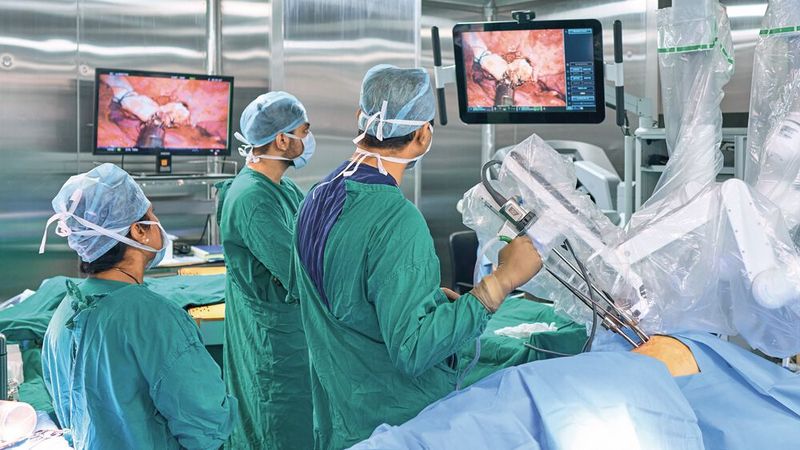
Robots don't tire, their gripping arms don't start shaking even after hours of use. But stamina is just one of their advantages in the operating room. Robot-controlled scalpels can make the smallest and finest cuts, optimizing minimally invasive operations. Patients thus recover faster. Cameras transmit real-time three-dimensional images of the procedure that can be magnified multiple times. The use of this innovative technology makes it possible to shorten operation times and thus the duration of anesthesia.
A robot system consists of the patient cart, a computer tower, and the surgeon console. Because robots do not work autonomously, but support the work of experienced surgeons. These sit at the console—possibly even several meters away from the operating table—and control the individual instruments. In doing so, they can adopt a relaxed posture, instead of having to bend over the operating table for long periods.
Medical robots have a lot of finesse: When the surgeon moves his hand a centimeter on the control, the robot can turn this into a cut of only a millimeter on the patient. Motors with low speeds and moderate torque allow precise control of the robot arms even at low speeds.
The human-machine interface is complex
The collaboration is mutual: robots transmit not only patient data to the surgeon, but also details of the surgical procedure, such as the resistance of the skin or tissue. The surgeon can then adjust the force he applies to the scalpel interface accordingly. The computer-assisted system simulates the haptic sensation of a real hand movement with a real scalpel.
The robot depends on receiving the right commands. Because the programming and design of the human-to-machine interface are complex, the users need to be trained accordingly. To be allowed to operate with robot assistance, comprehensive training is required, which also includes simulation training and residencies with experienced surgeons. The scope of the training is determined by the manufacturers and can include up to 250 training units. Even experienced surgeons need months or even years to master the new technology.
The technical progress of medical technology has overtaken legislation. Nevertheless, it is by no means a legally free space: For manufacturers and developers, the Medical Device Regulation (MDR) of the European Union is mandatory. It defines requirements for the performance and safety of robots in medical use. For robots for invasive procedures, the IEC 80601-2-77 of the International Electrotechnical Commission (IEC) comes into play. This international standard for robot-assisted surgery systems formulates requirements for the maximum permissible risks, such as motion control. The robot must implement the movements of the operator in the correct direction and at the right speed.
Safety thanks to the IEC standard 80601-2-77
In addition, the IEC standard stipulates that the system must trigger preventive stops, for example, if the camera's view of the operating area is obstructed. All instruments then immediately remain in their current position. If there are complications or technical disturbances, an emergency stop is initiated: all processes of the robot system come to a standstill. The requirements serve the safety and integrity of the patients.
The same guideline also defines that medical personnel must be trained in the use of the technology. Because an unacceptable risk would be that the information from the human to the machine is transmitted incorrectly. Therefore, TÜV Süd offers courses for people who work with robots in the medical environment. TÜV Süd also provides further training for manufacturers, for example, on security against data loss or hacker attacks.
Typical applications for robot-assisted operations
In the daily routine of clinics, medical robots already significantly relieve surgeons today. Because they improve the quality of procedures, patients also benefit. Typical applications for robot-assisted operations are neurosurgery, procedures in internal medicine and urology. Another area of application is still underdeveloped: tele-surgery. Here, the surgeon sits at one location, the patient is at another—possibly thousands of kilometers away. The surgeon remotely controls the operating robot.
Specialists for difficult cases no longer have to be flown in, the operation can take place promptly. This allows procedures to take place in places that have so far been poorly served medically, such as in developing countries. So far, the application in telemedicine is still rare. However, the more rapidly the digitalization and technologization of medicine progresses, the more likely such operations will become in the future. (heh)
Date: 08.12.2025
Naturally, we always handle your personal data responsibly. Any personal data we receive from you is processed in accordance with applicable data protection legislation. For detailed information please see our privacy policy.
Consent to the use of data for promotional purposes
I hereby consent to Vogel Communications Group GmbH & Co. KG, Max-Planck-Str. 7-9, 97082 Würzburg including any affiliated companies according to §§ 15 et seq. AktG (hereafter: Vogel Communications Group) using my e-mail address to send editorial newsletters. A list of all affiliated companies can be found here
Newsletter content may include all products and services of any companies mentioned above, including for example specialist journals and books, events and fairs as well as event-related products and services, print and digital media offers and services such as additional (editorial) newsletters, raffles, lead campaigns, market research both online and offline, specialist webportals and e-learning offers. In case my personal telephone number has also been collected, it may be used for offers of aforementioned products, for services of the companies mentioned above, and market research purposes.
Additionally, my consent also includes the processing of my email address and telephone number for data matching for marketing purposes with select advertising partners such as LinkedIn, Google, and Meta. For this, Vogel Communications Group may transmit said data in hashed form to the advertising partners who then use said data to determine whether I am also a member of the mentioned advertising partner portals. Vogel Communications Group uses this feature for the purposes of re-targeting (up-selling, cross-selling, and customer loyalty), generating so-called look-alike audiences for acquisition of new customers, and as basis for exclusion for on-going advertising campaigns. Further information can be found in section “data matching for marketing purposes”.
In case I access protected data on Internet portals of Vogel Communications Group including any affiliated companies according to §§ 15 et seq. AktG, I need to provide further data in order to register for the access to such content. In return for this free access to editorial content, my data may be used in accordance with this consent for the purposes stated here. This does not apply to data matching for marketing purposes.
Right of revocation
I understand that I can revoke my consent at will. My revocation does not change the lawfulness of data processing that was conducted based on my consent leading up to my revocation. One option to declare my revocation is to use the contact form found at https://contact.vogel.de. In case I no longer wish to receive certain newsletters, I have subscribed to, I can also click on the unsubscribe link included at the end of a newsletter. Further information regarding my right of revocation and the implementation of it as well as the consequences of my revocation can be found in the data protection declaration, section editorial newsletter.
Detect errors in the lab already
For manufacturers and developers, the experts check whether all requirements of the robot systems for information security and technology have been met, including technical documentation, risk management, and cybersecurity. In addition, TÜV SÜD/Germany has a test laboratory: errors can be simulated here and it can be tested how resilient the robots are under extreme conditions. An early bird assessment can be booked during product development to avoid expensive corrections afterwards. The manufacturers receive comprehensive feedback, so that the experience from the laboratory can flow into product development.



:quality(80)/p7i.vogel.de/wcms/c3/6f/c36f031df46d22615d941d077d32313c/0129800025v1.jpeg "The laser-assisted process is intended to make wafer cutting significantly more productive. (Image:Trumpf)")
:quality(80)/p7i.vogel.de/wcms/ef/1e/ef1e248f58a3697ec1384f6849762d5a/0129842086v1.jpeg "Bodo will soon be hitting it off smart! Signing the memorandum of understanding in Las Vegas: Steffen Haack, Member of the Board of Bosch Rexroth, and Yoshimoto Matsuda, Managing Director of Precision Machinery & Robot Company, Kawasaki Heavy Industries. Here's what it's all about ... (Image:Bosch Rexroth)")
:quality(80)/p7i.vogel.de/wcms/40/b3/40b38efc9eae25e69d644512a2dc4b7c/0129806862v1.jpeg "This is one of the new MDA power clamping nuts from Jakob Antriebstechnik from various angles. It is described as particularly durable and powerful. Here are a few specific data ... (Image:Jakob Drive Technology)")
:quality(80)/p7i.vogel.de/wcms/f5/61/f561ad7c72ed41fd7a67ad9c481cb15d/0129799343v1.jpeg "Engine-generator units (MGU) from Steyr Motors are at work in the Leopard 2 main battle tank and the Leguan bridge vehicle (pictured). An extended contract is now to secure at least 500 more systems of this type for the Bundeswehr ... (Image:German Armed Forces)")
:quality(80)/p7i.vogel.de/wcms/9c/ac/9cac6246660e746c5a3989399ac4d250/0128561645v1.jpeg "Artificial intelligence can drive efficiency in smart factories through centralized data management and predictive maintenance. (Picture: ©Fardived - stock.adobe.com)")
:quality(80)/p7i.vogel.de/wcms/6b/e2/6be235b5ad8a442ccd9d164b0b300d8b/0129763992v1.jpeg "As early as 2020, the Zimmer Group announced that it would convert its production to be sustainably CO2-neutral. (Image:Zimmer Group)")
:quality(80)/p7i.vogel.de/wcms/d4/ba/d4bab9481e66f8570f40eb8ef2a90198/0129795613v1.jpeg "A camera inspection during removal ensures that the components are placed correctly in the KLTs. (Image:Yaskawa Europe)")
:quality(80)/p7i.vogel.de/wcms/cb/56/cb56e42b01638b618e8d1b9b38f32faa/0129810132v1.jpeg "From summer 2026, \"AEON\" will support people at the BMW plant in Leipzig. (Image:diephotodesigner.de/BMW)")
:quality(80)/p7i.vogel.de/wcms/76/81/7681b6450512b2cce1e453cd3d732543/0129479309v1.jpeg "Symbolic image: Model-based design combines virtual system models with real machines and systems in order to simulate, validate and coordinate functions, control and software early on in the development process. (Image:Dall-E / AI-generated)")
:quality(80)/p7i.vogel.de/wcms/5c/0f/5c0fee074c4b6c8e8c0993f3217c2f5a/0129773718v1.jpeg "The General Fusion demonstration reactor. (Image:General Fusion)")
:quality(80)/p7i.vogel.de/wcms/b5/5e/b55ed9355e0395ec0caf111d6af6b494/adobestock-495980372--c2-a9-20natali-mis-20-e2-80-93-20stock-adobe-com-6720x3778v1v1.jpeg "Which engineering skills will be in vogue in 2026? (Image:natali_mis - stock.adobe.com)")
:quality(80)/p7i.vogel.de/wcms/bf/a5/bfa5d882e93f159ce93e933742272b00/nord-vibn-cmyk-2196x1235v1v1.jpeg "With digital twins for virtual commissioning, Nord supports customers in ensuring that systems are available more quickly, even with complex drive systems. (Image:Nord Drivesystems)")
:quality(80)/p7i.vogel.de/wcms/2c/7d/2c7dd82cd4ab194a509126bc75b34fcd/0129849981v1.jpeg "From March 10 to 12, 2026, everything in Nuremberg will once again revolve around embedded systems when Embedded World opens its doors. (Image:NürnbergMesse | Thomas Geiger)")
:quality(80)/p7i.vogel.de/wcms/29/3a/293a6a8483f59bc2fa65a7e1a4d9a703/0129822140v1.jpeg "The Fraunhofer IDMT, Mercedes-Benz and Burmester have developed the 3D audio technology \"Audiofields\". (Image:Thomas Günnel - Automotive Industry)")
:quality(80)/p7i.vogel.de/wcms/cb/23/cb23acd8e9de969d52522692b62b1892/0129680605v1.jpeg "The Z22198 is an extremely compact, three-axis IEPE acceleration sensor for measuring oscillations (vibrations) and shocks in demanding applications. With an edge length of just 0.24 inches and a weight of 0.03 ounces, it is ideal for lightweight structures and confined spaces. (Image:Copyright 2020 ScROGERS,All Rights Reserved)")
:quality(80)/p7i.vogel.de/wcms/c4/40/c44043c61f9dd99b80ccca398c284018/0129795093v1.jpeg "Subaru manufactures the E-Outback at its Yajima plant, marking the first time it has produced an electric vehicle in-house. (Image:Subaru)")
:quality(80)/p7i.vogel.de/wcms/84/cc/84cc506003388ecffaab464677c7afa6/0129843694v1.jpeg "Launched last year, ASML's TWINSCAN XT:260 is an i-line scanner with a throughput of 270 wafers per hour. With a focus on the increased demands of AI chips, ASML wants to shift its focus away from pure front-end tools for chip production in the next ten to fifteen years with packaging and bonding technologies. (Image:ASML)")
:quality(80)/p7i.vogel.de/wcms/8f/48/8f48b0ed0d6c5c4f299b1310a7b577e9/0129830738v1.jpeg "Data centers in orbit are indeed dreams of the future, while data centers under water are already being tested. (Image:Dall-E / AI-generated)")
:quality(80)/p7i.vogel.de/wcms/36/ec/36ec46b311c3fb2cf9759ba4843047c5/0129831604v1.jpeg "Keysight and Ericsson enable validation of pre-6G interoperability with real network infrastructure and devices. (Image:Keysight)")
:quality(80)/p7i.vogel.de/wcms/c5/7a/c57ab05221defbbcaf6bddc346d21464/0129752421v1.jpeg "(Image:concept electronic GmbH)")
:fill(fff,0)/images.vogel.de/vogelonline/companyimg/76800/76895/65.jpg "FAULHABER_120mm.jpg ()")
:fill(fff,0)/p7i.vogel.de/companies/67/eb/67eba621ef6ea/logo2.png "logo2 (Wuxi InfiMotion)")
:quality(80)/p7i.vogel.de/wcms/6b/5c/6b5cf02ffa718f295c1b0194dce14c1e/0126983566v1.jpeg "Customized plastic hand splint manufactured using a 3D printer. (Image: ©mari1408 - stock.adobe.com)")
:quality(80)/p7i.vogel.de/wcms/ad/c8/adc87d4266af65d5f1595a6448ebd90c/0124284496v1.jpeg "The Space Mouse Module has more degrees of freedom than any other finger joystick on the market. (Image:Megatron Elektronik GmbH & Co. KG)")