Configurable eFuse elements create the conditions for a quicker transition to software-defined vehicle architectures. Why? They not only meet the demands for intelligent power distribution and software-defined zonal ECUs, but also offer cost and space advantages and ensure time-efficient development. Thus, they can present an alternative to traditional fuses.
For software-defined vehicles, many components play an important role, such as eFuses.
(Image: Mercedes-Benz AG)
The transition to software-defined vehicles (SDV) is the greatest revolution in the automotive industry in the past ten years. Traditional vehicle designs consisted of hardware-based subsystems that were each assigned specific functions, such as the powertrain or infotainment. However, because vehicle models are developed and modernized in increasingly shorter cycles, it is more efficient to combine several functions into modular, flexible subsystems, or zones. Instead of special area or domain control units, vehicles can now contain two to three zone control units with integrated functions.
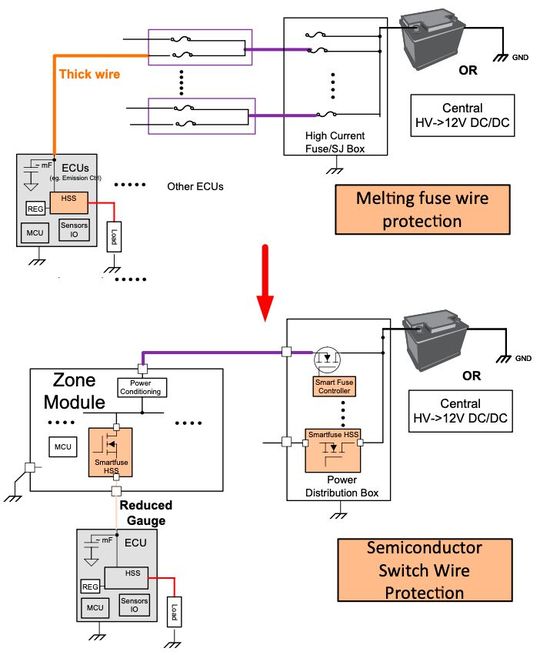
The transition to zonal architectures includes replacing traditional fuses with semiconductor switching elements, known as eFuses, which offer numerous advantages compared to fuses. First and foremost, eFuses are resettable, meaning they no longer need to be replaced and can therefore be placed where it is technically most sensible. Because they no longer need to be easily accessible, the wiring connections between the power supply and the consumer can often be shortened. Additionally, eFuses have an improved, significantly less variable current-time characteristic, making it possible to reduce conductor cross-sections and thus the weight and cost of wiring harnesses. The power management system also offers increased possibilities for the prevention and diagnosis of failures, which positively affects power consumption management and makes it possible to maximize the range of electric vehicles. Image 1 illustrates the transition from fuses to eFuses.
Image 1: Replacement of fuses with eFuses in zone control units and distribution boxes
(Image: Texas Instruments)
Design with eFuses
A connected vehicle must be able to capture the state of the respective system at all times, ranging from demanding sensor functions to protective elements. Last but not least, zonal platforms require flexibility, as the demands on fuses vary depending on the consumer being supplied. eFuses, for example, of the type TPS2HCS10-Q1, can help solve both problems by offering the possibility to configure the switches according to the requirements of the respective consumer via an interface like the Serial Peripheral Interface (SPI). Additionally, they can contribute to informed decisions by reading diagnostic information from the consumer. The overall system costs and component requirements are lower despite the extended range of functions, as eFuses do not require external passive components to configure the protection and diagnostic features.
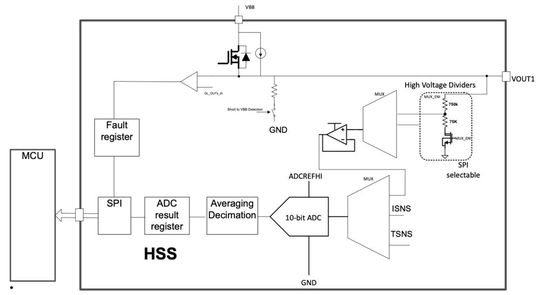
The constant availability of multiple failure diagnostic features for switches and consumers, realized through the SPI interface, reduces the burden on the microcontroller (MCU). An A/D converter (ADC) integrated into the eFuse element allows for purely digital reading of diagnostic information via SPI, meaning that no ADC in the microcontroller needs to be reserved for receiving current and voltage information. Image 2 illustrates how an eFuse element detects the output voltage and identifies short circuits to the battery as well as a broken connection to the consumer without external components.
Image 2: Sensing output voltage and detecting shorts to the battery and open connections to the load
(Image: Texas Instruments)
Among the particular challenges in the transition to SDVs is streamlining software and firmware development to create a cohesive system. If different systems need to be validated for various vehicle models, it negatively impacts time and cost effort. A favorable aspect in this context is that eFuses can be used equally for both low and high load currents and possess a uniform interface for programming and reading information, covering numerous model variants and load currents. The availability of a digital interface for software configuration as well as for control and diagnostic purposes also results in fewer I/O pins being occupied on the MCU, thus reducing costs for additional I/O expanders and the required PCB area.
Why are Software-Configurable eFuses a Good Choice?
Software-configurable eFuses offer several advantages. These include:
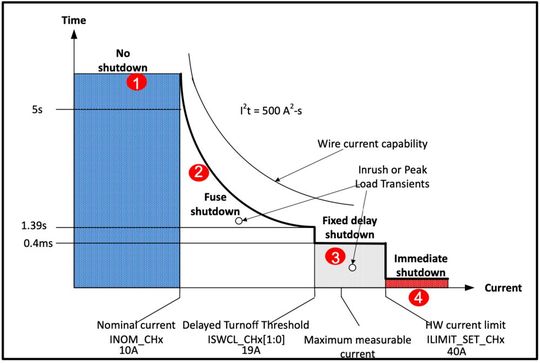
Configurable current-time profiles: Instead of a uniform limit current, an eFuse element's stored current-time characteristic determines whether and when the shutdown occurs, depending on the magnitude and duration of the load current. Thus, eFuses can allow high current peaks, such as those occurring during the start-up or blocking of a motor, for a short time, but still shut down in the event of a true overload to protect the wiring, circuit traces, and connectors. The SPI-based configurability also allows the fuse characteristic to be programmed with only two parameters, namely the rated current and the response threshold for shutdown, within wide limits. Image 3 shows an exemplary protection scheme for the entire current range.
Low quiescent current consumption: Many electronic control units (ECUs) remain switched on even when the vehicle is turned off. Therefore, the eFuses used in the power supply of these ECUs must consume very little current to prevent the battery from discharging prematurely and to keep the necessary consumers active. Despite the lower current consumption, the protection functions remain effective and offer protection against short circuits. More importantly, eFuses can distinguish between active and power-saving modes based on load conditions, allowing them to autonomously perform their tasks without additional effort for the MCU. TI's eFuse portfolio meets all requirements and is characterized by very low quiescent current consumption.
Date: 08.12.2025
Naturally, we always handle your personal data responsibly. Any personal data we receive from you is processed in accordance with applicable data protection legislation. For detailed information please see our privacy policy.
Consent to the use of data for promotional purposes
I hereby consent to Vogel Communications Group GmbH & Co. KG, Max-Planck-Str. 7-9, 97082 Würzburg including any affiliated companies according to §§ 15 et seq. AktG (hereafter: Vogel Communications Group) using my e-mail address to send editorial newsletters. A list of all affiliated companies can be found here
Newsletter content may include all products and services of any companies mentioned above, including for example specialist journals and books, events and fairs as well as event-related products and services, print and digital media offers and services such as additional (editorial) newsletters, raffles, lead campaigns, market research both online and offline, specialist webportals and e-learning offers. In case my personal telephone number has also been collected, it may be used for offers of aforementioned products, for services of the companies mentioned above, and market research purposes.
Additionally, my consent also includes the processing of my email address and telephone number for data matching for marketing purposes with select advertising partners such as LinkedIn, Google, and Meta. For this, Vogel Communications Group may transmit said data in hashed form to the advertising partners who then use said data to determine whether I am also a member of the mentioned advertising partner portals. Vogel Communications Group uses this feature for the purposes of re-targeting (up-selling, cross-selling, and customer loyalty), generating so-called look-alike audiences for acquisition of new customers, and as basis for exclusion for on-going advertising campaigns. Further information can be found in section “data matching for marketing purposes”.
In case I access protected data on Internet portals of Vogel Communications Group including any affiliated companies according to §§ 15 et seq. AktG, I need to provide further data in order to register for the access to such content. In return for this free access to editorial content, my data may be used in accordance with this consent for the purposes stated here. This does not apply to data matching for marketing purposes.
Right of revocation
I understand that I can revoke my consent at will. My revocation does not change the lawfulness of data processing that was conducted based on my consent leading up to my revocation. One option to declare my revocation is to use the contact form found at https://contact.vogel.de. In case I no longer wish to receive certain newsletters, I have subscribed to, I can also click on the unsubscribe link included at the end of a newsletter. Further information regarding my right of revocation and the implementation of it as well as the consequences of my revocation can be found in the data protection declaration, section editorial newsletter.
Configurable mode for capacitive loads: Many zonal consumers are capacitive in nature, so the switches used must be suitable for efficiently charging these capacities. In contrast, this capability is absent in traditional fuses and switches. However, eFuses offer a constant current charging mode for cases where significant load currents occur during charging, or a mode with a set peak voltage for consumers with particularly large load capacity, which are charged with a very low current. In both cases, the inrush current is limited to a low value during a programmable period. A beneficial feature of eFuses is that they are suitable for consumers with low or high load capacity by appropriately adjusting the current and voltage limits. Configuring the element for the capacitive charging mode is the best choice to cover capacitance and parallel load current.
Image 3: Programmable features of the eFuse element
(Image: Texas Instruments)
eFuses are replacing traditional semiconductor switches
TI's portfolio of intelligent high-side switches with integrated field-effect transistors and a wide on-resistance range for different load currents helps tackle the challenges in the design of zonal architectures. The eFuse element TPS2HCS10-Q1, with its SPI interface, low-power mode, I2T current limiting, and intelligent capacitor charging function, simplifies development and mitigates technical challenges. With these switches, a more sophisticated power distribution is possible, while providing protection and diagnostic functions.
(se)
*Sreenath Unnikrishnan is Senior Member of the Technical Staff, Power Switches, at Texas Instruments.



:quality(80)/p7i.vogel.de/wcms/8e/63/8e631ccb75fda465c197fc52848289fa/0130260202v1.jpeg "According to the Laser-Zentrum Hannover, what is sizzling away underwater marks the first steps towards a way of repairing steel structures more cheaply and without complications using robots, laser 3D printing and AI ... (Image:LZH)")
:quality(80)/p7i.vogel.de/wcms/67/30/6730b015b3dd6f925877edd795eda319/0130247463v1.jpeg "The comparison between the SLA printable plastics Accura Xtreme Grey (above) and the robust newcomer Accura Xtreme Black now used at Speedpart, which represents an inexpensive and deep black alternative to mechanically processed plastic prototypes ... (Image:Speedpart)")
:quality(80)/p7i.vogel.de/wcms/06/9d/069d939b77a4feab0a8d2ece62c28dc1/0129655701v1.jpeg "This turned part is slotted twice. The deburring that would otherwise be necessary is no longer required for high-pressure machining. (Image:Knoll)")
:quality(80)/p7i.vogel.de/wcms/3f/72/3f72e30d61f3522bff192171b60776a4/0130245214v1.jpeg "No idea what else your humanoid robot can do, or where it fails? Then it might be worth taking a look at the Humanoid Capabilities Navigator, which now helps you to find the right robot for a job, or to improve humanoids in a targeted manner ... (Image:Fraunhofer IPA)")
:quality(80)/p7i.vogel.de/wcms/ba/28/ba28ec056a82abd76758c8c87296c0d5/0130213997v1.jpeg "The Nexy automatic material call-off system (AMS) controls the replenishment of non-stocked materials or components. (Image:Steute Technologies GmbH & Co. KG, Löhne)")
:quality(80)/p7i.vogel.de/wcms/21/3b/213b5e5454b0c4344ba0eaa700857607/0129635774v1.jpeg "The QRV flow control valves from Lee are available in sizes from 5.5 to 18 mm and cover a flow rate of 0.2 to 20 l/min. Depending on the version, the pressure range is either between 0.1 and 2.75 bar (1.5 - 40 psi) or between 0.17 and 2 bar (2.5 - 30 psi). (Image:Lee)")
:quality(80)/p7i.vogel.de/wcms/63/e9/63e9db3259a656cca88c5f7158af3fcb/0129385769v1.jpeg "The Agibot A2 at a Fortune China event in December 2025. (Image:Agibot)")
:quality(80)/p7i.vogel.de/wcms/df/a1/dfa1786a3b05f5ff2e51d0f633695c57/0130137877v1.jpeg "Openclaw inspires AI communities. (Image:Openclaw.ai)")
:quality(80)/p7i.vogel.de/wcms/e4/51/e451d52ce0182fb0aaa46a5774f832ef/26-04-pi-fraunhofer-iws-21160-bioslide-pic-01-4128x2321v1v1.jpeg "With the BioSlide research project, the Fraunhofer IWS is investigating how sliding systems can be designed to be more sustainable and energy-efficient. New materials can be tested in a particularly application-oriented manner on this plain bearing test stand. (Image:Fraunhofer IWS)")
![Thanks to advanced 3D printing technology, a more efficient use of resources should contribute to lower-emission aviation—this is the goal of ['skai]-lab. (Image:Oleksandr Pashchenko - stock.adobe.com / AI-generated)](https://cdn1.vogel.de/nghHNSbySccfOjG3n1qCA-FVOjQ=/288x162/smart/filters:format(jpg):quality(80)/p7i.vogel.de/wcms/62/64/626424c97a16e69f871bf216c9629c2a/adobestock-1927043193--c2-a9-20oleksandr-20pashchenko-20-e2-80-93-20stock-adobe-com-ki-generiertv1v1.jpeg "Thanks to advanced 3D printing technology, a more efficient use of resources should contribute to lower-emission aviation—this is the goal of ['skai]-lab. (Image:Oleksandr Pashchenko - stock.adobe.com / AI-generated)")
:quality(80)/p7i.vogel.de/wcms/78/28/7828775af76773458b4d1409ceb1cf0c/368945-20dam-20imagery-digital-transformation-pc-1920x1079v1v1.jpeg "Complex development projects with high regulatory requirements, such as in the aerospace industry, benefit in particular from the Intelligent Product Lifecycle. (Image:PTC)")
:quality(80)/p7i.vogel.de/wcms/e7/82/e7822e208621ba2ae892d609e60481e8/texas-20uni-850x478v1v1.jpeg "Superfoam is a composite that is capable of absorbing 10 times more energy than a conventional foam. (Image:Abbey Toronjo/Texas A&M University Division of Marketing & Communications)")
:quality(80)/p7i.vogel.de/wcms/e6/53/e6539c6b5df2d2af2970ca981131fb42/0130215307v1.jpeg "Volkswagen is in first place in the first two months of 2026—no one has sold as many cars in China as the car manufacturer. (Image:Volkswagen)")
:quality(80)/p7i.vogel.de/wcms/b0/6d/b06d9ad54bfc39053e1db5494df5cb9a/0130237932v1.jpeg "Pleased about their partnership in the field of bidirectional charging: Christian Haferkamp and Aurélie Alemany from enercity as well as Stefan Mecha and Lars Krause, both Volkswagen Commercial Vehicles (from left to right). (Image:PSONNACK)")
:quality(80)/p7i.vogel.de/wcms/2b/0b/2b0b5ff55299be32174cb0ed76718253/0130177406v1.jpeg "Rolls-Royce has received funding of 70 million US dollars from the EU public-private partnership \"Joint Undertakings for Clean Aviation\". (Image:Rolls-Royce)")
:quality(80)/p7i.vogel.de/wcms/95/7e/957ed49b185794b3e76b9e610a8a389f/0130217926v1.jpeg "Bosch wants to offer components for e-vehicles in India together with Tata. (Image:Bosch)")
:quality(80)/p7i.vogel.de/wcms/22/08/22085b4997a696887dd5a712a30b262b/0130211045v1.jpeg "Imec has announced that the world's most advanced high numerical aperture (High NA) EUV lithography system, the ASML EXE:5200, has arrived at its 300mm cleanroom in Leuven. (Image:Imec)")
:quality(80)/p7i.vogel.de/wcms/48/f2/48f250e2385d3f43743dc44133cc4731/0130161592v1.jpeg "The world's first fully functional quantum battery as a proof-of-concept, developed by CSIRO and its cooperation partners, the University of Melbourne and RMIT. (Image:CSIRO and collaborators, The University of Melbourne and RMIT)")
:quality(80)/p7i.vogel.de/wcms/16/9c/169c092e854d8740928a080cead3b88e/0130241261v1.jpeg "NVIDIA's GB300 AI chip with HBM3E and HBM4 from SK Hynix. (Image:SK Hynix)")
:quality(80)/p7i.vogel.de/wcms/3a/50/3a50d3f269f38f14d7a25a93c6f2b2f8/0130147601v1.jpeg "The compact modulator enables fast and energy-efficient data transmission and can be manufactured cost-effectively. (Image:Hugo Larocque, EPFL)")
:fill(fff,0)/p7i.vogel.de/companies/67/eb/67eba621ef6ea/logo2.png "logo2 (Wuxi InfiMotion)")
:quality(80)/p7i.vogel.de/wcms/bb/6e/bb6e230f8c1580fb1843b0de7d5abcf1/0124522783v1.jpeg "The AI Assurance in Mobility Conference Europe, which took place on April 1st and 2nd, 2025, in Berlin, focused on one question: How can we build trust in AI-based driving systems? (Image:AI Assurance in Mobility)")
:quality(80)/p7i.vogel.de/wcms/bf/20/bf20fddb17c0919ee4e3cbec6c8b5002/0122617040v1.jpeg "Implementing software-defined vehicles is one of the challenges currently facing the automotive industry. (Image:Mathworks)")
:quality(80):fill(efefef,0)/p7i.vogel.de/wcms/67/ad/67adf4a647532/elatec-wp-machine-authentication.png "Elatec WP Machine Authentication")
:quality(80)/p7i.vogel.de/wcms/b9/0c/b90cc85f64dcb5e00768e429f72225a8/0129191183v1.jpeg "Car manufacturers rely on a software platform that allows them to manage software updates as well as the condition and status of the vehicle. (Image:Sibros)")
:quality(80)/p7i.vogel.de/wcms/e6/f6/e6f63cd0fc19352f77d99ca431746bad/0125460682v1.jpeg "With BASE-AU, an optical Ethernet solution is available that meets the strict mechanical, thermal, and electromagnetic requirements of the automotive industry. (Image:MD)")