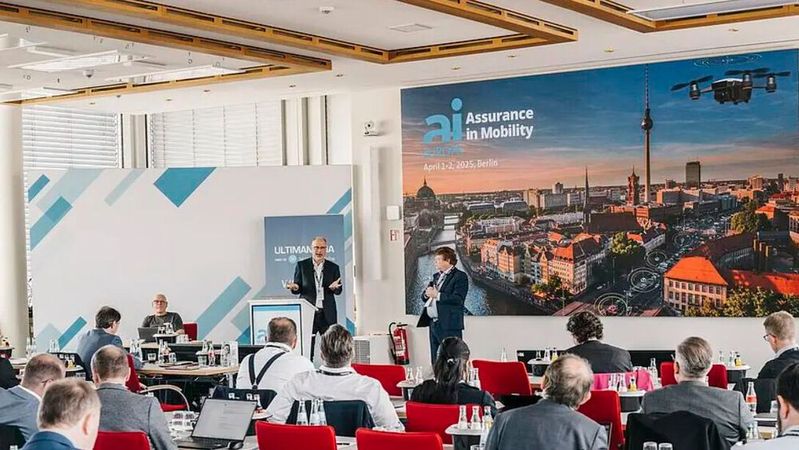
What does the current state of technological progress in connected and automated driving look like? What legal frameworks present challenges, and how can these be resolved? What role will artificial intelligence play? These and other questions were the focus of the conference "AI Assurance in Mobility," which took place in early April 2025 in Berlin.
The AI Assurance in Mobility Conference Europe, which took place on April 1st and 2nd, 2025, in Berlin, focused on one question: How can we build trust in AI-based driving systems?
(Image: AI Assurance in Mobility)
Already at CES 2025, it was clearly evident that automated driving will soon find its way into everyday life on European roads. The technical solutions are in place, and in China as well as in various US cities, self-driving "taxis" are already a common feature on the road. However, it may still take some time before the first private cars drive through urban traffic at Level 4 in Europe, even in the premium segment. For commercial applications such as trucks in long-distance traffic between hubs outside of cities and for passenger transport services by taxi competitors like Uber or Lyft, automated driving is also getting closer here, as there is a business case that pays off. After all, Level 4 vehicles can operate 24/7 almost 365 days a year, and the driver shortage is not an issue with autonomous driving. In the USA, these applications could already be operating in real numbers on highways (trucks) and in urban areas (taxi competitors) in five years.
SDV as a Basis for AD
The fundamental basis for automated driving (AD) is the software-defined vehicle (SDV). Lars Reger, CTO of NXP, aptly highlighted the necessity of SDVs: "All automotive manufacturers are slowly realizing that there is no way around the platform approach." The NXP CTO emphasizes that a good SDV platform involves a good ecosystem in which many companies must have the opportunity to participate, as this could benefit all involved.
One thing is fundamentally important: the SDV must be both safe and secure, meaning functionally safe according to ISO 26262 as well as secure in terms of cybersecurity according to ISO 21434. For financial and practical reasons, the SDV platform should also be scalable across multiple vehicle segments. The constant need for Over-the-Air updates (OTA) is not only known from smartphones, but this necessity has also been recognized in the automotive industry.
Interaction Between Car and Driver Software
In principle, every vehicle requires two essential components: one part encompasses the hardware, meaning the car itself as it has been known for decades with ever-increasing levels of innovation. The other part is the driver—either a human or, in the case of AD, the driver software. In a conventional vehicle, the seat, brake, accelerator pedal, steering wheel, etc., must suit the person behind the wheel. While a person can shift a little to the left, right, forward, or backward, this is not possible with automated driving. Here, the hardware of an automated vehicle must fit very precisely with the overlying driver software. Nowadays, however, there is Aurora, a company that almost delivers the automated driver as a standard product: if the hardware prerequisites—including on the sensor side—are met, then the software from Aurora—or in the future also from other providers—can take over the driver function.
International Rule Set
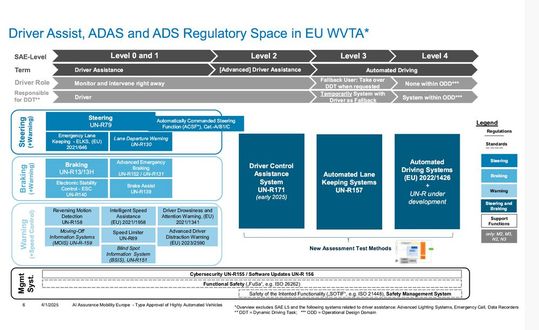
Currently, an international team with representatives from North America, Europe, and Asia is working on a "Set of Regulations for ADS," where ADS stands for Automated Driving Systems. Although the work only began in March 2024, the set of regulations is expected to be completed by mid-2026. An important element in this context is the Data Storage System for Automated Driving, abbreviated DSSAD, which captures the current status of the automated or even autonomous driving system and the driver, and is more than just an Event Data Recorder (EDR, similar to a black box in a car). The initial task is to define the categories of data to be recorded, the data format, and the events that should trigger a recording. Naturally, it is also important to define the technical specifications in terms of system performance, such as lifespan, availability, storage capacity, or data security. The required privacy and data protection are to be defined as a separate design feature.
"This overview is meant to simplify something that is not simple," explains Thomas Quernheim from TÜV Rheinland.
(Image: TÜV Rheinland @ AI Assurance Europe)
In addition, further work is needed since all requirements have so far been defined for vehicles with a human on board. Now, a review of all regulations is pending, including those for tires, lights, mirrors, etc. The reason for this is the completely different requirements of ADS.
AD Strategy in Germany
For Germany, the framework is now set. Since November 28, 2024, the strategy has been established in the brochure "Autonomous Driving in Public Transport" for cities, communities, and transport providers, and on December 4, 2024, the federal government released an update of its strategy to the public under the title "The Future Drives Autonomously," intended to serve as a framework directive for the implementation of AD technology.
Date: 08.12.2025
Naturally, we always handle your personal data responsibly. Any personal data we receive from you is processed in accordance with applicable data protection legislation. For detailed information please see our privacy policy.
Consent to the use of data for promotional purposes
I hereby consent to Vogel Communications Group GmbH & Co. KG, Max-Planck-Str. 7-9, 97082 Würzburg including any affiliated companies according to §§ 15 et seq. AktG (hereafter: Vogel Communications Group) using my e-mail address to send editorial newsletters. A list of all affiliated companies can be found here
Newsletter content may include all products and services of any companies mentioned above, including for example specialist journals and books, events and fairs as well as event-related products and services, print and digital media offers and services such as additional (editorial) newsletters, raffles, lead campaigns, market research both online and offline, specialist webportals and e-learning offers. In case my personal telephone number has also been collected, it may be used for offers of aforementioned products, for services of the companies mentioned above, and market research purposes.
Additionally, my consent also includes the processing of my email address and telephone number for data matching for marketing purposes with select advertising partners such as LinkedIn, Google, and Meta. For this, Vogel Communications Group may transmit said data in hashed form to the advertising partners who then use said data to determine whether I am also a member of the mentioned advertising partner portals. Vogel Communications Group uses this feature for the purposes of re-targeting (up-selling, cross-selling, and customer loyalty), generating so-called look-alike audiences for acquisition of new customers, and as basis for exclusion for on-going advertising campaigns. Further information can be found in section “data matching for marketing purposes”.
In case I access protected data on Internet portals of Vogel Communications Group including any affiliated companies according to §§ 15 et seq. AktG, I need to provide further data in order to register for the access to such content. In return for this free access to editorial content, my data may be used in accordance with this consent for the purposes stated here. This does not apply to data matching for marketing purposes.
Right of revocation
I understand that I can revoke my consent at will. My revocation does not change the lawfulness of data processing that was conducted based on my consent leading up to my revocation. One option to declare my revocation is to use the contact form found at https://contact.vogel.de. In case I no longer wish to receive certain newsletters, I have subscribed to, I can also click on the unsubscribe link included at the end of a newsletter. Further information regarding my right of revocation and the implementation of it as well as the consequences of my revocation can be found in the data protection declaration, section editorial newsletter.
Nothing Works Without AI
However, it has long been apparent that the artificial driver in an autonomous vehicle can only be realized based on artificial intelligence (AI), and thus machine learning (ML) with all its advantages and disadvantages comes into play. The big question is only: How can AI be trusted, how can it be used without leading to significant wrong decisions?
This question is so important that this year already two conferences on "AI Assurance in Mobility" took place—one in Austin, Texas, and one in Berlin. It was always about answering the question "How can I ensure that AI in mobility applications really works as it should?" The great significance of this topic can be seen, for example, from the fact that at the conference in Berlin, the President of the Federal Motor Transport Authority (KBA), Richard Damm, not only gave the opening keynote but was also present for the entire first day of the conference and used it for intensive exchange. The topic has thus reached the highest level, and that is good because only in this way can automated driving be appropriately promoted, guided, tamed, regulated, and advanced.
At the conference held in mid-February in Austin, Texas, Jason JonMichael, Vice Chairman of the US DOT, the US Department of Transportation, was supposed to give the opening keynote, but the Trump administration had already put a stop to it at that time, so Prof. Joachim Taiber, Executive Director of the IAMTS, International Alliance for Mobility Testing and Standardization, inspired by the contents of the US DOT, delivered the opening lecture. And for the conference in Berlin, Jason JonMichael was "of course" also not allowed to travel, even though he had confirmed his attendance with official travel permission from his superiors during President Biden's tenure. The conclusion of the conference participants, put cautiously, is this: It is not foreseeable that the US administration will become a leader in terms of "AI Assurance" in the foreseeable future.
Testing—Especially and Primarily Virtually
For the type approval of highly automated vehicles, there are clear EU guidelines with document 2022/1426, but particularly important is the EU document "Interpretation of EU Regulation 2022/1426 on the Type Approval of Automated Driving Systems." It addresses the technical interpretation of the regulatory text, supplemented by six annexes with examples and relevant resources.
Thomas Quernheim, Senior Vice President Mobility at TÜV Rheinland, pointed out at the AI Assurance Conference in Berlin that with many hardware-software systems, object-based testing is not possible—and this is especially relevant when AI is involved. Any software must be validated before its deployment, meaning its integration into the overall system, to ensure that it complies with the relevant laws and meets all regulatory requirements, recommendations, and conditions. This also applies to the update process and excludes online learning for systems that fall within the scope of the regulation. According to the current legal situation, the vehicle is explicitly not allowed to learn independently within the framework of AI usage. And without intensive virtual testing, we will not obtain type approval for highly automated vehicles, as physical testing is already at its limit today.
For TÜV, according to Thomas Quernheim, one thing is clear: the paradigm shift in testing methods for type approval will continue to lead to more regulations, and AI will place further demands on the type approval process. The Safety Management System (SMS) will play an increasingly important role. He is convinced: "To facilitate scalability and provide business cases, harmonization and synchronization of test scenarios are imperative." (se)
Future-Proof Authentication with Universal RFID Readers



:quality(80)/p7i.vogel.de/wcms/eb/2b/eb2bd1b8487afe577b37363cd02f16ff/0113143253v1.jpeg "In our China Market Insider, we regularly provide you with relevant information straight from China. (Image:© Eisenhans - stock.adobe.com)")
:quality(80)/p7i.vogel.de/wcms/dd/b8/ddb8edc98c49b384734ab2432b297eb5/adobestock-1913662309--irene-stock-adobe-com-ki-generiertv1.jpeg "Rotary joints are used in grippers and swivel mechanisms to allow assemblies to rotate or swivel smoothly relative to one another, even under very high loads (illustrative image). (Source: Irene - stock.adobe.com / KI-generiert)")
:quality(80)/p7i.vogel.de/wcms/d1/ef/d1ef6b6f7d4543f7999980bacccaf22b/0133499261v1.jpeg "As the growing imbalance in trade relations with China continues to widen, the EU Chamber of Commerce foresees a day when trade with China will have to be seriously reevaluated ... (Image: AI-generated)")
:quality(80)/p7i.vogel.de/wcms/fe/1f/fe1fa5ee713f94deaba963dc24c3abc5/0133299273v1.jpeg "The Flexistar enables highly flexible production of laser-welded tubes thanks to its tool-free clamping system. (Image:Because Technology, LLC)")
:quality(80)/p7i.vogel.de/wcms/60/ef/60ef4f07e4829b2c2929befc0f353c58/0133511729v1.jpeg "Humanoid robots can match human performance in certain tasks. (Image:Gemini / AI-generated)")
:quality(80)/p7i.vogel.de/wcms/2e/99/2e99726b522e4b35b690e25eb6a42643/0133463991v1.jpeg "Robotics: In AMR applications, connection technology must reliably transmit power, signals, and data despite vibration and shock loads—in very confined spaces and in a way that allows for regular maintenance. (Image:Hyperever)")
:quality(80)/p7i.vogel.de/wcms/d0/18/d01801e3d5dbd7bc9d0b4f60408b630c/0133468429v1.jpeg "Quality requirements for film packaging are on the rise. At the same time, many companies are turning to recyclable film materials, which, however, have their own challenges. Fraunhofer researchers have therefore developed a fast system that detects problems in real time. (Image:Fraunhofer IKTS)")
:quality(80)/p7i.vogel.de/wcms/b1/06/b106cf44923ce39565c3264982fd20eb/0133414574v1.jpeg "Robots Build Robots: At the new Ubtech factory, automated systems even handle parts of the material supply and logistics for the production of humanoid robots. (Image:Ubtech)")
:quality(80)/p7i.vogel.de/wcms/c0/52/c052f405eb55fc3d08c4837e77206fc0/adobestock-2021845957--aucartstudio-stock-adobe-com-ki-generiertv1.jpeg "An innovation from China to combat extreme summer heat: A novel coating lowers temperatures. (Source: © AucArtStudio – stock.adobe.com_AI-generated)")
:quality(80)/p7i.vogel.de/wcms/66/a7/66a7b78159caeacce57136529688799f/0133503398v1.jpeg "Sunlight Makes Stone! These stone blocks weren't made the traditional way. Instead, they were additively manufactured from sand using a laser. In the future, however, the laser is set to be replaced by concentrated sunlight—if the startup Addisol is successful... (Image:Addisol / F. Fiedler)")
:quality(80)/p7i.vogel.de/wcms/72/b9/72b995c2c8d812c5e2115cbef31e035a/0133462727v1.jpeg "Eggl manufactures center hoods that are precisely tailored to each cooking island—whether standard size or custom shape. They are made entirely of stainless steel and are individually customized in terms of size and filter arrangement. (Image:SPI)")
:quality(80)/p7i.vogel.de/wcms/13/5d/135dfae6229ceaf5c55467a43e8f7257/adobestock-1879961393--ardi-stock-adobe-com-ki-generiertv1.jpeg "Annoying chatterboxes or awkward silences in response to questions—a moderator should specifically prepare for difficult situations in order to navigate them effectively. (Image:ardi - stock.adobe.com_AI-generated)")
:quality(80)/p7i.vogel.de/wcms/aa/a2/aaa2c6dd2daa24b485cddbf9297590c0/0133467318v1.jpeg "Battery Monitoring: Battery monitoring using electrochemical impedance spectroscopy offers several advantages. (Image:TI)")
:quality(80)/p7i.vogel.de/wcms/39/b2/39b21bf03be1683831862239a369987c/0133469638v1.jpeg "Data from autonomous vehicles and robots operating autonomously is in high demand, and Ruqi wants to capitalize on this. (Image:Ruqi Mobility)")
:quality(80)/p7i.vogel.de/wcms/8a/bb/8abbb6217220595edc1549ac9b84f307/0133429906v1.jpeg "The IAA in Hanover showcased the ambitions of Chinese commercial vehicle manufacturers in Europe. (Image:Wehner - VCG)")
:quality(80)/p7i.vogel.de/wcms/0c/53/0c5313ef91c14b6df0d0996efc33c8ad/jpg03568-bearbeitetv1.jpeg "The category winners of the 2027 German Car of the Year award. (Source: GCOTY)")
:quality(80)/p7i.vogel.de/wcms/48/15/4815da27c45973ca629a99b375ac3aef/0133509585v1.jpeg "Ventuno Q RoadTest: Designed to help the Element14 community gain practical insights from real-world tests using the Ventuno Q. (Image:Farnell/Element14)")
:quality(80)/p7i.vogel.de/wcms/17/2b/172bd132f9febdfcbcedba292ad0504d/aufmacherv1.jpeg "Micro-Epsilon offers a wide range of IO-Link-compatible sensors. (Source: Micro-Epsilon Messtechnik GmbH & Co. KG)")
:quality(80)/p7i.vogel.de/wcms/ca/b4/cab46fd26d19d6a2febca032048200b6/0133471827v1.jpeg "Photonics SDK for C and Python: Computational operations are now abstracted as standard mathematical functions. (Image:Q.ANT)")
:quality(80)/p7i.vogel.de/wcms/92/b2/92b2ed5299cde450c0764f4f64468395/0133505895v1.jpeg "The \"Iris 100\" test system for high-precision volume production of microLEDs uses a spectrometer and a high-resolution camera. (Image:Teradyne)")
:fill(fff,0)/images.vogel.de/vogelonline/companyimg/76800/76895/65.jpg "FAULHABER_120mm.jpg ()")
:quality(80):fill(efefef,0)/p7i.vogel.de/wcms/67/ae/67ae0b9ac31f8/elatec-wp-universal-reader.png "Elatec WP Universal Reader")
:quality(80)/p7i.vogel.de/wcms/3f/45/3f45896c5fdf3f724c96ad496906bc39/0131918196v1.jpeg "In Berlin, a real-world drive with the research vehicle Edgar, developed by TU Munich, demonstrates what a testing methodology under real traffic conditions could look like. (Image: TÜV Association)")
:quality(80)/p7i.vogel.de/wcms/33/b8/33b87575f3e5a8018627f091eefb9c4e/0130516846v1.jpeg "Politicians must move with the times: Berlin and Brussels are called upon to drive prosperity, growth and innovation forward in Germany and Europe and not to slow down branches of industry. (Image:Stefanie Eckardt)")