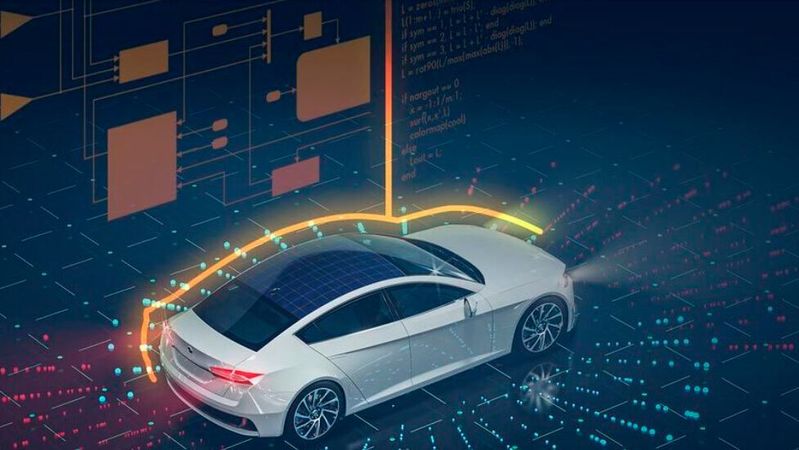
The realization of software-defined vehicles is one of the challenges currently facing the automotive industry. A key feature is the ability to expand and improve characteristics and functions via software updates while ensuring safety standards. Such software updates are conducted over-the-air, requiring the vehicles to be connected and equipped with a new E/E architecture. Additionally, the development of software and hardware must occur independently.
Implementing software-defined vehicles is one of the challenges currently facing the automotive industry.
(Image: Mathworks)
On the path to the software-defined vehicle (SDV), a new level of integration of software, tools, and processes is necessary. For continuous updates, especially of safety-relevant functions, models and simulations are required. Choosing the right model depth is crucial to keep time and costs under control.
Models and Simulations: Key to Virtual Development
Models play a central role in the development of SDVs. They form the basis for the analysis and optimization of complex technical systems without relying on expensive and elaborate physical prototypes. Moreover, simulations based on these models offer the advantage of reproducible tests and allow the examination of scenarios beyond performance and load limits, as well as potential danger situations.
In the automotive industry, many partners and companies often report that "Software Factories" are exclusively focused on code and do not perform validation in the overall context of the vehicle. To test and validate safety-relevant systems with established processes, this approach must be supplemented with models and simulations. To meet software safety requirements, ISO 26262, for example, recommends the use of Model-, Software-, and Hardware-in-the-Loop simulations (MiL, SiL, and HiL). These requirements are not new to the industry. What is new, however, is the integration of these safety requirements with the requirements of the SDV in the Software Factory.
Software Factories—or Continuous Integration, Continuous Delivery, and Continuous Testing (CI/CD/CT)—are a crucial advancement in vehicle software development. There are already examples of the use of such a highly automated and robust environment for software development, integration, validation, and release in the automotive sector. This approach shortens development cycles and allows for the regular delivery of updates.
SDV Development: Developing Models as a Foundation
Automotive engineers validate complex vehicle functions in the overall context of the vehicle using models. For SDV development, virtual representations of the vehicle, its components and parts, as well as the computing platforms used, must therefore additionally be integrated into the Software Factory in the form of models. This is the only way to incorporate validation into the automation structure.
A simulation model is a mathematical or logical representation of a system that allows for the investigation, analysis, and prediction of its behavior in a virtual environment. The essential characteristics of a model depend heavily on the question to be solved. As the British statistician and professor George Box saw it: "All models are wrong, but some of them are useful." No model perfectly represents reality, but its usefulness lies in adapting relevant aspects of a system to the question at hand. A good model is characterized by practicality, efficiency, and flexibility.
Suitability: Models should answer specific questions and find a balance between simplicity and accuracy. They must contain enough details to capture relevant phenomena while avoiding unnecessary complexity.
Efficiency: Models save time and resources by replacing experiments and optimally utilizing computing resources.
Flexibility: Adjustments to different scenarios or boundary conditions should be possible without fundamental changes.
Simplified, models can be divided into two categories:
First-principle models are based on physical laws and offer high precision and traceability. However, they can be computationally intensive when the physical equations become complex. They are flexibly adaptable through modular construction and parameterization and can be optimized concerning computing resources. The creation of such models often takes place in Simulink and Simscape.
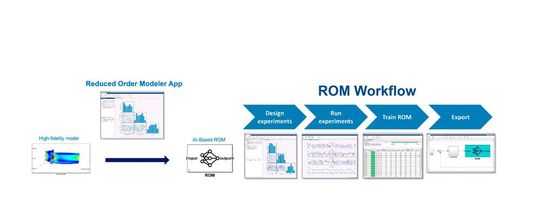
Behavioral models use data-based approaches such as statistical models, lookup tables, or artificial intelligence (AI). A new approach in the automotive field is Reduced Order Models (ROM) for the efficient modeling of vehicle components. ROMs employ dynamic deep learning networks to simplify complex models with high accuracy and reduce computational complexity while maintaining acceptable error tolerances. The development of ROMs is facilitated by the Simulink Reduced-Order Modeling Add-on (Image 1).
Both approaches can be combined. Most of the time, physical models form the basis and are extended by data-based models to represent unknown or nonlinear effects. A model must not only have the right level of detail but also be validatable and parameterizable.
Image 1: Workflow for generating Reduced Order Models in Simulink.
(Image: Mathworks)
From Model Development to Model Integration
By virtualizing the development and validation of vehicle functions using models, hardware and software development can be decoupled. This decoupling is necessary in the context of SDVs because it allows software to be used for various vehicle variants (model series, engine, battery). However, updates require tests for all relevant vehicle variants to ensure compatibility and functionality. Complex systems are divided into components to facilitate parallel developments, which applies to both real and virtual development. Experts create individual component models, which a simulation engineer later integrates. Clear and stable interfaces are crucial. Additionally, large modeling projects must be well-organized, and files and versions efficiently managed. Simulink with System Composer and MATLAB Projects offer suitable tools for this purpose.
The biggest challenges in model integration are similar to those for individual models: practicality, efficiency, and flexibility. The difference lies in the need to bring together many components from different sources. Various tools are used in modern vehicle development for this purpose. To ensure seamless cooperation, standard formats like Functional Mock-up Interface (FMI) and Functional Mock-up Units (FMUs) are used. Simulink supports the integration of FMI 2 & 3, and the FMU Builder facilitates the creation of FMUs.
Date: 08.12.2025
Naturally, we always handle your personal data responsibly. Any personal data we receive from you is processed in accordance with applicable data protection legislation. For detailed information please see our privacy policy.
Consent to the use of data for promotional purposes
I hereby consent to Vogel Communications Group GmbH & Co. KG, Max-Planck-Str. 7-9, 97082 Würzburg including any affiliated companies according to §§ 15 et seq. AktG (hereafter: Vogel Communications Group) using my e-mail address to send editorial newsletters. A list of all affiliated companies can be found here
Newsletter content may include all products and services of any companies mentioned above, including for example specialist journals and books, events and fairs as well as event-related products and services, print and digital media offers and services such as additional (editorial) newsletters, raffles, lead campaigns, market research both online and offline, specialist webportals and e-learning offers. In case my personal telephone number has also been collected, it may be used for offers of aforementioned products, for services of the companies mentioned above, and market research purposes.
Additionally, my consent also includes the processing of my email address and telephone number for data matching for marketing purposes with select advertising partners such as LinkedIn, Google, and Meta. For this, Vogel Communications Group may transmit said data in hashed form to the advertising partners who then use said data to determine whether I am also a member of the mentioned advertising partner portals. Vogel Communications Group uses this feature for the purposes of re-targeting (up-selling, cross-selling, and customer loyalty), generating so-called look-alike audiences for acquisition of new customers, and as basis for exclusion for on-going advertising campaigns. Further information can be found in section “data matching for marketing purposes”.
In case I access protected data on Internet portals of Vogel Communications Group including any affiliated companies according to §§ 15 et seq. AktG, I need to provide further data in order to register for the access to such content. In return for this free access to editorial content, my data may be used in accordance with this consent for the purposes stated here. This does not apply to data matching for marketing purposes.
Right of revocation
I understand that I can revoke my consent at will. My revocation does not change the lawfulness of data processing that was conducted based on my consent leading up to my revocation. One option to declare my revocation is to use the contact form found at https://contact.vogel.de. In case I no longer wish to receive certain newsletters, I have subscribed to, I can also click on the unsubscribe link included at the end of a newsletter. Further information regarding my right of revocation and the implementation of it as well as the consequences of my revocation can be found in the data protection declaration, section editorial newsletter.
The credibility of simulations is often underestimated but is essential. Not only individual tools but the entire simulation toolchain of software tools and processes must be consistent and trustworthy. Reliable simulations are particularly important for SDVs because they predict the real behavior of a vehicle without prototypes. Credible simulations require thorough validation and verification of tools, models, and processes. Only in this way can precise, consistent results be achieved, enabling quick and informed decisions. This reduces the need for expensive physical tests and increases confidence in the simulation results.
Simulation in the Cloud for Scaling
To accelerate development, the cloud offers a good opportunity to scale and parallelize computations. Comprehensive simulation studies are possible in the cloud, providing quick results for the further alignment of the development process.
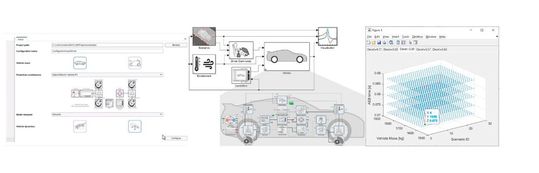
The sensible use of cloud resources can be well illustrated by building a virtual vehicle model: Even building the virtual vehicle model from scratch is a complex task. Therefore, it makes sense to start with a reference model and then adapt it to one's own requirements. With the Virtual Vehicle Composer App, developers can configure and generate virtual vehicle models. Changes can then be incorporated, and various scenarios can be simulated and analyzed (Image 2).
Image 2: The Virtual Vehicle Composer App and view of the generated vehicle model at the top model level, as well as an example of the simulation results.
(Image: Mathworks)
For the initial run with desktop simulations, limited tests are selected to check the effect chain. However, for a full factorial study with thousands of simulations, scaling to the cloud is very sensible because it allows for the flexible use of large computing resources. The usual computing capacity of one's own workstation is not sufficient for such comprehensive studies. When working in MATLAB, switching from the desktop to the cloud is straightforward—neither scripts nor models need to be adjusted. Reference architectures for running in the cloud exist from MATLAB and Simulink on virtual machines (VM) and prefabricated containers for deployment. Such full factorial simulation studies with virtual vehicle models facilitate error identification and enable developers to focus early in the development process on potentially critical issues.
Conclusions
Virtual development with simulations will become a cornerstone for accelerating innovation while ensuring safety and reliability across all vehicle variants. Simulations are an indispensable tool for the development of software-defined vehicles because they allow complex systems to be efficiently analyzed and optimized without relying on physical prototypes. They promote reproducible tests and enable the examination of extreme scenarios. The integration of models and simulations into Software Factories is essential for continuously delivering updates for safety-critical systems. The scalability of simulations is made possible by the cloud. The use of MATLAB and Simulink in combination with cloud-based simulations allows for the automation of large-scale simulation studies and the analysis of vehicle systems under a variety of conditions.
Furthermore, the benefit of models and simulations in the development of SDVs lies in their ability to adapt relevant aspects of vehicle systems to the question at hand. Good models are characterized by practicality, efficiency, and flexibility. Credible simulations require thorough validation and verification of tools, models, and processes. Only then can precise, consistent results be achieved, enabling quick and informed decisions. (se)
*Robert ter Waarbeek is Automotive Industry Manager EMEA at MathWorks



:quality(80)/p7i.vogel.de/wcms/21/b6/21b61c2ac1df28254fb0dad1574fb2d7/0132853015v1.jpeg "The rose-gold, TiAlSiN-based coating material InoxaCon contributes significantly to the stability and service life of HPTec's new RQR-350 milling tool. It enables safe and efficient automated processes in the manufacturing of surgical instruments. (Image:Cemecon)")
:quality(80)/p7i.vogel.de/wcms/d2/73/d273374d6347651e4e6200cf6061ea4e/0132860560v1.jpeg "Even in July, the flag of the Chinese economy did not flutter particularly briskly in the air. Read here what’s happening and why production in China is apparently declining ... (Image:AI-generated)")
:quality(80)/p7i.vogel.de/wcms/18/47/1847f131e3afda201d1dbb98ad0ecb04/0132826776v1.jpeg "Image 1: Difender armored steels from Dillinger stand out with top scores in ballistic testing and cold bending. Defense companies therefore readily choose them. They can be found, for example, in the armored vehicles Fuchs and GTK Boxer of the German Armed Forces. (Image: Dillinger)")
:quality(80)/p7i.vogel.de/wcms/1e/7d/1e7d651782e0e97b3efc25abf2b52350/img-3485v1.jpeg "The Siemens Energy employees attach balancing weights at the precisely calculated and adjusted angular position to achieve the best possible result. (Source: Schenck Rotec)")
:quality(80)/p7i.vogel.de/wcms/a7/38/a73840cb81da9dc3c503f4c04bf66b96/0132892768v1.jpeg "Unitree's IPO symbolizes the high expectations for humanoid robots and embodied AI. (Image:Dall-E / AI-generated)")
:quality(80)/p7i.vogel.de/wcms/1c/a5/1ca5e3ef5d834c3a42de8909c872e3c6/0132876444v1.jpeg "The autonomous transport system Active Shuttle marketed by Bosch Rexroth has been sold to Neura Robotics. (Image:Bosch Rexroth)")
:quality(80)/p7i.vogel.de/wcms/30/1a/301a1aa59e093d848b69e9ff7006b83e/image1v1.jpeg "Wireless switching devices offer advantages in numerous industrial applications – wherever wired communication reaches its limits (Image: Steute) (Image:)")
:quality(80)/p7i.vogel.de/wcms/a2/85/a285b12508af812e28b17be3482a736c/0132488872v1.jpeg "NIS2 is no longer an abstract requirement in the distant future for many industrial companies. (Image:AI-generated)")
:quality(80)/p7i.vogel.de/wcms/41/fc/41fc456ff1ff8f30807924663e8df127/img-0942v1.jpeg "In industrial additive manufacturing, the production strategy must influence the design from the very beginning. (Source: Materialise)")
:quality(80)/p7i.vogel.de/wcms/44/fe/44fe86a16c26c09bb363b3671bf0b930/0132847771v1.jpeg "CoreTechnologie (CT) points out that the 3D printing software 4D_Additive has been equipped with additional application possibilities. Here you can learn more about what the new version 1.8 can do – such as generating complex lattice structures or optimizing faulty data ... (Image:CT)")
:quality(80)/p7i.vogel.de/wcms/b4/f2/b4f2c272247f79c5e87334a6839f20cb/0132549860v1.jpeg "Morefire analysis: Many mechanical engineering websites focus on technical specs instead of customer benefits. Translating features into clear benefits increases visibility, inquiries, and competitiveness. (Image: ©peopleimages.com - stock.adobe.com)")
:quality(80)/p7i.vogel.de/wcms/b4/9a/b49aaad0500e06e253f7d75ecb77338a/adobestock-4840668--dani-kreienb-hl-stock-adobe-comv1.jpeg "Metal processing in 2026 will be more digital, automated, and data-driven – but not automatically easier. (Image:© Dani Kreienbühl - stock.adobe.com)")
:quality(80)/p7i.vogel.de/wcms/5b/88/5b88d94e6a43f2b857462cd1921f7386/0132281427v1.jpeg "The eTurbo solves a well-known turbocharger problem: by combining an exhaust gas turbocharger and a permanently excited synchronous motor into a highly integrated core assembly, the compressor achieves sufficient speed even when the exhaust energy is actually not yet sufficient. (Image: BorgWarner)")
:quality(80)/p7i.vogel.de/wcms/75/fe/75feffb63bc6275786606d78a8d797c4/0132901853v1.jpeg "Steyr Motors reports similar business results as last year. Here you can learn more about the details of the Austrian company's situation ... (Image:E-Steyr)")
:quality(80)/p7i.vogel.de/wcms/57/d2/57d2b75d884c18866b46e776126fb46b/org-blobs-user-response-file-output-dac07b02-0e97-4452-9a3a-26528da583b3-file-1787126178766-jpgv1.jpeg "The memory manufacturer CXMT has had an extremely successful IPO. Among the investors are several car manufacturers. (Image:KI-generiert)")
:quality(80)/p7i.vogel.de/wcms/d0/68/d0681c9d26012538a22ff5c103429612/0132875205v1.jpeg "Electric vehicles: Structure of the zone architecture in a modern vehicle. (Image:TI)")
:quality(80)/p7i.vogel.de/wcms/22/82/22826566c11220ed61efac5982fb94a2/0132896083v1.jpeg "Electrodes made from paper and copper paste deliver comparable signal quality to the established gold standard. They perform significantly better in all environmental impact analyses. (Image:Screentec)")
:quality(80)/p7i.vogel.de/wcms/c4/9f/c49f5b8173f678f7ef071355b1fbbd7c/yamu-jay-ai-generated-9088888v1.jpeg "As part of a strategic partnership, Siemens and Reinhausen are advancing the future of energy supply solutions for AI data centers. (Symbol image) (Source: pixabay / AI-generated)")
:quality(80)/p7i.vogel.de/wcms/28/20/28204a4592a69a8682bfbf9a8f7e1dc2/0132846993v1.jpeg "The health status of a lithium-ion battery changes with increasing aging. AI models can utilize characteristic changes in the charge and voltage curves to estimate the state of health. (Image:freely licensed)")
:quality(80)/p7i.vogel.de/wcms/90/dc/90dc332e30a3e4bd3ff77646ed0633b7/0132833369v1.jpeg "Through a compromised repository of the widely used open-source tool LiteLLM, attackers were able to capture several terabytes of data and login credentials. Security company CloudSEK concludes, after analyzing the data, that the attack conducted in March of this year affected more than 2,000 companies, including major players like Microsoft, Nvidia, AWS, and Deutsche Bahn. (Image:freely licensed)")
:quality(80)/p7i.vogel.de/wcms/0b/d1/0bd1965d7c0d5aeff9226a59b201a993/5660-1529x860v1.png "MBSE proves especially valuable wherever system complexity, variant diversity, and safety requirements must be addressed simultaneously. (Image: AI-generated with DALL-E)")
:quality(80)/p7i.vogel.de/wcms/af/7c/af7cd87cd9c99f3ec21442f192992bae/0128044433v1.jpeg "In an SDV, software is the central product. It enables functions such as over-the-air updates, personalized driving experiences, and automated driving. To make this possible, the way vehicles are developed and designed must be fundamentally reimagined. (Image:Intellias)")
:quality(80)/p7i.vogel.de/wcms/14/e1/14e111999375605ccd9f83e5db2ad7f4/0130414750v1.jpeg "Software-defined vehicles have redefined expectations regarding the speed of innovation. (Image:Sonatus)")