Thermal management is one of the biggest challenges in the development of wall boxes: size, shape, efficiency, reliability, and safety are determined by it. Advances in relay technology contribute to making new components discreet and easy to install while simultaneously ensuring more efficient charging.
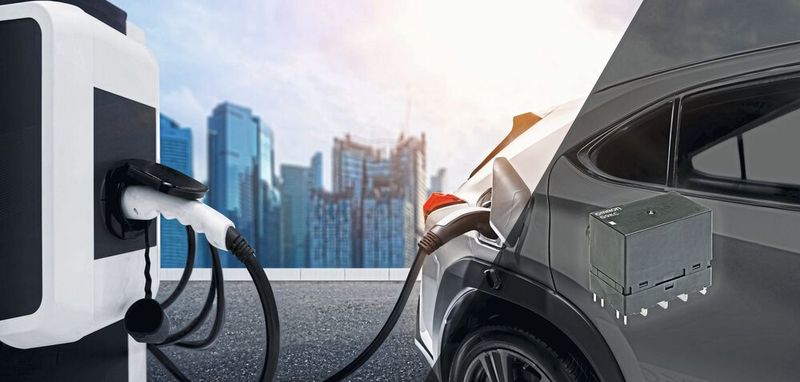
Electromechanical relays: When fast-charging electric vehicles at wall boxes, specially designed and optimized relays significantly reduce heat generation.
(Image: Omron)
The ongoing electrification promises a cleaner and more energy-efficient life. Consumers are driving the demand for more compact devices that integrate seamlessly and stylishly into their lives and living spaces while offering higher performance. These demands for smaller, slimmer, and faster devices apply to everything from accessories and small appliances to power supplies and chargers, including chargers for electric vehicles (EVSE—electric vehicle service equipment).
High-performance wall boxes for charging electric cars are now increasingly found in households and businesses. These support Mode 3 charging, which mandates integrated control and protection functions, and charge an electric vehicle with up to 22 kW in three phases from the AC power grid.
Such wall boxes provide convenient access to safe charging, allowing the charging process to occur overnight or during the workday. They also help to dispel concerns about charging time and range, which are often cited as the main reasons for drivers' reluctance to use electric vehicles in everyday life.
Wall Boxes: Why Efficient Thermal Management is Necessary
On the other hand, size and aesthetics are becoming important distinguishing features among manufacturers. However, integrating power electronics into the smallest possible housing poses challenges for thermal management. Therefore, efficient thermal management is crucial to ensure the long-term reliability of the EVSE and safety during use.
Wall boxes of this type are either operated continuously or used to charge multiple vehicles in quick succession, especially at workplaces. This means the wall boxes barely cool down between charging sessions. Under direct sunlight, their internal temperature can easily reach 70 to 80˚C (158 to 176°F) and fluctuate by 50 to 60˚C (122 to 140°F) within a few hours.
If chargers throttle the charging current via temperature sensors during overheating, this means slower charging times and thus less convenience for the end user. On an especially hot day, or if the wall box overheats due to a defect, the charger might not function at all.
Self-Heating Effects in Wall Boxes
Within the wall box, self-heating occurs in resistors, power transistors, coils, transformers, cables, and connectors due to power loss, which increases with the square of the flowing current (I2R).
A surprisingly high proportion of the I2R-related heat generation in a wallbox is associated with the contact resistance of the main switching device, typically an electromechanical relay or contactor. Unlike power transistors, which can be connected in parallel to distribute the load current, the parallel connection of electromechanical switches is impractical.
Since the entire load current must flow through the relay, the contact heats up significantly upon closing. An increase in contact resistance by just one milliohm can cause a temperature rise at the load of up to 18˚C (approx. 65°F, reference conditions for the thermal simulation: 32-A current load on three load terminals. Tambient = 85℃ (185°F). Evaluation board: 2 layers with 10 mm wide (approx. 0.4 inches) and 0.3 mm deep (approx. 0.01 inches) copper traces).
Excessive heat dissipation within the housing is undesirable and also hinders a slimmer and more compact design of the wallbox. A smaller housing has a reduced surface area for heat dissipation, leading to a higher temperature increase. Additionally, a denser arrangement of components in a confined space can restrict airflow and result in local hotspots.
In many cases, additional thermal management with heat sinks, enhanced ventilation, or active fan cooling is necessary. However, this increases the cost and complexity of the wall box. Additionally, a fan can be noisy and may affect overall reliability.
Wall Boxes: Relay Evolution in Terms of Heat Generation
Reducing the heat load generated by electrical components, including relay contacts, can break this deadlock and provide developers with greater flexibility in downsizing the wallbox. Advances in relay design have led to compact new PCB relays that combine high current capacity with low contact resistance, resulting in lower power loss and reduced temperature rise.
In the past, PCB relays were suitable for applications up to around 25 A. For higher currents, contactors with screw terminals mounted on external DIN rails were often used. Modern PCB relays come with innovative features that allow them to handle current levels well above 25 A. This enables them to replace conventional contactors, for example, in high-performance industrial systems and power supplies.
Date: 08.12.2025
Naturally, we always handle your personal data responsibly. Any personal data we receive from you is processed in accordance with applicable data protection legislation. For detailed information please see our privacy policy.
Consent to the use of data for promotional purposes
I hereby consent to Vogel Communications Group GmbH & Co. KG, Max-Planck-Str. 7-9, 97082 Würzburg including any affiliated companies according to §§ 15 et seq. AktG (hereafter: Vogel Communications Group) using my e-mail address to send editorial newsletters. A list of all affiliated companies can be found here
Newsletter content may include all products and services of any companies mentioned above, including for example specialist journals and books, events and fairs as well as event-related products and services, print and digital media offers and services such as additional (editorial) newsletters, raffles, lead campaigns, market research both online and offline, specialist webportals and e-learning offers. In case my personal telephone number has also been collected, it may be used for offers of aforementioned products, for services of the companies mentioned above, and market research purposes.
Additionally, my consent also includes the processing of my email address and telephone number for data matching for marketing purposes with select advertising partners such as LinkedIn, Google, and Meta. For this, Vogel Communications Group may transmit said data in hashed form to the advertising partners who then use said data to determine whether I am also a member of the mentioned advertising partner portals. Vogel Communications Group uses this feature for the purposes of re-targeting (up-selling, cross-selling, and customer loyalty), generating so-called look-alike audiences for acquisition of new customers, and as basis for exclusion for on-going advertising campaigns. Further information can be found in section “data matching for marketing purposes”.
In case I access protected data on Internet portals of Vogel Communications Group including any affiliated companies according to §§ 15 et seq. AktG, I need to provide further data in order to register for the access to such content. In return for this free access to editorial content, my data may be used in accordance with this consent for the purposes stated here. This does not apply to data matching for marketing purposes.
Right of revocation
I understand that I can revoke my consent at will. My revocation does not change the lawfulness of data processing that was conducted based on my consent leading up to my revocation. One option to declare my revocation is to use the contact form found at https://contact.vogel.de. In case I no longer wish to receive certain newsletters, I have subscribed to, I can also click on the unsubscribe link included at the end of a newsletter. Further information regarding my right of revocation and the implementation of it as well as the consequences of my revocation can be found in the data protection declaration, section editorial newsletter.
New High-Performance Relays for Wall Boxes
Among these new high-performance relays is the G9KC series from Omron, with a guaranteed initial contact resistance of less than 6 milliohms—about half the resistance of comparable solutions on the market. It is specifically optimized for use in AC wallboxes. The extremely low resistance under full load (32 A per phase) not only improves the efficiency and performance of the charging process but also reduces hotspots caused by the current flow, thereby lowering the likelihood of current throttling.
The reliability and durability of the relays themselves, as well as the surrounding components, are also improved. It is crucial that the relay maintains a low contact resistance throughout its entire lifespan. This is especially important as wall boxes are typically designed to remain in operation for several years or longer.
The core of the G9KC is a specially designed, mechanically linked double-break contact that, thanks to an improved contact design (a so-called cradle structure), offers exceptional durability. This structure increases energy efficiency while simultaneously reducing heat dissipation. As a result, operating temperatures in a typical 22 kW, 32 A wallbox can be reduced by up to 10˚C with a well-designed charger. This not only enables faster and more efficient charging but also opens up new opportunities for developers to create more compact and robust wallbox designs.
With a main contact gap of 4 mm and a short-circuit resistance of 10 kA, tested according to IEC62955 (TÜV-certified), the relay exceeds the requirements of the upcoming standard for conductive charging systems for electric vehicles, IEC 61851 ED4. Additionally, the relay, with its compact 4-pole structure, can replace larger multipole contactors or up to four individual single-pole relays.
Comfort and Safety During Charging
While Mode 3 chargers offer comfort and safety to address range anxiety in electric vehicles, the charging infrastructure must be further improved to meet the demands of the rapidly growing EV market. By using thermally more efficient components, additional features can be integrated, such as extra sensors to monitor charging speed. Other innovations could include wireless charging.
On the other hand, thermal management remains one of the biggest challenges in the development of wall boxes. Recent developments in relay technology contribute to making new components discreet and easy to install while ensuring more efficient charging. (kr)
*Steve Drumm is Strategic Marketing Manager – Solutions in Energy at OMRON Electronic Components Europe B.V. in Hoofddorp, Netherlands.



:quality(80)/p7i.vogel.de/wcms/a0/47/a04725ef9bd09fb6c9341a1bea1b5d93/0130443083v1.jpeg "Here, a type of plastic pallet is produced by thermoforming (vacuum forming or deep drawing) at the corresponding division of New England Plastics in the USA. This division, which specializes in so-called liners, is now part of Ringmetall ... (Image:New England Plastics)")
:quality(80)/p7i.vogel.de/wcms/e3/42/e342b3c593ea92d56604d3be969e9c9a/0130437231v1.jpeg "Daimler Truck will be building even more trucks at its Czech plant in Cheb in the future. This is because it is now being expanded for strategic cost-saving reasons ... (Image:Daimler Truck)")
:quality(80)/p7i.vogel.de/wcms/23/99/23992bf2dcdc432c9b7209c34a4a7c48/0129733089v1.jpeg "Stork relies on the modular Neoswiss turning system from Iscar to shorten the set-up times for its sliding headstock lathes and work more productively. (Image:Iscar)")
:quality(80)/p7i.vogel.de/wcms/7d/e2/7de2923434b2f1a78ba5482d8d335269/0113143253v1.jpeg "In our China Market Insider we regularly provide you with relevant information directly from China. (Image:© Eisenhans - stock.adobe.com)")
:quality(80)/p7i.vogel.de/wcms/b7/36/b736dfebc16c42d6901d0d0e1f390493/3d-druck-20factory-20--20ki-20generiert-1920x1079v1.png "(Source: AI-generated)")
:quality(80)/p7i.vogel.de/wcms/79/b2/79b21aad663f4a7bd4472afc1c1afc62/0130433994v1.jpeg "Mission Joyride: The free-flying robot (shown here in the rendering) will relieve the ISS crew of logistics tasks from 2027 with its two mechanical arms. (Image:Icarus Robotics)")
:quality(80)/p7i.vogel.de/wcms/6b/45/6b4546fa6ebf305c3660326909363f32/0130437089v1.jpeg "Industrial AI in action: Rockwell Automation presents practical solutions for self-controlling production systems at the Hannover Messe. (Image:Rainer Jensen, Deutsche Messe)")
:quality(80)/p7i.vogel.de/wcms/78/e9/78e9188c25a8a94e67c34c9bf8ffe495/visual-agile-20robots-20and-20google-20deepmind-20partner-20to-20bring-20intelligence-20to-20robotics-2500x1406v1v1.jpeg "Together, the partners are developing adaptable, intelligent robots for a wide range of applications (Image:Agile Robots SE)")
:quality(80)/p7i.vogel.de/wcms/59/a2/59a2b11f0aa1b700eff02addd5de8703/adobestock-1788280853--c2-a9-20satria-20-e2-80-93-20stock-adobe-com-5081x2860v1v1.jpeg "Quantum computers require extreme cooling to temperatures close to absolute zero in order to keep qubits stable. (Image:satria - stock.adobe.com)")
:quality(80)/p7i.vogel.de/wcms/62/5f/625f41e87ebfef156a98c8e6393e32fd/0130211654v1.jpeg "Axial flux motors have some advantages over radial flux motor—but their production is currently still expensive. (Image:RWTH Aachen University)")
:quality(80)/p7i.vogel.de/wcms/f6/ae/f6aec4f6241b36ed5e3a990ac9176b42/0130429460v1.jpeg "Verne, Pony.ai and Uber want to launch a robotaxi service in Europe. (Image:Verne)")
:quality(80)/p7i.vogel.de/wcms/d7/88/d788699f2974708a332baa4e7a62fa9e/0130438967v1.jpeg "Skoda is withdrawing from China. The brand has produced well over three million vehicles there. (Image:Skoda car)")
:quality(80)/p7i.vogel.de/wcms/b0/43/b043b86899837532aad62d63368a917a/0130371361v1.jpeg "Skoda leaves the chinese market.
(Image:Skoda)")
:quality(80)/p7i.vogel.de/wcms/c3/c4/c3c4ce270b083eeac55654148611f064/0130237945v1.jpeg "China is not giving up on hydrogen, but is intensifying its efforts. (Image:freely licensed from Pixabay)")
:quality(80)/p7i.vogel.de/wcms/ee/09/ee09acbd6dc896df25affaa9e871e6e5/0130440053v1.jpeg "IMS chip module for simple system integration into an ion mobility spectrometer. (Image:Fraunhofer IPMS)")
:quality(80)/p7i.vogel.de/wcms/10/6c/106cd22de5f68a0f74639d654827228c/0130345302v1.jpeg "Made in India: According to the India Electronics and Semiconductor Association (IESA), the country should be able to produce between 75 and 80 million chips by the beginning of 2027, once the plants currently under construction become operational. (Image:Pixabay (Montage: Sebastian Gerstl))")
:quality(80)/p7i.vogel.de/wcms/a5/ed/a5ed6fda029d362732a293d6b19d74c4/0130444216v1.jpeg "Thirteen executives from the Chinese chip industry have drawn up a plan to achieve an 80% self-sufficiency rate for semiconductors by 2030. (Image:Maxim_Kazmin - stock.adobe.com)")
:quality(80)/p7i.vogel.de/wcms/31/a6/31a646018b34d8e0a44bfc8bf17837f6/0130361632v1.jpeg "For many companies, PFAS are considered indispensable in electronics production. (Image:freely licensed)")
:quality(80):fill(efefef,0)/p7i.vogel.de/wcms/67/ad/67adf4a647532/elatec-wp-machine-authentication.png "Elatec WP Machine Authentication")
:quality(80)/p7i.vogel.de/wcms/ab/e9/abe9da01f02db1651d56da5da5cbef9a/0127889253v1.jpeg "Current wallboxes offer an appealing design with compact construction and high functionality. (Image:Phoenix Contact)")
:quality(80)/p7i.vogel.de/wcms/5d/5e/5d5e7842ec3b7b7ddfe20148cf18601c/0124417307v1.jpeg "Rohm has developed new high-power density SiC power modules, especially for use in OBCs. (Image:Rohm)")