Electromobility plays a key role in the All Electric Society and is paving the way for a sustainable future. However, the acceptance of electric mobility stands and falls with high availability of charging points, low maintenance costs and short charging times. Electrical connection technology plays a decisive role in improving these factors.
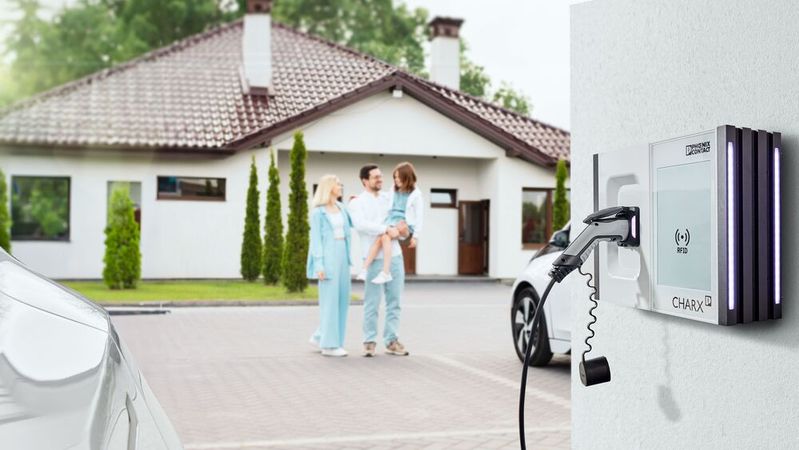
Current wallboxes offer an appealing design with compact construction and high functionality.
(Image: Phoenix Contact)
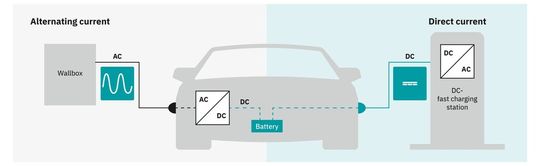
The number of charging points required worldwide is continuously increasing. Both alternating current (AC) and direct current (DC) charging play a central role in this. AC charging typically takes place via wallboxes at home or at public AC charging points. It is particularly suitable for charging overnight or in places where the vehicle is parked for long periods of time. In comparison, DC charging allows the vehicle battery to be charged much faster, which is particularly necessary on long-distance journeys. (Image 1)
Depending on the region, the split between AC and DC charging points is around 10:1. 30,000,000 new AC charging points will be needed in Europe alone by 2030 (Source European EV Charging Infrastructure Masterplan). Connection technology plays a decisive role in the economic implementation and reliable operation of these AC chargers.
AC and DC charging in comparison
(Image: Phoenix Contact)
Economical and Reliable AC Charging Points
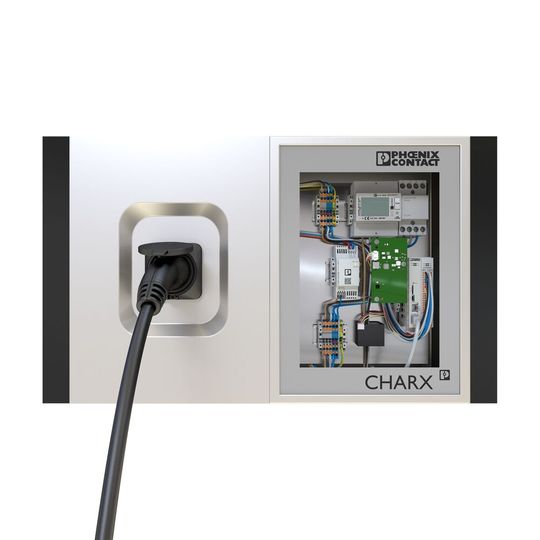
If charging stations have a modular design, the power supply, AC charging controller, mains contactors, electricity meter, communication module and residual current monitoring, for example, are often mounted on mounting rails and wired manually. The manual installation and wiring of the individual modules is time-consuming and causes corresponding costs. Manual wiring is also prone to errors. (Fig. 2) It is therefore advantageous to bring as many functions as possible directly onto the PCB. On the one hand, this reduces manual wiring and the error rate. On the other hand, the wallboxes become more compact. The components required for PCB assembly are available and are cheaper overall than individual separate assemblies.
PCB-based wallbox with significantly reduced wiring effort
(Image: Phoenix Contact)
Safe and Fast Installation on Site
The average investment for an 11 kW charging point in Europe is 125 euros/kW (~$145/kW) charging capacity (source: European EV Charging Infrastructure Masterplan). This means that an 11 kW charging point costs around 1,375 euros (~$1,586). The installation costs here are 375 euros (~$432), i.e. almost 30 percent.
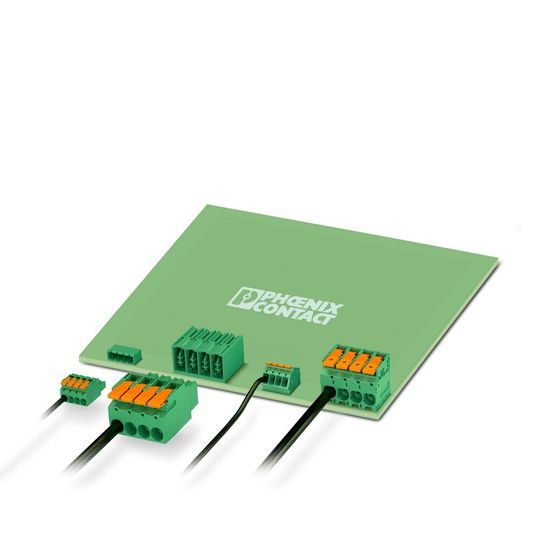
When installing a charging point on site, the specialist is often under time pressure. Any instructions can only be viewed briefly, if at all. Intuitive, safe quick-connection technology now offers advantages. When installing a wallbox, the grid connection is single-phase, two-phase or three-phase. Due to the higher power and the desired symmetrical loading of all phases, the three-phase connection offers advantages. PCB terminals with a lever connection are ideal for connecting conductors up to 6 mm², sometimes even up to 16 mm². The conductor connection is self-explanatory, tool-free and quick thanks to the orange lever. The lever position provides visual feedback that all conductors are properly connected (Fig. 3). There is no need for an additional check of the connections. In addition, the high spring force ensures permanently secure contacting. With the LPT series, Phoenix Contact offers a complete portfolio for conductor cross-sections from 2.5 to 25 mm². Horizontal and angled conductor entries enable the optimum solution for every device.
If the installation of several charging points is planned, the mains supply must be looped through from charging point to charging point. The use of pre-assembled cables with connectors from the QPD and PRC series is recommended here. The coding of the connectors prevents errors.
The lever connection technology is intuitive to use thanks to the orange operating lever. The high spring force guarantees a permanently secure connection.
(Image: Phoenix Contact)
Space-Saving Connection Technology
The internal wiring of a charger is carried out under controlled conditions at the manufacturer's premises. The connection technology should be as space-saving as possible and enable fast wiring. Push-in PCB terminal blocks and connectors are the first choice here. Phoenix Contact offers a comprehensive product range of connectors and PCB terminal blocks for signals and power. Vertical, horizontal and angled connection directions always provide an optimum solution.
Communication between the electric car and the AC charging point takes place via a signal line in the charging cable using the PWM signal (Pulse Width Modulation). The charging point sends information about the maximum charging power. During charging, communication takes place via this CP line (Control Pilot). This enables the vehicle to start, monitor and end the charging process. The Proximity Pilot contact (PP contact) in the charging plug has the task of recognizing the current-carrying capacity of the charging cable and ensuring that safe charging takes place. The maximum voltage at the PP and CP contact is 12 volts and the current is in the mA range. Space-saving connectors with Push-X are ideal for connecting these signal cables to the charger. Push-X technology enables the direct connection of flexible cables by simply plugging in the conductors. The user also receives acoustic feedback.
Date: 08.12.2025
Naturally, we always handle your personal data responsibly. Any personal data we receive from you is processed in accordance with applicable data protection legislation. For detailed information please see our privacy policy.
Consent to the use of data for promotional purposes
I hereby consent to Vogel Communications Group GmbH & Co. KG, Max-Planck-Str. 7-9, 97082 Würzburg including any affiliated companies according to §§ 15 et seq. AktG (hereafter: Vogel Communications Group) using my e-mail address to send editorial newsletters. A list of all affiliated companies can be found here
Newsletter content may include all products and services of any companies mentioned above, including for example specialist journals and books, events and fairs as well as event-related products and services, print and digital media offers and services such as additional (editorial) newsletters, raffles, lead campaigns, market research both online and offline, specialist webportals and e-learning offers. In case my personal telephone number has also been collected, it may be used for offers of aforementioned products, for services of the companies mentioned above, and market research purposes.
Additionally, my consent also includes the processing of my email address and telephone number for data matching for marketing purposes with select advertising partners such as LinkedIn, Google, and Meta. For this, Vogel Communications Group may transmit said data in hashed form to the advertising partners who then use said data to determine whether I am also a member of the mentioned advertising partner portals. Vogel Communications Group uses this feature for the purposes of re-targeting (up-selling, cross-selling, and customer loyalty), generating so-called look-alike audiences for acquisition of new customers, and as basis for exclusion for on-going advertising campaigns. Further information can be found in section “data matching for marketing purposes”.
In case I access protected data on Internet portals of Vogel Communications Group including any affiliated companies according to §§ 15 et seq. AktG, I need to provide further data in order to register for the access to such content. In return for this free access to editorial content, my data may be used in accordance with this consent for the purposes stated here. This does not apply to data matching for marketing purposes.
Right of revocation
I understand that I can revoke my consent at will. My revocation does not change the lawfulness of data processing that was conducted based on my consent leading up to my revocation. One option to declare my revocation is to use the contact form found at https://contact.vogel.de. In case I no longer wish to receive certain newsletters, I have subscribed to, I can also click on the unsubscribe link included at the end of a newsletter. Further information regarding my right of revocation and the implementation of it as well as the consequences of my revocation can be found in the data protection declaration, section editorial newsletter.
Robust Connectors for Reliable Communication
With an AC charging point, wireless communication can take place via various technologies such as LTE, WLAN and Bluetooth to support the following functions:
LTE (mobile communications)
Remote monitoring and control: Charging points are connected to backend systems via LTE to monitor status, report faults and receive updates.
Billing: Data on charging processes is sent to billing systems in real time.
WLAN
Local control and configuration: Users configure and control the charging points locally via Wi-Fi, for example using a smartphone app.
Integration into smart home systems: WLAN enables the charging point to be integrated into a home network, e.g. to optimize charging times based on energy consumption in the household.
Bluetooth
Simple authentication: Bluetooth can be used to authenticate the user by using the smartphone as a key.
Short-range communication: Bluetooth is used for initial setup and diagnostics to establish a quick and easy connection.
The functions listed are often combined on a communication circuit board. Depending on the configuration of the charger, this circuit board is simply plugged in. High-pole fine-pitch board-to-board or board-to-wire connectors with a pitch of 0.635 mm, 0.8 mm or 1.27 mm, for example, are used for contacting. Particularly robust, reliable connectors are required, as most chargers are operated outdoors in different climate zones. Extreme weather conditions such as extreme heat or cold can damage the electronics of the charging station or impair its function.
According to IEC 61851-1, AC charging points must typically be designed for a temperature range of -25 to 55 °C (~-13 to 131 °F). Thermal effects can cause relative movements of the plug connection. Thermal effects can cause relative movements in the plug connection. FS series board-to-board connectors are suitable for these extreme requirements. The floating system offers tolerance compensation of up to 0.7 mm in the x and y directions and 0.6 mm in the z direction.
Depending on the charger, wired interfaces are also available. USB-A and USB-C ports enable firmware updates and the connection of diagnostic devices. RJ45 connections allow connection to a local network (LAN) and connection to a central management system. For this purpose, Phoenix Contact offers a portfolio of field-attachable RJ45 connectors and patch cables with various cable types. Phoenix Contact also offers USB PCB connectors and patch cables.
Conclusions
Malfunctions caused by improper or loose connections during commissioning are avoided by using the correct connection technology. High-quality, long-term stable contact points enable high reliability of charging stations and wallboxes even under extreme environmental conditions. (se)
*Georg Grunenberg is Application Expert EV Charging Infrastructure Business Area Device Connectors at Phoenix Contact in Blomberg.



:quality(80)/p7i.vogel.de/wcms/eb/2b/eb2bd1b8487afe577b37363cd02f16ff/0113143253v1.jpeg "In our China Market Insider, we regularly provide you with relevant information straight from China. (Image:© Eisenhans - stock.adobe.com)")
:quality(80)/p7i.vogel.de/wcms/dd/b8/ddb8edc98c49b384734ab2432b297eb5/adobestock-1913662309--irene-stock-adobe-com-ki-generiertv1.jpeg "Rotary joints are used in grippers and swivel mechanisms to allow assemblies to rotate or swivel smoothly relative to one another, even under very high loads (illustrative image). (Source: Irene - stock.adobe.com / KI-generiert)")
:quality(80)/p7i.vogel.de/wcms/d1/ef/d1ef6b6f7d4543f7999980bacccaf22b/0133499261v1.jpeg "As the growing imbalance in trade relations with China continues to widen, the EU Chamber of Commerce foresees a day when trade with China will have to be seriously reevaluated ... (Image: AI-generated)")
:quality(80)/p7i.vogel.de/wcms/fe/1f/fe1fa5ee713f94deaba963dc24c3abc5/0133299273v1.jpeg "The Flexistar enables highly flexible production of laser-welded tubes thanks to its tool-free clamping system. (Image:Because Technology, LLC)")
:quality(80)/p7i.vogel.de/wcms/60/ef/60ef4f07e4829b2c2929befc0f353c58/0133511729v1.jpeg "Humanoid robots can match human performance in certain tasks. (Image:Gemini / AI-generated)")
:quality(80)/p7i.vogel.de/wcms/2e/99/2e99726b522e4b35b690e25eb6a42643/0133463991v1.jpeg "Robotics: In AMR applications, connection technology must reliably transmit power, signals, and data despite vibration and shock loads—in very confined spaces and in a way that allows for regular maintenance. (Image:Hyperever)")
:quality(80)/p7i.vogel.de/wcms/d0/18/d01801e3d5dbd7bc9d0b4f60408b630c/0133468429v1.jpeg "Quality requirements for film packaging are on the rise. At the same time, many companies are turning to recyclable film materials, which, however, have their own challenges. Fraunhofer researchers have therefore developed a fast system that detects problems in real time. (Image:Fraunhofer IKTS)")
:quality(80)/p7i.vogel.de/wcms/b1/06/b106cf44923ce39565c3264982fd20eb/0133414574v1.jpeg "Robots Build Robots: At the new Ubtech factory, automated systems even handle parts of the material supply and logistics for the production of humanoid robots. (Image:Ubtech)")
:quality(80)/p7i.vogel.de/wcms/c0/52/c052f405eb55fc3d08c4837e77206fc0/adobestock-2021845957--aucartstudio-stock-adobe-com-ki-generiertv1.jpeg "An innovation from China to combat extreme summer heat: A novel coating lowers temperatures. (Source: © AucArtStudio – stock.adobe.com_AI-generated)")
:quality(80)/p7i.vogel.de/wcms/66/a7/66a7b78159caeacce57136529688799f/0133503398v1.jpeg "Sunlight Makes Stone! These stone blocks weren't made the traditional way. Instead, they were additively manufactured from sand using a laser. In the future, however, the laser is set to be replaced by concentrated sunlight—if the startup Addisol is successful... (Image:Addisol / F. Fiedler)")
:quality(80)/p7i.vogel.de/wcms/72/b9/72b995c2c8d812c5e2115cbef31e035a/0133462727v1.jpeg "Eggl manufactures center hoods that are precisely tailored to each cooking island—whether standard size or custom shape. They are made entirely of stainless steel and are individually customized in terms of size and filter arrangement. (Image:SPI)")
:quality(80)/p7i.vogel.de/wcms/13/5d/135dfae6229ceaf5c55467a43e8f7257/adobestock-1879961393--ardi-stock-adobe-com-ki-generiertv1.jpeg "Annoying chatterboxes or awkward silences in response to questions—a moderator should specifically prepare for difficult situations in order to navigate them effectively. (Image:ardi - stock.adobe.com_AI-generated)")
:quality(80)/p7i.vogel.de/wcms/3e/2f/3e2f1ec6c4e1a24eac32957acebd0901/0133601693v1.jpeg "From the boule (bottom) to the wafer to the chip (on top of the boule). Transistors are used as switches in power electronics. (Image:Bosch)")
:quality(80)/p7i.vogel.de/wcms/8f/99/8f9956e7dce99d1b28c27fb1c30ea236/04-dsc-2230v1.jpeg "Bosch is cutting jobs in Nuremberg. (Source: Bosch)")
:quality(80)/p7i.vogel.de/wcms/aa/a2/aaa2c6dd2daa24b485cddbf9297590c0/0133467318v1.jpeg "Battery Monitoring: Battery monitoring using electrochemical impedance spectroscopy offers several advantages. (Image:TI)")
:quality(80)/p7i.vogel.de/wcms/39/b2/39b21bf03be1683831862239a369987c/0133469638v1.jpeg "Data from autonomous vehicles and robots operating autonomously is in high demand, and Ruqi wants to capitalize on this. (Image:Ruqi Mobility)")
:quality(80)/p7i.vogel.de/wcms/28/28/2828c5261714321afb0bab67bf771823/0133353387v1.jpeg "The 130-meter-long China Zorrilla draws its power from a battery system with a capacity of more than 40 MWh. Eight electric motors drive an equal number of water jets. (Image:Incat Australia Pty Ltd)")
:quality(80)/p7i.vogel.de/wcms/48/15/4815da27c45973ca629a99b375ac3aef/0133509585v1.jpeg "Ventuno Q RoadTest: Designed to help the Element14 community gain practical insights from real-world tests using the Ventuno Q. (Image:Farnell/Element14)")
:quality(80)/p7i.vogel.de/wcms/17/2b/172bd132f9febdfcbcedba292ad0504d/aufmacherv1.jpeg "Micro-Epsilon offers a wide range of IO-Link-compatible sensors. (Source: Micro-Epsilon Messtechnik GmbH & Co. KG)")
:quality(80)/p7i.vogel.de/wcms/ca/b4/cab46fd26d19d6a2febca032048200b6/0133471827v1.jpeg "Photonics SDK for C and Python: Computational operations are now abstracted as standard mathematical functions. (Image:Q.ANT)")
:fill(fff,0)/images.vogel.de/vogelonline/companyimg/76800/76895/65.jpg "FAULHABER_120mm.jpg ()")
:quality(80)/p7i.vogel.de/wcms/30/44/304461dfe0c920f14b85739fbc231b9a/0131638193v1.jpeg "Connector review:
Product highlights in summer 2026 range from outdoor connectors to terminal blocks to industrial connectors. (Image: RdM)")
:quality(80)/p7i.vogel.de/wcms/2e/99/2e99726b522e4b35b690e25eb6a42643/0133463991v1.jpeg "Robotics: In AMR applications, connection technology must reliably transmit power, signals, and data despite vibration and shock loads—in very confined spaces and in a way that allows for regular maintenance. (Image:Hyperever)")