Car manufacturers in Europe and Japan are struggling to survive. On the other hand, some suppliers are reporting ever higher margins. The market is turning completely upside down.
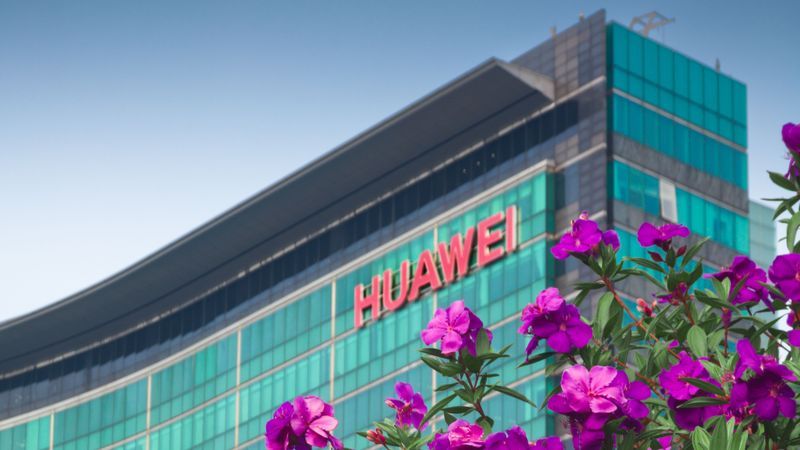
Huawei's automotive unit is doing very well. The division is generating high profits.
(Image: Huawei)
Is car manufacturing still a good business model? The question has been raised at the latest since the annual reports of listed companies in China became available. Battery manufacturer CATL earned more in 2025 than 13 Chinese car manufacturers combined, reports Chinese car portal Zhongguo Qiche Bao.
The margins of the largest automakers have fallen by an average of 4.1 percent. Top suppliers, such as CATL (batteries) or Huawei (intelligence), are making record profits.
"The profits are shifting to suppliers. Are automakers becoming mere assembly plants?" headlines the Chinese auto portal. The discussion initiated by this is currently being continued in all the country's trade media.
Shift to "Dominance of Technology"
While many automakers are struggling with declining margins, which are gradually becoming alarming, the net margin of CATL last year was about 17 percent, according to the numbers in the annual report. The Chinese business magazine Caixin estimates CATL's gross margin for 2025 at over 26 percent.
Manufacturers of semiconductors, which account for an increasingly large part of the value creation of cars, also show margins of more than ten percent. "Overall, the industry is moving from a dominance of automakers to a dominance of technology," said Cui Dongshu, Secretary General of the Chinese Passenger Car Association CPCA.
For Huawei, finding reliable data is a bit more challenging. However, according to Caixin, the revenue of the "Intelligent Automotive Solutions" business unit increased by 72 percent year-over-year last year.
Profits on One Side
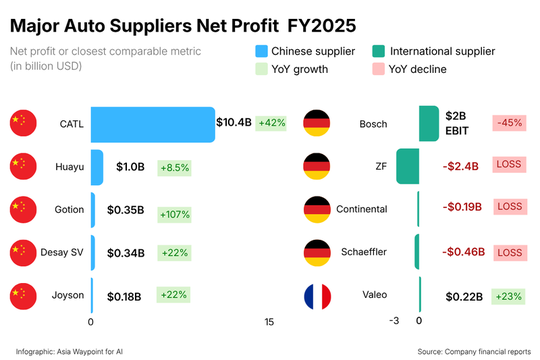
The Profits of Major Automotive Suppliers – in China and Europe.
(Source: VCG)
The higher margins reflect strong profits among some of the top suppliers, even though they have to spend as much or more on research and development as the automakers.
On average, Contemporary Amperex Technology earned about 200 million yuan (approximately 25.5 million euros) per day. CATL's net profit amounted to over nine billion euros in 2025, an increase of more than 42 percent compared to the previous year. The battery group's annual profit surpassed the total profits of 13 Chinese automakers listed on the Shanghai and Shenzhen stock exchanges, calculated the Chinese auto portal.
Role Reversal in the Automotive Industry
Some participants in the public debate in China believe that this widening profit gap in favor of certain technology suppliers is temporary. Expert Lang Xuehong refers to it as a "transitional phenomenon," attributed in part to price fluctuations in lithium carbonate. She is the Deputy Secretary-General of the China Automobile Dealers Association (CADA).
However, much suggests that this is a long-term shift in market power. Due to the dual transformation to electric drives and to greater intelligence with AI-supported driving assistance and intelligent chassis and cockpits, the pricing power is shifting from traditional automakers to suppliers of new core components such as chips, AI models, and batteries.
Fight for Survival
The Chinese economist Zhang Jianping refers to this as a "role reversal." During the era of the internal combustion engine, which is now slowly ending, automakers stood at the "center of the value chain" and "were largely able to determine the prices of supplier products." In the "new era of electrification and intelligence," this is different.
Supporting this interpretation of a fundamental shift in the value creation within the auto industry is the fact that not only automakers but also many traditional suppliers are currently under significant pressure. And this is true not only in China but worldwide.
"We in the automotive industry are fighting for our survival," said Koji Sato, at the time still President and CEO of Toyota, on March 25 at the 22nd Supplier Conference of his corporation. "I want everyone here to share this sense of crisis," Sato told his 484 assembled suppliers, according to a transcript of his speech in the Toyota Times.
Date: 08.12.2025
Naturally, we always handle your personal data responsibly. Any personal data we receive from you is processed in accordance with applicable data protection legislation. For detailed information please see our privacy policy.
Consent to the use of data for promotional purposes
I hereby consent to Vogel Communications Group GmbH & Co. KG, Max-Planck-Str. 7-9, 97082 Würzburg including any affiliated companies according to §§ 15 et seq. AktG (hereafter: Vogel Communications Group) using my e-mail address to send editorial newsletters. A list of all affiliated companies can be found here
Newsletter content may include all products and services of any companies mentioned above, including for example specialist journals and books, events and fairs as well as event-related products and services, print and digital media offers and services such as additional (editorial) newsletters, raffles, lead campaigns, market research both online and offline, specialist webportals and e-learning offers. In case my personal telephone number has also been collected, it may be used for offers of aforementioned products, for services of the companies mentioned above, and market research purposes.
Additionally, my consent also includes the processing of my email address and telephone number for data matching for marketing purposes with select advertising partners such as LinkedIn, Google, and Meta. For this, Vogel Communications Group may transmit said data in hashed form to the advertising partners who then use said data to determine whether I am also a member of the mentioned advertising partner portals. Vogel Communications Group uses this feature for the purposes of re-targeting (up-selling, cross-selling, and customer loyalty), generating so-called look-alike audiences for acquisition of new customers, and as basis for exclusion for on-going advertising campaigns. Further information can be found in section “data matching for marketing purposes”.
In case I access protected data on Internet portals of Vogel Communications Group including any affiliated companies according to §§ 15 et seq. AktG, I need to provide further data in order to register for the access to such content. In return for this free access to editorial content, my data may be used in accordance with this consent for the purposes stated here. This does not apply to data matching for marketing purposes.
Right of revocation
I understand that I can revoke my consent at will. My revocation does not change the lawfulness of data processing that was conducted based on my consent leading up to my revocation. One option to declare my revocation is to use the contact form found at https://contact.vogel.de. In case I no longer wish to receive certain newsletters, I have subscribed to, I can also click on the unsubscribe link included at the end of a newsletter. Further information regarding my right of revocation and the implementation of it as well as the consequences of my revocation can be found in the data protection declaration, section editorial newsletter.
Even the survival of Toyota is no longer a given, said Toyota's then-chief, who was replaced shortly after this speech on April 1 by the previous CFO Kenta Kon. "If things don't change, we will not survive," Sato stated before the assembled "Who's Who" of the supplier industry.
Too Slow and Processes Needing Improvement
Unlike what is often heard in the recent German debate, Sato did not solely blame a "China shock" for these conditions. He did mention the challenge of remaining "competitive" on costs, which everyone in the room understood as a reference to China. However, he cited the company's own "pace of technological adoption" and processes for collaboration between Toyota and its suppliers that needed improvement as the main reasons for the crisis.
The market competition, as everyone knew it, is now a thing of the past in the automotive industry. No company can rest on its old strengths any longer, Sato said in essence.
This aligns with what the European supplier association CLEPA heard in its spring survey on March 23. According to CLEPA, 24 percent of European auto suppliers forecast losses for 2026. In the previous survey, that share had been 15 percent.
Seventy-six percent of them expect a profit margin of less than five percent. This is the figure the industry considers necessary as a prerequisite for critical investments in research, development, and production.
Job Cuts at Tier 1 Suppliers
This also indicates that it is not just a simple "role distribution" within the power structure between car companies and suppliers. Both share the pain of this transformation.
Media reports suggest that Bosch, Continental, ZF, Valeo, Forvia, Schaeffler, and Mahle have announced job cuts totaling more than 100,000 employees over the past two years. Japanese suppliers are faring only slightly better. According to media reports, Denso's operating profit, for instance, plummeted by 30 percent between April and December 2025 compared to the previous year.
Honda President Mibe is Impressed
The pressure from structural change in the German and Japanese industries is increasing further as the Chinese automotive industry has significantly caught up in terms of quality and technology at the top level. Some manufacturers and suppliers are now serious competitors.
Moreover, the Chinese are also fast. They developed new models in 18 to 24 months, which is half as fast as Japanese manufacturers, said Honda President Toshihiro Mibe at the end of February after a visit to a fully automated factory of a major Chinese supplier, as reported by the Japanese business newspaper Nikkei Asia. "We have no chance against that," Mibe said.
Another leverage point is the vertically integrated supply chains of Chinese OEMs like BYD, with costs that European and Japanese competitors can hardly keep up with. Europe faces additional self-inflicted problems, chief among them the very high energy prices compared to international standards.
Additionally, disruptions to global supply chains, caused by the war in Ukraine, the conflict in the Middle East, and US additional tariffs, are squeezing margins in all markets. The auto supply chain is currently being "thrown back from global to regional and fragmented," as articulated by the Chinese auto portal Zhongguo Qiche Bao.
Will Suppliers Soon Dictate Car Technology?
The structural change driven by new technology and geopolitical trends is resulting in a "redistribution of labor" between manufacturers and suppliers. At least, that is the view of some participants in the Chinese debate about the diverging profit margins.
Will automakers focus more on brand management, sales channels, and customer relationships in the future, while top suppliers like CATL and Huawei define the technological routes and the distribution of value creation?
What is certain is that the old structure is currently changing rapidly. This is due to the many new players and all sorts of alliances and joint ventures. There is a shift from a linear to a new "network structure," says Chinese automotive veteran Fu Yuwu, Honorary President of the "China Society of Automotive Engineers," in the course of the current discussion. Due to the many new players and all sorts of alliances and joint ventures.
It could also be said that the cards in the automotive industry are being completely reshuffled right now.



:quality(80)/p7i.vogel.de/wcms/dd/92/dd928ba2e2956aa2bfff4888af8b08f8/photo--1v1.jpeg "Catalog product for extreme operating conditions: The new NRTVG guide carriage from Bosch Rexroth withstands extreme environmental conditions. (Source: Bosch Rexroth AG)")
:quality(80)/p7i.vogel.de/wcms/5a/9e/5a9e57e26964ba5c9d8719a9ee520bb3/0133310195v1.jpeg "Germany and the United Arab Emirates have signed an agreement to stand shoulder to shoulder in times of crisis. This will bring Germany many billions, to say the least.
From left: Sheikh Mohammed bin Sajed al-Nahjan and Federal Chancellor Friedrich Merz. (Image:dpa / K. Nietfeld)")
:quality(80)/p7i.vogel.de/wcms/ce/96/ce964ee3cbd875e63a809c3df1d2b01e/0133312918v1.jpeg "Do you also have a branch in China and are looking for a local partner there with whom you can work to strengthen your market position? If so, time is running out, as a survey by the German Chamber of Foreign Trade in Beijing reveals ... (Image: AI-generated)")
:quality(80)/p7i.vogel.de/wcms/a0/94/a09489b453e958dc8ffd85accab2aaf3/0130556732v1.jpeg "Mutares supported two of its portfolio companies to help them strengthen their position. It worked out perfectly. Now both have been sold. Read here to find out exactly what this is all about... (Image:Mutares)")
:quality(80)/p7i.vogel.de/wcms/81/dc/81dc63ed24c562521413023779495e7d/chris-kramerv1.jpeg "Chris Kramar, Director and General Manager of OEM Solutions for Germany, Austria, and Switzerland at Dell Technologies (Source: Dell Technologies)")
:quality(80)/p7i.vogel.de/wcms/bb/f5/bbf5342f532debc1bd7c09c2b9a0bf42/0133176497v1.jpeg "Over the past two years, AI has emerged as the most important growth driver in the industry. (Image: ©Gorodenkoff - stock.adobe.com)")
:quality(80)/p7i.vogel.de/wcms/01/61/01615a0939754c41e9d2c8971bf0b38a/web-image-kuka-kmf-1500p-300-dpi-1v1.jpeg "Thanks to its design, the KMF 1500P-CB is suitable for the stable and flexible handling of closed and open pallets. (Source: Kuka)")
:quality(80)/p7i.vogel.de/wcms/0b/ef/0bef343dfe1c7f83a1be01e7e83cc5ac/delta-fabrikv1.jpeg "Autonomous mobile manipulation robots can perform a wide range of tasks in a modern factory, from loading machines to quality control. (Image:Delta)")
:quality(80)/p7i.vogel.de/wcms/f4/3d/f43d1f4297d9ae0cd1b6d2adfcb5ffe1/0133276470v1.jpeg "Simulation: Electric arcs in the electrical industry, including associated field simulation. (Image:CADFEM)")
:quality(80)/p7i.vogel.de/wcms/1d/fb/1dfbb415cd837102a33ce21ecf052ec3/0133277411v1.jpeg "LED drivers: LED circuit boards connect the light fixture to the electronics. During design, the operating current, forward voltage, and temperature must be taken into account across the entire operating range. (Image: ©Maria - stock.adobe.com)")
:quality(80)/p7i.vogel.de/wcms/80/8a/808a0eccf49a2a4fe560bd1998506ef9/0133308770v1.jpeg "Just like that, the supports are gone! High-speed footage of the automated, ultrasound-based process for removing optimized support structures from additively manufactured metal parts. It will be presented for the first time at Formnext from November 17 to 20. (Image:Fraunhofer IAPT)")
:quality(80)/p7i.vogel.de/wcms/be/4d/be4d7294d3d171468dc0b83efa4f442c/0133268906v1.jpeg "Here, two experts from Lufthansa Technik are applying the “AeroSHARK” coating to an aircraft. Until now, Boeing has been using this coating, which mimics the skin structure of sharks. Now Airbus also wants to use it to make its aircraft more fuel-efficient. (Image:Lufthansa Technik)")
:quality(80)/p7i.vogel.de/wcms/39/86/398641ac031ac48fd402c27ffe4f0e0d/zf-screenshot-2026-09-09-131739v1.png "The decarbonization of commercial vehicles will be a key topic at IAA Transportation next week. ZF is advocating for a more technology-neutral approach. (Image:ZF)")
:quality(80)/p7i.vogel.de/wcms/94/1e/941e22de0ec2d22e9619c469ec79292b/20260731163822591v1.jpeg "The Chinese government wants its automakers to adhere to certain rules of conduct when operating abroad. (Image:Sany Truck)")
:quality(80)/p7i.vogel.de/wcms/33/f6/33f69ba076b4f655d74bd6788cf5c4a0/0133305882v1.jpeg "As they move toward production readiness, the BMW iX5 Hydrogen prototypes are undergoing an extensive testing program. (Image:BMW)")
:quality(80)/p7i.vogel.de/wcms/bb/02/bb02989aac1291557168fb36afc42343/0133288089v1.jpeg "In China, automakers will be held liable in the future if traffic rules are violated while in autonomous driving mode and, for example, an accident occurs. (Image:Created with AI)")
:quality(80)/p7i.vogel.de/wcms/6c/a6/6ca6c6410e051401d5596d5cc6dfa277/0133283570v1.jpeg "From Core to Platform: With MIPS, ARC, and RISC-V, competition is shifting from individual processor IP blocks to integrated compute platforms for specialized applications. (Image:Dall-E / AI-generated)")
:quality(80)/p7i.vogel.de/wcms/73/17/73174a2afe684fa12d7d6a57b29b20e2/0133305506v1.jpeg "AI data centers are a key driver of direct current technologies. (Image:Pixabay / Brian Penny / AI-generated)")
:quality(80)/p7i.vogel.de/wcms/08/b2/08b2ce49b6d6d11d5953064bb0a62f37/0133308791v1.jpeg "If what Anthropics is accusing its Chinese AI competitors of is true, then the industry is in for quite a shakeup! At stake is nothing less than Chinese AI systems—such as Kimi and Deepseek—that were actually trained indirectly using U.S. AI systems. (Image: AI-generated)")
:quality(80)/p7i.vogel.de/wcms/c4/b5/c4b5badd67b0037f23c1d69806a13d16/0133216860v1.jpeg "Fascinating Technology: ASML's NXE3800E EUV machine. (Image:ASML)")
:fill(fff,0)/p7i.vogel.de/companies/69/de/69de1b7403b0d/simtos-logo.jpeg "simtos-logo (SIMTOS)")
:quality(80)/p7i.vogel.de/wcms/3a/ed/3aed943c2c83093b13abcaf7a26112da/580727-xpeng-20p7-r5a9710-9202e9-original-1741189346-3600x2024v1v1.jpeg "\"Car manufacturing is not a good business model,\" says He Xiaopeng, founder and CEO of Chinese e-car manufacturer Xpeng. (Image:Xpeng)")
:quality(80)/p7i.vogel.de/wcms/fc/27/fc27e6317a676eb56da2911d0e471299/db2026au00455-largev1.jpeg "Jetta is a brand of the joint venture FAW-Volkswagen. Previously very popular, especially in the Shanghai area, the brand's sales are now significantly declining. (Image: Volkswagen AG)")