8.2 Billion U.S. DollarsAMD Plans to Acquire AI Startup World Labs
By
Sebastian Gerstl | Translated by AI
4 min Reading Time
AMD has announced the acquisition of World Labs, an AI startup focused on spatial intelligence. The $8.2 billion stock deal is expected to strengthen AMD's capabilities in AI models, 3D environment simulation, robotics, and future computing infrastructure.
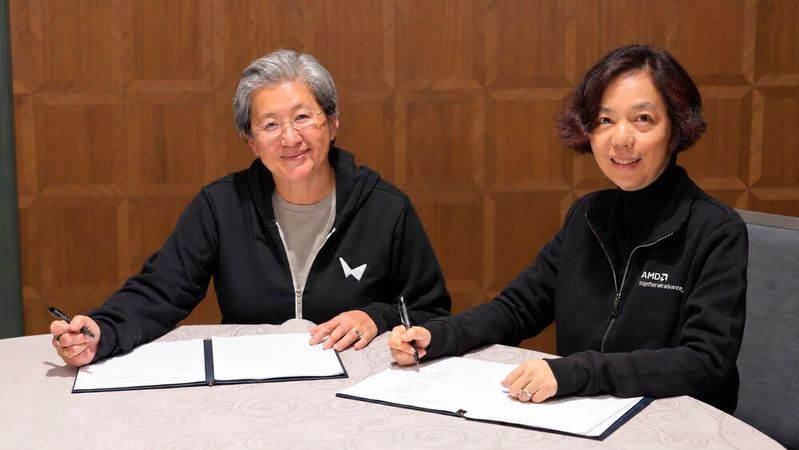
AMD CEO Lisa Hsu (left) and World Labs founder Dr. Fei-Fei Li (right) at the signing of the letter of intent. AMD plans to acquire World Labs, a startup specializing in AI “world models,” for $8.2 billion.
(Image: World Labs)
The U.S. chipmaker AMD plans to acquire the AI company World Labs. Both companies have signed an agreement to that effect. The transaction, which will be paid for entirely with stock, is valued at approximately $8.2 billion and is expected to be completed by the end of 2026, subject to approval by the relevant authorities and other customary closing conditions.
With this acquisition, AMD aims to expand its expertise not only in processors and accelerators, but also in AI models, software, and complete computing systems. According to the company, World Labs’ research will help provide a better understanding of the demands that new AI applications will place on the underlying hardware in the future.
World Labs was founded in 2024 and is headquartered in San Francisco. The company focuses primarily on what is known as spatial intelligence. Its models can generate, reconstruct, and simulate three-dimensional environments from text, images, and videos. Such virtual worlds are intended for use in areas such as design, scientific applications, and robot training, among others.
AI Is Supposed to Understand the Physical World
The research centers on the idea that powerful AI systems must not only process language but also understand the structure and behavior of the physical world. To this end, World Labs is developing foundational models capable of recognizing spatial relationships and generating new views of an environment.
One of the company's most recent developments is the Atlas model. It is designed to predict additional camera perspectives from two-dimensional images by combining generative AI with multi-image geometry techniques. World Labs sees potential applications for this in areas such as robotics simulations, engineering, real estate, entertainment, and research.
Such models are particularly interesting for robotics because machines can first learn specific processes in simulated environments. The generated 3D worlds can, for example, serve as training environments before a robot performs tasks in a real factory. The extent to which the technology is also suitable for direct navigation in real environments has not yet been comprehensively demonstrated.
AMD and World Labs have been working together for some time now. According to the startup, a more intensive technical collaboration began last year, which included optimizing the training and execution of AI models on AMD graphics processors. This collaboration ultimately led to the decision to integrate hardware, software, models, and applications more closely.
Founder and Former Google AI Champion Fei-Fei Li joins AMD's Leadership Team
World Labs co-founder Fei-Fei Li plays a central role in the acquisition. The computer scientist and Stanford professor is considered one of the most influential researchers in the field of computer vision. She became particularly well-known for her work on ImageNet, an extensive image database that has become crucial for the development of modern image recognition systems. Before founding World Labs, she was chief scientist at Google, where she was dubbed the “Godmother of AI.”
Once the transaction is complete, Li is set to join AMD as Executive Vice President and Chief Scientist. In this role, she will report directly to CEO Lisa Su. World Labs co-founders Justin Johnson and Ben Mildenhall are set to work alongside Li to continue the company’s existing research efforts within AMD.
AMD emphasizes that the acquisition is primarily about integrating model research with computing infrastructure. The better the company understands how AI models and applications evolve, the more precisely it can tailor future hardware, software, and systems to their requirements. The company also points to AI applications beyond traditional language models, such as simulations and so-called physical AI.
Date: 08.12.2025
Naturally, we always handle your personal data responsibly. Any personal data we receive from you is processed in accordance with applicable data protection legislation. For detailed information please see our privacy policy.
Consent to the use of data for promotional purposes
I hereby consent to Vogel Communications Group GmbH & Co. KG, Max-Planck-Str. 7-9, 97082 Würzburg including any affiliated companies according to §§ 15 et seq. AktG (hereafter: Vogel Communications Group) using my e-mail address to send editorial newsletters. A list of all affiliated companies can be found here
Newsletter content may include all products and services of any companies mentioned above, including for example specialist journals and books, events and fairs as well as event-related products and services, print and digital media offers and services such as additional (editorial) newsletters, raffles, lead campaigns, market research both online and offline, specialist webportals and e-learning offers. In case my personal telephone number has also been collected, it may be used for offers of aforementioned products, for services of the companies mentioned above, and market research purposes.
Additionally, my consent also includes the processing of my email address and telephone number for data matching for marketing purposes with select advertising partners such as LinkedIn, Google, and Meta. For this, Vogel Communications Group may transmit said data in hashed form to the advertising partners who then use said data to determine whether I am also a member of the mentioned advertising partner portals. Vogel Communications Group uses this feature for the purposes of re-targeting (up-selling, cross-selling, and customer loyalty), generating so-called look-alike audiences for acquisition of new customers, and as basis for exclusion for on-going advertising campaigns. Further information can be found in section “data matching for marketing purposes”.
In case I access protected data on Internet portals of Vogel Communications Group including any affiliated companies according to §§ 15 et seq. AktG, I need to provide further data in order to register for the access to such content. In return for this free access to editorial content, my data may be used in accordance with this consent for the purposes stated here. This does not apply to data matching for marketing purposes.
Right of revocation
I understand that I can revoke my consent at will. My revocation does not change the lawfulness of data processing that was conducted based on my consent leading up to my revocation. One option to declare my revocation is to use the contact form found at https://contact.vogel.de. In case I no longer wish to receive certain newsletters, I have subscribed to, I can also click on the unsubscribe link included at the end of a newsletter. Further information regarding my right of revocation and the implementation of it as well as the consequences of my revocation can be found in the data protection declaration, section editorial newsletter.
Expansion of the AI Ecosystem
With World Labs, AMD is also stepping up its efforts to build a broader AI ecosystem around its own processors and accelerators. In addition to raw computing power, software, development platforms, and models are becoming increasingly important. Competitor Nvidia has been pursuing a similar approach for years with its own platforms for AI and robotics simulation.
According to their own statements, AMD and World Labs plan to work on an open AI ecosystem that ranges from hardware and software to platforms and models that are as widely available as possible. World Labs is expected to continue researching fundamental AI models even after the acquisition. For AMD, the $8.2 billion transaction is also one of the largest acquisitions in recent years.
Whether and to what extent the investment will pay off financially is likely to depend largely on how quickly spatial AI and robotics applications are deployed on a larger scale. First, however, the acquisition must be finalized. If the regulatory authorities approve the deal and the other conditions are met, World Labs is expected to become part of AMD before the end of 2026.



:quality(80)/p7i.vogel.de/wcms/b5/67/b5676f3bfb36251ed31f9a0cccf650b6/0133167827v1.jpeg "Thanks to JumboFlex Generation 2, employees can effortlessly move wheelchairs weighing as much as 40 kilograms. (Image:Lard)")
:quality(80)/p7i.vogel.de/wcms/5e/c6/5ec615b7a51440f668259f2af9158cb9/0132654694v1.jpeg "Strategic Partnerships in Industry: As buyers and restructuring partners, Chinese investors are increasingly helping to preserve jobs in Germany. (Image: ©Anatolii Rymarchuk - stock.adobe.com)")
:quality(80)/p7i.vogel.de/wcms/eb/2b/eb2bd1b8487afe577b37363cd02f16ff/0113143253v1.jpeg "In our China Market Insider, we regularly provide you with relevant information straight from China. (Image:© Eisenhans - stock.adobe.com)")
:quality(80)/p7i.vogel.de/wcms/dd/b8/ddb8edc98c49b384734ab2432b297eb5/adobestock-1913662309--irene-stock-adobe-com-ki-generiertv1.jpeg "Rotary joints are used in grippers and swivel mechanisms to allow assemblies to rotate or swivel smoothly relative to one another, even under very high loads (illustrative image). (Source: Irene - stock.adobe.com / KI-generiert)")
:quality(80)/p7i.vogel.de/wcms/3a/9c/3a9c1fd546e1f041b86bb1d03cf39101/0133610524v1.jpeg "The Mason W-01 combines industrial-grade humanoid hardware, Physical AI-based perception, and autonomous task planning. (Image:Nova X Robotics)")
:quality(80)/p7i.vogel.de/wcms/d0/74/d074ae5d5d705b841b63107b20f9d8c2/699711-xpeng-iron-01-79661c-original-1788864313v1.png "(Source: XPeng Motors (Germany) GmbH)")
:quality(80)/p7i.vogel.de/wcms/60/ef/60ef4f07e4829b2c2929befc0f353c58/0133511729v1.jpeg "Humanoid robots can match human performance in certain tasks. (Image:Gemini / AI-generated)")
:quality(80)/p7i.vogel.de/wcms/2e/99/2e99726b522e4b35b690e25eb6a42643/0133463991v1.jpeg "Robotics: In AMR applications, connection technology must reliably transmit power, signals, and data despite vibration and shock loads—in very confined spaces and in a way that allows for regular maintenance. (Image:Hyperever)")
:quality(80)/p7i.vogel.de/wcms/3d/ff/3dff5e51c24b30c8dc37c1d024887157/0133602931v1.jpeg "Just a few years ago, SpaceX specialists were working on the world’s largest rocket—the Starship. Now, Elon Musk’s company has reached a milestone during a test flight: Earth’s orbit! But there was also a downside... (Image: SpaceX)")
:quality(80)/p7i.vogel.de/wcms/55/06/5506709cc56afcc7301c9d3319e19114/2026-03-08-aerospike-09-980x551v1.jpeg "The engine was developed using Noyron, the computer-aided design model for the LEAP 71. Noyron uses fundamental physical principles, engineering logic, and manufacturing specifications to design independently, without human intervention. (Source: LEAP 71)")
:quality(80)/p7i.vogel.de/wcms/b6/1f/b61f4081bab96d308e87eebaeb756c4f/pm4526-1v1.jpeg "Call for Innovative Ideas: The 2027 Manus Award will once again recognize unique projects featuring lubrication-free polymer plain bearings. (Source: Igus SE & Co. KG)")
:quality(80)/p7i.vogel.de/wcms/c0/52/c052f405eb55fc3d08c4837e77206fc0/adobestock-2021845957--aucartstudio-stock-adobe-com-ki-generiertv1.jpeg "An innovation from China to combat extreme summer heat: A novel coating lowers temperatures. (Source: © AucArtStudio – stock.adobe.com_AI-generated)")
:quality(80)/p7i.vogel.de/wcms/fc/be/fcbe4fcc65f3f972323d69796fd88d27/0133603683v1.jpeg "For those who don't know: Volkswagen has a subsidiary called Powerco that manufactures batteries for electric cars. The Chinese battery expert Gotion has been supporting this effort for some time. Now the two companies plan to significantly expand their collaboration in Europe for mutual benefit ... (Image: Volkswagen)")
:quality(80)/p7i.vogel.de/wcms/42/95/4295a1b01f6fa1f696ffff89cd542737/0133563161v1.jpeg "At its plant in Zaragoza, Spain, Stellantis draws energy from a hybrid energy portfolio. Solar and wind power are expected to cover about 80 percent of the plant’s local electricity needs. (Image:Stellantis)")
:quality(80)/p7i.vogel.de/wcms/3e/2f/3e2f1ec6c4e1a24eac32957acebd0901/0133601693v1.jpeg "From the boule (bottom) to the wafer to the chip (on top of the boule). Transistors are used as switches in power electronics. (Image:Bosch)")
:quality(80)/p7i.vogel.de/wcms/8f/99/8f9956e7dce99d1b28c27fb1c30ea236/04-dsc-2230v1.jpeg "Bosch is cutting jobs in Nuremberg. (Source: Bosch)")
:quality(80)/p7i.vogel.de/wcms/f6/9f/f69f7aad844f2f2c369ee012505f3e37/0133630806v1.jpeg "Even though prices for DRAM and NAND memory remain high due to strong demand and limited capacity, the market appears to be showing the first signs of a slowing boom. Consequently, investors are becoming increasingly skeptical about how much longer the AI boom can sustain the ongoing upward trend in the memory market. (Image:Dall-E / AI-generated)")
:quality(80)/p7i.vogel.de/wcms/c0/e9/c0e91df681b13f3a8f37badeae0a32b3/0133619268v1.jpeg "AMD CEO Lisa Hsu (left) and World Labs founder Dr. Fei-Fei Li (right) at the signing of the letter of intent. AMD plans to acquire World Labs, a startup specializing in AI “world models,” for $8.2 billion. (Image:World Labs)")
:quality(80)/p7i.vogel.de/wcms/ed/b1/edb1335d07debd3de7ae5a2fb74b571a/0133546658v1.jpeg "Securing digital infrastructure is not just about technical risks, but increasingly also about origin, supply chains, and political requirements. (Image:Dall-E / AI-generated)")
:quality(80)/p7i.vogel.de/wcms/22/f0/22f07d1635c733a29049fff5b1b8ccc8/0133601916v1.jpeg "AI models from various providers have been causing quite a stir lately because they’ve done things they weren’t supposed to—or so they say! Now, in light of recent incidents, the company “OpenAI” has decided against releasing a new AI model... (Image: AI-generated)")
:quality(80)/p7i.vogel.de/wcms/73/f1/73f1b6ea230da6eec20134f3af51fa91/0133131975v1.jpeg "Hugging Face is considered a leading platform for open AI models. An acquisition would bring Nvidia closer to the entire value chain—from computing hardware to model development and distribution. (Image:freely licensed)")
:quality(80)/p7i.vogel.de/wcms/2a/58/2a58af66b323ddd57f7d1dc338025991/0128754562v1.jpeg "A coordinated workflow demonstrates how humanoid robots can autonomously perform real warehouse tasks safely and reliably. (Image:Mentee)")
:quality(80)/p7i.vogel.de/wcms/eb/0c/eb0c1cfab0cfc0f978818e2482e6d326/0127066711v1.jpeg "In the competition for powerful AI, there is no winner yet. (Image:Dall-E / AI-generated)")