September 23, the U.S. Department of Commerce submitted a legislative proposal that calls for banning key technologies from China for connected vehicles. Effectively, this would mean the import of almost all vehicles manufactured in China would be banned—and also pose significant challenges for European car manufacturers.
Drastic Measures: The United States aims to completely ban ADAS software and hardware, as well as connectivity technologies coming from China and used in connected vehicles, from U.S. roads by 2030.
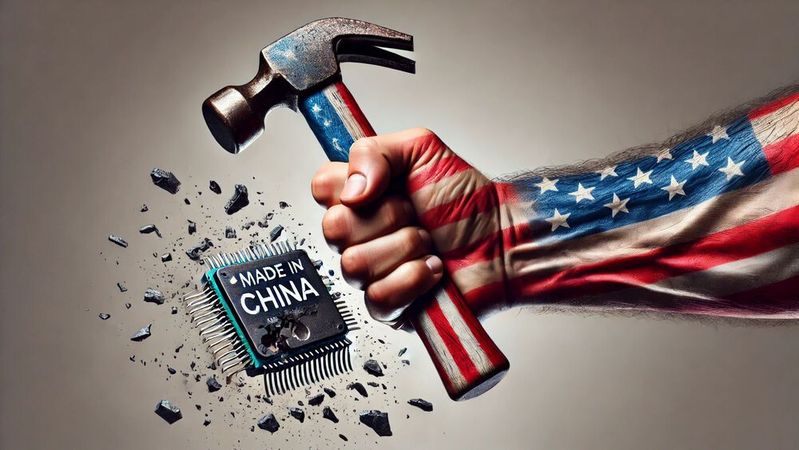
(Image: AI-generated / DALL-E)
In the longstanding technology trade dispute, the next level of escalation is emerging: The US government has announced a complete ban on the import of key technologies from Chinese and Russian production for connected and autonomous vehicles by no later than 2030. The US Department of Commerce introduced the corresponding legislative proposal on September 23, 2024.
Software bans by 2027, hardware components by 2030
Accordingly, by the year 2027, connected and autonomous vehicles approved for the American market will no longer contain any software originating from China or Russia. By the vehicle model year 2030, this ban will also extend to certain hardware technologies necessary for connectivity and ADAS (Advanced Driver-Assistance Systems). Depending on the vehicle manufacturers' production cycle and the duration of the approval process, effectively from the year 2029, none of the affected components will be installed if the vehicle is to be approved for the US market.
The restrictions are extensive and include systems and components that connect the vehicle to the outside world, including Bluetooth, cellular, satellite, and Wi-Fi modules. Additionally, testing autonomous vehicles that use corresponding technologies from China will be completely prohibited on American roads.
Consequently, the United States is significantly intensifying its ongoing restrictions on vehicles, software, and components manufactured in China. At the beginning of this month, the Biden administration decided on steep tariff increases on Chinese imports, including a [100 percent tariff on electric vehicles as well as new increases on batteries for electric vehicles and key minerals].
Concerns regarding espionage and disruptions of critical infrastructure
So far, the US government has only published a notice of proposed rulemaking (NPRM). If this is enacted into law as proposed, it would prohibit the sale or import of connected vehicles containing the mentioned technologies, as well as the import of certain components from "countries of concern." This primarily refers to China and Russia, as well as "entities with sufficient connections to the People's Republic of China or Russia." While this regulation would effectively ban Chinese vehicles completely from American roads, it would also impose significant obstacles for European manufacturers: to gain approval in the United States, they must demonstrate that none of the components affected by the regulation and made in China are used.
"Chinese automakers are trying to dominate the technologies for connected vehicles in the United States and globally," the Biden Administration stated during the recent tightening of trade laws. "This poses a new threat to our national security, including through our supply chains." There are serious concerns that Chinese companies might use their vehicle technologies to collect data about US drivers and infrastructure and relay it to their government. This includes data collected inside the vehicle, such as sensitive driver and passenger information, as well as cameras and sensors that enable automated driving systems and record detailed information about American infrastructure. Additionally, there are concerns about potential foreign manipulation of internet-connected vehicles and navigation systems.
The White House initiated an investigation in February regarding these potential dangers. The current legislative proposal is the result of this study. "If foreign adversaries develop software for a vehicle, it can be used for surveillance and be remotely controlled, which threatens the privacy and safety of Americans on the road,"CNBC quotes US Commerce Secretary Gina Raimondo."In an extreme situation, a foreign adversary could shut down all vehicles operating in the United States at the same time, or take control of them, thereby causing accidents and blocking roads." Therefore, the hardware and software components in connected vehicles covered by the ban would enable the collection of information about geographical areas or critical infrastructure, and thus offer malicious actors the opportunity to disrupt the operation of the infrastructure or the vehicles themselves.
Date: 08.12.2025
Naturally, we always handle your personal data responsibly. Any personal data we receive from you is processed in accordance with applicable data protection legislation. For detailed information please see our privacy policy.
Consent to the use of data for promotional purposes
I hereby consent to Vogel Communications Group GmbH & Co. KG, Max-Planck-Str. 7-9, 97082 Würzburg including any affiliated companies according to §§ 15 et seq. AktG (hereafter: Vogel Communications Group) using my e-mail address to send editorial newsletters. A list of all affiliated companies can be found here
Newsletter content may include all products and services of any companies mentioned above, including for example specialist journals and books, events and fairs as well as event-related products and services, print and digital media offers and services such as additional (editorial) newsletters, raffles, lead campaigns, market research both online and offline, specialist webportals and e-learning offers. In case my personal telephone number has also been collected, it may be used for offers of aforementioned products, for services of the companies mentioned above, and market research purposes.
Additionally, my consent also includes the processing of my email address and telephone number for data matching for marketing purposes with select advertising partners such as LinkedIn, Google, and Meta. For this, Vogel Communications Group may transmit said data in hashed form to the advertising partners who then use said data to determine whether I am also a member of the mentioned advertising partner portals. Vogel Communications Group uses this feature for the purposes of re-targeting (up-selling, cross-selling, and customer loyalty), generating so-called look-alike audiences for acquisition of new customers, and as basis for exclusion for on-going advertising campaigns. Further information can be found in section “data matching for marketing purposes”.
In case I access protected data on Internet portals of Vogel Communications Group including any affiliated companies according to §§ 15 et seq. AktG, I need to provide further data in order to register for the access to such content. In return for this free access to editorial content, my data may be used in accordance with this consent for the purposes stated here. This does not apply to data matching for marketing purposes.
Right of revocation
I understand that I can revoke my consent at will. My revocation does not change the lawfulness of data processing that was conducted based on my consent leading up to my revocation. One option to declare my revocation is to use the contact form found at https://contact.vogel.de. In case I no longer wish to receive certain newsletters, I have subscribed to, I can also click on the unsubscribe link included at the end of a newsletter. Further information regarding my right of revocation and the implementation of it as well as the consequences of my revocation can be found in the data protection declaration, section editorial newsletter.
Possible exemptions still under consideration
The Alliance for Automotive Innovation (AAI), a trade group representing automakers like Volkswagen, General Motors, Toyota, and Hyundai, has already warned about a too stringent timeline for these bans. They pointed out that replacing such key components in upcoming vehicle models would be very cost- and time-intensive. The group highlighted that hardware and software for connected vehicles are developed globally, including in China, but could not provide specific details on the extent to which components manufactured in China are currently predominant in U.S. models.
Additionally, it should be investigated what happens with components that are manufactured in Mexico or South America. The USA has a free trade agreement with Mexico; however, Chinese companies have been producing electronic components in South America for some time now and labeling them for Mexico. Critics warn that Chinese products might effectively enter the US market this way.
The timeline for when the final regulations will be enacted is not yet known, as a final version is still being drafted. The US Department of Commerce has announced plans to closely collaborate with the industry, political allies and partners of the USA, and other stakeholders throughout the regulatory process to minimize unintended economic consequences or disruptions. For instance, procedures are being developed that might allow smaller vehicle manufacturers to be temporarily or completely exempt from the regulations in exceptional cases. At the same time, it was emphasized that all measures will be taken in the interest of the national security of the USA.
China responds calmly, central bank enacts economic aid
Initially, the Chinese economy appeared unimpressed by the latest US maneuvers in the trade dispute: According to CNBC, all Chinese vehicle manufacturers listed on the Hong Kong stock exchange experienced a slight increase in value.
This may also be related to the announcement by the Chinese central bank to provide a comprehensive investment package of 800 billion yuan (approximately 101 billion euros) to reinvigorate the recently faltering Chinese economy and ensure the liquidity of troubled Chinese companies. According to the China Automobile Dealers Association (CADA), auto dealers in the country had to absorb a total loss of 138 billion yuan (17.55 billion euros) in the first eight months of the year, as they were forced to sell new cars at significant discounts.



:quality(80)/p7i.vogel.de/wcms/68/a5/68a5ce0896756c1dcf48dbeceefafbd3/0132300990v1.jpeg "Christoph Geigges is President and CEO of Walter AG. Headquartered in Tübingen (Germany), the company is one of the world’s leading suppliers of precision tools for metalworking. Under Geigges’ leadership, this long-established company is increasingly transforming itself from a tool manufacturer into an engineering partner that supports the entire manufacturing process. (Image: Walter AG)")
:quality(80)/p7i.vogel.de/wcms/3e/7c/3e7c26f44c68545fc7318597b6b65903/0133649650v1.jpeg "The flexible Heller circular storage system can store and process pallets measuring both 630 millimeters by 630 millimeters and 800 millimeters by 800 millimeters—even in mixed-mode operation. This makes the entire production line particularly flexible. (Image:Brighter)")
:quality(80)/p7i.vogel.de/wcms/16/29/162983885950ec1df27ab441bfe88613/0133132549v1.jpeg "Bernd Hermeler is the CEO of Cemecon AG. He studied mechanical engineering at RWTH Aachen University (Germany)—the very university from which the company emerged as a spin-off 40 years ago. Today, Hermeler is responsible for the global strategy of the coating specialist, which, with branches in Europe, the U.S., China, Japan, and India, is considered the global technology leader in the coating of cutting tools. (Image: Cemecon AG)")
:quality(80)/p7i.vogel.de/wcms/af/81/af81b53cb4926dcadc20ba369a29d412/0132695968v1.jpeg "International venture capital is increasingly flowing into the machining industry. Here are the players that entrepreneurs and CEOs should keep an eye on right now. (Image: ©NDABCREATIVITY - stock.adobe.com)")
:quality(80)/p7i.vogel.de/wcms/ea/18/ea18e84aed24bbe1c91937f30c2f7301/image1v1.jpeg "Kassow Robots' new product portfolio now includes seven 7-axis cobots. (Image: Kassow Robots (Image:)")
:quality(80)/p7i.vogel.de/wcms/c8/d0/c8d0c68a98e4eff417e2bacc58da92b7/aveva-world-media-kitv1.jpeg "Predictive maintenance should not be a matter of plant size or budget, but rather a matter of the proper integration of data collection, analysis, and feedback to operators. (Source: Aveva)")
:quality(80)/p7i.vogel.de/wcms/f2/3b/f23bff6710f706981c703b3110407075/geralt-traffic-signs-663368v1.jpeg "Nearly all of the manufacturing companies surveyed worldwide measure AI outcomes in some form, but only 49 percent rigorously calculate the ROI of AI. (Source: )")
:quality(80)/p7i.vogel.de/wcms/aa/3e/aa3e2603a812f8e7d33c00ba8ae28c9f/0133507886v1.jpeg "With the Iggy Rob, igus is bringing a humanoid robot into factories for a price of 47,999 euros ($54,718). (Image: igus)")
:quality(80)/p7i.vogel.de/wcms/5b/a2/5ba21b3e5fcdd91f6bfe806f745ea723/isc-physioink-bild-3v1.jpeg "In the PhysioINK project, Fraunhofer researchers are developing bio-printing inks from the most common tissue proteins. Under the microscope, the living tissue cells (fibroblasts) are visible in the printed lattice structure: blue represents the cell nucleus, and green represents the cytoskeleton. (Source: Tobias Weigel/Fraunhofer ISC)")
:quality(80)/p7i.vogel.de/wcms/9c/16/9c16e4aa02594fe4bf82ead736562b07/directhop1-scaledv1.jpeg "Light as a feather, but without feathers: The University of Washington's robot, which weighs just one gram, uses a bionic direct-drive system to catapult itself into the air with centimeter-level precision. (Source: Mark Stone/University of Washington)")
:quality(80)/p7i.vogel.de/wcms/e7/94/e794290f265afbd0ffc7a06c4fe9d425/adobestock-1887113836--hypnotics-14-stock-adobe-com-ki-generiertv1.jpeg "In both autonomous driving and industrial production, there is growing skepticism as to whether full autonomy is always desirable. (Source: © Hypnotics 14 – stock.adobe.com / AI-generated)")
:quality(80)/p7i.vogel.de/wcms/a8/71/a8712e5c6ef536228444ab5275cedfe2/adobestock-340905887--gorodenkoff-stock-adobe-comv1.jpeg "A new position paper outlines the conditions that the business community, academia, and policymakers must jointly establish in order to ensure the long-term viability of industry in Germany and Europe. (Source: © Gorodenkoff – stock.adobe.com)")
:quality(80)/p7i.vogel.de/wcms/e9/47/e9470a0380c0d0022533e8a694f239f6/0133704817v1.jpeg "Range Extender: In the BYD Dolphin, the parallel hybrid system operates almost exclusively using a series strategy. (Image:BYD)")
:quality(80)/p7i.vogel.de/wcms/38/40/3840a78113b846a7a13486d73506eff5/citroen-2cv-screenshot-ki-bearbeitetv1.jpeg "This is what Citroën's 2CV concept car might look like. (Image:Stellantis / KI-generiert)")
:quality(80)/p7i.vogel.de/wcms/24/49/244902b72b5020c427bb50c6d3513811/0133725464v1.jpeg "Solid-state batteries: They promise a massive increase in the range of electric cars. Is there any truth to this promise, and what about mass production? (Image:Dall-E / AI-generated)")
:quality(80)/p7i.vogel.de/wcms/fa/bb/fabb3c45272579793253b5da63f911f7/db2023im00001-largev1.jpeg "The planned VW/Powerco battery cell factory is located north of Valencia, not far from the port of Sagunt (left). On the right, a future expansion of the factory is faintly visible through the transparency. (Image:Volkswagen AG)")
:quality(80)/p7i.vogel.de/wcms/70/59/7059db055d4eeb8dea752651a071f360/geralt-handshake-4608297v1.jpeg "The deal between Schneider Electric and PTC is intended to create end-to-end data flows for the industry. (Source: )")
:quality(80)/p7i.vogel.de/wcms/67/3d/673d8f6f14bd030b53b61800a0aeb06d/0133548286v1.jpeg "Overview: If even a single critical component is missing, the entire production process can come to a standstill. Proactive procurement is intended to mitigate such bottlenecks early on. (Image:Dall-E / AI-generated)")
:quality(80)/p7i.vogel.de/wcms/b3/8d/b38d7e914a0a51c24db7e93c8a8420e2/0133672676v1.jpeg "Figure 1: Today, the AT cut is most commonly used for quartz crystals. The double-twisted SC cut further enhances the stability and aging resistance of OCXO oscillators. (Image:Q-Tech)")
:quality(80)/p7i.vogel.de/wcms/40/34/4034915f85470ad8264659267e4f02d0/0133655653v1.jpeg "Cariad, Volkswagen's software subsidiary, continues to struggle. Now, another round of layoffs has been announced, which will result in the loss of many jobs ... (Image:Cariad)")
:fill(fff,0)/images.vogel.de/vogelonline/companyimg/76800/76895/65.jpg "FAULHABER_120mm.jpg ()")
:fill(fff,0)/p7i.vogel.de/companies/68/a4/68a47beec75ce/logo-cmyk-de.jpeg "logo-cmyk-de (https://www.datatec.eu/)")
:quality(80)/p7i.vogel.de/wcms/98/f4/98f4d32f11a3ecb4ae3911e8cd9df779/0118509994.jpeg "The tariffs on Chinese goods being imported into the US are being significantly increased in some cases. (Image:Royalty-free)")
:quality(80)/p7i.vogel.de/wcms/11/b0/11b041587fe5783597a78530b628ed7c/0132682714v1.jpeg "Symbolic image: New US rules could make market access more difficult for foreign providers of mobile robots and connected inverters. (Image:Dall-E / AI-generated)")
:quality(80)/p7i.vogel.de/wcms/ed/b1/edb1335d07debd3de7ae5a2fb74b571a/0133546658v1.jpeg "Securing digital infrastructure is not just about technical risks, but increasingly also about origin, supply chains, and political requirements. (Image:Dall-E / AI-generated)")