The free developer tools on the Würth Elektronik online platform REDEXPERT have a new addition: With the ICLED Color Calculator, PWM values can be determined to display specific color values with ICLEDs. The basis is the parameters that the manufacturer determines for each batch of its pixel LEDs with integrated IC before they leave the warehouse.
Defined color values with RGB LEDs: A free tool allows PWM values to be determined to display specific color values with ICLEDs.
Carlos Roberto Hernández Gómez is Product Manager Optoelectronics at Würth Elektronik eiSos.
Grouping red, green, and blue LEDs into pixels and using additive color mixing to represent any color opened up new possibilities for displays and lighting designs. From ambient lighting systems to audio and gaming devices, signal systems, displays on charging stations, and full-color matrix displays, powerful solutions can be realized by using adjacent red, green, and blue LEDs as pixels instead of the pixels of an LCD.
The approach becomes particularly interesting with ICLEDs. These components, also known as addressable, smart, or pixel LEDs, are LED packages that include an integrated circuit (IC). This driver enables the individual control of the red, green, and blue chips in the package through pulse-width modulation (PWM), allowing for sophisticated and precise lighting solutions with various colors. Since each pixel color can be individually regulated in brightness from 0 to 100 percent and digitally dimmed, the integrated RGB LEDs can produce more than 16 million different color and brightness values (based on the current standard of 8-bit depth).
And since fewer components, such as resistors, are needed, display solutions with the intelligent LEDs are not only faster to implement but also more energy-efficient than traditional LEDs. Digital control increases the flexibility of what can be displayed. Instead of being limited to a few pre-set circuits, any texts or symbols can be displayed.
Efficient LED Dimming Through Pulse-Width Modulation
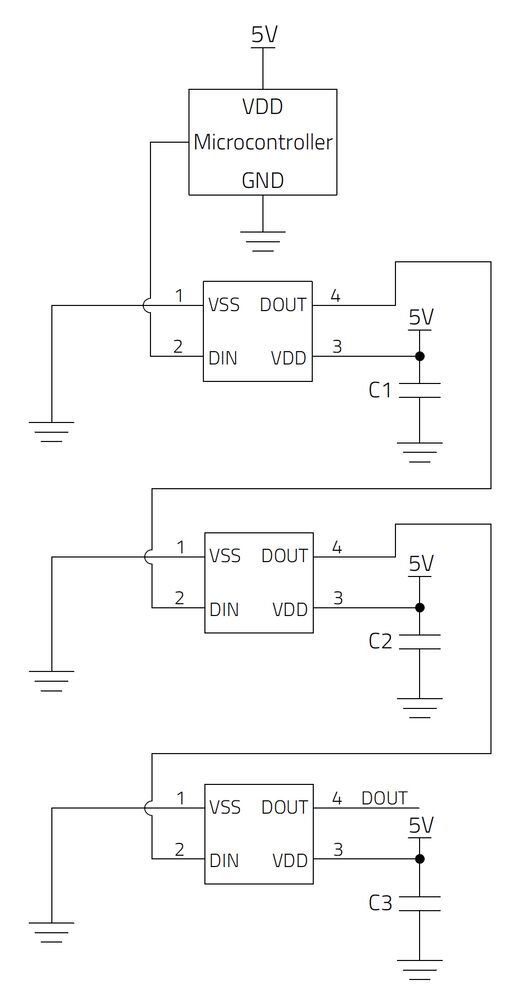
Image 1: The ICLEDs can be connected in a daisy-chain circuit.
(Image: Würth Elektronik)
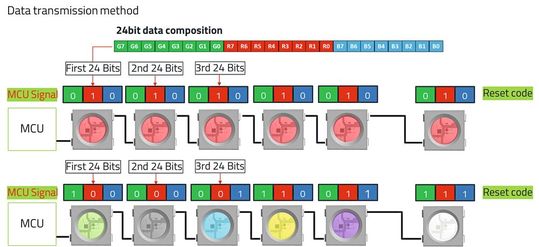
Image 2: ICLEDs and data transmission.
(Image: Würth Elektronik)
The simplest method for controlling the brightness of LEDs is dimming via current intensity. However, this can alter the color value, which is often undesirable. In contrast, pulse-width modulation (PWM) in pixel LEDs with an integrated circuit (IC) enables precise "dimming" by turning the current on and off in extremely fast intervals that are imperceptible to the human eye.
In practice, control is carried out via data signals generated by a microcontroller (MCU). These signals are sent through a data line to the DIN pin of the first ICLED in the circuit. Additional components are connected in a so-called daisy-chain configuration (Figure 1). Each integrated circuit (IC) in the ICLED reduces the received data packets by its own, for example, 24 bits, and forwards the remaining data bits to the next LED in the chain (Figure 2).
If the DIN pin of the first ICLED detects a reset code, it signals the start of a new data packet transmission. This method ensures that each LED can be controlled precisely and independently without any color changes. This technique represents a significant advancement for electronics developers aiming to implement sophisticated lighting applications.
PWM Control And Color Calibration of LEDs
The frequency of pulse-width modulation (PWM) determines the brightness of each individual red, green, and blue LED in a pixel LED system. These frequency combinations create different color values in additive color mixing. With knowledge of the specific frequency that leads each LED to a desired color value and brightness, developers can produce a wide color palette. However, application developers have so far encountered a significant problem: accurately determining these frequencies has been a challenge, as manufacturers provided little support in this area.
Additionally, the challenges were exacerbated by the varying color reproduction of LEDs, even within the same shipment. Even the smallest deviations in materials or production processes can lead to noticeable performance differences, despite the components being considered identical. This issue highlights the need for precise calibration techniques and closer collaboration between manufacturers and developers to achieve consistent and reliable results in LED control.
From Quality to Binning
Würth Elektronik entered the ICLED market late and had to differentiate itself through quality and service. For its ICLEDs, available in six designs, the manufacturer placed particular emphasis on high-quality manufacturing, such as gold coatings for chip LEDs and silver coatings for PLCC versions, to improve solderability. Comparative measurements with pin-compatible competing models showed 40 percent higher luminous intensity.
A bothersome issue during assembly was also addressed: unlike comparable solutions currently available on the market, the smart LEDs feature a moisture sensitivity level of MSL3, instead of the usual MSL5 or MSL5a. To qualify the LEDs for various applications, the manufacturer provides photobiological test reports according to EN 62471:2008 and IEC 62471:2006 for all models in the product group. These are required by customers needing to assess potential risks to eye safety from light sources, such as in consumer products, lighting solutions, or medical devices. The tests and qualifications are conducted based on the guidelines of AEC Q102-003.
Date: 08.12.2025
Naturally, we always handle your personal data responsibly. Any personal data we receive from you is processed in accordance with applicable data protection legislation. For detailed information please see our privacy policy.
Consent to the use of data for promotional purposes
I hereby consent to Vogel Communications Group GmbH & Co. KG, Max-Planck-Str. 7-9, 97082 Würzburg including any affiliated companies according to §§ 15 et seq. AktG (hereafter: Vogel Communications Group) using my e-mail address to send editorial newsletters. A list of all affiliated companies can be found here
Newsletter content may include all products and services of any companies mentioned above, including for example specialist journals and books, events and fairs as well as event-related products and services, print and digital media offers and services such as additional (editorial) newsletters, raffles, lead campaigns, market research both online and offline, specialist webportals and e-learning offers. In case my personal telephone number has also been collected, it may be used for offers of aforementioned products, for services of the companies mentioned above, and market research purposes.
Additionally, my consent also includes the processing of my email address and telephone number for data matching for marketing purposes with select advertising partners such as LinkedIn, Google, and Meta. For this, Vogel Communications Group may transmit said data in hashed form to the advertising partners who then use said data to determine whether I am also a member of the mentioned advertising partner portals. Vogel Communications Group uses this feature for the purposes of re-targeting (up-selling, cross-selling, and customer loyalty), generating so-called look-alike audiences for acquisition of new customers, and as basis for exclusion for on-going advertising campaigns. Further information can be found in section “data matching for marketing purposes”.
In case I access protected data on Internet portals of Vogel Communications Group including any affiliated companies according to §§ 15 et seq. AktG, I need to provide further data in order to register for the access to such content. In return for this free access to editorial content, my data may be used in accordance with this consent for the purposes stated here. This does not apply to data matching for marketing purposes.
Right of revocation
I understand that I can revoke my consent at will. My revocation does not change the lawfulness of data processing that was conducted based on my consent leading up to my revocation. One option to declare my revocation is to use the contact form found at https://contact.vogel.de. In case I no longer wish to receive certain newsletters, I have subscribed to, I can also click on the unsubscribe link included at the end of a newsletter. Further information regarding my right of revocation and the implementation of it as well as the consequences of my revocation can be found in the data protection declaration, section editorial newsletter.
Since deviations are unavoidable even with good manufacturing practices, Würth Elektronik introduced particularly strict binning to ensure customers can rely on consistent performance. For quality assurance, all LEDs are 100 percent electrically and optically tested after production. They are then sorted into groups based on brightness and color. This binning ensures that the LEDs on a reel are largely uniform. The luminance tolerance is currently ± 5% per color per batch. For color location, the current products feature a tolerance of ± 0.005 for the xy color coordinate values in the CIE 1931 color space per color.
If controlling ICLEDs allows the selection of 16 million color and brightness values, it should also reliably be possible to reproducibly apply a specific color uniformly to a group of LEDs. Uniformity is achieved through strict binning. To achieve the desired color tone, there is the ICLED Color Calculator.
Individual Color Values With 8-Bit
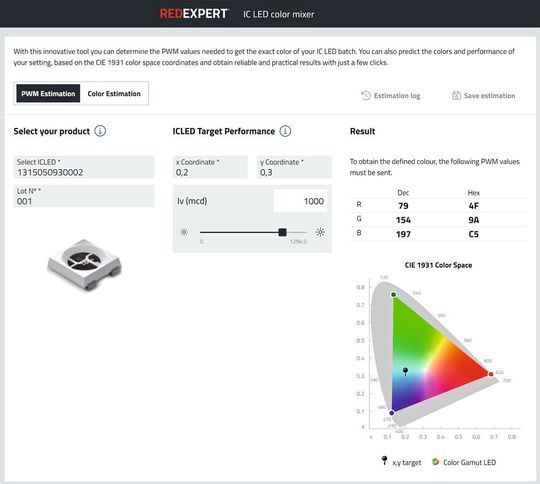
Image 3: The REDEXPERT ICLED Color Calculator outputs the PWM control values after entering the component, bin, and color.
(Image: Würth Elektronik)
The ICLED Color Calculator significantly expands the possibilities for lighting and signal solutions with ICLEDs. With this service, developers can, for the first time, easily determine the necessary programming specifications to represent a specific color value. On the intuitive user interface of the REDEXPERT ICLED Color Calculator (Figure 3), customers select the desired ICLED type as well as the color and brightness in the CIE1931 standard color system ("xy color space"). This automatically generates the appropriate digital value for the pulse-width modulation of the RGB LEDs integrated into the ICLED component, based on the characteristics of their bin. These values can be directly incorporated into the ICLEDs' programming. The generated color values for PWM control can also be exported to an Excel file. Additional export formats can be added based on customer requirements. A future version is expected to include an API for automated tool integration.
Currently, the tool provides PWM values with 8-bit depth, corresponding to 256 levels and thus meeting the common industry standard. However, the architecture is already designed to allow an extension to 12-bit, which is planned for version 2 of the tool.
The fact that the frequencies used by ICLEDs for PWM signals vary is irrelevant for the ICLED Color Calculator, as the tool ensures the reproducibility of a targeted color per batch. For example, the very common PLCC 4 version in the 5050 form factor operates at 4 kHz, while the PLCC 6 5050 Dual type operates at 20 kHz. Using the part and batch numbers, you can obtain the respective RGB values for control, which, for instance, produce the Würth Red, corresponding to the coordinate point x = 0.6408 and y = 0.33 in the CIE1931 color space.
Flexibility And Openness in Focus
When developers work with ICLEDs from Würth Elektronik, numerous possibilities are available. With controllers such as Arduino Uno, Adafruit Feather M0, Raspberry Pi, or ESP32, a wide range of platforms is offered for their projects. Würth Elektronik's provided Software Development Kit (SDK) supports quick software integration. A comprehensive set of tools can be found on the company's website, including platform-independent drivers and example applications. The latter are written in C and C++ and developed with Visual Studio to ensure seamless integration.
In case certain ICLEDs are not yet included in the Online Calculator, Würth Elektronik provides the raw data for the respective batch upon request via email. This approach promotes open and versatile data availability, independent of specific systems or applications. The goal is to offer developers maximum freedom and flexibility to effectively implement their projects.
Functions for Optimizing ICLED Developments
Currently, Würth Elektronik's tool focuses on the precise calculation of PWM values for color mixing in the CIE 1931 color space. Although gamma corrections are important for visually or color-critical applications, their integration into the tool is still in the evaluation phase. Developer feedback is appreciated to determine whether and how this feature should be added in the future.
Another planned feature is temperature compensation. The ICLED Color Calculator is currently based on measurements at 77 °F. Future updates aim to account for temperature drift, as it can affect color accuracy. For applications with high LED density, effective cooling—whether passive or active—is recommended to ensure a consistent thermal environment. This minimizes color drift and ensures stable, color-accurate results.
ICLEDs enrich the portfolio beyond conventional analog LEDs and specifically address a wide range of market requirements. Particularly in demanding applications in signal technology or for optical effects, they offer decisive advantages. Thanks to their high precision in control, which Würth Elektronik has enabled through accurate color reproduction, new fields of application are opening up, such as in adaptive lighting or color-coded signal applications. (heh)
Future-Proof Authentication with Universal RFID Readers



:quality(80)/p7i.vogel.de/wcms/45/2e/452ebe27b324cc535db2760946dfd15d/0131742792v1.jpeg "A major advantage of the new system is, on the one hand, the stability of the holder system and, on the other hand, the internal coolant supply directly to the working area. (Image:Horn/Sauermann)")
:quality(80)/p7i.vogel.de/wcms/d1/6c/d16c902c1311170a225c4e1b7db7bd4b/0132073916v1.jpeg "Now there is finally a saw with an XXL rotating table, so that ton-heavy plastic or fiber composite material panels can be cut gently and quickly. It is called FK-6, and it was built by IMA Schelling Precision. Read here what has been done ... (Image:IMA Schelling Precision)")
:quality(80)/p7i.vogel.de/wcms/50/9a/509a5a7e54f038aadfea20d1e98bf3e2/0113143253v1.jpeg "In our China Market Insider, we regularly provide you with relevant information directly from China. (Image:© Eisenhans - stock.adobe.com)")
:quality(80)/p7i.vogel.de/wcms/3f/32/3f3272843333b0e8215db84152362ba8/0132070616v1.jpeg "Linear guides combined with other components form complex systems for automation. (Image:IEF-Werner)")
:quality(80)/p7i.vogel.de/wcms/9d/b0/9db0180b9d22b66c04fe5dba7c288b0e/0131649599v1.jpeg "It may still take some time before this vision becomes reality. And whether workshop robots necessarily need human-like legs is also not certain. (Image: AI-generated)")
:quality(80)/p7i.vogel.de/wcms/e5/0d/e50d800573729eefbdcdcd6ee5211fb8/adobestock-1696648818--c2-a9-20alexander-20-e2-80-93-20stock-adobe-comv1.jpeg "At Limtronik, the use of AI is not based on an isolated innovation project but on a digital infrastructure that has been developed over years. (Source: © Alexander – stock.adobe.com)")
:quality(80)/p7i.vogel.de/wcms/14/dc/14dc9fff54875a06b98592536134e0e3/0131864932v1.jpeg "The complete IO-Link package makes the difference. When the interaction of sensors, powerful masters, and a manufacturer-independent configuration tool is seamless, significantly enhanced machine performance is possible. (Image:Baumer)")
:quality(80)/p7i.vogel.de/wcms/1c/78/1c78ac0aaadd921509594b8b9683853e/adar-one---electronics-480x270v1.jpeg "The world's first safety-certified 3D ultrasonic sensor, ADAR One, introduces a new safety layer for robotics, a certified 3D perceptual foundation that sits beneath any camera, AI stack, or motion system, independently verifying that the space around a robot is safe. (Image: Sonair)")
:quality(80)/p7i.vogel.de/wcms/04/eb/04ebee99febeb716da7782b9e42d78b8/0132051842v1.jpeg "The Basic Day Thermal Management is an essential part of the \"Power of Electronics\" conference and originally evolved from the \"Cooling Days.\" (Image: Stefan Bausewein)")
:quality(80)/p7i.vogel.de/wcms/19/27/1927ccde4c7d25ce6f4e274a06bfc06c/cover-20imagev1.jpeg "Additive manufacturing has established itself as a complementary alternative to traditional machining for automotive tools, offering greater speed and flexibility. (Source: Stratasys)")
:quality(80)/p7i.vogel.de/wcms/15/00/1500298944949437fde0e0ba332eaa3c/adobestock-1898612059v1.jpeg "(Source: Anusa - stock.adobe.com)")
:quality(80)/p7i.vogel.de/wcms/5f/59/5f59f681a45fb2359bb8c8c07d4adb55/siemens-pave360-automotive-01v1.jpeg "Virtual twins, AI-powered tests, and new validation concepts: vehicle development is becoming increasingly software-driven—and is thus gaining speed. (Image: Siemens)")
:quality(80)/p7i.vogel.de/wcms/b6/bb/b6bbb8b6cfc885e28518d42d31efaaa4/org-blobs-user-response-file-output-e3944719-21bc-489b-908d-2e20572fbcf0-file-1782765707127-jpgv1.jpeg "In China, several companies are working on sodium-ion batteries for heavy trucks. (Image: )")
:quality(80)/p7i.vogel.de/wcms/bd/28/bd28688c768b9a6ab0fbfe23bd355643/0132083515v1.jpeg "Europe's car manufacturers may soon have the Chinese competition right on their doorstep! This is because they are increasingly looking for factories in Europe to bypass new additional tariffs on hybrids. BYD will start manufacturing in Hungary this year and likely elsewhere too... (Image: BYD)")
:quality(80)/p7i.vogel.de/wcms/2a/7d/2a7d061766e1b35d02e969606076158e/0132082107v1.jpeg "By separating the drive board and application, the driverless vehicle U-Shift II becomes a versatile multi-talent for shuttle and logistics services. (Image: KIT)")
:quality(80)/p7i.vogel.de/wcms/55/e3/55e36b0fa8130f29e52a6a6030b2ff40/0132081018v1.jpeg "Maintenance before failure instead of repair afterward: Volkswagen is expanding its digital services for commercial vehicle fleets and focusing more on data-driven service processes. (Image: Connected cars)")
:quality(80)/p7i.vogel.de/wcms/52/07/52071244e4b5cc28a8834b26ae30eee6/0132094074v1.jpeg "Symbol image: Photonics. (Image: Dall-E / AI-generated)")
:quality(80)/p7i.vogel.de/wcms/78/66/7866a25d3734c5caed45c3ea0f516dff/0132071151v1.jpeg "Under the name \"Rollable Flex,\" Samsung Display has already presented prototypes of a rollable OLED display. (Image:Samsung Display)")
:quality(80)/p7i.vogel.de/wcms/d4/f9/d4f93e4bfa02c1e6e242d5d8318fbcf5/0132044846v1.jpeg "The South Korean chip manufacturers Samsung and SK Hynix are on the rise. But that is not enough for the country! South Korea's government now aims to invest billions to maintain its leading role in the long term ... (Image: Samsung Electronics)")
:quality(80)/p7i.vogel.de/wcms/fe/e1/fee174199114ed9d7825cc5d8c6da984/0132076430v1.jpeg "Can AI replace classical motor control? Burger Engineering and TH Nürnberg have investigated this. (Image: Burger Engineering / istockphoto.com)")
:fill(fff,0)/p7i.vogel.de/companies/69/de/69de1b7403b0d/simtos-logo.jpeg "simtos-logo (SIMTOS)")
:quality(80):fill(efefef,0)/p7i.vogel.de/wcms/67/ae/67ae0b9ac31f8/elatec-wp-universal-reader.png "Elatec WP Universal Reader")
:quality(80)/p7i.vogel.de/wcms/b4/81/b481676a2e67f89ddde4853ac1ceab2d/0126766600v1.jpeg "The Neo:LED display technology maximizes TFT-IPS technology and delivers OLED quality. (Image:LG Display)")
:quality(80)/p7i.vogel.de/wcms/55/4b/554b5dd34b07a0dd4a4e8c7094890c17/0126709475v1.jpeg "Modern signalling technology can be used to visualize fill levels in warehouses. For example, LED lights can indicate how high a stack of pallets is. (Image:Item Industrial Technology)")