All-in-one machines combine wire feeding from the coil, straightening and cutting, upsetting the head and rolling the thread in a single system and in a continuous process. Amba has now introduced a machine with wire diameters of up to 18 mm (0.7 inches) that integrates inductive heating.
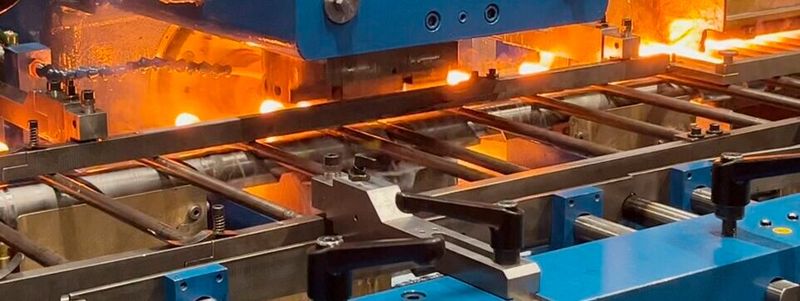
Screw head forming with heat: The heads of the blanks are heated to over 1,000 °C in the induction stage.
(Image: Aachen mechanical engineering)
For the first time, inductive heating is being used in the area of screw head forming, which Aachener Maschinenbau (Amba) is integrating into its machines. The first machine in the new series will produce fasteners between 160 and 1,500 millimetres long (~6 to 59 inches) with a diameter of up to 18 millimetres (~0.7 inches) directly from the wire. As very high forces have to be applied when forming the large-volume heads, Amba is switching from cold to hot forming for the first time and integrating a system for inductive heating.
This machine is used to produce square-headed bolts, which are used in the field of energy transmission and are produced in millions of units. This development has enabled a customer to replace two old machines connected in series. By avoiding the manual reloading and moving of parts, it was possible to increase productivity in production. A complete enclosure for the machine significantly reduces noise emissions and emulsion vapors can be extracted. At the same time, it forms the core of the safety concept so that the system can be operated in full compliance with CE regulations.
Hot Forming and Its Significance
In addition to mastering the actual forming process, hot forming required special design measures. The integration of several water circuits for cooling the upsetting heads and the thread roll is particularly noteworthy. Several air-water heat exchanger systems are used here, which actively cool and can be precisely controlled.
In addition, the oil and grease vapors that arise during the induction heating of the blanks must be extracted. This is the primary reason for enclosing the system once it has been installed at the customer's premises.
New Approach: Integrated Hot Forming
The new series of stud machines is designed to cold form wire with a diameter of up to 12 millimetres (~0.5 inches) as before and to hot form material up to 18 millimetres thick (~0.7 inches) . Even for experienced designers, the dimensions initially posed a challenge: The transition from 10 to 12 millimetres results (~0.4 to 0.5 inches) in forming forces that are around 40 percent higher than those of the predecessor model BM 10.
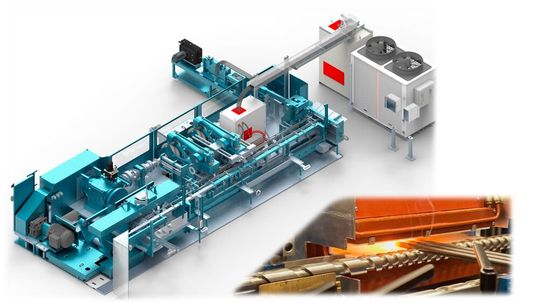
Amba BM 12 billet machine with an inductive unit for heating the products for hot forming.
(Image: Aachen mechanical engineering)
To get these forces under control, Amba integrated hot forming - a first in the company's history. This entailed a fundamental redevelopment of every single station: starting with the insertion of the wire with the WFS Wire Feeding System, the straightening and cutting of the blanks, the upsetting of the heads and the rolling of the thread. The forming tools also have to be cooled and other components protected from the intense heat radiation. The bearing shells of the transport spindles must also be cooled in order to minimize expansion effects due to the heat input via the blanks.
In order to ensure that the machine achieves the required performance, extensive numerical simulations of the forming behavior were carried out in advance, which were confirmed by real tests.
The Function of the System in Detail - From Wire to Bolt
The wire rod is brought from the coil to the target diameter in an unwinding system provided by the customer via a pre-drawing device, pre-straightened in a rotating wire straightening system, cut to length and deposited in the transport system.
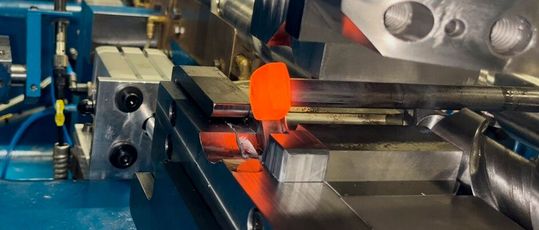
Deformed bolt head after upsetting and turning.
(Image: Aachen mechanical engineering)
Before the first upsetting stage, the ends of the blanks are heated from room temperature to over 1,000 degrees Celsius (~1,830 °F) over a distance of 450 millimetres (~17.7 inches) in around 13 seconds. An induction heating system has been integrated into the machine for this purpose. The temperature of the preheated area of each workpiece is checked inline by a pyrometer to ensure that the required minimum temperature has been reached before the next work step.
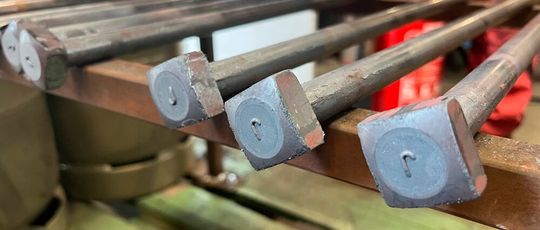
The screw head is formed in two stages. In the first forming unit, one end of the blank is formed into a pre-volume, in the second, the finished square head is produced. The upsetting heads work with a force of up to 100 tons.
A finished screw head after forming.
(Image: Aachen mechanical engineering)
The newly developed thread rolling station is designed for more than 400 millimetre long thread rolling tools (~15.8 inches) provided by the customer in accordance with industry standards. The Amba tool concept allows the synchronous rolling of the thread as well as the form rolling of a large chamfer at the bolt tip and is compatible with common standard dies, enabling integration without individual solutions. The finished billets leave the system via a chain conveyor.
Date: 08.12.2025
Naturally, we always handle your personal data responsibly. Any personal data we receive from you is processed in accordance with applicable data protection legislation. For detailed information please see our privacy policy.
Consent to the use of data for promotional purposes
I hereby consent to Vogel Communications Group GmbH & Co. KG, Max-Planck-Str. 7-9, 97082 Würzburg including any affiliated companies according to §§ 15 et seq. AktG (hereafter: Vogel Communications Group) using my e-mail address to send editorial newsletters. A list of all affiliated companies can be found here
Newsletter content may include all products and services of any companies mentioned above, including for example specialist journals and books, events and fairs as well as event-related products and services, print and digital media offers and services such as additional (editorial) newsletters, raffles, lead campaigns, market research both online and offline, specialist webportals and e-learning offers. In case my personal telephone number has also been collected, it may be used for offers of aforementioned products, for services of the companies mentioned above, and market research purposes.
Additionally, my consent also includes the processing of my email address and telephone number for data matching for marketing purposes with select advertising partners such as LinkedIn, Google, and Meta. For this, Vogel Communications Group may transmit said data in hashed form to the advertising partners who then use said data to determine whether I am also a member of the mentioned advertising partner portals. Vogel Communications Group uses this feature for the purposes of re-targeting (up-selling, cross-selling, and customer loyalty), generating so-called look-alike audiences for acquisition of new customers, and as basis for exclusion for on-going advertising campaigns. Further information can be found in section “data matching for marketing purposes”.
In case I access protected data on Internet portals of Vogel Communications Group including any affiliated companies according to §§ 15 et seq. AktG, I need to provide further data in order to register for the access to such content. In return for this free access to editorial content, my data may be used in accordance with this consent for the purposes stated here. This does not apply to data matching for marketing purposes.
Right of revocation
I understand that I can revoke my consent at will. My revocation does not change the lawfulness of data processing that was conducted based on my consent leading up to my revocation. One option to declare my revocation is to use the contact form found at https://contact.vogel.de. In case I no longer wish to receive certain newsletters, I have subscribed to, I can also click on the unsubscribe link included at the end of a newsletter. Further information regarding my right of revocation and the implementation of it as well as the consequences of my revocation can be found in the data protection declaration, section editorial newsletter.
Compact Drive with Plenty of Power
The new compact press drive is specially designed for the system. In addition to the required drive power at maximum production speed, the design parameters also include the highest possible working capacity with good adjustability in set-up mode. Despite a reduction in external dimensions of over 50 percent, the drive is significantly more powerful due to the high flywheel speeds and provides the machine with power reserves. In addition, the BM 12 has been equipped with a mechanical overload clutch integrated into the main shaft, which prevents damage to the drive unit in the event of an overload.
The system also features optional process monitoring and the option of remote maintenance. The process monitoring is part of a configuration that can be selected by the customer and detects trend behavior in the process. If there are signs of tool wear, for example, the machine is automatically stopped to prevent machine damage and avoid the production of rejects.
*Michael Köhlbach is Product Manager at Aachener Maschinenbau GmbH (Amba)



:quality(80)/p7i.vogel.de/wcms/a0/47/a04725ef9bd09fb6c9341a1bea1b5d93/0130443083v1.jpeg "Here, a type of plastic pallet is produced by thermoforming (vacuum forming or deep drawing) at the corresponding division of New England Plastics in the USA. This division, which specializes in so-called liners, is now part of Ringmetall ... (Image:New England Plastics)")
:quality(80)/p7i.vogel.de/wcms/23/99/23992bf2dcdc432c9b7209c34a4a7c48/0129733089v1.jpeg "Stork relies on the modular Neoswiss turning system from Iscar to shorten the set-up times for its sliding headstock lathes and work more productively. (Image:Iscar)")
:quality(80)/p7i.vogel.de/wcms/7d/e2/7de2923434b2f1a78ba5482d8d335269/0113143253v1.jpeg "In our China Market Insider we regularly provide you with relevant information directly from China. (Image:© Eisenhans - stock.adobe.com)")
:quality(80)/p7i.vogel.de/wcms/9d/2b/9d2b802f800e5caf17b2831e74228cd3/screenshot-202026-03-03-20103822-609x343v1v1.png "Visual comparison: on the left, a clean, burr-free cut edge; on the right, typical burr formation with oxidation discoloration. This illustrates how strongly parameter control and gas management influence the quality of the result. (CO₂ laser, oxygen cutting gas, sheet thickness approx. 15 mm). (Image:Picture: Rime)")
:quality(80)/p7i.vogel.de/wcms/b7/36/b736dfebc16c42d6901d0d0e1f390493/3d-druck-20factory-20--20ki-20generiert-1920x1079v1.png "(Source: AI-generated)")
:quality(80)/p7i.vogel.de/wcms/79/b2/79b21aad663f4a7bd4472afc1c1afc62/0130433994v1.jpeg "Mission Joyride: The free-flying robot (shown here in the rendering) will relieve the ISS crew of logistics tasks from 2027 with its two mechanical arms. (Image:Icarus Robotics)")
:quality(80)/p7i.vogel.de/wcms/6b/45/6b4546fa6ebf305c3660326909363f32/0130437089v1.jpeg "Industrial AI in action: Rockwell Automation presents practical solutions for self-controlling production systems at the Hannover Messe. (Image:Rainer Jensen, Deutsche Messe)")
:quality(80)/p7i.vogel.de/wcms/78/e9/78e9188c25a8a94e67c34c9bf8ffe495/visual-agile-20robots-20and-20google-20deepmind-20partner-20to-20bring-20intelligence-20to-20robotics-2500x1406v1v1.jpeg "Together, the partners are developing adaptable, intelligent robots for a wide range of applications (Image:Agile Robots SE)")
:quality(80)/p7i.vogel.de/wcms/59/a2/59a2b11f0aa1b700eff02addd5de8703/adobestock-1788280853--c2-a9-20satria-20-e2-80-93-20stock-adobe-com-5081x2860v1v1.jpeg "Quantum computers require extreme cooling to temperatures close to absolute zero in order to keep qubits stable. (Image:satria - stock.adobe.com)")
:quality(80)/p7i.vogel.de/wcms/49/38/493876a248943456b7e4a6db6edfc454/0130230765v1.jpeg "Safe and reliable in aircraft construction: light-curing adhesive bond combined with universal fastening elements. (Source: Delo)")
:quality(80)/p7i.vogel.de/wcms/b5/c7/b5c749d16c8a2e789c1469c2c8c1c387/0130452780v1.jpeg "Volvo Trucks completes road tests with its new hydrogen-powered trucks. (Image:Volvo Trucks)")
:quality(80)/p7i.vogel.de/wcms/ba/69/ba6975f417a85147084f38dc2cd209e2/0130451386v1.jpeg "Together with Nvidia, Hyundai wants to develop an architecture that will be used for level 4 robotaxis (image) as well as for level 2 customer vehicles. (Image:Hyundai)")
:quality(80)/p7i.vogel.de/wcms/93/4d/934de334b47abaa526c78cba1417d7af/0130343495v1.jpeg "The new SU7 is available in three price categories, \"Standard\", \"Pro\" and \"Max\" (Image:Xiaomi)")
:quality(80)/p7i.vogel.de/wcms/df/a0/dfa048434bb94f1b7d030e346b25b3ae/0130373541v1.jpeg "From August, BMW will be producing the i3 at its main plant in Munich - which the car manufacturer has extensively rebuilt for this purpose. (Image:Rainer Haeckl)")
:quality(80)/p7i.vogel.de/wcms/ee/09/ee09acbd6dc896df25affaa9e871e6e5/0130440053v1.jpeg "IMS chip module for simple system integration into an ion mobility spectrometer. (Image:Fraunhofer IPMS)")
:quality(80)/p7i.vogel.de/wcms/10/6c/106cd22de5f68a0f74639d654827228c/0130345302v1.jpeg "Made in India: According to the India Electronics and Semiconductor Association (IESA), the country should be able to produce between 75 and 80 million chips by the beginning of 2027, once the plants currently under construction become operational. (Image:Pixabay (Montage: Sebastian Gerstl))")
:quality(80)/p7i.vogel.de/wcms/a5/ed/a5ed6fda029d362732a293d6b19d74c4/0130444216v1.jpeg "Thirteen executives from the Chinese chip industry have drawn up a plan to achieve an 80% self-sufficiency rate for semiconductors by 2030. (Image:Maxim_Kazmin - stock.adobe.com)")
:quality(80)/p7i.vogel.de/wcms/31/a6/31a646018b34d8e0a44bfc8bf17837f6/0130361632v1.jpeg "For many companies, PFAS are considered indispensable in electronics production. (Image:freely licensed)")
:fill(fff,0)/images.vogel.de/vogelonline/companyimg/76800/76895/65.jpg "FAULHABER_120mm.jpg ()")
:fill(fff,0)/p7i.vogel.de/companies/69/88/69882c428938e/tmts2026-ticec-banner-en-2000px.png "tmts2026-ticec-banner-en-2000px (https://www.tmts.tw/en)")
:quality(80)/p7i.vogel.de/wcms/f6/4f/f64f33261d5838e1a4ca2e6fe3c3992a/0127265106v1.jpeg "The system allows rings with a diameter of up to 79 inches and a height of up to 16 inches to be rolled. (Image:Andritz Schuler)")
:quality(80)/p7i.vogel.de/wcms/3d/be/3dbe9894ebc1d78bba79212ee492af23/0128343810v1.jpeg "Premium steel with a sustainability effect! Wambandwerk 2 of Thyssenkrupp Steel Europe has now reached a record level of 250 million tons of hot-rolled steel. Read more here ... (Image:Thyssenkrupp Steel Europe)")