The semiconductor industry never stands still. High-NA EUV, the latest generation of advanced lithography featuring critical components from Germany, is now at the heart of a geopolitical debate.
No more cliffhangers: High-NA systems like ASML's EXE:5000 - shown here during assembly - are the key to producing the next generation of microprocessors and memory chips.
(Image: ASML)
Anna Kobylinska and Filipe Pereira Martins work for McKinley Denali, Inc., USA.
Lithography—printing tiny patterns on silicon with light—is a fundamental step in the mass production of microchips and a central point in the global race for the most powerful processors for AI.
Lithography systems project circuit patterns for chips onto silicon wafers. The higher their precision—the sharper the edges and the smaller the deviations—the finer and more complex chip architectures can be mapped on the wafers, and the denser the circuits can be packed.
The EUV lithography (Extreme Ultraviolet Lithography), the predominant method of the modern semiconductor industry, utilizes ultraviolet light with an extremely short wavelength. High-NA EUV lithography (High Numerical Aperture Extreme Ultraviolet) takes it a step further: It reduces the critical dimension (short: CD for Critical Dimension in the Rayleigh criterion equation), meaning the smallest printable structure size, from 13.5 nm to 8 nm. This metric is a function of the wavelength of the light (λ), the numerical aperture (NA) of the optics, and the k1 factor, which in turn depends on a number of process-related parameters.
The numerical aperture is a measure of an optical system's ability to collect and focus light. It ultimately determines the resolution.
High-NA EUV lithography operates with a numerical aperture (NA) of 0.55 instead of 0.33 as in the case of conventional EUV systems. This results in an almost 70 percent increase in imaging performance, as the resolution in lithography is roughly proportional to the NA. This reduction is primarily based on a more complex mirror system that allows for a larger angle of incidence of the EUV light, thus achieving higher imaging accuracy.
In practice, this opens up new possibilities for accommodating more transistors and thus more computing power per chip. At the same time, however, the demands on the cleanroom environment, the precision of the mechanical components, and the accuracy of the masks increase, as even the smallest distortions or contaminations can have an immediate impact on the imaging quality.
With High-NA EUV lithography, chip manufacturers can print transistors that are nearly 1.7 times smaller and have a packing density 2.9 times higher than is possible with pure EUV lithography. In practice, however, the actual scaling potential also depends on other factors, including process optimizations, the availability of suitable mask technologies, and the properties of the photoresists used.
The improved precision allows for higher yields in manufacturing and lower energy consumption of the resulting semiconductors – a double win for the foundry. No wonder the market for lithography is highly competitive. Cutthroat competition is currently the order of the day.
Only with High-NA EUV lithography do process nodes of the Ångström era become possible— and significant performance enhancements, primarily for artificial intelligence and high-performance computing applications.
Angst and fear
There is widespread "ångst" and concern in the economy about the supply of AI chips. Companies fear for their innovation capabilities, the development of energy costs for operating large AI models, and long-term supply security, not least in light of the planned revision of the Supply Chain Act. Governments worry about national security, consumers about a looming price spiral, delivery delays, and bottlenecks.
There are chip architectures for AI like sand on the beach, but relevant manufacturers can be counted on one hand. For the supply of High-NA EUV systems, all chip manufacturers have only one single source available: ASML, a global leading manufacturer of lithography systems from Veldhoven, Netherlands (Brainport Eindhoven region).
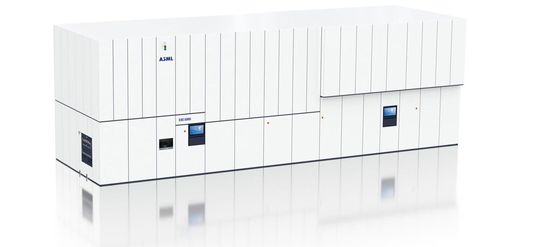
"The ultimate wisdom"? The TWINSCAN EXE:5000, the first EUV lithography system of the High-NA class with a numerical aperture (NA) of 0.55 and a resolution of 8 nm, masters process nodes at 2 nm (factor 4x). The EXE platform system can print features with a single exposure that are 1.7 times smaller than what is possible with the TWINSCAN systems of the NXE generation—and achieve a 2.9 times higher transistor density.
(Image: ASML)
The very first delivery of a High-NA EUV system, the TWINSCAN EXE:5000 from ASML, has been secured by Intel's Foundry Services division for their D1X test facility in the state of Oregon, USA; the system is currently undergoing final calibration. As a long-standing strategic partner of ASML, Intel was able to exercise preferential rights.
The transport from ASML's headquarters in the Netherlands to Intel's Gordon Wharf Park in Oregon required more than 250 transport crates, which were loaded onto multiple cargo planes as well as 20 semi-trailer trucks, distributed across 43 freight containers. That's how massive the system is.
Date: 08.12.2025
Naturally, we always handle your personal data responsibly. Any personal data we receive from you is processed in accordance with applicable data protection legislation. For detailed information please see our privacy policy.
Consent to the use of data for promotional purposes
I hereby consent to Vogel Communications Group GmbH & Co. KG, Max-Planck-Str. 7-9, 97082 Würzburg including any affiliated companies according to §§ 15 et seq. AktG (hereafter: Vogel Communications Group) using my e-mail address to send editorial newsletters. A list of all affiliated companies can be found here
Newsletter content may include all products and services of any companies mentioned above, including for example specialist journals and books, events and fairs as well as event-related products and services, print and digital media offers and services such as additional (editorial) newsletters, raffles, lead campaigns, market research both online and offline, specialist webportals and e-learning offers. In case my personal telephone number has also been collected, it may be used for offers of aforementioned products, for services of the companies mentioned above, and market research purposes.
Additionally, my consent also includes the processing of my email address and telephone number for data matching for marketing purposes with select advertising partners such as LinkedIn, Google, and Meta. For this, Vogel Communications Group may transmit said data in hashed form to the advertising partners who then use said data to determine whether I am also a member of the mentioned advertising partner portals. Vogel Communications Group uses this feature for the purposes of re-targeting (up-selling, cross-selling, and customer loyalty), generating so-called look-alike audiences for acquisition of new customers, and as basis for exclusion for on-going advertising campaigns. Further information can be found in section “data matching for marketing purposes”.
In case I access protected data on Internet portals of Vogel Communications Group including any affiliated companies according to §§ 15 et seq. AktG, I need to provide further data in order to register for the access to such content. In return for this free access to editorial content, my data may be used in accordance with this consent for the purposes stated here. This does not apply to data matching for marketing purposes.
Right of revocation
I understand that I can revoke my consent at will. My revocation does not change the lawfulness of data processing that was conducted based on my consent leading up to my revocation. One option to declare my revocation is to use the contact form found at https://contact.vogel.de. In case I no longer wish to receive certain newsletters, I have subscribed to, I can also click on the unsubscribe link included at the end of a newsletter. Further information regarding my right of revocation and the implementation of it as well as the consequences of my revocation can be found in the data protection declaration, section editorial newsletter.
The market-leading foundry TSMC (global market share: 61.7 percent) is unlikely to have got involved until a few months later, but has neither confirmed nor denied this so far. Whether, like Intel, it also involves ASML's TWINSCAN EXE:5000 or a later version such as the EXE:5200 is also unclear. Due to the higher quantities, TSMC would actually need an "enhanced" version of the scanner to achieve the intended production volume.
According to current knowledge, TSMC has fueled official plans for the intended use of High-NA EUV lithography in a future process generation, with it generally being assumed that this can happen at the earliest from the 2-nm node ("N2") or a subsequent development ("in the course of the second half" of the current decade, mind you). TSMC has not yet released more precise details on the exact schedule and process name.
Since High-NA relies on a significantly higher numerical aperture in EUV, semiconductor manufacturing with such scanners is exceedingly complex and involves substantial investment and development effort. Accordingly, TSMC remains cautious in its communication, emphasizing that such transitions to new lithography generations must be precisely prepared before being implemented in mass production.
Samsung has also expressed immediate interest in the technology. With good reason: TSMC is said to have refused to manufacture for Samsung—either out of concern over possible consequences of a knowledge transfer to the emerging rival or for other unspecified reasons. Samsung, the global number two in contract manufacturing, has a respectable global market share of at least 11 percent. In comparison: The latest addition to the capital-intensive semiconductor manufacturing, Intel Foundry Services, can account for just two percent of global sales.
However, Intel has already developed a technological lead. The company is working intensively on the introduction of High-NA EUV lithography in its own 14A process.
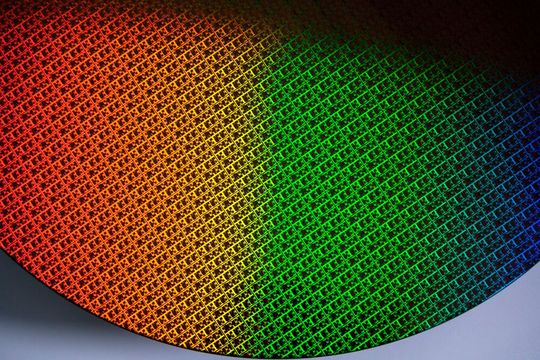
A complete package: An Intel 18A wafer still originates from ASML's NXE platform in conventional EUV lithography. The EXE platform for High-NA EUV is expected to begin mass production from 2025–2026 and drive geometric scaling into the next decade. The focus is on upcoming advanced process nodes, starting with the 2-nm logic node and subsequently memory nodes with comparable density.
(Image: Intel Foundry)
Chips of Intel's Clearwater Forest series are already in production on the 18A node and are to be transitioned to the 14A node as quickly as possible. According to current knowledge, behind the mysterious codename, Clearwater Forest, are Intel's data center processors in the "E-Core" architecture (Efficiency Cores) for large-scale data processing, artificial intelligence, and machine learning, i.e., server and cloud workloads. According to Intel, this processor architecture is intended to combine high computational density with reduced energy consumption.
Intel has also signed a contract with Microsoft for the manufacturing of custom chips (keyword: Custom Silicon) on the 14A node. The chips are intended to run AI-accelerated workloads on Microsoft Azure and provide cryptographic security.
By the year 2030, Intel wanted to catch up to TSMC as the second-largest foundry in the world, with subsidies from the Chips Act initiatives on both sides of the Atlantic. After disappointing quarterly results in the middle of last year, Intel decided to postpone the planned investments in new chip factories for the two-nanometer node in Germany and Poland by about two years—apparently, they had "ångst" of their own audacity.
In semiconductor manufacturing, the latest lithography systems are referred to as "scanners" because the process is not merely a single exposure or "imaging." Instead, the image of the structures—which are on a mask called a reticle—is scanned through a narrow slit of light and projected onto the wafer in synchronous motion.
In older "stepper" systems, the mask was exposed to different areas of the wafer surface step-by-step without this continuous scanning process. In contrast, current High-NA EUV scanners combine highly precise motion controls for the reticle and wafer stage with an extremely focused EUV light beam to scan the exposure area row by row. In this way, better focus and illumination can be achieved across the entire wafer surface, which plays a crucial role in particularly narrow structure widths and high reproducibility of the chips. The word "scanner" thus refers to the controlled, continuous movement process used to transfer the mask information onto the silicon.
A High-NA EUV scanner uses highly precise projection optics and powerful laser beams internally to project circuit patterns onto silicon wafers in previously unattainable resolution. This technical heavyweight, as large as a double-decker bus and with a total weight comparable to that of a blue whale, can expose finer structures and accommodate more transistors per area thanks to the higher numerical aperture than ever was possible before. However, this is associated with highly complex mechanics, which, in conjunction with extremely demanding cleanroom conditions, require the precise interaction of mirrors, lenses, and laser beams.
The TWINSCAN EXE:5000 from ASML marks a significant milestone in modern semiconductor manufacturing; High-NA EUV lithography moves the entire industry a big step forward.
(Image: Intel)
The massive installation occupies a total of three floors in the production hall. The laser is powerful enough to cut through steel. A beam delivery system directs the high-energy pulses to the machine, where they hit tiny tin droplets, only a third of the width of an average human hair. At a frequency of 50,000 laser pulses per second, the tin transforms into hot plasma that emits light in the extreme ultraviolet range. A collector mirror gathers this EUV light and directs it to a scanner, where it is deflected by especially precise mirrors and shaped into a narrow slit.
The crucial component for the improved resolution is the projection optics. The higher NA necessitated the use of larger mirrors.
The company Carl Zeiss SMT from Oberkochen supplies the high-precision optical modules. For the High-NA technology, these modules use extremely flat mirrors whose deviation from the ideal shape is hardly measurable even at the atomic level. Without these precise mirrors, the higher numerical aperture (NA), which is the heart of the new scanners, could not be realized.
The thickness variation of the largest mirror surface, if it were stretched over an area the size of the entire Earth, would still be thinner than a playing card, as Steve Carson of Intel has calculated.
Steve Carson, Tech Lead for EUV scanners in the Foundry Technology Development department at Intel, is a big fan of Zeiss optics from Germany.
(Image: Intel)
Another challenge was that the larger mirrors also increase the angle at which the light hits the reticles that contain the pattern for printing. At this larger angle, the reticle loses its reflective properties, preventing the pattern from being transferred to the wafer. This problem could have been solved by an 8-fold reduction of the pattern instead of the 4-fold reduction in the NXE systems, but that would have forced semiconductor manufacturers to switch to larger reticles.
Instead, the EXE system uses a groundbreaking solution: anamorphic optics. Instead of uniformly reducing the pattern to be printed, the mirrors scale the pattern by a factor of four in one direction and by a factor of eight in the other direction. This solution reduces the angle at which the light hits the reticle and prevents the reflection problem. More importantly, it also minimizes the impact of the new technology on the semiconductor ecosystem by allowing semiconductor manufacturers to continue using traditionally sized reticles—a win all along the line.
German companies also supply critical system components for the laser source. For example, the electronics division of Trumpf (based in Freiburg and Zielonka near Warsaw) is involved in the development of high-power CO₂ lasers that excite the tin plasma to generate EUV light. These lasers must have an enormously high pulse frequency and energy efficiency to withstand continuous operation in a large-scale production process. The impacting laser pulses reach temperatures of nearly 220,000 °C (396,032°F)in the plasma, forty times the temperature assumed for the sun's surface.
The innovative strength of German suppliers also extends to areas such as high-precision drive technology, metrological systems for the exact alignment of wafer and reticle, and various special materials used both in the mirrors and in mechanical components.
Overall, the scanners require over a thousand mechanical connections. Thus, Germany contributes essential elements that make High-NA EUV functional and market-ready. Thanks to the reduced number of process steps in high-volume manufacturing, semiconductor manufacturers benefit from a significant decrease in potential defects, lower production costs, and shorter cycle times.
Tension field lithography
The latest US regulations for the export of AI chips, which will come into effect in the next 120 days, divide the world into three categories: 18 designated "partner countries," "enemy countries," and the "rest of the world." Partner countries, including Germany, France, and Italy, can purchase the latest AI chips without restrictions. For "enemy countries" (this classification was given to Russia, North Korea, and China), there is a ban on importing AI chips. Countries in the "rest of the world" category have restricted access.
The regulation essentially stipulates for the "rest of the world" category that certain high-performance processors and accelerators, which were previously freely traded, may now only be exported from the USA with a special license. For this, the US authorities review each individual case to determine whether the requested chips—based on their computing performance, memory bandwidth, number of tensor or GPU cores, or other parameters—fall into the high-performance AI category. If a chip or a complete system exceeds certain thresholds, there is a general presumption of denial, unless the exporter can provide compelling reasons for an exception.
Typically, these thresholds are based on the chips' ability to perform highly complex AI computations, such as in training large language or image models. The risk of potential military or security-related use also plays a role in the individual case assessment. In practice, this means that for most "remaining" countries, they might have to resort to less powerful alternatives or customized performance-limited versions of the processors.
Access to the latest lithography technology has been strictly limited in China for some time. ASML, the world's leading manufacturer of EUV lithography scanners, has not delivered any EUV systems to Chinese customers since 2019. This is partly due to export controls imposed by the Dutch government itself in the form of licensing procedures (for semiconductors in the 7-nanometer range and below). Instead, only less powerful DUV systems (Deep Ultraviolet) are allowed to be sold to customers in the affected countries. These systems operate with a wavelength of 193 nm (instead of 13.5 for EUV) and achieve a critical dimension of just 30 nm.
Contract manufacturers in the People's Republic of China have to work with older lithography machines, which somewhat limits their competitiveness compared to Western and Taiwanese companies and strains diplomatic relations. The highly complex political dimension casts its shadow over volatile trade relations on the entire global economy.
Conclusion
High-NA EUV lithography will significantly shape the entire semiconductor industry in the coming years. With a numerical aperture of 0.55 compared to the previous 0.33 in standard EUV, significantly finer structure sizes are within reach, enabling more transistors per area in the long term and thus higher chip densities, continuing Moore's Law.
However, the implementation of High-NA technology requires significant investments and even more demanding production conditions, including high-precision mirrors, complex vacuum and stage systems, and special photoresists. The supply chain will thus be more closely coordinated, and suppliers contributing key components will gain further importance.
German companies play a central role in the development and production of High-NA EUV lithography systems. Crucial key components are manufactured in Germany. (mbf)



:quality(80)/p7i.vogel.de/wcms/c3/6f/c36f031df46d22615d941d077d32313c/0129800025v1.jpeg "The laser-assisted process is intended to make wafer cutting significantly more productive. (Image:Trumpf)")
:quality(80)/p7i.vogel.de/wcms/ef/1e/ef1e248f58a3697ec1384f6849762d5a/0129842086v1.jpeg "Bodo will soon be hitting it off smart! Signing the memorandum of understanding in Las Vegas: Steffen Haack, Member of the Board of Bosch Rexroth, and Yoshimoto Matsuda, Managing Director of Precision Machinery & Robot Company, Kawasaki Heavy Industries. Here's what it's all about ... (Image:Bosch Rexroth)")
:quality(80)/p7i.vogel.de/wcms/40/b3/40b38efc9eae25e69d644512a2dc4b7c/0129806862v1.jpeg "This is one of the new MDA power clamping nuts from Jakob Antriebstechnik from various angles. It is described as particularly durable and powerful. Here are a few specific data ... (Image:Jakob Drive Technology)")
:quality(80)/p7i.vogel.de/wcms/f5/61/f561ad7c72ed41fd7a67ad9c481cb15d/0129799343v1.jpeg "Engine-generator units (MGU) from Steyr Motors are at work in the Leopard 2 main battle tank and the Leguan bridge vehicle (pictured). An extended contract is now to secure at least 500 more systems of this type for the Bundeswehr ... (Image:German Armed Forces)")
:quality(80)/p7i.vogel.de/wcms/9c/ac/9cac6246660e746c5a3989399ac4d250/0128561645v1.jpeg "Artificial intelligence can drive efficiency in smart factories through centralized data management and predictive maintenance. (Picture: ©Fardived - stock.adobe.com)")
:quality(80)/p7i.vogel.de/wcms/6b/e2/6be235b5ad8a442ccd9d164b0b300d8b/0129763992v1.jpeg "As early as 2020, the Zimmer Group announced that it would convert its production to be sustainably CO2-neutral. (Image:Zimmer Group)")
:quality(80)/p7i.vogel.de/wcms/d4/ba/d4bab9481e66f8570f40eb8ef2a90198/0129795613v1.jpeg "A camera inspection during removal ensures that the components are placed correctly in the KLTs. (Image:Yaskawa Europe)")
:quality(80)/p7i.vogel.de/wcms/cb/56/cb56e42b01638b618e8d1b9b38f32faa/0129810132v1.jpeg "From summer 2026, \"AEON\" will support people at the BMW plant in Leipzig. (Image:diephotodesigner.de/BMW)")
:quality(80)/p7i.vogel.de/wcms/76/81/7681b6450512b2cce1e453cd3d732543/0129479309v1.jpeg "Symbolic image: Model-based design combines virtual system models with real machines and systems in order to simulate, validate and coordinate functions, control and software early on in the development process. (Image:Dall-E / AI-generated)")
:quality(80)/p7i.vogel.de/wcms/5c/0f/5c0fee074c4b6c8e8c0993f3217c2f5a/0129773718v1.jpeg "The General Fusion demonstration reactor. (Image:General Fusion)")
:quality(80)/p7i.vogel.de/wcms/b5/5e/b55ed9355e0395ec0caf111d6af6b494/adobestock-495980372--c2-a9-20natali-mis-20-e2-80-93-20stock-adobe-com-6720x3778v1v1.jpeg "Which engineering skills will be in vogue in 2026? (Image:natali_mis - stock.adobe.com)")
:quality(80)/p7i.vogel.de/wcms/bf/a5/bfa5d882e93f159ce93e933742272b00/nord-vibn-cmyk-2196x1235v1v1.jpeg "With digital twins for virtual commissioning, Nord supports customers in ensuring that systems are available more quickly, even with complex drive systems. (Image:Nord Drivesystems)")
:quality(80)/p7i.vogel.de/wcms/2c/7d/2c7dd82cd4ab194a509126bc75b34fcd/0129849981v1.jpeg "From March 10 to 12, 2026, everything in Nuremberg will once again revolve around embedded systems when Embedded World opens its doors. (Image:NürnbergMesse | Thomas Geiger)")
:quality(80)/p7i.vogel.de/wcms/29/3a/293a6a8483f59bc2fa65a7e1a4d9a703/0129822140v1.jpeg "The Fraunhofer IDMT, Mercedes-Benz and Burmester have developed the 3D audio technology \"Audiofields\". (Image:Thomas Günnel - Automotive Industry)")
:quality(80)/p7i.vogel.de/wcms/cb/23/cb23acd8e9de969d52522692b62b1892/0129680605v1.jpeg "The Z22198 is an extremely compact, three-axis IEPE acceleration sensor for measuring oscillations (vibrations) and shocks in demanding applications. With an edge length of just 0.24 inches and a weight of 0.03 ounces, it is ideal for lightweight structures and confined spaces. (Image:Copyright 2020 ScROGERS,All Rights Reserved)")
:quality(80)/p7i.vogel.de/wcms/c4/40/c44043c61f9dd99b80ccca398c284018/0129795093v1.jpeg "Subaru manufactures the E-Outback at its Yajima plant, marking the first time it has produced an electric vehicle in-house. (Image:Subaru)")
:quality(80)/p7i.vogel.de/wcms/84/cc/84cc506003388ecffaab464677c7afa6/0129843694v1.jpeg "Launched last year, ASML's TWINSCAN XT:260 is an i-line scanner with a throughput of 270 wafers per hour. With a focus on the increased demands of AI chips, ASML wants to shift its focus away from pure front-end tools for chip production in the next ten to fifteen years with packaging and bonding technologies. (Image:ASML)")
:quality(80)/p7i.vogel.de/wcms/8f/48/8f48b0ed0d6c5c4f299b1310a7b577e9/0129830738v1.jpeg "Data centers in orbit are indeed dreams of the future, while data centers under water are already being tested. (Image:Dall-E / AI-generated)")
:quality(80)/p7i.vogel.de/wcms/36/ec/36ec46b311c3fb2cf9759ba4843047c5/0129831604v1.jpeg "Keysight and Ericsson enable validation of pre-6G interoperability with real network infrastructure and devices. (Image:Keysight)")
:quality(80)/p7i.vogel.de/wcms/c5/7a/c57ab05221defbbcaf6bddc346d21464/0129752421v1.jpeg "(Image:concept electronic GmbH)")
:fill(fff,0)/images.vogel.de/vogelonline/companyimg/76800/76895/65.jpg "FAULHABER_120mm.jpg ()")
:fill(fff,0)/p7i.vogel.de/companies/67/eb/67eba621ef6ea/logo2.png "logo2 (Wuxi InfiMotion)")
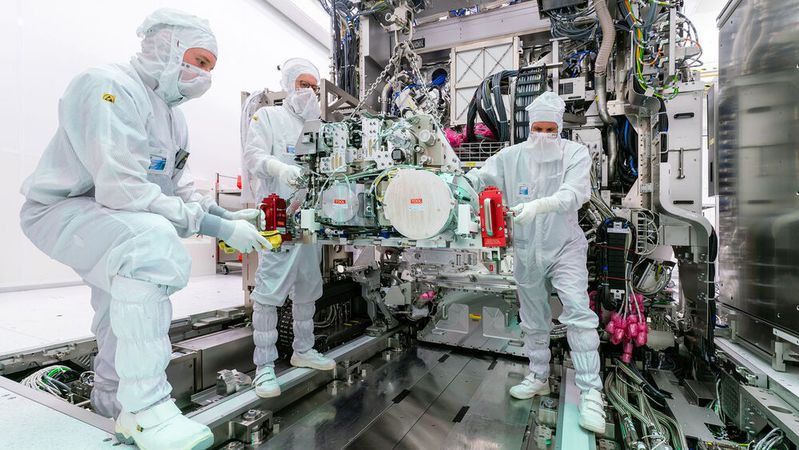
:quality(80)/p7i.vogel.de/wcms/55/59/555975db6415008bc6e340020bcc8164/0121554835v1.jpeg "It takes weeks, sometimes even months, for a Twinscan EXE:5000 system from ASML to be installed. (Image:ASML)")
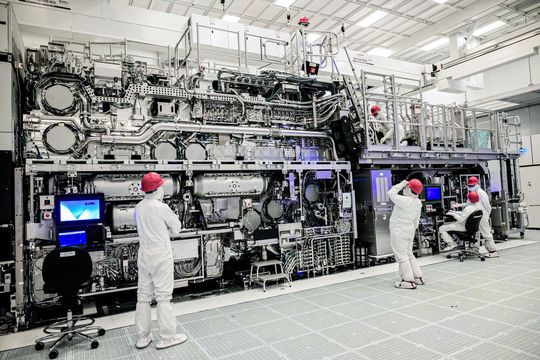

:quality(80)/p7i.vogel.de/wcms/59/84/598495514bdbefa9e315f5f4ab1628f3/0123619958v1.jpeg "Twinscan EXE:5000 is ASML's most advanced lithography machine, utilizing High-NA EUVL (High Numerical Aperture Extreme Ultraviolet Lithography) (Image:ASML)")
:quality(80)/p7i.vogel.de/wcms/40/93/40938cbdf42e6397877cc725d53532e8/0125755484v1.jpeg "The new generation of the EXE series, model 5200, promises a 60 percent productivity boost compared to the EXE:5000, according to ASML's CEO Christophe Fouquet. (Image:ASML)")