The Austrian company Sigmatek produces its modular electronic components at its headquarters near Salzburg. By switching intralogistics to a driverless transport system with application-specific autonomous transport vehicles (AGVs) developed by Melkus Mechatronik, Sigmatek was able to further increase the level of automation.
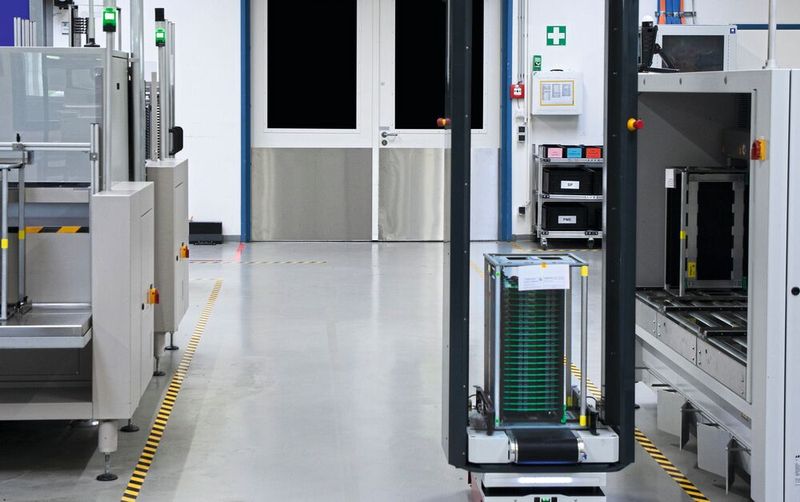
At the automation system manufacturer Sigmatek, autonomous transport vehicles (AGVs) of the type Melkus Rack Stacker BLS4060 supply the automatic production lines for electronic assemblies, transport finished circuit boards, and thus relieve their human colleagues. They named them "Sisi and Franz."
(Image: Sigmatek)
The digitalization and automation of production are prerequisites for the competitiveness of manufacturing companies in globalized markets. At the same time, they significantly contribute to the availability of affordable products for consumers.
Future-Oriented Automation Systems
The owner-managed family business Sigmatek, based in Lamprechtshausen near Salzburg (Austria), covers the entire spectrum of industrial automation as a full-service provider of process, motion, and safety controls, as well as drives and visualization systems. Just like the object-oriented engineering and real-time software Lasal, the company develops and produces the entire range of industrial-grade electronic products in-house, with the exception of motors.
This, and thanks to our flexibility as a medium-sized company, allows us to successfully compete in a market with significantly larger competitors. In line with our business purpose and given the high location costs, we aim for a high degree of automation in our production.
Alexander Melkus, Managing Director of Sigmatek
Intralogistics Ties Up Workforce
For a long time, intralogistics—the in-house material supply to workstations and machines as well as the transport of processed materials—was considered economically unfeasible to automate. Production employees had to carry out these tasks themselves, interrupting their primary work. "This was not only an inadequate occupation for our qualified personnel, who are already hard to find," says Gerald Haas, Vice President Operations at Sigmatek GmbH & Co KG. "When these specialists spend valuable time on unproductive side tasks such as internal material transport, it also represents a significant limitation to productivity."
Long Paths on Two Levels
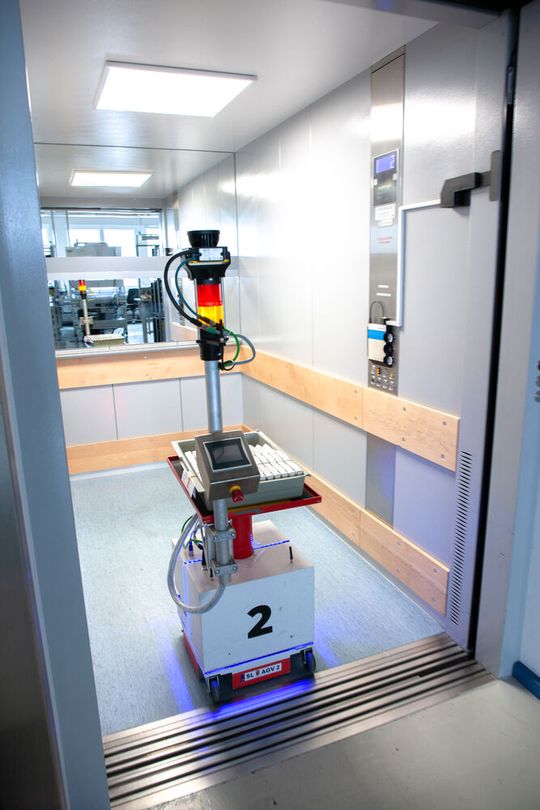
This led to the desire for a main-time parallel, automated transport system using autonomous guided vehicles. As a first step, the transport of fully assembled control system modules from the assembly cells to the finished goods warehouse or, if needed, to a quality assurance workstation was to be automated. The transport routes can span around 328 feet. Additionally, the nine stations in total are spread across two floors. Therefore, the vehicles need to use an elevator to switch floors.
Main-Time Parallel Transport
To alleviate the workload of the existing team, Sigmatek launched a pilot project with an autonomous guided vehicle (AGV) system featuring two vehicles for transporting Euroboxes in the assembly area. Melkus Mechatronic emerged as the winner from the evaluation of various AGV manufacturers. The selection criteria included not only the expected high service quality due to geographic proximity. In addition to the manufacturer's many years of experience, Sigmatek was impressed by the compact, agile vehicles of the Melkus Q40 type. The AGVs, measuring just 16 × 16 inches, do not require installed navigation points thanks to the SLAM navigation (Simultaneous Localization and Mapping) developed by Sigmatek.
On the approximately 328 feet-long transport routes, the autonomous transport vehicles need to change floors using an elevator. The specially developed device for automated button selection enables the Melkus Q40 to switch floors.
(Image: Sigmatek)
They can rotate on the spot—even under a fixed load—and operate in extremely confined spaces. Additionally, they can be pushed aside effortlessly, ensuring that the aisle they travel in retains its function as an escape route. Using a mechatronic unit developed in-house by Sigmatek, the floor selection of the freight elevators was automated without interfering with the elevator's own control system. This enables the AGV system to autonomously operate the elevator. Travel orders are issued via control terminals at the transfer stations. Even this first automation step has led to a significant productivity gain. The autonomous transport system completes more than 50 trips per day.
This frees up our production employees for their core tasks and helps them maintain focus. Thus, several person-hours daily can flow directly into production.
Gerald Haas, Vice President Operations, Sigmatek
Specifically for Electronics Manufacturing
This success suggests automating the loading and unloading of the SMT lines with PCB magazines and Euroboxes via AGVs as well. SMT stands for Surface Mount Technology, a process in which circuit boards are automatically assembled, soldered, and tested on both sides with surface-mountable components. For this, the electronic assemblies pass through the line twice consecutively.
This automation step was intended to be significantly larger. While the travel orders for the AGVs in the assembly area were issued via control terminals at the transfer stations, in this case, the trips were to be initiated on-demand through a connection to the ERP software. Additionally, material transfer was not to be done manually; instead, the vehicles were to deliver the empty circuit boards in a job-controlled manner and pick up the completed electronic assemblies. The vehicles also needed to be designed to be ESD-compliant to avoid damaging the sensitive electronic assemblies through electrostatic discharge.
In just six months, Melkus Mechatronic developed the Melkus Rack Stacker BLS4060 in close collaboration with Sigmatek. "With this dynamic small AGV, we didn't create a custom special solution but a series product," emphasizes Ing. David Barth, Head of Design and Development at Melkus Mechatronic GmbH. "It meets requirements that we encounter everywhere in electronics manufacturing or precision mechanics."
Agile in Narrow Aisles
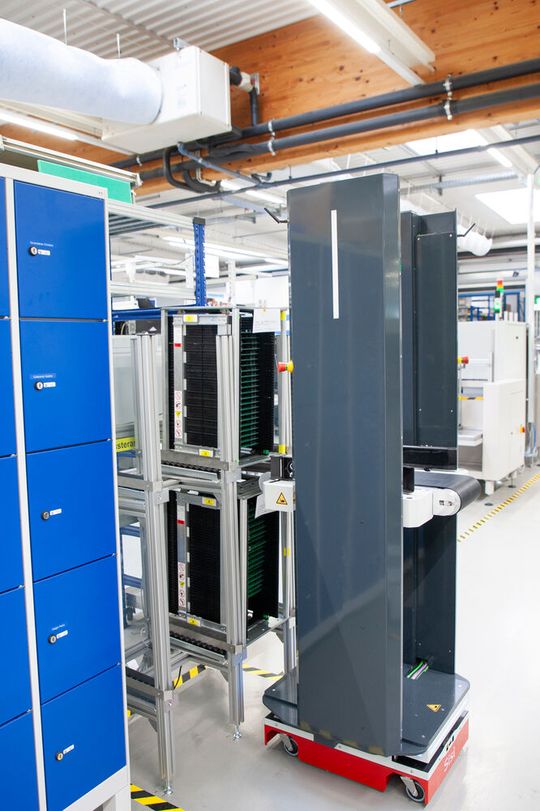
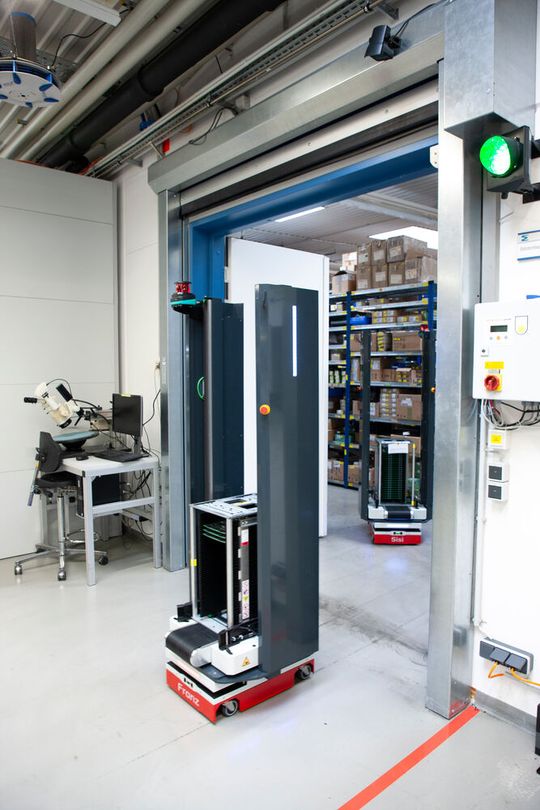
The Melkus Rack Stacker BLS4060, developed for electronics and precision mechanics production, can automatically pick up or set down loads at heights from 13 to 71 inches and still fits through any standard door. Since it can rotate on the spot, load transfer can also be carried out efficiently in confined spaces.
(Image: Sigmatek)
The Melkus Rack Stacker BLS4060 is suitable for the transport and handling of all standard PCB magazines as well as classic Euroboxes up to a size of 16 × 24 inches. The extremely short development time was made possible by the consistently modular design of all vehicles from Melkus Mechatronic. It was developed based on the proven compact platform AGV Melkus C4060. The LiFePO4 batteries enable an uninterrupted operating time of up to eight hours.
Date: 08.12.2025
Naturally, we always handle your personal data responsibly. Any personal data we receive from you is processed in accordance with applicable data protection legislation. For detailed information please see our privacy policy.
Consent to the use of data for promotional purposes
I hereby consent to Vogel Communications Group GmbH & Co. KG, Max-Planck-Str. 7-9, 97082 Würzburg including any affiliated companies according to §§ 15 et seq. AktG (hereafter: Vogel Communications Group) using my e-mail address to send editorial newsletters. A list of all affiliated companies can be found here
Newsletter content may include all products and services of any companies mentioned above, including for example specialist journals and books, events and fairs as well as event-related products and services, print and digital media offers and services such as additional (editorial) newsletters, raffles, lead campaigns, market research both online and offline, specialist webportals and e-learning offers. In case my personal telephone number has also been collected, it may be used for offers of aforementioned products, for services of the companies mentioned above, and market research purposes.
Additionally, my consent also includes the processing of my email address and telephone number for data matching for marketing purposes with select advertising partners such as LinkedIn, Google, and Meta. For this, Vogel Communications Group may transmit said data in hashed form to the advertising partners who then use said data to determine whether I am also a member of the mentioned advertising partner portals. Vogel Communications Group uses this feature for the purposes of re-targeting (up-selling, cross-selling, and customer loyalty), generating so-called look-alike audiences for acquisition of new customers, and as basis for exclusion for on-going advertising campaigns. Further information can be found in section “data matching for marketing purposes”.
In case I access protected data on Internet portals of Vogel Communications Group including any affiliated companies according to §§ 15 et seq. AktG, I need to provide further data in order to register for the access to such content. In return for this free access to editorial content, my data may be used in accordance with this consent for the purposes stated here. This does not apply to data matching for marketing purposes.
Right of revocation
I understand that I can revoke my consent at will. My revocation does not change the lawfulness of data processing that was conducted based on my consent leading up to my revocation. One option to declare my revocation is to use the contact form found at https://contact.vogel.de. In case I no longer wish to receive certain newsletters, I have subscribed to, I can also click on the unsubscribe link included at the end of a newsletter. Further information regarding my right of revocation and the implementation of it as well as the consequences of my revocation can be found in the data protection declaration, section editorial newsletter.
An extremely small footprint of 28 × 27 inches enables the autonomous transport vehicle to navigate in tight spaces. “The vehicles have to share the aisles with pedestrians here,” explains Gerald Haas. “Since they can be pushed aside effortlessly after an emergency stop, they even retain their function as escape routes.”
Automated Load Transfer
For load transfer, the AGV specialists were able to rely on field-tested components. Completely new, however, is the innovative lift system of the Melkus Rack Stacker. It allows the flexible transfer of transport goods at varying heights from 13 to 71 inches. In line with the modular concept of Melkus Mechatronic, it is equipped as a mechatronic unit with standalone control. Despite one of the two LIDAR scanners being mounted at the topmost point, the innovative AGV, with a total height of 77 inches, fits through any standard door.
The precise and efficient transfer takes place on both sides via an integrated conveyor belt system with clamping jaws to grip the load carriers. Since the Melkus Rack Stacker can rotate on the spot, load transfer can be efficiently executed even in confined spaces. An integrated RFID scanner enables the automatic identification of the containers.
Like all AGVs from Melkus Mechatronic, the BLS4060 utilizes automation technology from Sigmatek. This extends not only to the CPUs, displays, and electronic modules but also to the navigation software. They operate with SLAM navigation under the control of the intelligent Traffic Control System (TCS)—both developments by Sigmatek. This system is connected to the ERP software and warehouse management. It can translate data from material management into travel orders. "To enable the additional functionalities of the Melkus Rack Stacker, we expanded the TCS," explains Gerhard Veldman, the Sigmatek application engineer responsible for the development of Sigmatek TCS. "It now considers the height of the storage location and an offset in all directions. This resulted in TCS 3D."
Highest Acceptance for Sisi And Franz
Sisi and Franz navigate using LIDAR scanners and SLAM navigation without special installations, communicate via WLAN, and can be integrated into any control systems thanks to VDA5050 compatibility.
(Image: Sigmatek)
The installation at Sigmatek has not yet reached its final stage. Additional investments are still required at the transfer stations. Nevertheless, the benefits are already very apparent. Currently, the correct racks are automatically delivered to the SMT lines based on orders from the ERP system and from there directly to the correct storage location or an inspection workstation. "This not only relieves our employees of unpopular side tasks but also helps to avoid errors," notes Gerald Haas. "Moreover, the elimination of the previous intermediate storage in the production hall has improved workplace quality and enabled the expansion from two to three SMT lines."
Among the affected employees, there is a high level of acceptance, as Sigmatek involved them in the project from the very beginning to generate enthusiasm for this forward-looking technology. They were already familiar with the reliability of the AGVs from the Melkus Q40. To better integrate the Melkus Rack Stacker, the vehicles were given the names of the former imperial couple Sisi and Franz after an internal competition. This made the new robotics duo not only a part of Sigmatek's intralogistics but also a valuable part of the team.



:quality(80)/p7i.vogel.de/wcms/a0/47/a04725ef9bd09fb6c9341a1bea1b5d93/0130443083v1.jpeg "Here, a type of plastic pallet is produced by thermoforming (vacuum forming or deep drawing) at the corresponding division of New England Plastics in the USA. This division, which specializes in so-called liners, is now part of Ringmetall ... (Image:New England Plastics)")
:quality(80)/p7i.vogel.de/wcms/e3/42/e342b3c593ea92d56604d3be969e9c9a/0130437231v1.jpeg "Daimler Truck will be building even more trucks at its Czech plant in Cheb in the future. This is because it is now being expanded for strategic cost-saving reasons ... (Image:Daimler Truck)")
:quality(80)/p7i.vogel.de/wcms/23/99/23992bf2dcdc432c9b7209c34a4a7c48/0129733089v1.jpeg "Stork relies on the modular Neoswiss turning system from Iscar to shorten the set-up times for its sliding headstock lathes and work more productively. (Image:Iscar)")
:quality(80)/p7i.vogel.de/wcms/7d/e2/7de2923434b2f1a78ba5482d8d335269/0113143253v1.jpeg "In our China Market Insider we regularly provide you with relevant information directly from China. (Image:© Eisenhans - stock.adobe.com)")
:quality(80)/p7i.vogel.de/wcms/b7/36/b736dfebc16c42d6901d0d0e1f390493/3d-druck-20factory-20--20ki-20generiert-1920x1079v1.png "(Source: AI-generated)")
:quality(80)/p7i.vogel.de/wcms/79/b2/79b21aad663f4a7bd4472afc1c1afc62/0130433994v1.jpeg "Mission Joyride: The free-flying robot (shown here in the rendering) will relieve the ISS crew of logistics tasks from 2027 with its two mechanical arms. (Image:Icarus Robotics)")
:quality(80)/p7i.vogel.de/wcms/6b/45/6b4546fa6ebf305c3660326909363f32/0130437089v1.jpeg "Industrial AI in action: Rockwell Automation presents practical solutions for self-controlling production systems at the Hannover Messe. (Image:Rainer Jensen, Deutsche Messe)")
:quality(80)/p7i.vogel.de/wcms/78/e9/78e9188c25a8a94e67c34c9bf8ffe495/visual-agile-20robots-20and-20google-20deepmind-20partner-20to-20bring-20intelligence-20to-20robotics-2500x1406v1v1.jpeg "Together, the partners are developing adaptable, intelligent robots for a wide range of applications (Image:Agile Robots SE)")
:quality(80)/p7i.vogel.de/wcms/59/a2/59a2b11f0aa1b700eff02addd5de8703/adobestock-1788280853--c2-a9-20satria-20-e2-80-93-20stock-adobe-com-5081x2860v1v1.jpeg "Quantum computers require extreme cooling to temperatures close to absolute zero in order to keep qubits stable. (Image:satria - stock.adobe.com)")
:quality(80)/p7i.vogel.de/wcms/62/5f/625f41e87ebfef156a98c8e6393e32fd/0130211654v1.jpeg "Axial flux motors have some advantages over radial flux motor—but their production is currently still expensive. (Image:RWTH Aachen University)")
:quality(80)/p7i.vogel.de/wcms/f6/ae/f6aec4f6241b36ed5e3a990ac9176b42/0130429460v1.jpeg "Verne, Pony.ai and Uber want to launch a robotaxi service in Europe. (Image:Verne)")
:quality(80)/p7i.vogel.de/wcms/d7/88/d788699f2974708a332baa4e7a62fa9e/0130438967v1.jpeg "Skoda is withdrawing from China. The brand has produced well over three million vehicles there. (Image:Skoda car)")
:quality(80)/p7i.vogel.de/wcms/b0/43/b043b86899837532aad62d63368a917a/0130371361v1.jpeg "Skoda leaves the chinese market.
(Image:Skoda)")
:quality(80)/p7i.vogel.de/wcms/c3/c4/c3c4ce270b083eeac55654148611f064/0130237945v1.jpeg "China is not giving up on hydrogen, but is intensifying its efforts. (Image:freely licensed from Pixabay)")
:quality(80)/p7i.vogel.de/wcms/ee/09/ee09acbd6dc896df25affaa9e871e6e5/0130440053v1.jpeg "IMS chip module for simple system integration into an ion mobility spectrometer. (Image:Fraunhofer IPMS)")
:quality(80)/p7i.vogel.de/wcms/10/6c/106cd22de5f68a0f74639d654827228c/0130345302v1.jpeg "Made in India: According to the India Electronics and Semiconductor Association (IESA), the country should be able to produce between 75 and 80 million chips by the beginning of 2027, once the plants currently under construction become operational. (Image:Pixabay (Montage: Sebastian Gerstl))")
:quality(80)/p7i.vogel.de/wcms/a5/ed/a5ed6fda029d362732a293d6b19d74c4/0130444216v1.jpeg "Thirteen executives from the Chinese chip industry have drawn up a plan to achieve an 80% self-sufficiency rate for semiconductors by 2030. (Image:Maxim_Kazmin - stock.adobe.com)")
:quality(80)/p7i.vogel.de/wcms/31/a6/31a646018b34d8e0a44bfc8bf17837f6/0130361632v1.jpeg "For many companies, PFAS are considered indispensable in electronics production. (Image:freely licensed)")
:fill(fff,0)/images.vogel.de/vogelonline/companyimg/76800/76895/65.jpg "FAULHABER_120mm.jpg ()")
:quality(80)/p7i.vogel.de/wcms/bc/5d/bc5dc35f6390e4852efb3d5d4814a1e3/0127164098v1.jpeg "At the automation system manufacturer Sigmatek, autonomous transport vehicles (AGVs) of the type Melkus Rack Stacker BLS4060 supply the automatic production lines for electronic assemblies, transport finished circuit boards, and thus relieve their human colleagues. They named them \"Sisi and Franz.\"(Image: Sigmatek)")
:quality(80)/p7i.vogel.de/wcms/fb/ae/fbaedb905e309227b9e02d5c67941496/0126748548v1.jpeg "Founded in 1988, Sigmatek GmbH & Co KG researches, develops, manufactures, and sells automation technology for industrial machinery and plant engineering in Lamprechtshausen near Salzburg.(Image: Sigmatek)")
:quality(80)/p7i.vogel.de/wcms/ae/d5/aed56f26d93b09bc0051fa97282bc5f6/0126748870v1.jpeg "Not only Sisi and Franz, but also the autonomous Eurobox transporters of the Q40 type, which have been in use for a longer time, operate within the same installation of SIGMATEK's open AGV fleet management system TCS (Traffic Control System).(Image: Sigmatek)")
:quality(80)/p7i.vogel.de/wcms/2d/d1/2dd1055678253adf1851ab377ec2051d/0126748857v1.jpeg "Its extremely small footprint of 719 x 676 mm enables the task-specific, ESD-compliant autonomous transport vehicle to navigate in tight spaces, even in corridors shared with humans.(Image: Sigmatek)")
:quality(80):fill(efefef,0)/p7i.vogel.de/wcms/67/ad/67adf4a647532/elatec-wp-machine-authentication.png "Elatec WP Machine Authentication")
:quality(80)/p7i.vogel.de/wcms/ba/28/ba28ec056a82abd76758c8c87296c0d5/0130213997v1.jpeg "The Nexy automatic material call-off system (AMS) controls the replenishment of non-stocked materials or components. (Image:Steute Technologies GmbH & Co. KG, Löhne)")
:quality(80)/p7i.vogel.de/wcms/b5/57/b557d73c814969a8a87dab815e3b3c45/0123626364v1.jpeg "With a tech showcase, Linde Material Handling demonstrated at the recently concluded Logimat how artificial intelligence (AI) is taking intralogistics to a new level. (Image:Linde-MH)")