In the optimization of material flow processes, warehouse managers will receive increasing support from artificial intelligence (AI) in the future. Linde Material Handling (Linde-MH) demonstrated how this product vision works and is gradually becoming a reality in a tech showcase at the Logimat trade fair in Stuttgart (Germany).
With a tech showcase, Linde Material Handling demonstrated at the recently concluded Logimat how artificial intelligence (AI) is taking intralogistics to a new level.
(Image: Linde-MH)
The solution is being developed based on Nvidia's powerful AI platform "Omniverse," which will use a digital twin to capture, process, and analyze vast amounts of process data in warehouses in real-time. Only in January, the parent company, the Kion Group, announced a large-scale collaboration with AI leader Nvidia and the digitalization experts from Accenture to elevate industrial automation to a new level.
In an extension area of the Linde-MH exhibition stand, a scenario was presented typical for the "warehouses of tomorrow": manual and automated industrial trucks working in perfect harmony with the help of innovative AI technology. Operators of large fleets particularly benefit from this, as intelligent hardware and software combined with immense computing power ensure that every process in the warehouse becomes transparent and orders can be completed faster, safer, and more flexibly through continuous simulation. "Machine learning and neural networks will make the warehouse more efficient. Throughput increases, manual and automated fleets can be optimized, and personnel used more efficiently. Overall, this leads to significant cost savings for companies," forecasts Ulrike Just, member of the management board of Linde-MH. "As one of the technology and innovation leaders in our industry, we have begun developing solutions based on AI. We are breaking new ground to improve the competitiveness of our customers and make their material flow future-proof. We are planning pilot projects with major clients, as the associated investments will particularly pay off for them."
Real-time localization creates transparency
Linde-MH's strategy initially focuses on networking manual industrial trucks. The intralogistics company is currently developing a real-time localization system that works both inside warehouses and outside buildings. It allows seamless tracking of each vehicle's location, leveraging innovative "low infrastructure" ultra-wideband technology. Drivers receive navigation instructions through the warehouse or updates on new or amended driving orders via an intelligent display. The system combines location with vehicle data, such as steering angle. This way, the route can be adjusted in real time if there is excessive traffic on driving routes, leading to potential time loss.
At some point, it only works with AI
However, the coordinated collaboration and route optimization between manual and automated industrial trucks—in the second step—place significantly higher demands on the computing power of computers due to the increasing complexity. "If 100 or more vehicles are to be coordinated, this is only possible with a superior intelligence and hardware capable of processing such large amounts of data," explains Ron Winkler, Managing Director of the Digital Business Unit at Linde-MH. "This is where the AI of the Nvidia Omniverse platform comes into play. A digital twin of the warehouse is created, a virtual 1:1 image of physical reality." In this digital twin, simulations can be calculated in fractions of a second. Either to optimize driving routes and the optimal coordination of AMR and manual industrial trucks, or to achieve optimizations in existing warehouse layouts.
The special feature: Solutions for changing demands or problems in the warehouse, such as current order or inventory changes, traffic density in certain warehouse areas, obstacles or overhanging loads, are captured in real-time, simulated in the digital twin, and recalculations are fed back to the vehicle control—for example, ensuring that a delayed arriving truck is unloaded by the nearest forklift equipped accordingly. To achieve this, all physical data of industrial trucks (such as engine performance, steering angle) and infrastructure (such as rack spaces, driving paths, machine times) are digitally stored in the Nvidia Omniverse platform. In this virtual space, information permanently comes from sensors, intelligent vehicle and infrastructure cameras, warehouse management software, and vehicle controls is processed.
Simulation is the key
The tracking of load carriers, AMR, manually guided vehicles, as well as the monitoring of the load and storage zones, is handled by intelligent camera systems on the infrastructure and on the manual and automated vehicles. Their images are directly interpreted and processed by the AI.
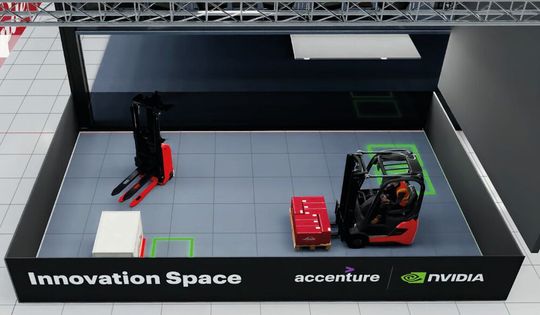
The showcase at the trade fair stand demonstrated this specifically: A forklift driver brought goods to the staging area with his Linde electric forklift. From the defined handover area, a fully automated Linde reach truck took the pallet to transport it into the warehouse. To seamlessly document and track materials and goods on the Omniverse platform, the manual forklift's mobile intelligent vehicle camera automatically takes a picture of the load when picking up the pallet and stores it in the system. At the same time, it detects people and obstacles and immediately adjusts the vehicle's behavior accordingly. The stationary cameras in the warehouse provide information about the occupancy of storage locations to the system and also register potential collisions with people and can initiate a reduction in vehicle speed.
Date: 08.12.2025
Naturally, we always handle your personal data responsibly. Any personal data we receive from you is processed in accordance with applicable data protection legislation. For detailed information please see our privacy policy.
Consent to the use of data for promotional purposes
I hereby consent to Vogel Communications Group GmbH & Co. KG, Max-Planck-Str. 7-9, 97082 Würzburg including any affiliated companies according to §§ 15 et seq. AktG (hereafter: Vogel Communications Group) using my e-mail address to send editorial newsletters. A list of all affiliated companies can be found here
Newsletter content may include all products and services of any companies mentioned above, including for example specialist journals and books, events and fairs as well as event-related products and services, print and digital media offers and services such as additional (editorial) newsletters, raffles, lead campaigns, market research both online and offline, specialist webportals and e-learning offers. In case my personal telephone number has also been collected, it may be used for offers of aforementioned products, for services of the companies mentioned above, and market research purposes.
Additionally, my consent also includes the processing of my email address and telephone number for data matching for marketing purposes with select advertising partners such as LinkedIn, Google, and Meta. For this, Vogel Communications Group may transmit said data in hashed form to the advertising partners who then use said data to determine whether I am also a member of the mentioned advertising partner portals. Vogel Communications Group uses this feature for the purposes of re-targeting (up-selling, cross-selling, and customer loyalty), generating so-called look-alike audiences for acquisition of new customers, and as basis for exclusion for on-going advertising campaigns. Further information can be found in section “data matching for marketing purposes”.
In case I access protected data on Internet portals of Vogel Communications Group including any affiliated companies according to §§ 15 et seq. AktG, I need to provide further data in order to register for the access to such content. In return for this free access to editorial content, my data may be used in accordance with this consent for the purposes stated here. This does not apply to data matching for marketing purposes.
Right of revocation
I understand that I can revoke my consent at will. My revocation does not change the lawfulness of data processing that was conducted based on my consent leading up to my revocation. One option to declare my revocation is to use the contact form found at https://contact.vogel.de. In case I no longer wish to receive certain newsletters, I have subscribed to, I can also click on the unsubscribe link included at the end of a newsletter. Further information regarding my right of revocation and the implementation of it as well as the consequences of my revocation can be found in the data protection declaration, section editorial newsletter.
But what happens if the forklift driver does not place the pallet exactly on the designated spot, as an AGV normally requires? Through the stationary cameras, the digital twin knows that the pallet has been set down and has passed the pick-up order to the Linde L-Matic core. Thanks to the intelligent camera of the fully automated AGV, the AI recognizes the tilted pallet and searches for a solution—in this case, the appropriate approach for picking up the load. Similarly, if boxes shift or a part of the load overhangs, these issues do not escape the stationary cameras. In this case, the AI would conclude that the goods should not be picked up by an AGV. The Linde L-Matic core stays put and can be assigned another transport order. Instead, the AI calculates which manually operated vehicle is nearby to take over the task.
"With the configuration of a digital warehouse image, any conceivable infrastructure and fleet configuration can be simulated in 3D optics and tested for its efficiency," explains Ron Winkler. "The AI can be continuously trained and refined. This creates the conditions for a warehouse universe that proactively solves challenges and continuously improves."
* Heike Oder is Head of Trade Press at Linde Material Handling GmbH in 63743 Aschaffenburg (Germany), Tel. +49 6021 991277, heike.oder@linde-mh.de



:quality(80)/p7i.vogel.de/wcms/a0/47/a04725ef9bd09fb6c9341a1bea1b5d93/0130443083v1.jpeg "Here, a type of plastic pallet is produced by thermoforming (vacuum forming or deep drawing) at the corresponding division of New England Plastics in the USA. This division, which specializes in so-called liners, is now part of Ringmetall ... (Image:New England Plastics)")
:quality(80)/p7i.vogel.de/wcms/e3/42/e342b3c593ea92d56604d3be969e9c9a/0130437231v1.jpeg "Daimler Truck will be building even more trucks at its Czech plant in Cheb in the future. This is because it is now being expanded for strategic cost-saving reasons ... (Image:Daimler Truck)")
:quality(80)/p7i.vogel.de/wcms/23/99/23992bf2dcdc432c9b7209c34a4a7c48/0129733089v1.jpeg "Stork relies on the modular Neoswiss turning system from Iscar to shorten the set-up times for its sliding headstock lathes and work more productively. (Image:Iscar)")
:quality(80)/p7i.vogel.de/wcms/7d/e2/7de2923434b2f1a78ba5482d8d335269/0113143253v1.jpeg "In our China Market Insider we regularly provide you with relevant information directly from China. (Image:© Eisenhans - stock.adobe.com)")
:quality(80)/p7i.vogel.de/wcms/b7/36/b736dfebc16c42d6901d0d0e1f390493/3d-druck-20factory-20--20ki-20generiert-1920x1079v1.png "(Source: AI-generated)")
:quality(80)/p7i.vogel.de/wcms/79/b2/79b21aad663f4a7bd4472afc1c1afc62/0130433994v1.jpeg "Mission Joyride: The free-flying robot (shown here in the rendering) will relieve the ISS crew of logistics tasks from 2027 with its two mechanical arms. (Image:Icarus Robotics)")
:quality(80)/p7i.vogel.de/wcms/6b/45/6b4546fa6ebf305c3660326909363f32/0130437089v1.jpeg "Industrial AI in action: Rockwell Automation presents practical solutions for self-controlling production systems at the Hannover Messe. (Image:Rainer Jensen, Deutsche Messe)")
:quality(80)/p7i.vogel.de/wcms/78/e9/78e9188c25a8a94e67c34c9bf8ffe495/visual-agile-20robots-20and-20google-20deepmind-20partner-20to-20bring-20intelligence-20to-20robotics-2500x1406v1v1.jpeg "Together, the partners are developing adaptable, intelligent robots for a wide range of applications (Image:Agile Robots SE)")
:quality(80)/p7i.vogel.de/wcms/59/a2/59a2b11f0aa1b700eff02addd5de8703/adobestock-1788280853--c2-a9-20satria-20-e2-80-93-20stock-adobe-com-5081x2860v1v1.jpeg "Quantum computers require extreme cooling to temperatures close to absolute zero in order to keep qubits stable. (Image:satria - stock.adobe.com)")
:quality(80)/p7i.vogel.de/wcms/62/5f/625f41e87ebfef156a98c8e6393e32fd/0130211654v1.jpeg "Axial flux motors have some advantages over radial flux motor—but their production is currently still expensive. (Image:RWTH Aachen University)")
:quality(80)/p7i.vogel.de/wcms/f6/ae/f6aec4f6241b36ed5e3a990ac9176b42/0130429460v1.jpeg "Verne, Pony.ai and Uber want to launch a robotaxi service in Europe. (Image:Verne)")
:quality(80)/p7i.vogel.de/wcms/d7/88/d788699f2974708a332baa4e7a62fa9e/0130438967v1.jpeg "Skoda is withdrawing from China. The brand has produced well over three million vehicles there. (Image:Skoda car)")
:quality(80)/p7i.vogel.de/wcms/b0/43/b043b86899837532aad62d63368a917a/0130371361v1.jpeg "Skoda leaves the chinese market.
(Image:Skoda)")
:quality(80)/p7i.vogel.de/wcms/c3/c4/c3c4ce270b083eeac55654148611f064/0130237945v1.jpeg "China is not giving up on hydrogen, but is intensifying its efforts. (Image:freely licensed from Pixabay)")
:quality(80)/p7i.vogel.de/wcms/ee/09/ee09acbd6dc896df25affaa9e871e6e5/0130440053v1.jpeg "IMS chip module for simple system integration into an ion mobility spectrometer. (Image:Fraunhofer IPMS)")
:quality(80)/p7i.vogel.de/wcms/10/6c/106cd22de5f68a0f74639d654827228c/0130345302v1.jpeg "Made in India: According to the India Electronics and Semiconductor Association (IESA), the country should be able to produce between 75 and 80 million chips by the beginning of 2027, once the plants currently under construction become operational. (Image:Pixabay (Montage: Sebastian Gerstl))")
:quality(80)/p7i.vogel.de/wcms/a5/ed/a5ed6fda029d362732a293d6b19d74c4/0130444216v1.jpeg "Thirteen executives from the Chinese chip industry have drawn up a plan to achieve an 80% self-sufficiency rate for semiconductors by 2030. (Image:Maxim_Kazmin - stock.adobe.com)")
:quality(80)/p7i.vogel.de/wcms/31/a6/31a646018b34d8e0a44bfc8bf17837f6/0130361632v1.jpeg "For many companies, PFAS are considered indispensable in electronics production. (Image:freely licensed)")
:fill(fff,0)/images.vogel.de/vogelonline/companyimg/76800/76895/65.jpg "FAULHABER_120mm.jpg ()")
:fill(fff,0)/p7i.vogel.de/companies/69/88/69882c428938e/tmts2026-ticec-banner-en-2000px.png "tmts2026-ticec-banner-en-2000px (https://www.tmts.tw/en)")
:quality(80):fill(efefef,0)/p7i.vogel.de/wcms/67/ad/67adf92d254d2/elatec-wp-smart-factory.png "Elatec WP Smart Factory")
:quality(80)/p7i.vogel.de/wcms/ba/28/ba28ec056a82abd76758c8c87296c0d5/0130213997v1.jpeg "The Nexy automatic material call-off system (AMS) controls the replenishment of non-stocked materials or components. (Image:Steute Technologies GmbH & Co. KG, Löhne)")
:quality(80)/p7i.vogel.de/wcms/ad/da/adda2b0237d0167d79524dc8845649b8/0128720455v1.jpeg "Pepsico is digitizing selected production facilities and warehouses in the USA using Digital Twin Composer. (Image:Pepsico)")