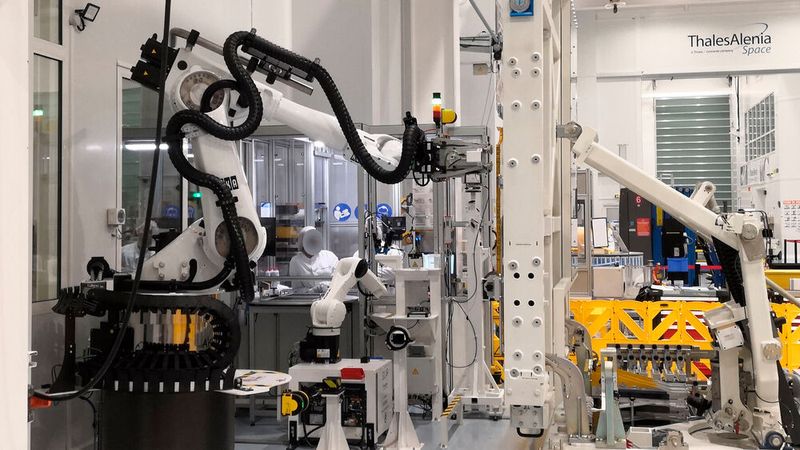
Automation specialist Akeoplus has developed a robot cell for the production of satellite panels at the aerospace company Thales Alenia Space. The special feature: Robots apply the components with very high precision on a workspace of 6 by 3 meters under cleanroom conditions. This is made possible by industrial image processing.
Robots apply solar reflectors to panels with an accuracy of 0.2 millimeters under cleanroom conditions.
(Image: Mvtec)
Increasing productivity, relieving humans of physically demanding tasks, and improving quality are the major advantages of robot-based automation. Industrial image processing (Machine Vision), the eye of production, ensures that robots reliably fulfill these promises.
A specialist in implementing robot-based automation solutions in conjunction with Machine Vision is the company Akeoplus. The company, headquartered in the French Château-Gaillard, is considered a pioneer in the field of robotics. Akeoplus was founded in 2006 and supports customers from various industries with applications for optimizing industrial robots. As part of its robotics solutions, Akeoplus uses modern image processing systems and advanced algorithms.
Gallery
A system that combines the strengths of robotics and industrial image processing was developed by Akeoplus in cooperation and on behalf of the Thales Alenia Space site in Cannes, southern France. Thales Alenia Space is a global space corporation that offers high-tech solutions for telecommunications, navigation, earth observation, environmental management, exploration, science, and orbital infrastructures. The engineers at Thales Alenia Space have developed an innovative adhesive process that can automate the placement of Optical Solar Reflectors (OSR), while also increasing thermal performance and weight. The experts at Akeoplus then worked with the Thales Alenia Space teams to develop a robot solution for a satellite panel manufacturing process.
In the system named "Solar", robots apply Optical Solar Reflectors (OSR) to satellite panels. The task in the development was to enable the robots to apply the OSR to the 6 by 3 meter panel with an accuracy of less than 0.2 millimeters under clean room conditions. The ratio of positioning accuracy to the size of the working area is 1:40,000, which posed a particular challenge in the implementation. To meet the requirements, Akeoplus relied on the Machine Vision software Mvtec Halcon, which supports inspection activities and alignment of the OSR.
Benefits of automation
Optical solar reflectors are used in space travel, for example to protect satellites in geostationary orbits from the high radiation levels there. A corresponding panel as an outer wall is equipped with up to 7,000 reflectors, with an OSR measuring 40 by 43 millimeters.
Our customer can now produce much faster, even though we have introduced additional steps for traceability and quality assurance.
Maxime Motisi, COO with Akeoplus
Until now, the OSR were applied to the panel purely manually. Two or more fitters lying on mats had the task of positioning the OSR components with their arms stretched downwards and ensuring their correct alignment.
"The production of large panels has increased, and working on such surfaces was not ideal for employees for ergonomic reasons. Thales Alenia Space is a major player in the field of space equipment and is constantly striving for excellent working conditions and the quality of its processes. That's why we decided together to automate the entire process. The robot cell was developed to speed up the process and thus increase productivity. Our customer can now produce much faster, even though we have introduced additional steps for traceability and quality assurance," explains Maxime Motisi, Chief Operating Officer and Project Manager of the Solar Robot Cell at Akeoplus.
Thanks to Machine Vision, two robots work autonomously
For the new automated production process, Akeoplus, together with Thales Alenia Space, developed the Solar robot cell. Inside it, there are two robots and a positioning table on which the satellite panels rest individually. For absolutely precise guidance, a laser tracker is responsible for the 6-axis robot arm, and for industrial image processing, three high-resolution 2D cameras are used on the hardware side. The Halcon image processing software is responsible for the quality check of the OSR, fine positioning, the human-machine interface, and visualization.
The manufacturing process proceeds as follows: The smaller and faster robot picks up an OSR from the tray and places it on a vacuum backlight under the first camera station. The camera takes a picture, which is examined by Halcon for fractures and scratches. In addition, the exact position of the OSR is determined and checked whether the component in size and shape also corresponds to the model provided for in the blueprint using the Machine Vision method "Shape Matching".
The position determination is so important because the robot picks up each optical solar reflector slightly differently. Therefore, the OSR is aligned using Machine Vision in order to transport it to the next production step with an accuracy of around 0.2 millimeters. If the component is "OK", it is placed under the nozzle of the adhesive dispenser. After the adhesive is applied, the smaller of the two robots picks up the OSR again and places it in a designated spot so that the larger robot can pick it up for further processing. The robot with the larger workspace now moves the component in front of the next image processing station, where the second camera takes images of the applied adhesive. The extracted image of the adhesive pattern is analyzed by Halcon. It checks whether the adhesive is evenly distributed and adheres to a very specific pattern that thermal engineers from Thales Alenia Space have developed and that must be reproduced exactly. This is followed by the precise alignment of the OSR on the robot's arm. This is the first step in being able to attach the reflector to the designated spot on the satellite panel with high accuracy. For this, the third high-resolution camera again takes pictures of the OSR. The alignment is carried out by Halcon's algorithms determining the spatial transformation between the outer edges of the OSR and the coordinate system of the gripper, which holds the OSR with a vacuum gripping system.
Date: 08.12.2025
Naturally, we always handle your personal data responsibly. Any personal data we receive from you is processed in accordance with applicable data protection legislation. For detailed information please see our privacy policy.
Consent to the use of data for promotional purposes
I hereby consent to Vogel Communications Group GmbH & Co. KG, Max-Planck-Str. 7-9, 97082 Würzburg including any affiliated companies according to §§ 15 et seq. AktG (hereafter: Vogel Communications Group) using my e-mail address to send editorial newsletters. A list of all affiliated companies can be found here
Newsletter content may include all products and services of any companies mentioned above, including for example specialist journals and books, events and fairs as well as event-related products and services, print and digital media offers and services such as additional (editorial) newsletters, raffles, lead campaigns, market research both online and offline, specialist webportals and e-learning offers. In case my personal telephone number has also been collected, it may be used for offers of aforementioned products, for services of the companies mentioned above, and market research purposes.
Additionally, my consent also includes the processing of my email address and telephone number for data matching for marketing purposes with select advertising partners such as LinkedIn, Google, and Meta. For this, Vogel Communications Group may transmit said data in hashed form to the advertising partners who then use said data to determine whether I am also a member of the mentioned advertising partner portals. Vogel Communications Group uses this feature for the purposes of re-targeting (up-selling, cross-selling, and customer loyalty), generating so-called look-alike audiences for acquisition of new customers, and as basis for exclusion for on-going advertising campaigns. Further information can be found in section “data matching for marketing purposes”.
In case I access protected data on Internet portals of Vogel Communications Group including any affiliated companies according to §§ 15 et seq. AktG, I need to provide further data in order to register for the access to such content. In return for this free access to editorial content, my data may be used in accordance with this consent for the purposes stated here. This does not apply to data matching for marketing purposes.
Right of revocation
I understand that I can revoke my consent at will. My revocation does not change the lawfulness of data processing that was conducted based on my consent leading up to my revocation. One option to declare my revocation is to use the contact form found at https://contact.vogel.de. In case I no longer wish to receive certain newsletters, I have subscribed to, I can also click on the unsubscribe link included at the end of a newsletter. Further information regarding my right of revocation and the implementation of it as well as the consequences of my revocation can be found in the data protection declaration, section editorial newsletter.
The corners of the OSR are determined by the intersections of the edges. From this a coordinate system can be derived in which the corner of the OSR is centered and aligned to the edges of the OSR. The coordinate system of the effector robot was determined in advance by a hand-eye calibration of the robot.
The determination of the coordinate systems is important for two reasons: First, for 3D alignment. It may be that the reflector is tilted on the gripper. Therefore, the corners of the OSR are matched with the effector, each corner being known and thus serving as a reference point. This allows even minimal tilts or shifts to be compensated for. Secondly, the corner of the OSR serves as a reference point for mounting on the panel.
However, since the 2.4 meter long gripper arm of the robot is not 100 percent accurate, but the reflectors must be attached with very high precision, the inaccuracies must be compensated. With the support of the laser tracker and the image processing software Halcon, Akeoplus has developed an iterative feedback process. This enables the robot to attach the OSR with the required accuracy at the exact spot on the 18 square meter panel.
Aligning the OSR on the panel with sub-millimeter accuracy
"We have been working with Mvtec for many years now. Therefore, we knew that with Halcon we have the powerful Machine Vision software that we need for the Solar Robot Cell," explains Maxime Motisi. Akeoplus uses the C# programming language to control its systems. With the help of the Hdevelop development environment integrated in Halcon, seamless process integration can be enabled, for example by loading the programming of the system control in Halcon and developing it further. Then, the Akeoplus Human-Machine Interface can represent each Halcon process as a function with the inputs and outputs to be used in the process sequence. This is helpful in order not to mix the work of the C# developers and the image processing expert: The image processing process takes place within a capsule, uses images and parameters as input, and returns results or values. Another important factor for the implementation was the speed and the ability to quickly develop or adapt powerful algorithms that can in turn be easily integrated into the "host system".
On the other hand, a powerful image processing software like Halcon offers technologies to perform, for example, three-dimensional position determinations or to detect errors in components. Specifically, objects can be reliably found with a higher accuracy than 1/20 pixel using matching methods, even if they are partially obscured. In addition, images can be suitably aligned. Subpixel accurate shape matching is one of the most important technologies. It enables the precise, robust and very fast finding of objects. In terms of quality control, in addition to checking for defects, determining dimensional accuracy is essential. It checks whether the components are within the defined tolerance ranges. Last but not least, industrial image processing enables subpixel accurate measurement of edges along lines or circular segments in less than a millisecond.
Application also serves as a showcase
The Solar Robot Cell is already in operation. "The implementation was not quite easy. Especially the work on and with the adhesive was challenging, but thanks to Thales Alenia Space's expertise in thermal adhesives, we were able to find solutions together. We can now be very pleased with the result, as the requirements in terms of quality, productivity and employee relief were all met," says Maxime Motisi. Specifically, this means that the cycle time for gluing and positioning an optical solar reflector has been reduced to less than 45 seconds and an OEE of >95 percent is achieved. As a result, a large panel can now be completely clad with solar reflectors by just one employee in five days. Previously, about two employees were busy with a panel for seven days. In addition, the work environment for employees has improved, as the tasks that took hours have been eliminated and contact with the chemical adhesive has been reduced. In addition, a new quality assurance process was successfully introduced, namely the inspection of the OSR for fractures and scratches.
In addition, the robot cell serves another purpose. Maxime Motisi explains: "With our Solar Robot Cell, not only can satellite panels be produced for actual use. The application is also a showcase project for Thales Alenia Space's robotics solutions, demonstrating their competencies and expertise. And we at Akeoplus are very proud of this use case. I would say that this case represents a summary of all our capabilities and knowledge, and it allows us to attract more customers for our innovative technologies."
For Akeoplus, the combination of robotics and industrial image processing has always been a necessity to meet requirements that have never been implemented before. "Our value lies in the connection of cutting-edge technologies with robots. Mvtec offers one of these key technologies and has already been a partner for more than eight years," concludes Maxime Motisi.
(kip)
This article was first published on our sister brand 'elektrotechnikAUTOMATISIERUNG' (German Edition), Vogel Communications Group



:quality(80)/p7i.vogel.de/wcms/9d/2b/9d2b802f800e5caf17b2831e74228cd3/screenshot-202026-03-03-20103822-609x343v1v1.png "Visual comparison: on the left, a clean, burr-free cut edge; on the right, typical burr formation with oxidation discoloration. This illustrates how strongly parameter control and gas management influence the quality of the result. (CO₂ laser, oxygen cutting gas, sheet thickness approx. 15 mm). (Image:Picture: Rime)")
:quality(80)/p7i.vogel.de/wcms/dd/08/dd086510d9ae7b50181f6070e4463b44/0129363730v1.jpeg "Typical application for ionizing devices: Wrapping films. (Picture: ©Adobe Stock/SMC)")
:quality(80)/p7i.vogel.de/wcms/35/57/3557c819943c53acec41a0ccba87da4f/0130049064v1.jpeg "Researchers at the Fraunhofer IWU in Chemnitz have long known that many typical sheet metal parts can be manufactured more cost-effectively using hollow embossing rollers. Now there is news to report ... (Image:Fraunhofer IWU)")
:quality(80)/p7i.vogel.de/wcms/59/02/590246e3b3f415c65edbee377c14ca77/26-06-pi-fraunhofer-iws-41450-direktplattieren-pic-01-7771x4369v1v1.jpeg "The Fraunhofer IWS has developed the new \"direct laser cladding\" process, which creates a functional layer directly on the base body by applying a strip-shaped metal to rotationally symmetrical components in a spiral and bonding it locally by laser. (Image:Christoph Wilsnack/Fraunhofer IWS)")
:quality(80)/p7i.vogel.de/wcms/78/e9/78e9188c25a8a94e67c34c9bf8ffe495/visual-agile-20robots-20and-20google-20deepmind-20partner-20to-20bring-20intelligence-20to-20robotics-2500x1406v1v1.jpeg "Together, the partners are developing adaptable, intelligent robots for a wide range of applications (Image:Agile Robots SE)")
:quality(80)/p7i.vogel.de/wcms/e7/66/e7669ecf0260ae8fc54c214e34e4902a/0130316817v1.jpeg "Siemens and Palo Alto Networks offer tested cybersecurity solution for industrial 5G. (Image:Siemens)")
:quality(80)/p7i.vogel.de/wcms/9f/55/9f55324832c4f426958031375124d9de/siemens-20ubtech-20hmnd-1920x1079v1v1.png "Ready for the factory floor: While Ubtech is planning mass production, Siemens is already testing humanoids in real factory applications in Erlangen. (Image:Siemens)")
:quality(80)/p7i.vogel.de/wcms/11/36/113695ed260e29c8c2d9d39dc5f9d869/0130213768v1.jpeg "AI can work cheaply in China and deliver the results rapidly all over the world. (Image:Dall-E / AI-generated)")
:quality(80)/p7i.vogel.de/wcms/62/5f/625f41e87ebfef156a98c8e6393e32fd/0130211654v1.jpeg "Axial flux motors have some advantages over radial flux motor—but their production is currently still expensive. (Image:RWTH Aachen University)")
:quality(80)/p7i.vogel.de/wcms/77/9b/779b0685d010dfe45c9c2cb1cfecd467/0128886425v1.jpeg "The BlueEye is the first \"real\" hyperspectral camera for the UV range and covers the wavelength range from 220 to 380nm. (Image:Inno-spec GmbH)")
:quality(80)/p7i.vogel.de/wcms/e4/51/e451d52ce0182fb0aaa46a5774f832ef/26-04-pi-fraunhofer-iws-21160-bioslide-pic-01-4128x2321v1v1.jpeg "With the BioSlide research project, the Fraunhofer IWS is investigating how sliding systems can be designed to be more sustainable and energy-efficient. New materials can be tested in a particularly application-oriented manner on this plain bearing test stand. (Image:Fraunhofer IWS)")
![Thanks to advanced 3D printing technology, a more efficient use of resources should contribute to lower-emission aviation—this is the goal of ['skai]-lab. (Image:Oleksandr Pashchenko - stock.adobe.com / AI-generated)](https://cdn1.vogel.de/nghHNSbySccfOjG3n1qCA-FVOjQ=/288x162/smart/filters:format(jpg):quality(80)/p7i.vogel.de/wcms/62/64/626424c97a16e69f871bf216c9629c2a/adobestock-1927043193--c2-a9-20oleksandr-20pashchenko-20-e2-80-93-20stock-adobe-com-ki-generiertv1v1.jpeg "Thanks to advanced 3D printing technology, a more efficient use of resources should contribute to lower-emission aviation—this is the goal of ['skai]-lab. (Image:Oleksandr Pashchenko - stock.adobe.com / AI-generated)")
:quality(80)/p7i.vogel.de/wcms/b0/43/b043b86899837532aad62d63368a917a/0130371361v1.jpeg "Skoda leaves the chinese market.
(Image:Skoda)")
:quality(80)/p7i.vogel.de/wcms/c3/c4/c3c4ce270b083eeac55654148611f064/0130237945v1.jpeg "China is not giving up on hydrogen, but is intensifying its efforts. (Image:freely licensed from Pixabay)")
:quality(80)/p7i.vogel.de/wcms/4e/c0/4ec0bd19390b169edfa23677373dcdf1/0130260089v1.jpeg "Renewable fuels can supply European road traffic, according to a study. (Image:Aral)")
:quality(80)/p7i.vogel.de/wcms/6f/c9/6fc9050301d745cad25585c6780f8f51/0130197341v1.jpeg "Production facilities are a worthwhile target and are therefore at risk. (Image:ABB Robotics)")
:quality(80)/p7i.vogel.de/wcms/4d/dd/4dddf438e91f394c04a095dbfd109d1c/0130236430v1.jpeg "Measurement modules: The 720301 module in combination with the SL2000 enables RMS and power calculations, among other things. (Image:Yokogawa)")
:quality(80)/p7i.vogel.de/wcms/61/fc/61fcf95f5cca15494ad18343901ae585/0130317237v1.jpeg "With the AGI CPU, Arm says it is taking a \"historic step\": With the processor aimed at AI in data centers, the company is presenting itself for the first time as a provider of its own chips, not just as a pure IP licensor. (Image:Arm)")
:quality(80)/p7i.vogel.de/wcms/82/90/8290dfe3595b6c6b33726ae8b76172c7/0130319587v1.jpeg "The concept image illustrates how the pattern of tiny protrusions and depressions created on the substrate (MgO, bottom) controls the arrangement of atoms in the superconducting material (YBCO, top). At the interface between the two layers, an electronic structure enables superconductivity to occur at higher temperatures than previously possible. (Image:Chalmers University of Technology / Riccardo Arpaia)")
:fill(fff,0)/images.vogel.de/vogelonline/companyimg/76800/76895/65.jpg "FAULHABER_120mm.jpg ()")
:quality(80)/p7i.vogel.de/wcms/12/f5/12f53f70d105a95a991d61815a3cb1b6/0117954983v1.jpeg "The edges determined by HALCON serve as a reference point for attachment to the panel.(Image: Mvtec)")
:quality(80)/p7i.vogel.de/wcms/70/25/70256a431b7c07f32c3495d758e0cdff/0117954980v1.jpeg "Machine Vision allows the highest accuracy of the robot in a workspace of 6 by 3 meters.(Image: Mvtec)")
:quality(80)/p7i.vogel.de/wcms/22/f5/22f5576a3b45b6cf93fafab85d24eb42/0117954992v1.jpeg "Determination of the center point of the component after one of the robots has grabbed it.(Image: Mvtec)")
:quality(80)/p7i.vogel.de/wcms/bd/b9/bdb921041dbeb58a7e3ad673f381269a/0117954987v1.jpeg "The Machine Vision software HALCON helps to detect defects such as scratches on the components.(Image: Mvtec)")
:quality(80)/p7i.vogel.de/wcms/82/47/82479c15ba77893b563e4a25f6b3d0a4/0126381950v1.jpeg "The flat vacuum gripping system, which is quickly interchangeable for the different-sized wafers, consistently maintains the specified positioning accuracy of ± 0.1 millimeters during the loading of the workpiece carriers. (Image:Azur Space Solar Power)")
:quality(80)/p7i.vogel.de/wcms/b3/0f/b30fa47b8a7e4a1703436255600dab10/0127132229v1.jpeg "Deflectometry for defect detection on reflective components (Image:MVTec Software GmbH)")