The Italian medical technology company Orthokey has developed its robot system "Robin" to support orthopedic surgeons in the operating room. The system is based on Kuka's LBR Med and, through its navigation system, enables precise robot-assisted procedures in total knee arthroplasty.
Kuka partner Orthokey from Italy presents its "Robin" system. It is a collaborative robot solution for orthopedic surgery.
(Image: Kuka)
The author: Jonas Micheler is Content Marketing Manager at Kuka.
The success of an operation often depends on the experience and skill of the surgeon—the more complex the procedure, the more important the surgeons are. When working manually, they use mechanical devices, which is time-consuming and potentially prone to errors. With "Robin," Orthokey opens the door to computer-assisted orthopedic surgery. "Robin" is an intraoperative robotic system that assists surgeons in the planning and positioning of orthopedic implants and in performing precise bone resections. It uses the individual patient's profile as well as specific kinematic and anatomical features. "We position several trackers on the patient, which can be detected by a camera with an accuracy of less than a millimeter. This allows the surgeon to plan the correct positioning of the implant for each individual patient before performing a resection," explains Simone Bignozzi, product manager at Orthokey, about the principle of "Robin."
Dr. Domenico Alesi, an orthopedic surgeon at the Istituto Ortopedico Rizzoli in Bologna, especially praises the system's ease of use: "'Robin' is intuitive and visually appealing. All interfaces simplify the complex processes for users and make their work easier. The accuracy of the system is amazing, and it is suitable not only for highly specialized surgeons but for a wide range of doctors." "Robin" is also based on a modular approach that considers different implant manufacturers and clinic concepts. Last but not least, Orthokey relies on high-quality components for its surgical solution, including the sensitive lightweight robot LBR Med from Kuka.
The engineers at Orthokey compared various robots and even considered developing their own. But then the LBR Med from Kuka came into play, which convinced them for three reasons, as Maria Pasquini, CTO of the "Robin" project at Orthokey, explains: "Firstly, the robotic arm is already approved for easy and fast integration into medical devices, which facilitated the certification of the overall system and brought it to market readiness faster. The second aspect is the seven degrees of freedom and the sensors in each joint, which can increase the accuracy and dexterity of the robot in the operating room. And thirdly, the LBR Med is a mature and established solution with reliable software, allowing us to work quickly and effectively from the start."
A collaborative development as a means to success
From the outset, the idea was to design the system simpler and smaller than comparable solutions. Orthokey developed the first prototype in collaboration with the University of Verona. "The proof of concept was completed after eight months, and hardware and software development was finished another nine months later. With this first version, we then started the product certification through the notified body," Bignozzi describes the challenging journey of "Robin" into the operating room.
Throughout the process, the team worked closely with Kuka's research and development team and greatly benefited from their experience. "Kuka has proven to be a well-established robotics company in medical technology and can draw on knowledge from numerous projects. The great commitment of each team member contributed to making 'Robin' a success," emphasizes Pasquini.
Highly precise human-robot collaboration
How does a procedure with "Robin" work? Before the procedure begins, the operating room staff carefully prepares the OR to ensure flawless interaction between human and robotic system. The correct positioning of the system is crucial to enable smooth collaboration with the surgical team and efficient maneuverability in the operating room.
During the operation, the surgeon uses infrared markers to map the patient's anatomy on the robot system. These markers make the patient "visible" to the device. The system can then track the patient's anatomy and position in real-time, ensuring precise alignment and guidance during the surgical process.
By capturing and visualizing the patient's anatomy on the screen, the surgeon can precisely plan the strategy for the bone resections. The detailed visualization of the patient's features allows the surgeon to develop a suitable approach for the procedure. Once the plan is set, the robotic arm comes into play. "It initially operates in automatic mode and precisely guides towards the patient. Once it reaches the designated area, the procedure transitions into a collaborative phase. In this mode, the surgeon can manually adjust the cutting guide held by 'Robin' to the target level while the robotic arm remains precisely positioned throughout the process. This cooperative approach is repeated for each step of the bone resection to ensure consistent precision," explains Dr. Alesi, describing the collaboration between the doctor and the medical robot.
Date: 08.12.2025
Naturally, we always handle your personal data responsibly. Any personal data we receive from you is processed in accordance with applicable data protection legislation. For detailed information please see our privacy policy.
Consent to the use of data for promotional purposes
I hereby consent to Vogel Communications Group GmbH & Co. KG, Max-Planck-Str. 7-9, 97082 Würzburg including any affiliated companies according to §§ 15 et seq. AktG (hereafter: Vogel Communications Group) using my e-mail address to send editorial newsletters. A list of all affiliated companies can be found here
Newsletter content may include all products and services of any companies mentioned above, including for example specialist journals and books, events and fairs as well as event-related products and services, print and digital media offers and services such as additional (editorial) newsletters, raffles, lead campaigns, market research both online and offline, specialist webportals and e-learning offers. In case my personal telephone number has also been collected, it may be used for offers of aforementioned products, for services of the companies mentioned above, and market research purposes.
Additionally, my consent also includes the processing of my email address and telephone number for data matching for marketing purposes with select advertising partners such as LinkedIn, Google, and Meta. For this, Vogel Communications Group may transmit said data in hashed form to the advertising partners who then use said data to determine whether I am also a member of the mentioned advertising partner portals. Vogel Communications Group uses this feature for the purposes of re-targeting (up-selling, cross-selling, and customer loyalty), generating so-called look-alike audiences for acquisition of new customers, and as basis for exclusion for on-going advertising campaigns. Further information can be found in section “data matching for marketing purposes”.
In case I access protected data on Internet portals of Vogel Communications Group including any affiliated companies according to §§ 15 et seq. AktG, I need to provide further data in order to register for the access to such content. In return for this free access to editorial content, my data may be used in accordance with this consent for the purposes stated here. This does not apply to data matching for marketing purposes.
Right of revocation
I understand that I can revoke my consent at will. My revocation does not change the lawfulness of data processing that was conducted based on my consent leading up to my revocation. One option to declare my revocation is to use the contact form found at https://contact.vogel.de. In case I no longer wish to receive certain newsletters, I have subscribed to, I can also click on the unsubscribe link included at the end of a newsletter. Further information regarding my right of revocation and the implementation of it as well as the consequences of my revocation can be found in the data protection declaration, section editorial newsletter.
Once all the necessary bone resections are completed, the surgeon inserts the orthopedic implant into the patient. During this final phase, they closely monitor the leg kinematics and overall outcome on the screen of the robotic system. "This comprehensive monitoring ensures that the implant is precisely placed and the desired surgical outcome is achieved. Once the surgeon confirms the success of the procedure, the operation is completed, and the patient is transferred to postoperative care," Dr. Alesi continues.
Partner in the operating room
"Robin" is ready for the market. Currently, certification is underway according to the Medical Device Regulation (MDR), and afterward, Orthokey plans to apply for further approvals in various countries—next year, for example, with the Food and Drug Administration (FDA) in the USA. "To achieve this and continuously improve our system, we are collaborating with several reference centers around the world. The feedback is consistently positive. Users appreciate Robin's dimensions and weight as well as the simplicity of the surgical workflow," says Simone Bignozzi.
The developers emphasize that the medical robot should not be seen as a competitor to the surgeon, but as an assistant in the operating room. Especially for young surgeons, this could allow for a steeper learning curve than in conventional surgery. "'Robin' will not restrict working possibilities but will enhance the skills of those involved. The OR staff, including the surgeons, will learn how to integrate the system seamlessly into the usual processes. The surgeon benefits from patient-centered surgery, and outliers can be reduced, particularly for surgeons who operate less frequently. Better training of residents, a better understanding of knee surgeries, and the collection of more reliable data can be additional advantages of the system," emphasizes Maria Pasquini.
Robot-based knee surgery on a new level
Dr. Domenico Alesi is also confident that "Robin" will elevate surgical procedures to a new level. "The solution aims to improve the accuracy of the procedure in the short term, reduce the number of surgical interventions, decrease variability among surgeons, and lead to more reproducible and precise results. All of this can result in a better surgical outcome. In the medium term, we can further develop surgical procedures and identify the key influencing factors," says the surgeon.
Frédéric Piasek, Business Development Manager Medical at Kuka, looks forward to further development: "We have a very good and open partnership with Orthokey. Thanks to constant dialogue about technical challenges, we were able to gradually develop the solution further. We also remain in regular contact about possible developments. I am eager to see what the future holds for our collaboration with Orthokey."



:quality(80)/p7i.vogel.de/wcms/23/99/23992bf2dcdc432c9b7209c34a4a7c48/0129733089v1.jpeg "Stork relies on the modular Neoswiss turning system from Iscar to shorten the set-up times for its sliding headstock lathes and work more productively. (Image:Iscar)")
:quality(80)/p7i.vogel.de/wcms/7d/e2/7de2923434b2f1a78ba5482d8d335269/0113143253v1.jpeg "In our China Market Insider we regularly provide you with relevant information directly from China. (Image:© Eisenhans - stock.adobe.com)")
:quality(80)/p7i.vogel.de/wcms/9d/2b/9d2b802f800e5caf17b2831e74228cd3/screenshot-202026-03-03-20103822-609x343v1v1.png "Visual comparison: on the left, a clean, burr-free cut edge; on the right, typical burr formation with oxidation discoloration. This illustrates how strongly parameter control and gas management influence the quality of the result. (CO₂ laser, oxygen cutting gas, sheet thickness approx. 15 mm). (Image:Picture: Rime)")
:quality(80)/p7i.vogel.de/wcms/dd/08/dd086510d9ae7b50181f6070e4463b44/0129363730v1.jpeg "Typical application for ionizing devices: Wrapping films. (Picture: ©Adobe Stock/SMC)")
:quality(80)/p7i.vogel.de/wcms/b7/36/b736dfebc16c42d6901d0d0e1f390493/3d-druck-20factory-20--20ki-20generiert-1920x1079v1.png "(Source: AI-generated)")
:quality(80)/p7i.vogel.de/wcms/79/b2/79b21aad663f4a7bd4472afc1c1afc62/0130433994v1.jpeg "Mission Joyride: The free-flying robot (shown here in the rendering) will relieve the ISS crew of logistics tasks from 2027 with its two mechanical arms. (Image:Icarus Robotics)")
:quality(80)/p7i.vogel.de/wcms/6b/45/6b4546fa6ebf305c3660326909363f32/0130437089v1.jpeg "Industrial AI in action: Rockwell Automation presents practical solutions for self-controlling production systems at the Hannover Messe. (Image:Rainer Jensen, Deutsche Messe)")
:quality(80)/p7i.vogel.de/wcms/78/e9/78e9188c25a8a94e67c34c9bf8ffe495/visual-agile-20robots-20and-20google-20deepmind-20partner-20to-20bring-20intelligence-20to-20robotics-2500x1406v1v1.jpeg "Together, the partners are developing adaptable, intelligent robots for a wide range of applications (Image:Agile Robots SE)")
:quality(80)/p7i.vogel.de/wcms/59/a2/59a2b11f0aa1b700eff02addd5de8703/adobestock-1788280853--c2-a9-20satria-20-e2-80-93-20stock-adobe-com-5081x2860v1v1.jpeg "Quantum computers require extreme cooling to temperatures close to absolute zero in order to keep qubits stable. (Image:satria - stock.adobe.com)")
:quality(80)/p7i.vogel.de/wcms/62/5f/625f41e87ebfef156a98c8e6393e32fd/0130211654v1.jpeg "Axial flux motors have some advantages over radial flux motor—but their production is currently still expensive. (Image:RWTH Aachen University)")
:quality(80)/p7i.vogel.de/wcms/f6/ae/f6aec4f6241b36ed5e3a990ac9176b42/0130429460v1.jpeg "Verne, Pony.ai and Uber want to launch a robotaxi service in Europe. (Image:Verne)")
:quality(80)/p7i.vogel.de/wcms/d7/88/d788699f2974708a332baa4e7a62fa9e/0130438967v1.jpeg "Skoda is withdrawing from China. The brand has produced well over three million vehicles there. (Image:Skoda car)")
:quality(80)/p7i.vogel.de/wcms/b0/43/b043b86899837532aad62d63368a917a/0130371361v1.jpeg "Skoda leaves the chinese market.
(Image:Skoda)")
:quality(80)/p7i.vogel.de/wcms/c3/c4/c3c4ce270b083eeac55654148611f064/0130237945v1.jpeg "China is not giving up on hydrogen, but is intensifying its efforts. (Image:freely licensed from Pixabay)")
:quality(80)/p7i.vogel.de/wcms/10/6c/106cd22de5f68a0f74639d654827228c/0130345302v1.jpeg "Made in India: According to the India Electronics and Semiconductor Association (IESA), the country should be able to produce between 75 and 80 million chips by the beginning of 2027, once the plants currently under construction become operational. (Image:Pixabay (Montage: Sebastian Gerstl))")
:quality(80)/p7i.vogel.de/wcms/a5/ed/a5ed6fda029d362732a293d6b19d74c4/0130444216v1.jpeg "Thirteen executives from the Chinese chip industry have drawn up a plan to achieve an 80% self-sufficiency rate for semiconductors by 2030. (Image:Maxim_Kazmin - stock.adobe.com)")
:quality(80)/p7i.vogel.de/wcms/31/a6/31a646018b34d8e0a44bfc8bf17837f6/0130361632v1.jpeg "For many companies, PFAS are considered indispensable in electronics production. (Image:freely licensed)")
:quality(80)/p7i.vogel.de/wcms/4d/dd/4dddf438e91f394c04a095dbfd109d1c/0130236430v1.jpeg "Measurement modules: The 720301 module in combination with the SL2000 enables RMS and power calculations, among other things. (Image:Yokogawa)")
:fill(fff,0)/images.vogel.de/vogelonline/companyimg/76800/76895/65.jpg "FAULHABER_120mm.jpg ()")
:fill(fff,0)/p7i.vogel.de/companies/69/88/69882c428938e/tmts2026-ticec-banner-en-2000px.png "tmts2026-ticec-banner-en-2000px (https://www.tmts.tw/en)")
:quality(80)/p7i.vogel.de/wcms/a3/aa/a3aa90dbd50c7d4e9e2e2fd3f5508e59/0121821189v1.jpeg "Kuka partner Orthokey from Italy presents its \"Robin\" system. It is a collaborative robot solution for orthopedic surgery.(Image: Kuka)")
:quality(80)/p7i.vogel.de/wcms/20/00/200004975b6e906b38990dab1227eee4/0121821196v1.jpeg "\"Robin\" supports a variety of orthopedic procedures, such as robot-assisted total knee arthroplasty.(Image: Kuka)")
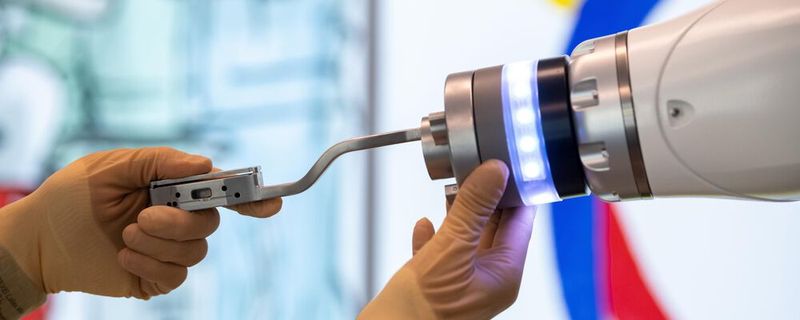
:quality(80)/p7i.vogel.de/wcms/4b/ed/4bed4cc3230087736cec57bf86ba611a/0121821199v1.jpeg "In its surgical solution, Orthokey relies on high-quality components, including the sensitive lightweight robot LBR Med from Kuka.(Image: Kuka)")
:quality(80)/p7i.vogel.de/wcms/f2/83/f283f3b4cc79537b11af5e2bedf17ac3/0121821202v1.jpeg "During the operation, the surgeon uses infrared markers to map the patient's anatomy on the robot system.(Image: Kuka)")
:quality(80)/p7i.vogel.de/wcms/6b/5c/6b5cf02ffa718f295c1b0194dce14c1e/0126983566v1.jpeg "Customized plastic hand splint manufactured using a 3D printer. (Image: ©mari1408 - stock.adobe.com)")
:quality(80)/p7i.vogel.de/wcms/d9/41/d941e1b8998814d001561be0a4977974/0125616599v1.jpeg "Researcher Carolin Müller from TUM Klinikum showcases a new robotic module developed for the case of a tension pneumothorax. (Image:TUM)")