The result of renewing an injection molding tool for ejector levers of relay modules at Phoenix Contact: less waste, less material, less energy, less CO2 emissions. The replacement of older tools can pay off.
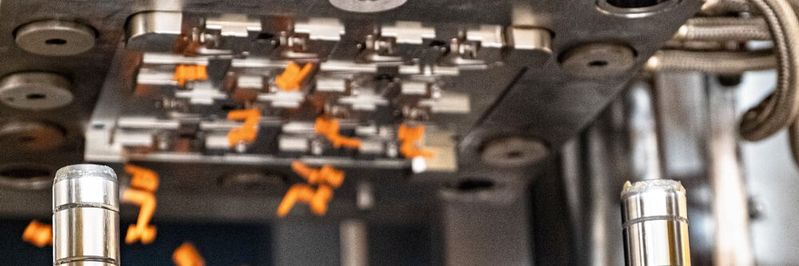
From eight to 16: With the new tool, productivity doubles while the amount of granulate required is halved.
(Image: Phoenix Contact)
Thorsten Sienk is a specialist editor for sustainability and technology, Corporate Communications, Phoenix Contact GmbH & Co. KG, Blomberg.
What potential lies in injection molding to handle plastic granules and energy more sparingly? What potential do tools in particular open up, which already have a construction year far in the past because of their longevity? After all, they come from a time when climate change and sustainability were hardly perceived by the general public.
Phoenix Contact has found answers to these questions by exemplarily converting a tool for ejector levers for relay modules. Less waste, less material, less energy, less CO2 emissions: The cost of around 100,000 Euros for building the new tool was quickly recouped. The Return on Investment (ROI) was less than a year. So it is worth taking a closer look, especially at older tools.
At Phoenix Contact, relay modules consist of a power contact relay with a relay base and an ejector in lever form. These components have been established technology in the electrical industry and control cabinet construction for decades. Production quantities are accordingly high. Since relays are so-called continuous runners, their production means are used for a long time. Evidence of this is the injection mould for the orange ejectors used to separate the relay from the socket, which was built in 1996. Thus, the unit has been serving for nearly 40 years. If it were a car, the injection mold would be classified as a vintage car with an H license plate. The fact that Phoenix Contact has now commissioned a new tool for this component is not due to a lack of manufacturing quality, but to aspects of sustainability—in this case, specifically to protect scarce resources.
Sprues cannot be used as recyclate
No waste, but instead the most economical and targeted use of non-renewable resources. Such sustainable action also pays off economically, as the example of the injection mould for the ejectors shows. Modern tools often come with a high five-figure cost. As already mentioned, the new tool for the ejectors costs about 100,000 Euros. This high investment sum makes it understandable to use tools that have been built once for as long as possible—even if they are long past tax depreciation periods.
This statement also applies to the ejector tool that went into operation in the mid-1990s. But why create a new one when the existing unit is still running well according to the principle "never change a running system"? Apart from climate protection and sustainability, the current shortage of raw materials is one of the key triggers for investing money at this point. The decision can be validated with a few figures. Before the tool change, the Phoenix Contact site in Bad Pyrmont consumed about 21 tons of granulate for the levers each year. The plastic is a dyed polyamide granulate, which is reinforced with glass fibers due to the required mechanical strength. Glass fibers provide stability and are effective against bending forces. However, this property makes it impossible to reintroduce sprues as recyclate back into the production cycle.
Eleven tons of material saved with hot runner system
So what is the key difference between the old and new tool? The new sixteen-compartment tool dispenses with all sprue channels and works in principle with a so-called hot runner system. Fine nozzles inject the liquid plastic directly into the mold while it closes precisely to vent. The visible sign of injection molding with hot runners is a small depression in the manufactured parts—known as a cap. "It results from the fact that the nozzle is placed in the tool there," explains Marco Schröder, team leader in component manufacturing at Phoenix Contact in Bad Pyrmont.
In the case of the ejector, the indentation is located in an area that lies invisibly inside the relay terminal after assembly. What sounds simple at first required a challenging approval process due to the design change. Despite this, the work and effort invested in completely redesigning the tool paid off—with a return on investment (ROI) of less than a year.
More waste than used plastic
With the old eight-compartment tool, the actual parts weighed only 6.8 grams—hence rounded 0.8 grams per ejector. However, the shot weight per cycle was an additional 7.5 grams. The non-usable waste thus amounted to a larger amount than the plastic for the eight ejectors. This is where the key reason for the quick amortization through saved resources comes in. The investment amount was—as mentioned—recouped after just a year solely by reducing the granulate. Marco Schröder: "The elimination of the sprue amounts to about eleven tons of material annually—which corresponds to around 100,000 Euros in purchasing. The total savings from the new tool are a little higher at 150,000 Euros."
Another advantage of the conversion results from the CO2 balance. With the newly conceived tool, CO2 emissions improve by 70 to 75 tons per year based on the calculation basis of database values. As an extended workbench of Phoenix Contact, Hadi-Plast GmbH also benefits from the new tool. "With us, the runners were constantly jamming and piling up into towers. Machine malfunctions hinder the workflow," remembers owner Dr. Karsten Anger. The fact that the double number of parts per cycle also saves production space and time also proves to be a plus point when evaluating this measure.
Date: 08.12.2025
Naturally, we always handle your personal data responsibly. Any personal data we receive from you is processed in accordance with applicable data protection legislation. For detailed information please see our privacy policy.
Consent to the use of data for promotional purposes
I hereby consent to Vogel Communications Group GmbH & Co. KG, Max-Planck-Str. 7-9, 97082 Würzburg including any affiliated companies according to §§ 15 et seq. AktG (hereafter: Vogel Communications Group) using my e-mail address to send editorial newsletters. A list of all affiliated companies can be found here
Newsletter content may include all products and services of any companies mentioned above, including for example specialist journals and books, events and fairs as well as event-related products and services, print and digital media offers and services such as additional (editorial) newsletters, raffles, lead campaigns, market research both online and offline, specialist webportals and e-learning offers. In case my personal telephone number has also been collected, it may be used for offers of aforementioned products, for services of the companies mentioned above, and market research purposes.
Additionally, my consent also includes the processing of my email address and telephone number for data matching for marketing purposes with select advertising partners such as LinkedIn, Google, and Meta. For this, Vogel Communications Group may transmit said data in hashed form to the advertising partners who then use said data to determine whether I am also a member of the mentioned advertising partner portals. Vogel Communications Group uses this feature for the purposes of re-targeting (up-selling, cross-selling, and customer loyalty), generating so-called look-alike audiences for acquisition of new customers, and as basis for exclusion for on-going advertising campaigns. Further information can be found in section “data matching for marketing purposes”.
In case I access protected data on Internet portals of Vogel Communications Group including any affiliated companies according to §§ 15 et seq. AktG, I need to provide further data in order to register for the access to such content. In return for this free access to editorial content, my data may be used in accordance with this consent for the purposes stated here. This does not apply to data matching for marketing purposes.
Right of revocation
I understand that I can revoke my consent at will. My revocation does not change the lawfulness of data processing that was conducted based on my consent leading up to my revocation. One option to declare my revocation is to use the contact form found at https://contact.vogel.de. In case I no longer wish to receive certain newsletters, I have subscribed to, I can also click on the unsubscribe link included at the end of a newsletter. Further information regarding my right of revocation and the implementation of it as well as the consequences of my revocation can be found in the data protection declaration, section editorial newsletter.
Develop optimization strategies together
Lack of raw materials, climate protection and above all, sustainable action out of inner conviction: The initial impulse to develop a new tool and replace a unit that has been running smoothly until now came from Hadi-Plast for the reasons mentioned. Even though the company from Hövelhof near Paderborn can initially be described as a supplier in its role: The cooperation between the two companies quickly led to a real partnership. This includes achieving process improvements together as well as producing in a more sustainable and resource-saving way. "We see ourselves as a system supplier who can master a process very well and thus can achieve more than a simple contract manufacturer," emphasizes Karsten Anger.
His company alone invested four million euros in new machines in 2022 and has thus developed into a flagship operation in terms of injection molding, Angerer says. This classification also includes how Hadi-Plast deals with its energy and the resources used. "Everything with us is designed for high efficiency. We want to increase the efficiency and consequently effectively limit losses." As an example, the managing director mentions the use of waste heat from production to heat the office building. "We no longer need gas at the site and even generate more heat than necessary."
Do more for climate protection
Anger draws his motivation to do more for climate protection from the future of his four children. "My family has been using green electricity for many years. This is personally important to me. I don't want to ruin anything on the back of the future. Balance is needed here." Karsten Anger views the close and reliable partnership with Phoenix Contact as a stable basis, which is necessary for long-term strategies. And it is precisely this aspect that Marco Schröder also appreciates, as Hadi-Plast has brought its competence into the project of the new injection moulding tool.



:quality(80)/p7i.vogel.de/wcms/dd/08/dd086510d9ae7b50181f6070e4463b44/0129363730v1.jpeg "Typical application for ionizing devices: Wrapping films. (Picture: ©Adobe Stock/SMC)")
:quality(80)/p7i.vogel.de/wcms/35/57/3557c819943c53acec41a0ccba87da4f/0130049064v1.jpeg "Researchers at the Fraunhofer IWU in Chemnitz have long known that many typical sheet metal parts can be manufactured more cost-effectively using hollow embossing rollers. Now there is news to report ... (Image:Fraunhofer IWU)")
:quality(80)/p7i.vogel.de/wcms/59/02/590246e3b3f415c65edbee377c14ca77/26-06-pi-fraunhofer-iws-41450-direktplattieren-pic-01-7771x4369v1v1.jpeg "The Fraunhofer IWS has developed the new \"direct laser cladding\" process, which creates a functional layer directly on the base body by applying a strip-shaped metal to rotationally symmetrical components in a spiral and bonding it locally by laser. (Image:Christoph Wilsnack/Fraunhofer IWS)")
:quality(80)/p7i.vogel.de/wcms/73/60/73608418789b1d9c393f5e2fa974eda2/0130209906v1.jpeg "The robots of the X6 generation from b+m enable very high painting quality and are also particularly compact and easy to maintain. (Image:Beckhoff)")
:quality(80)/p7i.vogel.de/wcms/78/e9/78e9188c25a8a94e67c34c9bf8ffe495/visual-agile-20robots-20and-20google-20deepmind-20partner-20to-20bring-20intelligence-20to-20robotics-2500x1406v1v1.jpeg "Together, the partners are developing adaptable, intelligent robots for a wide range of applications (Image:Agile Robots SE)")
:quality(80)/p7i.vogel.de/wcms/e7/66/e7669ecf0260ae8fc54c214e34e4902a/0130316817v1.jpeg "Siemens and Palo Alto Networks offer tested cybersecurity solution for industrial 5G. (Image:Siemens)")
:quality(80)/p7i.vogel.de/wcms/9f/55/9f55324832c4f426958031375124d9de/siemens-20ubtech-20hmnd-1920x1079v1v1.png "Ready for the factory floor: While Ubtech is planning mass production, Siemens is already testing humanoids in real factory applications in Erlangen. (Image:Siemens)")
:quality(80)/p7i.vogel.de/wcms/11/36/113695ed260e29c8c2d9d39dc5f9d869/0130213768v1.jpeg "AI can work cheaply in China and deliver the results rapidly all over the world. (Image:Dall-E / AI-generated)")
:quality(80)/p7i.vogel.de/wcms/62/5f/625f41e87ebfef156a98c8e6393e32fd/0130211654v1.jpeg "Axial flux motors have some advantages over radial flux motor—but their production is currently still expensive. (Image:RWTH Aachen University)")
:quality(80)/p7i.vogel.de/wcms/77/9b/779b0685d010dfe45c9c2cb1cfecd467/0128886425v1.jpeg "The BlueEye is the first \"real\" hyperspectral camera for the UV range and covers the wavelength range from 220 to 380nm. (Image:Inno-spec GmbH)")
:quality(80)/p7i.vogel.de/wcms/e4/51/e451d52ce0182fb0aaa46a5774f832ef/26-04-pi-fraunhofer-iws-21160-bioslide-pic-01-4128x2321v1v1.jpeg "With the BioSlide research project, the Fraunhofer IWS is investigating how sliding systems can be designed to be more sustainable and energy-efficient. New materials can be tested in a particularly application-oriented manner on this plain bearing test stand. (Image:Fraunhofer IWS)")
![Thanks to advanced 3D printing technology, a more efficient use of resources should contribute to lower-emission aviation—this is the goal of ['skai]-lab. (Image:Oleksandr Pashchenko - stock.adobe.com / AI-generated)](https://cdn1.vogel.de/nghHNSbySccfOjG3n1qCA-FVOjQ=/288x162/smart/filters:format(jpg):quality(80)/p7i.vogel.de/wcms/62/64/626424c97a16e69f871bf216c9629c2a/adobestock-1927043193--c2-a9-20oleksandr-20pashchenko-20-e2-80-93-20stock-adobe-com-ki-generiertv1v1.jpeg "Thanks to advanced 3D printing technology, a more efficient use of resources should contribute to lower-emission aviation—this is the goal of ['skai]-lab. (Image:Oleksandr Pashchenko - stock.adobe.com / AI-generated)")
:quality(80)/p7i.vogel.de/wcms/c3/c4/c3c4ce270b083eeac55654148611f064/0130237945v1.jpeg "China is not giving up on hydrogen, but is intensifying its efforts. (Image:freely licensed from Pixabay)")
:quality(80)/p7i.vogel.de/wcms/4e/c0/4ec0bd19390b169edfa23677373dcdf1/0130260089v1.jpeg "Renewable fuels can supply European road traffic, according to a study. (Image:Aral)")
:quality(80)/p7i.vogel.de/wcms/6f/c9/6fc9050301d745cad25585c6780f8f51/0130197341v1.jpeg "Production facilities are a worthwhile target and are therefore at risk. (Image:ABB Robotics)")
:quality(80)/p7i.vogel.de/wcms/b6/62/b662adc2cec8227d8172509bbfb6ee42/25c0207-107-4961x2789v1v1.jpeg "The GLB is the second model based on Mercedes' new MMA platform. Apparently, Geely's platform is better and cheaper, which is why the two companies are negotiating a partnership. (Image:Mercedes-Benz)")
:quality(80)/p7i.vogel.de/wcms/4d/dd/4dddf438e91f394c04a095dbfd109d1c/0130236430v1.jpeg "Measurement modules: The 720301 module in combination with the SL2000 enables RMS and power calculations, among other things. (Image:Yokogawa)")
:quality(80)/p7i.vogel.de/wcms/61/fc/61fcf95f5cca15494ad18343901ae585/0130317237v1.jpeg "With the AGI CPU, Arm says it is taking a \"historic step\": With the processor aimed at AI in data centers, the company is presenting itself for the first time as a provider of its own chips, not just as a pure IP licensor. (Image:Arm)")
:quality(80)/p7i.vogel.de/wcms/82/90/8290dfe3595b6c6b33726ae8b76172c7/0130319587v1.jpeg "The concept image illustrates how the pattern of tiny protrusions and depressions created on the substrate (MgO, bottom) controls the arrangement of atoms in the superconducting material (YBCO, top). At the interface between the two layers, an electronic structure enables superconductivity to occur at higher temperatures than previously possible. (Image:Chalmers University of Technology / Riccardo Arpaia)")
:fill(fff,0)/p7i.vogel.de/companies/69/88/69882c428938e/tmts2026-ticec-banner-en-2000px.png "tmts2026-ticec-banner-en-2000px (https://www.tmts.tw/en)")
:fill(fff,0)/p7i.vogel.de/companies/67/eb/67eba621ef6ea/logo2.png "logo2 (Wuxi InfiMotion)")
:quality(80)/p7i.vogel.de/wcms/f4/b7/f4b7c6c04ea25db63873db134881dce5/0116809663v1.jpeg "It's worth working closely together: Marco Schröder (left) and Dr. Karsten Angerer are pleased about the sustainable success of the conversion project.(Image: Phoenix Contact)")
:quality(80)/p7i.vogel.de/wcms/70/65/7065fcb732de64282a1546e5255e80d4/0116809665v1.jpeg "No waste, no disturbances: Thanks to the new tool, Hadi-Plast was able to improve the production process.(Image: Phoenix Contact)")
:quality(80)/p7i.vogel.de/wcms/d9/27/d927787e6b64b888993ebcfea1c86f11/0116809668v1.jpeg "The ejectors for the relay modules weigh less than a gram.(Image: Phoenix Contact)")
:quality(80)/p7i.vogel.de/wcms/2d/6b/2d6bd16b95addf2f5af068841df0d585/0117129668v1.jpeg "From eight to 16: With the new tool, productivity doubles while the amount of granulate required is halved.(Image: Phoenix Contact)")
:quality(80)/p7i.vogel.de/wcms/c9/9c/c99c57d6ca20002966fec4a251bc7262/image-1-duo-700-small-1920x1079v1.jpeg "Functionalised rear-end-lights are produced on the ENGEL duo 700 – with high precision and using clearmelt and foilmelt in a single integrated process with a compact footprint. (Image: ENGEL)")
:quality(80)/p7i.vogel.de/wcms/cf/b8/cfb85f27d7786bc99685ec5a2639a410/0129003760v1.jpeg "Setting a good example ourselves: Igus has already automated its production and logistics with low-cost automation components at 2,500 locations. (Image:Igus)")