They insert components into injection molding machines, remove the sprue or support assembly: Igus uses examples from its own company to show how monotonous tasks can be automated with low-cost automation components. Some of the solutions pay for themselves after just two months.
Setting a good example ourselves: Igus has already automated its production and logistics with low-cost automation components at 2,500 locations.
(Image: Igus)
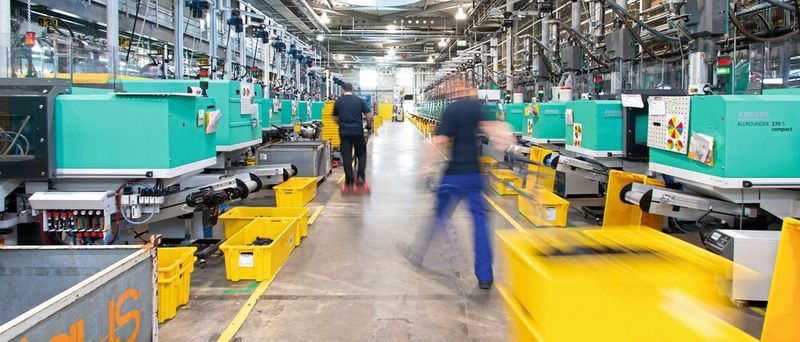
From energy chains weighing hundreds of pounds to plain bearings weighing just a few grams: whenever components made of high-performance plastic are required, the Cologne-based company (Germany) Igus is a sought-after address worldwide. At its headquarters in Cologne (Germany) alone, the Rhinelanders operate over 1,000 injection molding machines that produce over a billion parts every year. But the company's success is not a sure-fire success.
Igus is also facing challenges, says Alexander Mühlens, authorized signatory and Head of the Low-Cost Automation division at Igus: "Among other things, it is becoming increasingly difficult to get people interested in routine tasks, such as inserting components into injection moulding machines. We have therefore launched an initiative called 'No boring jobs', which automates monotonous activities. We are now successfully using robot solutions in over 1,500 positions in production and logistics. This allows us to continue producing successfully despite a shortage of labor and at the same time focus on training valuable employees for more demanding tasks."
Virtually all automation solutions are more cost-effective than average. This is because Igus only uses components that can be found on RBTX.de. This is an online marketplace where the company offers more than 1,000 low-cost robots and components from over 200 well-known manufacturers, which can be easily combined according to the modular principle—always with a compatibility guarantee. The motto is: robotics for everyone, even for small and medium-sized companies with small budgets and little automation experience. "Our factory is the best proof that we trust our own low-cost products," emphasizes Mühlens.
Robots Remove Sprue on Aound 1,000 Injection Molding Machines
Igus relies on low-cost automation for injection molding machines, for example. A "boring job" here is to remove the so-called sprue from injection molded parts. After cooling, this excess material remains attached to the component. Removing the material and collecting it in a recycling container used to be tedious and laborious manual work. Igus has therefore automated it with various solutions:
The standard sprue picker moves between the injection mold halves and grabs the sprue while the articles are ejected onto a conveyor belt.
Another solution is sprue separation directly behind the injection molding machine. A rotating disk is positioned under the machine's discharge chute, onto which the freshly moulded components fall. A camera identifies the position of the components so that a low-cost gantry robot with a gripper can pick them up. Two brushes then remove the sprue from the article, which then falls into a box.
In addition, downstream sprue separation also takes place. Here, the articles are collected in boxes at the injection molding machine and later separated from the sprue in a pick-and-place cell.
"With the help of these solutions, we have managed to automate sprue removal on our approximately 1,000 injection molding machines at low cost," says Mühlens. "A complete system like this, which consists exclusively of components from the RBTX marketplace, costs just under 11,700 USD, which is a fraction of the cost of a standard automation solution on the market."
Rebel Cobot Prints Components And Drills Threads
Drilling threads into rod ends made of high-performance plastic is also strenuous manual work—over 20,000 times a day. To transfer this work to machines, Igus relies on the Rebel, a compact and cost-effective cobot that the company has developed for simple automation tasks. It is made almost entirely of high-performance plastic, weighs just 18 lb and can handle loads of up to two kilograms. The cobot—which now has a license to work in the vicinity of people without a protective housing—picks up the rod ends from a rotating disc with a gripper and holds them under a tap.
The articulated arm robot is also used for marking semi-finished products on extrusion systems. Equipped with a compact, tubular inkjet printing unit on the robot hand, the Rebel can print on up to 16 cavities. It can be easily programmed using the Igus Robot Control software. The software has a virtual twin that can be used to define movement paths in just a few minutes—without any programming knowledge.
Rebel Move Transports Components Safely from A to B
Igus relies on the autonomous mobile robot Rebel Move for the provision of tools and materials at workstations, as well as transportation to production and packaging machines, for just 35,900 USD. The AMR can optionally be combined with the Rebel Cobot. With an operating time of 8 hours, a payload of 110 lb and a tensile weight of up to 220 lb, the AMR is extremely powerful. It can be set up quickly and operated easily via an intuitive app. The entire commissioning process is so easy that users can program simple jobs within 15 minutes. Integration into established IT landscapes is also no problem thanks to interfaces such as IoT, VDA 5050, REST, SAP and ERP.
Date: 08.12.2025
Naturally, we always handle your personal data responsibly. Any personal data we receive from you is processed in accordance with applicable data protection legislation. For detailed information please see our privacy policy.
Consent to the use of data for promotional purposes
I hereby consent to Vogel Communications Group GmbH & Co. KG, Max-Planck-Str. 7-9, 97082 Würzburg including any affiliated companies according to §§ 15 et seq. AktG (hereafter: Vogel Communications Group) using my e-mail address to send editorial newsletters. A list of all affiliated companies can be found here
Newsletter content may include all products and services of any companies mentioned above, including for example specialist journals and books, events and fairs as well as event-related products and services, print and digital media offers and services such as additional (editorial) newsletters, raffles, lead campaigns, market research both online and offline, specialist webportals and e-learning offers. In case my personal telephone number has also been collected, it may be used for offers of aforementioned products, for services of the companies mentioned above, and market research purposes.
Additionally, my consent also includes the processing of my email address and telephone number for data matching for marketing purposes with select advertising partners such as LinkedIn, Google, and Meta. For this, Vogel Communications Group may transmit said data in hashed form to the advertising partners who then use said data to determine whether I am also a member of the mentioned advertising partner portals. Vogel Communications Group uses this feature for the purposes of re-targeting (up-selling, cross-selling, and customer loyalty), generating so-called look-alike audiences for acquisition of new customers, and as basis for exclusion for on-going advertising campaigns. Further information can be found in section “data matching for marketing purposes”.
In case I access protected data on Internet portals of Vogel Communications Group including any affiliated companies according to §§ 15 et seq. AktG, I need to provide further data in order to register for the access to such content. In return for this free access to editorial content, my data may be used in accordance with this consent for the purposes stated here. This does not apply to data matching for marketing purposes.
Right of revocation
I understand that I can revoke my consent at will. My revocation does not change the lawfulness of data processing that was conducted based on my consent leading up to my revocation. One option to declare my revocation is to use the contact form found at https://contact.vogel.de. In case I no longer wish to receive certain newsletters, I have subscribed to, I can also click on the unsubscribe link included at the end of a newsletter. Further information regarding my right of revocation and the implementation of it as well as the consequences of my revocation can be found in the data protection declaration, section editorial newsletter.
Igus has developed the Rebel Move Pro for even more load capacity and higher speed. It travels at a speed of 6.6 ft per second and allows 440 lb of load capacity and 1,980 lb of tensile weight. Precise navigation using lidar technology increases safety and efficiency in logistics.
Delta Robot Supports the Assembly of E-Chains
Igus products, which are used in industries all over the world, also include energy chains. For the assembly of these e-chains, Igus has been using automatic assembly machines for several years, which connect the individual chain links. The company has installed Delta robots to feed them into the machine. They use a camera to recognize the chain links, which are pre-separated by a hopper conveyor and then separated from the sprue by a rotating disc. The delta robots pick them up and feed them to the assembly machine. Depending on the article, they achieve a cycle time of two seconds. "The price for the system, including the protective housing, is just under 52,650 USD. The return on investment is therefore usually achieved in nine months," says Mühlens.
Room Gantries Load Injection Molding Machines
There are other candidates on Igus' "no-boring jobs list". One of them is the insertion of products such as linear slides into injection molding machines. In the past, employees had to insert the products into the machine and wait for a process time of 40 seconds—hundreds of times a day. Today, this job is done by a low-cost gantry robot called "Ispel". The abbreviation stands for Igus injection molding inserter. The solution works as follows:
The linear slides are stored as bulk material in a container.
A step conveyor transports the slides onto a chute, where they land on a rotating unit that ensures separation.
A camera recognizes the position of the parts from a bird's eye view so that a suction gripper can pick up four parts at a time and place them in a transfer station.
A second gantry robot then inserts these into the injection molding machine.
The project costs for this type of gantry are usually around 25,740 USD. Alternatively, the Rebel, an articulated arm robot that inserts small spherical caps into injection molding machines at Igus, for example, is also suitable for loading work.
Solutions Must Pay for Themselves in Less than A Year
Automation at Igus is still in its infancy, but the vision is a big one: humanoid robots that will be able to move as freely as human colleagues in production in the future and use the entire infrastructure—rom the door handle to the touchscreen for machine control. An intermediate step on this path is the Rebel Move, a flat, autonomous vehicle that can, for example, piggyback and transport containers with injection molded parts. However, the solutions should always remain one thing: cost-effective and easy to operate. Alexander Mühlens: "We always aim for a return on investment of less than twelve months. Some of our solutions pay for themselves after just two months. With these prices, we make it possible for smaller companies to benefit from robotics and thus strengthen their competitiveness."
Longer service life of battery-based energy storage systems



:quality(80)/p7i.vogel.de/wcms/17/b8/17b8af0cb725e0e1d3e8d72458bab260/siemens-meet-at-the-machinev1.jpeg "“Meet at the Machine” is Siemens’ new initiative, which aims to bring together machine builders, software, and automation technologies to accelerate innovation in the machine tool industry and help manufacturers become productive more quickly. (Source: Siemens)")
:quality(80)/p7i.vogel.de/wcms/8e/7e/8e7e0cda4c68699bcc48283a38739769/0133316747v1.jpeg "A little-known hidden champion! When people think of laser cutting, the first thing that comes to mind is the power of the laser beam—and it is impressive to see the sparks flying. But Air Liquide—an exhibitor at Euroblech, by the way—wants to make it clear that the process gas is also key to success. (Image:AI-generated)")
:quality(80)/p7i.vogel.de/wcms/20/fa/20fa35e0af203c3464f7e7fdbb57a685/0133281172v1.jpeg "Since 2003, Etzinger AG has been developing and manufacturing high-quality coffee grinders, pepper mills, and grinding mechanisms for professional and home use. (Image:Etzinger)")
:quality(80)/p7i.vogel.de/wcms/69/91/6991413943488b4a2f6fde9dcd88c5b0/0133256686v1.jpeg "The CMA-patented pendulum mount can compensate for radial tolerances of up to one millimeter. (Image:Schwiening)")
:quality(80)/p7i.vogel.de/wcms/38/79/38799bfbbccd938b64c67068cfa68780/0133329362v1.jpeg "What exactly enables machines to act on their own? (Image:Shutterstock)")
:quality(80)/p7i.vogel.de/wcms/1b/9f/1b9fc9f113fc66212e2c0e17a3edaf9f/org-blobs-user-response-file-output-f317796f-57b7-483f-9403-5d9ac8a816f5-plugin-output-call-kdigtepb7be7us8xvbota0mh-1672x940v1.png "According to Barclays data, Europe leads the global trade in actuator components. With a 34 percent share, the region ranks ahead of China, which has a 26.3 percent share. (Source: Statista | CC BY-ND 4.0, AI-generated)")
:quality(80)/p7i.vogel.de/wcms/f5/4c/f54c9fc59ccb0604ab9219188469a45f/image1v1.jpeg "Christopher Savoia, Global Head of the UR+ Ecosystem at Universal Robots, presents the new SP7 Smart Panel on a UR17g-1300 robot during the unveiling of Gen 7—UR’s 7th-generation robot platform—at IMTS in Chicago on September 14, 2026. (Image:Image: Teradyne Robotics)")
:quality(80)/p7i.vogel.de/wcms/bd/4e/bd4ef09ab0f84932ea76ca0330ffe789/0133329802v1.jpeg "The robotics boom and its consequences: According to a study, a significant portion of value creation occurs in the electronics industry. (Image:Fraunhofer IPA)")
:quality(80)/p7i.vogel.de/wcms/87/87/87870cf2b30aaef7b8a06212a4ef2c14/0133403885v1.jpeg "A digital twin and a real component demonstrate how closely simulation and manufacturing are converging. Stampack Xpress 2026.1 virtually models forming behavior and supports the validation of process and tool design. (Image:Stampack)")
:quality(80)/p7i.vogel.de/wcms/59/2a/592a7f2d0964e9e6846cae331f5daa3a/0133266065v1.jpeg "Perforated metal sheets are particularly well-suited for balcony railings, as they combine stability, privacy, and design versatility. (Image:Ripo Factory)")
:quality(80)/p7i.vogel.de/wcms/45/64/45642ff0fe0a6bec251b77739131d83b/abb-ferrari-hypersail-16-9-three-quarter-front-viewv1.jpeg "The Ferrari Hypersail is a 100-foot monohull wing-in-plane yacht powered entirely by renewable energy. (Source: ABB / Ferrari Hypersail)")
:quality(80)/p7i.vogel.de/wcms/3e/0e/3e0e3ea22e48410ceada53b02ffccb59/0133358454v1.jpeg "BYD top executive Stella Li plans to offer megawatt flash charging for commercial vehicles as well. (Image:VDA/IAA Transportation 2026)")
:quality(80)/p7i.vogel.de/wcms/e2/7d/e27de60472809cc58ac0d321066c9679/l1051833v1.jpeg "Geely has acquired a stake of just over 26 percent in Renault do Brasil. Geely models for the South American market are now also being produced at the Ayrton Senna plant in São José dos Pinhais. (Image:Renault)")
:quality(80)/p7i.vogel.de/wcms/1e/c1/1ec1495eb283200f4b7cb55de0c4dff7/20260917-110436643v1.jpeg "Ceremonial launch of Mercedes-Benz GLA production in Rastatt; among those in attendance was plant manager Marco Zwick (second from the right). (Source: Thomas Günnel – Automotive Industry)")
:quality(80)/p7i.vogel.de/wcms/76/f3/76f310eed0caebc79ff91195c29de08d/visual-siwa-treatment-optimizerv1.jpeg "A Mireo train from Siemens Mobility was used in the “Automated Train” project for a fully automated delivery and return trip on the open rail network. (Source: Siemens Mobility)")
:quality(80)/p7i.vogel.de/wcms/4c/53/4c534208d09a9b1ce597938715e7fc19/0133288763v1.jpeg "Logic Folding: In its latest Kirin 9050 Pro, Huawei uses hybrid bonding to distribute the computing units across two silicon layers in order to increase the effective transistor density without resorting to finer manufacturing processes. (Image:Huawei)")
:quality(80)/p7i.vogel.de/wcms/56/d1/56d131e0b5bd05ef47411e92ad740cb4/0133351029v1.jpeg "Researchers at DTU have developed a nanolaser in a semiconductor membrane. The structure concentrates charge carriers and the light field into a small area (shaded in blue). If data is transmitted on microchips using light instead of electrical signals, transmission speeds can be increased and energy losses reduced. (Image:Yi Yu, DTU)")
:quality(80)/p7i.vogel.de/wcms/5e/55/5e55101ddc6338f755fcf3244db1367f/0133331863v1.jpeg "For data center projects, it is becoming increasingly important to also obtain the consent of the affected community. (Image:Dall-E / AI-generated)")
:quality(80)/p7i.vogel.de/wcms/8d/f9/8df95d3f58408673986b3d643e6b63ba/0133252773v1.jpeg "TXC targets high-speed optical links in AI data centers with 312.5 MHz oscillators, among other solutions. As data rates increase, requirements for jitter and frequency stability become more demanding as well. (Bild: TXC)")
:fill(fff,0)/p7i.vogel.de/companies/69/88/69882c428938e/tmts2026-ticec-banner-en-2000px.png "tmts2026-ticec-banner-en-2000px (https://www.tmts.tw/en)")
:fill(fff,0)/p7i.vogel.de/companies/69/de/69de1b7403b0d/simtos-logo.jpeg "simtos-logo (SIMTOS)")
:quality(80)/p7i.vogel.de/wcms/2d/d8/2dd846ff779bd5a9fd2d3f5a7903e702/0128280708v1.jpeg "Igus relies on its low-cost Delta robots for the downstream separation of sprue and injection-molded parts.(Image: Igus)")
:quality(80)/p7i.vogel.de/wcms/fb/f1/fbf177ea1c147ae22cadeae70df2c3d2/0128280710v1.jpeg "The Robofeed delta robot supports the assembly of Igus e-chains.(Image: Igus)")
:quality(80)/p7i.vogel.de/wcms/90/3d/903d46f86f8cd7d4ec0f9ca1d2fce17f/0128280718v1.jpeg "... which, among other things, transports rotary stacking containers with components from injection molding machines.(Image: Igus)")
:quality(80)/p7i.vogel.de/wcms/a9/39/a9398ad05f775c544bcfada443a567a1/0128280725v1.jpeg "The articulated arm robot Rebel is used, among other things, for marking semi-finished products on extrusion lines and for drilling threads in rod ends made of high-performance plastic.(Image: Igus)")
:quality(80):fill(efefef,0)/p7i.vogel.de/wcms/65/40/6540d82b23290/semitron-wp13-whitepaper-cover.png "Semitron_WP13_Whitepaper-Cover")
:quality(80)/p7i.vogel.de/wcms/37/8f/378f38b1ee4ff39af46906a5629da178/0127960109v1.jpeg "The solution from Igus improves process stability and workplace ergonomics in everyday manufacturing. (Image:Igus)")
:quality(80)/p7i.vogel.de/wcms/61/4a/614aa5816dcfc72ecb01032b2bb85255/igus-20iggy-20rob-20home-3507x1973v1v1.jpeg "Specifically designed for use in the service sector, igus has developed a new cost-effective and CE-compliant humanoid robot called Iggy Rob Home. (Image: Igus SE & Co. KG)")