"A tech company working with cars" is Luca de Meo's goal for the Renault Group. As ACEA President, he calls for a targeted industrial policy from the EU.
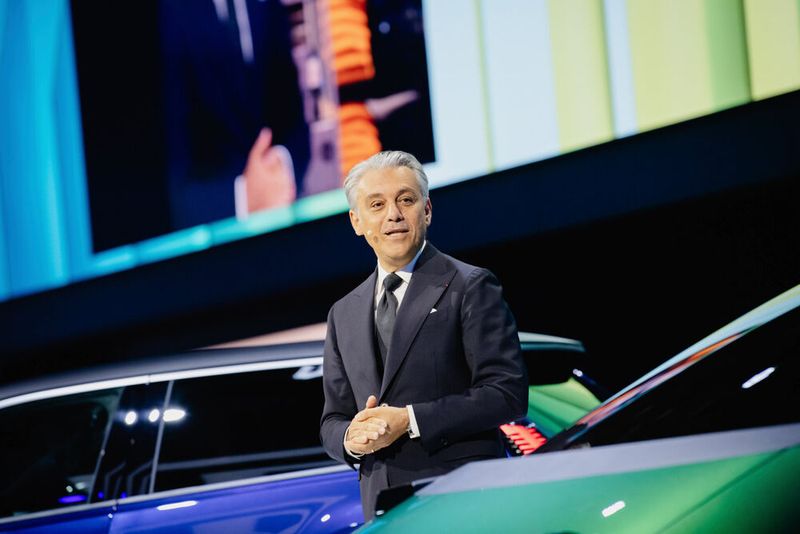
Renault boss and current ACEA President Luca de Meo at the 2024 Paris Motor Show: "We cannot do without cooperation with China."
(Image: Nicolas Lascourrèges)
The Renault Group is in the midst of the "Renaulution," a three-phase plan with which CEO Luca de Meo has been revitalizing the company since 2021. In 2020, Renault recorded a record loss of 8.48 billion USD. For 2024, with corporate revenues of about 53 billion USD, an operating margin of 7.5 percent and a free cash flow of about 2.65 billion USD are expected. The CEO is satisfied, noting that Renault is the only European car manufacturer that has not had to revise its financial targets downward, he recently said to the Neue Zürcher Zeitung.
Profitable "renovation"
In 2023, the "Renovation" phase began, scheduled to run until 2025: new models and the cross-brand use of standardized platforms, battery technology, and electronic architectures are expected to increase profitability. De Meo aims to reduce fixed costs by three billion euros and cut costs per vehicle by 636 USD. Additionally, higher-priced vehicles, especially in European markets, are intended to improve profit.
We will halve the battery price over the next ten years.
Until 2021, Renault was primarily a small car provider. Since then, the sales share of more profitable compact vehicles has increased from 30 to 43 percent. Just over 30 percent of the vehicles sold by the Renault Group in Europe during the first nine months of 2024 are electrified.
Reduce list prices by 40 percent
To provide the technologies necessary for electrification faster and, above all, more cheaply, a dedicated electric division, Ampere, was formed at the end of 2023. "Ampere combines the best of both worlds: the experience and strength of a leading car manufacturer with the agility and innovative spirit of a newcomer," said Luca de Meo, adding, "We will halve the battery price in the next ten years."
The new business unit develops electric vehicles, battery technology, and software—also for partner Nissan—and oversees the production and marketing of the group's electric cars. Ampere pursues ambitious goals: to reduce list prices for electric vehicles in the C-segment by 40 percent by 2028, thereby reaching the price level of combustion models. By 2031, Ampere aims to produce around one million electric vehicles annually and establish a product range with seven models for all key segments.
Renault's EV hub in Northern France
Ampere is also the operator of the industrial cluster "Renault ElectriCity" in northern France, where 400,000 electric cars are set to be produced annually starting next year. The three northern French locations Douai, with 11,000 employees, Maubeuge, and Ruitz, work together as a production network. A battery factory with a capacity of up to 24 gigawatt-hours (by 2030) is currently being built in Douai. Partners in this project are LG Chem, Envision AESC (a joint venture of Nissan Motor, NEC, and NEC Energy Devices), and battery specialist Verkor.
In Douai, the all-electric Mégane based on the CMF-EV platform of the Renault-Nissan-Mitsubishi alliance, the Scénic E-Tech Electric, and the R5 E-Tech Electric are currently rolling off the production lines. The latter is already based on the new AmpR-Small platform, which will also be slightly modified for use in the future E-Twingo. In Maubeuge, all Kangoo models are manufactured, and in the future, the Renault 4 Electric will also be produced there. Ruitz supplies electrical components.
De Meo places great hope in the revival of the R5. The small car, which sold millions in the seventies, is now coming to market as a modern-styled city electric vehicle. "We need to return to a balanced mix of premium cars and cars that people can buy," he is convinced. Also in the pipeline for 2025 are two microcar models as successors to the discontinued Twizy: the 95.87 inches short two-seater (tandem) "Duo" and the mini-van variant "Bento." The new E-Twingo is set to follow in 2026 as an entry-level model with a base price of around21,200 USD.
Revolution: "Faster than our competitors"
In 2025, phase three of the "Renaulution," the "revolution," is set to be launched. De Meo aims not only to become "the greenest brand on the market" but also to lead in digitalization and smart data. By 2030, 20 percent of the group's revenue is to be generated from mobility services, services, data, and energy trading.
"Our vehicles must be equipped like a smartphone, so we can update them throughout their life cycle and continuously adapt them to the needs and requirements of users. I want to ensure that Renault can do this faster and better than our competitors," said the CEO in a company video. In 2026, Renault aims to be the first OEM in Europe to launch such a "software-defined" car, where central software controls everything—from the drive system to charging to the air conditioning.
Date: 08.12.2025
Naturally, we always handle your personal data responsibly. Any personal data we receive from you is processed in accordance with applicable data protection legislation. For detailed information please see our privacy policy.
Consent to the use of data for promotional purposes
I hereby consent to Vogel Communications Group GmbH & Co. KG, Max-Planck-Str. 7-9, 97082 Würzburg including any affiliated companies according to §§ 15 et seq. AktG (hereafter: Vogel Communications Group) using my e-mail address to send editorial newsletters. A list of all affiliated companies can be found here
Newsletter content may include all products and services of any companies mentioned above, including for example specialist journals and books, events and fairs as well as event-related products and services, print and digital media offers and services such as additional (editorial) newsletters, raffles, lead campaigns, market research both online and offline, specialist webportals and e-learning offers. In case my personal telephone number has also been collected, it may be used for offers of aforementioned products, for services of the companies mentioned above, and market research purposes.
Additionally, my consent also includes the processing of my email address and telephone number for data matching for marketing purposes with select advertising partners such as LinkedIn, Google, and Meta. For this, Vogel Communications Group may transmit said data in hashed form to the advertising partners who then use said data to determine whether I am also a member of the mentioned advertising partner portals. Vogel Communications Group uses this feature for the purposes of re-targeting (up-selling, cross-selling, and customer loyalty), generating so-called look-alike audiences for acquisition of new customers, and as basis for exclusion for on-going advertising campaigns. Further information can be found in section “data matching for marketing purposes”.
In case I access protected data on Internet portals of Vogel Communications Group including any affiliated companies according to §§ 15 et seq. AktG, I need to provide further data in order to register for the access to such content. In return for this free access to editorial content, my data may be used in accordance with this consent for the purposes stated here. This does not apply to data matching for marketing purposes.
Right of revocation
I understand that I can revoke my consent at will. My revocation does not change the lawfulness of data processing that was conducted based on my consent leading up to my revocation. One option to declare my revocation is to use the contact form found at https://contact.vogel.de. In case I no longer wish to receive certain newsletters, I have subscribed to, I can also click on the unsubscribe link included at the end of a newsletter. Further information regarding my right of revocation and the implementation of it as well as the consequences of my revocation can be found in the data protection declaration, section editorial newsletter.
Everyone talks about 2035, but we should rather talk about 2025, because by then we will already be in trouble.
"We need a strategic industrial policy"
Since January 2023, Luca de Meo has also been President of the European Manufacturers Association ACEA. In this role, he urges car manufacturers to use cooperation to be better prepared for current and future challenges, for example, by sharing investment costs. He explains that the example of Airbus shows how European collaboration can work well. At the same time, he presents himself as a persistent critic of the EU and the Brussels authorities, especially regarding the CO2 emission targets for OEMs. "The EU only invents regulations but has no strategy. We need a strategic industrial policy."
Luca de Meo on ...
... the current challenges of the automotive industry in Europe, possible solutions, China as a pioneer, and the failure of the e-car cooperation with Volkswagen:
The challenges "In the automotive industry, the age-old mantra was size and efficiency. Now a new imperative has emerged: innovation and strategic agility. This is what automakers must now focus on."
"I am deeply convinced today that we also need a collective response and authorities capable of coordinating a European mobilization if we want our automotive industry to reach its full potential." "We are ready to coordinate with all relevant institutions and stakeholders. The prosperity of our continent is at stake."
The threat
"In the global competition for the electric car, three radically different strategies are opposed: China relies on a determined and ambitious industrial strategy [...]; the USA focuses on economic promotion [...]; Europe regulates as much as possible." "Simply imposing fines and setting deadlines without any flexibility is very dangerous."
Possible solutions
"If politics wants rapid growth for electric cars, it has to do something about it." [...] "Europe probably needs a mixed model with short-term protection of our industry and cooperation. I don't believe we can decarbonize transport and switch to e-vehicles without collaborating with other economic blocs."4
China as a partner
"We cannot do without cooperation with China. It has a generational lead in electromobility and control over the entire value chain."4
The time problem
"The pace of automotive electrification ramp-up is half as fast as what we need to achieve the targets where no fines are threatened." "According to our calculations, the European automotive industry could face fines of up to 15.9 billion USDif the electrification rate remains at the current level. Or it would have to forego the production of more than 2.5 million vehicle units. Everyone talks about 2035, [...] but we should talk about 2025, because by then we are already in trouble."
The failed e-car cooperation with VW
"I wanted to show that the European industry can work together as a team. So I think this is a missed opportunity. But maybe there is someone else."6 "For me personally, it would have been a strong symbol if two large European traditional houses had joined forces in this revolution."7
Recording
Our "recordings" are composed of quotes in renowned publications. This text form allows us to present the thoughts, strategies, and goals of top managers from the automotive industry promptly—focused on current topics and as concise as no typical interview can manage. Sources:
1 Autos.yahoo.com, 22.2.2024
2 Brief an Europa, www.renaultgroup.com, 19.3.2024



:quality(80)/p7i.vogel.de/wcms/a0/47/a04725ef9bd09fb6c9341a1bea1b5d93/0130443083v1.jpeg "Here, a type of plastic pallet is produced by thermoforming (vacuum forming or deep drawing) at the corresponding division of New England Plastics in the USA. This division, which specializes in so-called liners, is now part of Ringmetall ... (Image:New England Plastics)")
:quality(80)/p7i.vogel.de/wcms/e3/42/e342b3c593ea92d56604d3be969e9c9a/0130437231v1.jpeg "Daimler Truck will be building even more trucks at its Czech plant in Cheb in the future. This is because it is now being expanded for strategic cost-saving reasons ... (Image:Daimler Truck)")
:quality(80)/p7i.vogel.de/wcms/23/99/23992bf2dcdc432c9b7209c34a4a7c48/0129733089v1.jpeg "Stork relies on the modular Neoswiss turning system from Iscar to shorten the set-up times for its sliding headstock lathes and work more productively. (Image:Iscar)")
:quality(80)/p7i.vogel.de/wcms/7d/e2/7de2923434b2f1a78ba5482d8d335269/0113143253v1.jpeg "In our China Market Insider we regularly provide you with relevant information directly from China. (Image:© Eisenhans - stock.adobe.com)")
:quality(80)/p7i.vogel.de/wcms/b7/36/b736dfebc16c42d6901d0d0e1f390493/3d-druck-20factory-20--20ki-20generiert-1920x1079v1.png "(Source: AI-generated)")
:quality(80)/p7i.vogel.de/wcms/79/b2/79b21aad663f4a7bd4472afc1c1afc62/0130433994v1.jpeg "Mission Joyride: The free-flying robot (shown here in the rendering) will relieve the ISS crew of logistics tasks from 2027 with its two mechanical arms. (Image:Icarus Robotics)")
:quality(80)/p7i.vogel.de/wcms/6b/45/6b4546fa6ebf305c3660326909363f32/0130437089v1.jpeg "Industrial AI in action: Rockwell Automation presents practical solutions for self-controlling production systems at the Hannover Messe. (Image:Rainer Jensen, Deutsche Messe)")
:quality(80)/p7i.vogel.de/wcms/78/e9/78e9188c25a8a94e67c34c9bf8ffe495/visual-agile-20robots-20and-20google-20deepmind-20partner-20to-20bring-20intelligence-20to-20robotics-2500x1406v1v1.jpeg "Together, the partners are developing adaptable, intelligent robots for a wide range of applications (Image:Agile Robots SE)")
:quality(80)/p7i.vogel.de/wcms/59/a2/59a2b11f0aa1b700eff02addd5de8703/adobestock-1788280853--c2-a9-20satria-20-e2-80-93-20stock-adobe-com-5081x2860v1v1.jpeg "Quantum computers require extreme cooling to temperatures close to absolute zero in order to keep qubits stable. (Image:satria - stock.adobe.com)")
:quality(80)/p7i.vogel.de/wcms/62/5f/625f41e87ebfef156a98c8e6393e32fd/0130211654v1.jpeg "Axial flux motors have some advantages over radial flux motor—but their production is currently still expensive. (Image:RWTH Aachen University)")
:quality(80)/p7i.vogel.de/wcms/f6/ae/f6aec4f6241b36ed5e3a990ac9176b42/0130429460v1.jpeg "Verne, Pony.ai and Uber want to launch a robotaxi service in Europe. (Image:Verne)")
:quality(80)/p7i.vogel.de/wcms/d7/88/d788699f2974708a332baa4e7a62fa9e/0130438967v1.jpeg "Skoda is withdrawing from China. The brand has produced well over three million vehicles there. (Image:Skoda car)")
:quality(80)/p7i.vogel.de/wcms/b0/43/b043b86899837532aad62d63368a917a/0130371361v1.jpeg "Skoda leaves the chinese market.
(Image:Skoda)")
:quality(80)/p7i.vogel.de/wcms/c3/c4/c3c4ce270b083eeac55654148611f064/0130237945v1.jpeg "China is not giving up on hydrogen, but is intensifying its efforts. (Image:freely licensed from Pixabay)")
:quality(80)/p7i.vogel.de/wcms/ee/09/ee09acbd6dc896df25affaa9e871e6e5/0130440053v1.jpeg "IMS chip module for simple system integration into an ion mobility spectrometer. (Image:Fraunhofer IPMS)")
:quality(80)/p7i.vogel.de/wcms/10/6c/106cd22de5f68a0f74639d654827228c/0130345302v1.jpeg "Made in India: According to the India Electronics and Semiconductor Association (IESA), the country should be able to produce between 75 and 80 million chips by the beginning of 2027, once the plants currently under construction become operational. (Image:Pixabay (Montage: Sebastian Gerstl))")
:quality(80)/p7i.vogel.de/wcms/a5/ed/a5ed6fda029d362732a293d6b19d74c4/0130444216v1.jpeg "Thirteen executives from the Chinese chip industry have drawn up a plan to achieve an 80% self-sufficiency rate for semiconductors by 2030. (Image:Maxim_Kazmin - stock.adobe.com)")
:quality(80)/p7i.vogel.de/wcms/31/a6/31a646018b34d8e0a44bfc8bf17837f6/0130361632v1.jpeg "For many companies, PFAS are considered indispensable in electronics production. (Image:freely licensed)")
:fill(fff,0)/images.vogel.de/vogelonline/companyimg/76800/76895/65.jpg "FAULHABER_120mm.jpg ()")
:quality(80)/p7i.vogel.de/wcms/57/28/5728623acd92b810a1462471cb87a474/0128389554v1.jpeg "Cooperation for e-mobility. Ford, together with Renault, has designed two electric car models (symbolic image) that will soon be offered in Europe. It is emphasized that the aim is to be especially affordable to hinder China's entry into the European market. (Image:Ford)")
:quality(80)/p7i.vogel.de/wcms/d5/52/d55266362c63b1c618f64931529cb009/0126787309v1.jpeg "For the new Micra, Nissan collaborates closely with Renault. (Image:Nissan)")