New ModelsNissan Micra—Independent in Exterior And Chassis
From
Tomas Hirschberger/SP-X | Translated by AI
5 min Reading Time
With the Nissan Micra, an almost iconic compact car name returns to the automotive stage. Completely restyled, with a fully electric drive and the technology of its sibling Renault 5.
For the new Micra, Nissan collaborates closely with Renault.
(Image: Nissan)
Nissan has always said so when it came to their iconic city car Micra. Since the early 1980s, the Japan mini has stood for affordable reliability and a certain amount of character, charm, and lightheartedness. But over time, Nissan not only lost its courage but also its instinct for form and imagination. The Micra increasingly became a grey mouse in the small car segment.
Now the makers from Yokohama have rediscovered their early form. In its sixth generation and after over six million Micras sold, the small classic arrives completely redesigned, with a fully electric drive and starting prices just under $30,000. The new Micra will mark the beginning of a new electric offensive from Nissan in early 2026. It will be followed by the new Leaf, the fully electric Juke, and a completely new electric car in the A segment.
Specifically Designed for Europe
The electric Micra is anything but a mundane, additional continuation model. Nissan has decided to turn the familiar name back into a statement. Initially designed exclusively for the European market, the five-door vehicle, measuring 13 feet, has grown significantly into the compact class. Designed at the Nissan Design Europe studio in London, the Micra appears more modern, charismatic, and self-assured—seasoned with a delightful touch of nostalgia. Or shall we call it retro charm?
This characteristic is shared with its bandmate, the Renault 5 E-Tech, which also builds on the group’s “AmpR Small” platform and is produced alongside the Micra at the “ElectriCity” plant in Douai, France. A typical win-win partnership. Renault can share production costs, and Nissan—currently not exactly swimming in money—gets access to a recognized high-quality electric platform at a low cost.
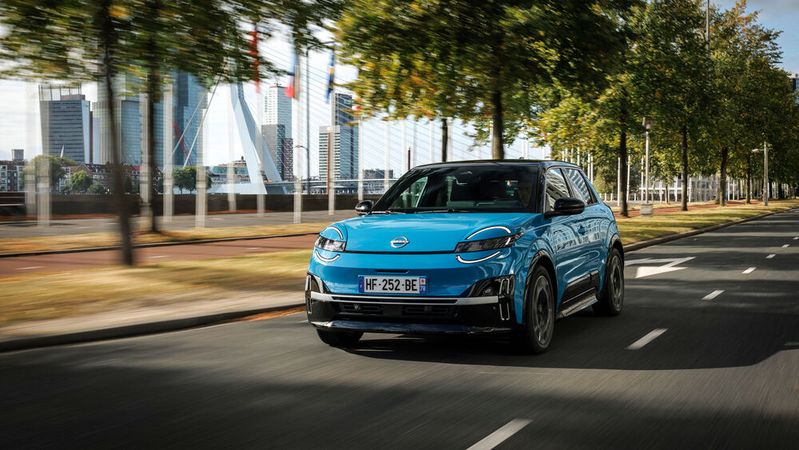
The close relationship with the French counterpart can already be seen in the silhouette, with slightly flared fenders and the side window line. The roof section was completely adopted from the R5. However, the front and rear of the Micra have been completely redesigned, giving the Japanese car a unique character. The seemingly smiling Micra front, featuring cute, round LED eyes that flash invitingly as a welcoming gesture, plays into the childlike cliché of a cute city car—much like the eternal Mini. Fitting for a car from the Land of Smiles.
At the rear, the light strips form a circle, connected by a horizontal bar with the company name in large letters. For those who like it, the compact five-door can be ordered for an additional $960 in a two-tone design with a black or gray roof. In total, there are 14 different color combinations.
Two Drive Variants With Pragmatic Charging Performance
In the future life of the Micra, the R5 plays the decisive role, as both are technically identical twins. Not such bad news for the Micra, after all, the R5 is currently the "Car of the Year 2025." Besides the visual differentiation, the differences lie in the finer details: the Nissan initially offers only two instead of three power levels, and since the Micra offers slightly less wind resistance, its range is slightly better. Specifically, this means that the Micra appears in the price lists with two differently sized lithium-ion batteries.
The entry-level version "Engage" for $30,000 comes with a 40-kWh battery, delivers 90 kW of power, and promises an electric range of nearly 200 miles. The larger 52-kWh battery starts in the "Advance" trim at $32,000, always offers 110 kW of power, and hums up to 260 miles according to Nissan. At an 11 kW AC charging station, it takes around 4.5 hours to recharge from 10 to 100 percent, while the smaller battery finishes an hour faster.
DC fast charging is handled with 80 kW or 100 kW for the larger battery, and in both cases, the energy supply is about 80 percent full after approximately 30 minutes. Particularly practical and always included is the "Vehicle-to-Load" technology, meaning the possibility of bidirectional charging to power speakers, electric grills, or to recharge bicycle batteries.
Date: 08.12.2025
Naturally, we always handle your personal data responsibly. Any personal data we receive from you is processed in accordance with applicable data protection legislation. For detailed information please see our privacy policy.
Consent to the use of data for promotional purposes
I hereby consent to Vogel Communications Group GmbH & Co. KG, Max-Planck-Str. 7-9, 97082 Würzburg including any affiliated companies according to §§ 15 et seq. AktG (hereafter: Vogel Communications Group) using my e-mail address to send editorial newsletters. A list of all affiliated companies can be found here
Newsletter content may include all products and services of any companies mentioned above, including for example specialist journals and books, events and fairs as well as event-related products and services, print and digital media offers and services such as additional (editorial) newsletters, raffles, lead campaigns, market research both online and offline, specialist webportals and e-learning offers. In case my personal telephone number has also been collected, it may be used for offers of aforementioned products, for services of the companies mentioned above, and market research purposes.
Additionally, my consent also includes the processing of my email address and telephone number for data matching for marketing purposes with select advertising partners such as LinkedIn, Google, and Meta. For this, Vogel Communications Group may transmit said data in hashed form to the advertising partners who then use said data to determine whether I am also a member of the mentioned advertising partner portals. Vogel Communications Group uses this feature for the purposes of re-targeting (up-selling, cross-selling, and customer loyalty), generating so-called look-alike audiences for acquisition of new customers, and as basis for exclusion for on-going advertising campaigns. Further information can be found in section “data matching for marketing purposes”.
In case I access protected data on Internet portals of Vogel Communications Group including any affiliated companies according to §§ 15 et seq. AktG, I need to provide further data in order to register for the access to such content. In return for this free access to editorial content, my data may be used in accordance with this consent for the purposes stated here. This does not apply to data matching for marketing purposes.
Right of revocation
I understand that I can revoke my consent at will. My revocation does not change the lawfulness of data processing that was conducted based on my consent leading up to my revocation. One option to declare my revocation is to use the contact form found at https://contact.vogel.de. In case I no longer wish to receive certain newsletters, I have subscribed to, I can also click on the unsubscribe link included at the end of a newsletter. Further information regarding my right of revocation and the implementation of it as well as the consequences of my revocation can be found in the data protection declaration, section editorial newsletter.
A Lot of Renault Design in the Interior
The wheelbase of 8 feet provides plenty of room in the front, but taller passengers in the back quickly run out of space for their knees and feet. The trunk, which initially requires navigating a high loading edge, offers a capacity of 320 liters, or 1,100 liters with the rear seatbacks folded down. Visually, everything here is also R5—from the two digital displays and the layout of the cockpit including the center console, to the flattened steering wheel with its overly complex four stalk controls. Even the graphics are adopted by Nissan.
A bit more desire for independence would have suited the Micra well. But that comes at a cost. Thus, the differences are limited to colors and patterns as well as the type of stitching.
Remarkably Agile Driving Experience
Depending on the trim, the central screen is either seven or 10.1 inches in size, and the infotainment system integrates Google services like Maps, Assistant, and Play. Within the menu, 70 apps are available for download. These services are free for five years. Apple CarPlay and Android Auto are available wirelessly. Naturally, numerous digital assistants are included as standard or optionally available. Through a smartphone app, the Micra can be pre-conditioned, and charging processes can be planned. Standard features include automatic climate control, a heat pump, and the keyless Smart-Key system.
You can truly appreciate the quality of the donor vehicle's genes once you start driving. First, there are the noticeably quiet wind and rolling noises, a result of elaborate soundproofing, especially in the wheel arches. The suspension—pleasantly balanced between comfort and sportiness—will appeal to most drivers. A highlight in this class is the multi-link rear axle, which keeps the Micra stable during quick directional changes and confidently absorbs uneven roads without bouncing. The Micra's consistently predictable and reliable handling is remarkable. Three driving modes are available: Comfort, Sport, and Eco. Performance-wise, the top version we drove belongs to the weaker electric cars on the market. However, as the Micra keeps its weight in check (around 1.65 US tons), the 110 kW accelerates with ease. It’s more than enough to bring a smile to your face that rivals the one on the Micra itself.
Future-Proof Authentication with Universal RFID Readers



:quality(80)/p7i.vogel.de/wcms/d2/73/d273374d6347651e4e6200cf6061ea4e/0132860560v1.jpeg "Even in July, the flag of the Chinese economy did not flutter particularly briskly in the air. Read here what’s happening and why production in China is apparently declining ... (Image:AI-generated)")
:quality(80)/p7i.vogel.de/wcms/18/47/1847f131e3afda201d1dbb98ad0ecb04/0132826776v1.jpeg "Image 1: Difender armored steels from Dillinger stand out with top scores in ballistic testing and cold bending. Defense companies therefore readily choose them. They can be found, for example, in the armored vehicles Fuchs and GTK Boxer of the German Armed Forces. (Image: Dillinger)")
:quality(80)/p7i.vogel.de/wcms/1e/7d/1e7d651782e0e97b3efc25abf2b52350/img-3485v1.jpeg "The Siemens Energy employees attach balancing weights at the precisely calculated and adjusted angular position to achieve the best possible result. (Source: Schenck Rotec)")
:quality(80)/p7i.vogel.de/wcms/a4/4c/a44ce96743685179c9e0fc31f35b1686/0132816576v1.jpeg "Laser Dicing: From the recoil force of the laser pulse upon impact on the semiconductor, a reproducible process signal can be derived in real time, enabling automated control of wafer dicing. (Image:Ciba University / CC BY-SA 4.0 / sciencedirect.com)")
:quality(80)/p7i.vogel.de/wcms/a2/85/a285b12508af812e28b17be3482a736c/0132488872v1.jpeg "NIS2 is no longer an abstract requirement in the distant future for many industrial companies. (Image:AI-generated)")
:quality(80)/p7i.vogel.de/wcms/e5/59/e5590f11cef563bf9ae1872bdc4e0fea/0132468153v1.jpeg "Matthias Wolfer is Product Manager Controller at Pilz. (Image: Pilz)")
:quality(80)/p7i.vogel.de/wcms/02/52/0252e5484816b31ca0bc0372bc62a19e/2-fi-pp-thermoprocess-technology-766561828v1.jpeg "Energy-intensive thermal processes require precise temperature control: Smart power controllers ensure the necessary energy efficiency and grid compatibility. (Source: Jumo)")
:quality(80)/p7i.vogel.de/wcms/20/d6/20d67956343287c2365a5eca2eb0a8b7/aufmacher-bihl-2bwiedemann-diagnoserepeater-20--20kopiev1.jpeg "With the ASi-5/ASi-3 diagnostic repeater, the cable length of an ASi network can be significantly extended. (Source: Bihl+Wiedemann)")
:quality(80)/p7i.vogel.de/wcms/44/fe/44fe86a16c26c09bb363b3671bf0b930/0132847771v1.jpeg "CoreTechnologie (CT) points out that the 3D printing software 4D_Additive has been equipped with additional application possibilities. Here you can learn more about what the new version 1.8 can do – such as generating complex lattice structures or optimizing faulty data ... (Image:CT)")
:quality(80)/p7i.vogel.de/wcms/b4/f2/b4f2c272247f79c5e87334a6839f20cb/0132549860v1.jpeg "Morefire analysis: Many mechanical engineering websites focus on technical specs instead of customer benefits. Translating features into clear benefits increases visibility, inquiries, and competitiveness. (Image: ©peopleimages.com - stock.adobe.com)")
:quality(80)/p7i.vogel.de/wcms/b4/9a/b49aaad0500e06e253f7d75ecb77338a/adobestock-4840668--dani-kreienb-hl-stock-adobe-comv1.jpeg "Metal processing in 2026 will be more digital, automated, and data-driven – but not automatically easier. (Image:© Dani Kreienbühl - stock.adobe.com)")
:quality(80)/p7i.vogel.de/wcms/1a/59/1a59392a5924d433a9bf21e34ecad8ce/ed2456-ferry-boat-123059v1.jpeg "New project brings hydrogen to passenger ships. (Source: Meyer Werft)")
:quality(80)/p7i.vogel.de/wcms/5d/a5/5da58961ea36104111c4cb0e1f941712/0132848377v1.jpeg "With the JCB Hydromax, the U.S. company JCB has now set the new speed record for hydrogen-powered vehicles. Systems from Poppe + Potthoff in Germany have contributed to this ... (Image:JCB)")
:quality(80)/p7i.vogel.de/wcms/a5/81/a5819b9b1f3a48a2ff466685f2d4251c/0132849735v1.jpeg "The first fully electric Ferrari is called Luce and triggered a wave of criticism. Yet, sales figures show that it still has many fans. And the very first built vehicle has now also fetched a record sum at an auction ... (Image: Ferrari)")
:quality(80)/p7i.vogel.de/wcms/c4/65/c4655e175f09db99b0fb17667db9d486/0132853627v1.jpeg "Heart Aerospace has completed the first flight with its fully battery-electric aircraft study X1. (Image:Heart Aerospace)")
:quality(80)/p7i.vogel.de/wcms/a4/e8/a4e8a47c76cc0e0a1885e7ed6a7f73d8/voyah-e59bbee78987-98-e1786787519878v1.webp "Voyah advertises the Passion S model with a stunt in a tunnel. (Source: Voyah)")
:quality(80)/p7i.vogel.de/wcms/28/20/28204a4592a69a8682bfbf9a8f7e1dc2/0132846993v1.jpeg "The health status of a lithium-ion battery changes with increasing aging. AI models can utilize characteristic changes in the charge and voltage curves to estimate the state of health. (Image:freely licensed)")
:quality(80)/p7i.vogel.de/wcms/90/dc/90dc332e30a3e4bd3ff77646ed0633b7/0132833369v1.jpeg "Through a compromised repository of the widely used open-source tool LiteLLM, attackers were able to capture several terabytes of data and login credentials. Security company CloudSEK concludes, after analyzing the data, that the attack conducted in March of this year affected more than 2,000 companies, including major players like Microsoft, Nvidia, AWS, and Deutsche Bahn. (Image:freely licensed)")
:quality(80)/p7i.vogel.de/wcms/93/40/9340a3a1088dd79fce6bda5c73b7dd2f/0132818390v1.jpeg "Already in 1980, Intel exited the production of DRAM chips, and in 2022, the Optane series, manufactured using the 3D XPoint process, marked the company's last commercial venture in the field of memory technologies. However, in light of the memory crisis and the growing demand for fast memory chips, Intel CEO Lip-Bu Tan now appears to be considering a possible return to the memory business. (Image: Intel)")
:quality(80)/p7i.vogel.de/wcms/b5/2a/b52a740bb2b6e48b2e530a9bb03fcd3b/0132819357v1.jpeg "Industrial high-speed communication: The CAN XL transceiver TCAN6062 transfers more data at higher speeds, making it suitable for applications such as humanoid robots, industrial robots, and HMI systems. (Image:Texas Instruments)")
:quality(80)/p7i.vogel.de/wcms/96/c9/96c929032669d7a232bae54ab545a24e/0126787097v1.jpeg "The entry-level version \"Engage\" for 28,000 euros has a 40 kWh battery, delivers 90 kW of power, and promises an electric range of about 310 kilometers.(Image: Nissan)")
:quality(80)/p7i.vogel.de/wcms/c3/21/c321b0bf249420fd0693cd5ffe2d6fb0/0126787305v1.jpeg "At the front, classic round headlights are suggested. Here, Nissan stands out noticeably from Renault.(Image: Nissan)")
:quality(80):fill(efefef,0)/p7i.vogel.de/wcms/67/ae/67ae0b9ac31f8/elatec-wp-universal-reader.png "Elatec WP Universal Reader")
:quality(80)/p7i.vogel.de/wcms/c2/57/c257d627beec10e94252cde72830adf6/0130472803v1.jpeg "With the Twingo E-Tech, Renault is now launching a purely electrically powered new edition of the Twingo small car (Image:Renault)")
:quality(80)/p7i.vogel.de/wcms/2f/4d/2f4d12c00f2313ca83f950a18df61f59/0128579297v1.jpeg "Toyota is launching an electric mini-crossover. (Image:Toyota)")