The importance of optical signals in the industrial environment is increasing. With suitable signaling solutions, processes in production and logistics can be made more transparent and safer. Standardized communication interfaces enable simple and individually configurable transmission of data and diagnostic information.
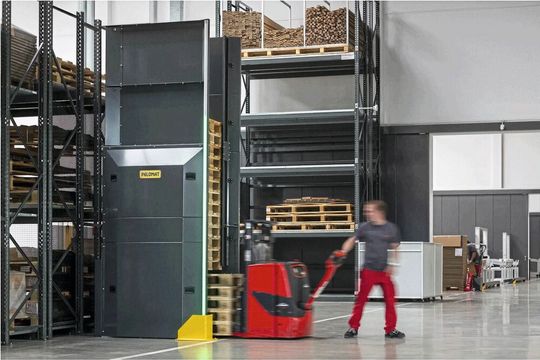
Modern signalling technology can be used to visualize fill levels in warehouses. For example, LED lights can indicate how high a stack of pallets is.
(Image: Item Industrial Technology)
Visual signals play an important role in everyday life. Everyone understands the colors of traffic lights: red means stop, green light means you can drive on. The situation is similar in an industrial environment. Here, too, machine traffic lights use their colors to indicate whether there are machine malfunctions or material bottlenecks. The classification is similar to that used in road traffic. A green light indicates that everything is in order. If the machine lights up red, immediate action is required. Signalling technology can therefore be used to easily visualize process statuses. Information is transmitted to the recipient quickly and non-verbally, there are no language barriers and no technical equipment is required to decode the signal.
Making Processes More Transparent
"The process signaling market is growing," says Jens-Uwe Gustmann, Product Manager at item Industrietechnik GmbH. "The reasons for this are, on the one hand, the further development of LED technology and, on the other, the prevailing shortage of personnel in many warehouses and production facilities." A small number of employees have to keep an eye on a large number of processes—usually in large warehouse, logistics and production areas. With the help of suitable signaling solutions, these processes can be recorded quickly and easily. This makes processes safer.
This is also the particular advantage over complex dashboards, which can also display information about the process when attached to individual workstations. However, it is often not immediately apparent from a long distance on the screens whether there is a fault or which process stage is currently being run through. With modern signaling, however, processes become more transparent. For example, it would be possible to integrate an LED strip within a machine cabin, in which individual segments go out or the entire process level lights up in a signal color depending on the progress of the process. This is the ideal way to visualize the process sequence or status.
If the LED strip lights up green, everything is OK. If it lights up yellow, the employee knows that a critical state will soon be reached and that they need to replenish material, for example. If the strip lights up completely in red, rapid intervention is required. The condition of the machine can be easily recognized from a distance.
However, the LED strip can also be used to signal that the process time has elapsed. As the illuminated segment becomes longer or shorter, the employee receives information about the remaining process time. With the help of suitable signaling, the employee intuitively knows how long the machine will continue to run and when it will stop. They do not have to constantly go to the machine to check the progress of the process, but can rely on the display and can therefore see from a certain distance whether and when intervention is required.
Visualize Fill Levels Easily
Modern signaling technology enables improved communication and supports the training of new or non-specialist employees. With the help of intuitive signalling, processes can be visualized using clear colors, regardless of language. This can also reduce training times. Incorrect operation can therefore be avoided and process reliability increases.
In addition, processes can be optimized and efficiency increases achieved. For example, fill levels in warehouses can be better visualized. One example: a forklift truck is used to transport pallets to different stations where they are collected for further use. The driver therefore makes several trips to the warehouse to collect new pallets. If LED lights at the stations indicate when new pallets are needed, the driver can optimize his transport process. He does not need any additional information, but knows exactly when and where to bring a new pallet stack.
Flexible Control via IO-Link
In the past, machine traffic lights were often used exclusively with electrical activation via a 24 V signal from the machine control system. There are now other signaling solutions with intelligent communication interfaces. Individual signal patterns and special functions can be implemented via IO-Link. "Our multi-segment LED strips can be controlled section by section via IO-Link," explains Jens-Uwe Gustmann. "The right controller makes it very easy to connect to a control system."
The LED strip is simply integrated into the profile groove of item constructions and can light up the entire surface or in individual segments. The long-lasting, bright RGB strip is available in lengths of up to 6,000 millimetres (~236.22 Inches). It can be shortened in sections of 17 millimetres and thus individually adapted. The IO-Link controller then determines the length of the LED strip using an innovative process.
Date: 08.12.2025
Naturally, we always handle your personal data responsibly. Any personal data we receive from you is processed in accordance with applicable data protection legislation. For detailed information please see our privacy policy.
Consent to the use of data for promotional purposes
I hereby consent to Vogel Communications Group GmbH & Co. KG, Max-Planck-Str. 7-9, 97082 Würzburg including any affiliated companies according to §§ 15 et seq. AktG (hereafter: Vogel Communications Group) using my e-mail address to send editorial newsletters. A list of all affiliated companies can be found here
Newsletter content may include all products and services of any companies mentioned above, including for example specialist journals and books, events and fairs as well as event-related products and services, print and digital media offers and services such as additional (editorial) newsletters, raffles, lead campaigns, market research both online and offline, specialist webportals and e-learning offers. In case my personal telephone number has also been collected, it may be used for offers of aforementioned products, for services of the companies mentioned above, and market research purposes.
Additionally, my consent also includes the processing of my email address and telephone number for data matching for marketing purposes with select advertising partners such as LinkedIn, Google, and Meta. For this, Vogel Communications Group may transmit said data in hashed form to the advertising partners who then use said data to determine whether I am also a member of the mentioned advertising partner portals. Vogel Communications Group uses this feature for the purposes of re-targeting (up-selling, cross-selling, and customer loyalty), generating so-called look-alike audiences for acquisition of new customers, and as basis for exclusion for on-going advertising campaigns. Further information can be found in section “data matching for marketing purposes”.
In case I access protected data on Internet portals of Vogel Communications Group including any affiliated companies according to §§ 15 et seq. AktG, I need to provide further data in order to register for the access to such content. In return for this free access to editorial content, my data may be used in accordance with this consent for the purposes stated here. This does not apply to data matching for marketing purposes.
Right of revocation
I understand that I can revoke my consent at will. My revocation does not change the lawfulness of data processing that was conducted based on my consent leading up to my revocation. One option to declare my revocation is to use the contact form found at https://contact.vogel.de. In case I no longer wish to receive certain newsletters, I have subscribed to, I can also click on the unsubscribe link included at the end of a newsletter. Further information regarding my right of revocation and the implementation of it as well as the consequences of my revocation can be found in the data protection declaration, section editorial newsletter.
Not only process data, but also parameterization and diagnostic information can be transmitted via IO-Link. The lights then display operating temperatures and operating hours, for example. When using the IO-Link controller, users can fall back on preset operating modes. "We define the operating modes fill level display, countdown, segment display and marking light," explains Jens-Uwe Gustmann. "This makes commissioning much easier, as no programming knowledge is required."
The Multi-Segment RGB Light, the 3-Segment RGB Signal Light and the 1-Segment RGB Signal Light from item, which can also be connected to the control unit via IO-Link, offer further options for displaying machine statuses. Colors and light functions such as flashing or blinking can be freely parameterized for each segment. The 3-segment RGB signal light is also available with a buzzer for acoustic signaling.
Different Operating Modes For a Wide Range of Applications
Poorly visible tank fill levels can be easily visualized using the "Fill level display" operating mode or it can be used to indicate how high the output of a system is. The "Countdown" operating mode, for example, shows a machine operator when to remove the workpiece or add material. The LED strips can be parameterized like a classic machine traffic light via the "segment display". It is also possible to change the color assignment or expand to several segments.
A combination with a switching or operating element would also be possible. If there is a problem at a workstation, the employee presses the switch and the segment switches directly to red. The control station knows immediately at which workstation help is needed. In the "marker light" operating mode, the LED strip lights up in one color to signal a process status. For example, it can be defined that the strip lights up blue when the machine is being serviced. If a problem occurs during maintenance, the LEDs switch to red. If required, the operating modes can also be combined. The user therefore has a wide range of options for displaying their individual signaling task.
Advantages For The User
Thanks to the expansion of the product portfolio, item now offers numerous signalling solutions that can be used to visualize processes and machine statuses. The products can be attached directly to item constructions using the supplied mounting kits. Customers receive a complete system that is easy to install and connect.
It is then immediately ready for operation. The lights meet the requirements of protection classes IP20 to IP67 and can therefore be individually selected depending on the application and requirements. The signal technology can be easily integrated into the existing system control via IO-Link. Freely adjustable colors and light functions offer maximum flexibility and enable efficient visualization in the production and logistics environment to increase process reliability and transparency.



:quality(80)/p7i.vogel.de/wcms/a0/47/a04725ef9bd09fb6c9341a1bea1b5d93/0130443083v1.jpeg "Here, a type of plastic pallet is produced by thermoforming (vacuum forming or deep drawing) at the corresponding division of New England Plastics in the USA. This division, which specializes in so-called liners, is now part of Ringmetall ... (Image:New England Plastics)")
:quality(80)/p7i.vogel.de/wcms/e3/42/e342b3c593ea92d56604d3be969e9c9a/0130437231v1.jpeg "Daimler Truck will be building even more trucks at its Czech plant in Cheb in the future. This is because it is now being expanded for strategic cost-saving reasons ... (Image:Daimler Truck)")
:quality(80)/p7i.vogel.de/wcms/23/99/23992bf2dcdc432c9b7209c34a4a7c48/0129733089v1.jpeg "Stork relies on the modular Neoswiss turning system from Iscar to shorten the set-up times for its sliding headstock lathes and work more productively. (Image:Iscar)")
:quality(80)/p7i.vogel.de/wcms/7d/e2/7de2923434b2f1a78ba5482d8d335269/0113143253v1.jpeg "In our China Market Insider we regularly provide you with relevant information directly from China. (Image:© Eisenhans - stock.adobe.com)")
:quality(80)/p7i.vogel.de/wcms/b7/36/b736dfebc16c42d6901d0d0e1f390493/3d-druck-20factory-20--20ki-20generiert-1920x1079v1.png "(Source: AI-generated)")
:quality(80)/p7i.vogel.de/wcms/79/b2/79b21aad663f4a7bd4472afc1c1afc62/0130433994v1.jpeg "Mission Joyride: The free-flying robot (shown here in the rendering) will relieve the ISS crew of logistics tasks from 2027 with its two mechanical arms. (Image:Icarus Robotics)")
:quality(80)/p7i.vogel.de/wcms/6b/45/6b4546fa6ebf305c3660326909363f32/0130437089v1.jpeg "Industrial AI in action: Rockwell Automation presents practical solutions for self-controlling production systems at the Hannover Messe. (Image:Rainer Jensen, Deutsche Messe)")
:quality(80)/p7i.vogel.de/wcms/78/e9/78e9188c25a8a94e67c34c9bf8ffe495/visual-agile-20robots-20and-20google-20deepmind-20partner-20to-20bring-20intelligence-20to-20robotics-2500x1406v1v1.jpeg "Together, the partners are developing adaptable, intelligent robots for a wide range of applications (Image:Agile Robots SE)")
:quality(80)/p7i.vogel.de/wcms/59/a2/59a2b11f0aa1b700eff02addd5de8703/adobestock-1788280853--c2-a9-20satria-20-e2-80-93-20stock-adobe-com-5081x2860v1v1.jpeg "Quantum computers require extreme cooling to temperatures close to absolute zero in order to keep qubits stable. (Image:satria - stock.adobe.com)")
:quality(80)/p7i.vogel.de/wcms/62/5f/625f41e87ebfef156a98c8e6393e32fd/0130211654v1.jpeg "Axial flux motors have some advantages over radial flux motor—but their production is currently still expensive. (Image:RWTH Aachen University)")
:quality(80)/p7i.vogel.de/wcms/f6/ae/f6aec4f6241b36ed5e3a990ac9176b42/0130429460v1.jpeg "Verne, Pony.ai and Uber want to launch a robotaxi service in Europe. (Image:Verne)")
:quality(80)/p7i.vogel.de/wcms/d7/88/d788699f2974708a332baa4e7a62fa9e/0130438967v1.jpeg "Skoda is withdrawing from China. The brand has produced well over three million vehicles there. (Image:Skoda car)")
:quality(80)/p7i.vogel.de/wcms/b0/43/b043b86899837532aad62d63368a917a/0130371361v1.jpeg "Skoda leaves the chinese market.
(Image:Skoda)")
:quality(80)/p7i.vogel.de/wcms/c3/c4/c3c4ce270b083eeac55654148611f064/0130237945v1.jpeg "China is not giving up on hydrogen, but is intensifying its efforts. (Image:freely licensed from Pixabay)")
:quality(80)/p7i.vogel.de/wcms/ee/09/ee09acbd6dc896df25affaa9e871e6e5/0130440053v1.jpeg "IMS chip module for simple system integration into an ion mobility spectrometer. (Image:Fraunhofer IPMS)")
:quality(80)/p7i.vogel.de/wcms/10/6c/106cd22de5f68a0f74639d654827228c/0130345302v1.jpeg "Made in India: According to the India Electronics and Semiconductor Association (IESA), the country should be able to produce between 75 and 80 million chips by the beginning of 2027, once the plants currently under construction become operational. (Image:Pixabay (Montage: Sebastian Gerstl))")
:quality(80)/p7i.vogel.de/wcms/a5/ed/a5ed6fda029d362732a293d6b19d74c4/0130444216v1.jpeg "Thirteen executives from the Chinese chip industry have drawn up a plan to achieve an 80% self-sufficiency rate for semiconductors by 2030. (Image:Maxim_Kazmin - stock.adobe.com)")
:quality(80)/p7i.vogel.de/wcms/31/a6/31a646018b34d8e0a44bfc8bf17837f6/0130361632v1.jpeg "For many companies, PFAS are considered indispensable in electronics production. (Image:freely licensed)")
:quality(80)/p7i.vogel.de/wcms/d8/cb/d8cbe060b165423f6a7fe390554853ef/0126709478v1.jpeg "Signalling technology makes it easy to visualize process statuses, for example by switching off individual segments or illuminating the entire process level in a signal color depending on the process progress.(Image: Item Industrial Technology)")
:quality(80)/p7i.vogel.de/wcms/60/9b/609b28c885d6eccc1a49325ae1a0442a/0126709482v1.jpeg "Machine statuses can also be displayed via the 3-segment RGB signal light, which can also be connected to the control unit via IO-Link. Colors and light functions such as flashing or blinking are freely selectable for each segment.(Image: Item Industrial Technology)")
:quality(80)/p7i.vogel.de/wcms/4b/ea/4bea9b615ae4c2135d414fa419cd69ba/0126709484v1.jpeg "The multi-segment LED Strips from item can be controlled in sections using IO-Link. The matching controller makes connecting them to a control system very easy.(Image: Item Industrial Technology)")
:quality(80)/p7i.vogel.de/wcms/eb/a8/eba8238a643dcd41178b7866dc81d28f/0126709487v1.jpeg "The LED strips can be parameterized like a classic machine traffic light via the \"segment display\". It is also possible to change the color assignment or expand to several segments.(Image: Item Industrial Technology)")
:quality(80)/p7i.vogel.de/wcms/45/36/45361c4897a74ead6831d2672d8ad823/0125926163v1.jpeg "Defined color values with RGB LEDs: A free tool allows PWM values to be determined to display specific color values with ICLEDs. (Image:freely licensed)")
:quality(80)/p7i.vogel.de/wcms/db/68/db689490e348201603dd30447711ea2b/0129578734v1.jpeg "With three-axis vibration measurement (X, Y and Z axes) and temperature detection, the CMSVT38 condition monitoring sensor provides detailed status information that helps to detect machine damage at an early stage. (Image:Kübler)")